

Fourteen years ago, Taiwan imple-mented education reforms that advocated independent thinking and learning for enjoyment. Since then, the reforms have been loved and loathed in equal measure. Now the Indonesian island of Nias, in the region devastated by the 26 December 2004 Asian tsunami, is being swept by a wave of educational reforms initiated by World Vision Taiwan.
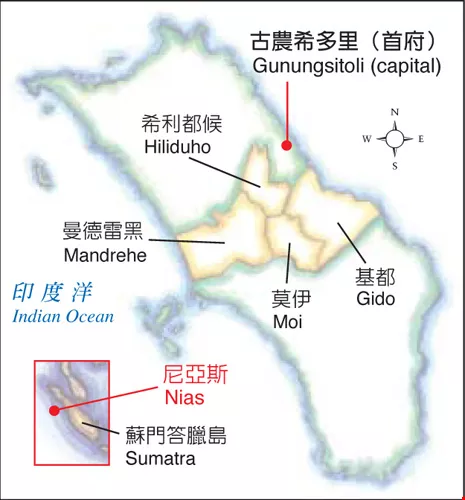
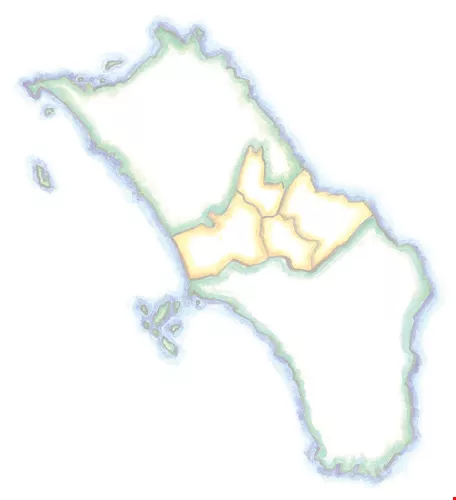
Nias, a 5,600-square-kilometer island located off the west coast of northern Sumatra, is one of Indonesia's poorest outlying islands.
Some 700,000 people live on the island, about 30% of whom live below the poverty line (defined as an income of less than US$1 per day). Nearly half the island's population has not completed primary school; 60% of its children between the ages of one and five suffer from malnutrition; and approximately half the island has no electricity. Before the tsunami struck, Nias was largely unknown even to Indonesians, much less to the rest of the world.
The Great Sumatra-Andaman earthquake that caused the tsunami was centered just 50 kilometers north of Nias. Though the tsunami struck only the west coast, buildings all over the island shook violently. The magnitude 8.7 quake that followed three months later did still more damage, knocking down half the homes and two-thirds of the schools on the island.
International relief organizations poured in after the disaster, among them World Vision Taiwan. The group used NT$108 million from the Taiwanese government's Hope for Tomorrow, Love from Taiwan project and another NT$130 million in private donations to undertake emergency relief efforts and medium-term reconstruction work. In addition to building 20 earthquake-resistant schools, it proposed an innovative new approach to education and began an effort to reform education in remote villages.
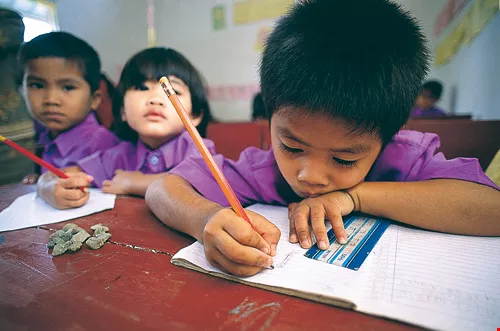
Losara's residents built a kindergarten to give their kids a jump start on their social skills and written Indonesian.
Visiting villages in Nias was a bit like visiting the rural of Taiwan 50 years ago. Wild banana trees lined the winding mountain roads, and we occasionally caught the potent scent of rubber. Coconuts and palm fronds lay lazily on the ground, drying in front of wooden homes roofed with sheet metal or grass. Now and again, we caught glimpses of brick homes. Dark-tanned children marched down the road together on their way to school, some barefoot, others in flip-flops or sneakers.
We drove past a bustling market, where vendors displayed a plethora of fabrics, clothing, knick-knacks, fruits, vegetables, grains and daily necessities. Villagers carrying baskets hurried to take advantage of market day, which only comes once per week. "Villagers come from kilometers away to do their shopping," says Erickson Sijabat, a World Vision Indonesia project manager stationed on Nias. Sijabat adds that the agricultural and other goods are expensive because they're all brought in from outside the area. Since residents lack their own means of transportation, they have little choice but to pay.
Sijabat says that there is hardly any development in Nias, and that some villages aren't even connected by roads. On average, residents of Nias have only 5.7 years of education, a figure that ranks dead last among Sumatra's 19 regencies. One of the principal reasons for this is that it is simply too difficult for village children to get to school. Those who do attend must traverse rugged roads through the hills, the nearer ones walking 2-3 kilometers and the more distant 7-8 km. Naturally, they end up covered in mud when it rains. As a result, most parents feel that an education is just too difficult and dangerous to bother with.
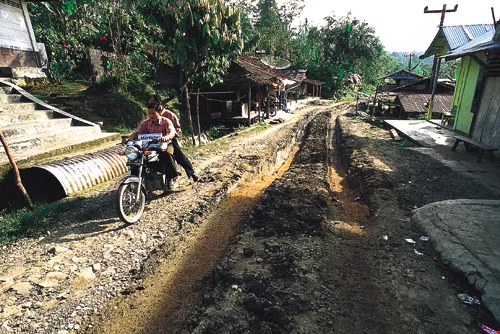
Nias's transportation network is sadly deficient, and roads are rough even in the villages. The island also lacks public transport. Residents who need to run errands outside their villages have little choice but to rent motorcycles.
The situation has been even worse since the quakes struck. Roads are more rugged or even broken, and landslides are frequent during the November to March rainy season. Before starting work on the schools themselves, World Vision had to build roads, bridges, and retaining walls just to get construction materials to the school sites. Of course, once the schools were complete, these same roads would make it easier for kids to attend them.
Nias consists of two administrative districts, a large one in the north and a smaller one in the south. Sijabat says that island's transportation difficulties led World Vision to concentrate its 20 schools in just four of the northern district's 14 subdistricts.
Driving west from Gunungsitoli, the northern district's east coast administrative capital, we spend an hour and a half flying over winding, hilly roads before reaching the village of Losara in the Hiliduho subdistrict.
Two rows of brand-new school buildings occupy less than a hectare amidst the steep hills. The 150-some students at this, Losara's pretty new elementary school, come from five nearby villages. In the second-graders' classroom, groups of six students are seated around tables for their math class. After their teacher finishes going over a point at the blackboard, she visits each table where she uses small stones to illustrate multiplication.
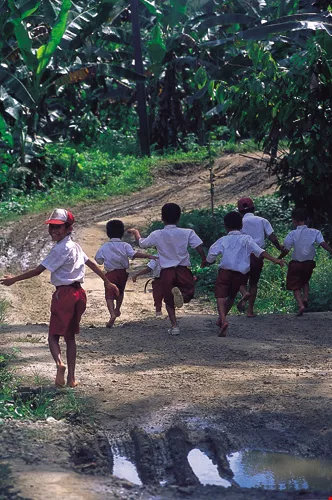
Student-centered educational reforms encourage children to explore on their own. These reforms have gotten more children attending school on Nias, radically changing the atmosphere on campuses.
"We've changed our approach to education a great deal," says Principal Yuniaro Lase. He explains that the use of stones is helping the kids more readily grasp arithmetic, that group work is giving them a closer relationship to their teachers, that new books, microscopes, educational posters and other materials are making their education livelier and more effective, and that pinning outstanding work to the walls is promoting healthy competition amongst the children. Lase says all of these techniques are new to the area.
Lase explains that Losara is hard to get to, and that they've had a hard time retaining teachers. The school currently only has one full-time teacher-his wife. The other eight are part-timers who live in the area and were assigned by the government. But the school has benefited tremendously from the resources provided by World Vision. Lase says that World Vision's work motivating teachers and fostering their development, together with its efforts to get parents and village chiefs involved in their children's education, have given him hope for the future.
According to Lase, World Vision has been using the Creating Learning Communities for Children program developed by UNESCO and UNICEF. The program has three major themes: local control; innovative methods; and community participation.
According to Liu Fen-yun, a project supervisor for World Vision Taiwan in Indonesia, the Indonesian government has approved the CLCC program and incorporated it into policy. Though CLCC has already been rolled out in Indonesia's major cities, a lack of resources at the local government level has slowed its expansion to outlying islands.
"World Vision was talking about implementing CLCC even before it built the schools," says Augustinus Gea, principal of the Tetehosi 1 Elementary School, a CLCC model school located in Nias's Gido subdistrict. Gea says that many schools felt that it wasn't feasible to implement the program. But Gea believed the program would foster a more proactive attitude that would in turn help with the post-tsunami reconstruction of the educational system. He therefore accepted the challenge and threw himself into making it work.
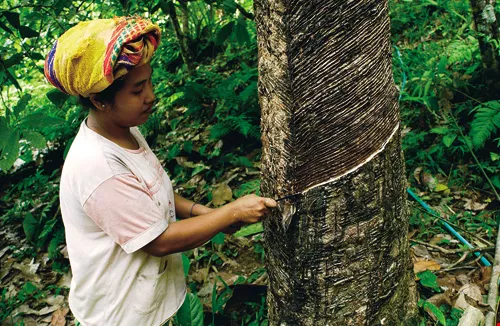
Some 90% of Nias's residents make their living from agriculture, most by collecting latex from rubber trees. Scoring 150 trees per day (a typical number) allows them to collect about three kilograms of latex, worth about Rp21,000 (NT$70).
"Thinking back on it, we never used to understand the goal of education," says Sarofati Waruwu, principal of the elementary school in the Mandrehe subdistrict's Hayo village. Waruwu says that in the past teachers tried to convey information to students just as it appeared in their textbooks. They had no concept of student-oriented education, nor any notion of developing individual students' potentials by teaching in accordance with their aptitudes. After undergoing the CLCC training, they began giving the students the kind of topics that would elicit discussion and letting students work out their own solutions. They also abandoned the practices of beating children who didn't do well on tests and chasing those who napped out of the classroom.
"Now students are happy to come to school," says Waruwu. "The teachers bear more responsibility, but they enjoy what they're doing and have a greater sense of accomplishment." He says that World Vision provided the training entirely free of charge, but required participants in the program to volunteer to teach the method to other schools. As a result, the CLCC educational reforms have been spreading like wildfire. Over the last year or so, Waruru has trained more than 400 Mandrehe primary school teachers in the method.
The CLCC method focuses on what it calls active, joyful, effective learning (AJEL). It emphasizes learning by doing, and uses a variety of engaging activities to heighten students' interest and help them learn better.
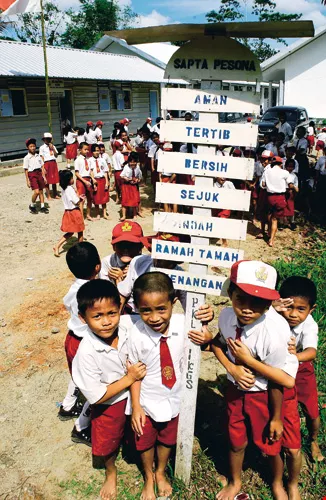
International NGOs have brought infrastructure and know-how to Nias, laying the foundation for the island's development and providing hope for its future. This photo, taken at Botomuzoi Elementary School, shows a newly constructed school building (right) and a temporary building yet to be removed (left).
"Every school's educational program has to be designed to meet the different environmental and other factors particular to its area," says Yurisman Zamasi. "It's a huge challenge for teachers." Zamasi, a teacher at Tetehosi 1 Elementary School, says that his school is located relatively close to the city, so they can take the kids to a museum to learn about traditional art. They also use the local market to introduce them to economic activities, taking the students there so they can see for themselves the relationship of supply and demand to price. The school has even gathered some medicinal herbs for a small botanical garden that's in the works. The garden will act as a living classroom for the kids, who will help the teachers care for the plants.
For his world history class, Furiso Gulo, a sixth-grade teacher at Mandrehe's Lolozizugi Elementary School, encourages his students to gather information and prepare questions based on what they find in newspapers, magazines and books. If he's teaching Indonesian history, he asks them to use their imaginations to put themselves in the period under discussion and act it out: "If you had been born during Indonesia's war for independence, how would you have handled it?"
"I think the Dutch ruled us cruelly. I would have fought to the finish to push the Dutch out!"
"I encourage students to ask questions. Asking a lot of questions shows intelligence. It didn't use to be this way. In the past, asking a lot of questions showed stupidity," jokes Gulo. But do students ask tough questions, or give impertinent answers to challenge authority? Gulo says that the kids are still very innocent, in spite of Indonesian society's ongoing move towards greater openness.
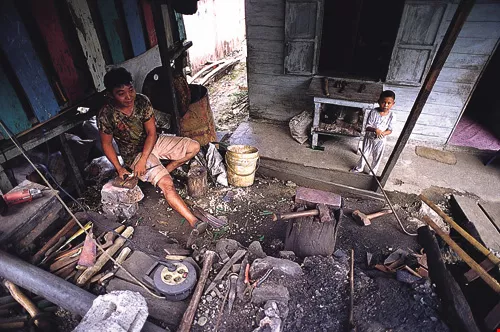
About 30% of Nias's residents live below the poverty line. The photo shows a blacksmith in the capital, Gunungsitoli.
A World Vision survey revealed the reason why so few children had pursued an education: many families couldn't afford the uniforms, books, and stationery they needed to do so. The group therefore provided nearly 3,000 students at 20 schools with everything they needed to attend school, which has led to tremendous improvements in the rural educational situation.
"Once our kids had uniforms and book bags, they could attend school with dignity," says Sulaiman Gulo, a Lolozizugi Elementary School parent. The new books and clothing also helped the students think of themselves as "scholars," making learning seem relevant and attending school a natural thing to do.
The parents of Nias have a lot to say about how their children have changed: "The kids have learned about hygiene." "They now have a concept of time, and are well behaved." "They used to come home wanting only to play. Now they finish their homework." Parents from developed nations may be unimpressed, but in a pre-industrial society where people still must be told to keep flies off of food and not to relieve themselves just anywhere, this represents real progress.
The changes in the kids are also rubbing off on the adults. Many parents who've spent their lives farming and never much valued education are now attending a variety of conferences and workshops sponsored by World Vision, as well as paying attention to what's happening at their children's schools.
Bezaro Lase, whose child attends Losara's elementary school, says that when the school was rebuilt, a group of 19 parents formed a committee that meets monthly to help keep it running. If the school needs paint, for example, they raise money to buy it. They also sponsor a quarterly clean up, and even arranged for families to donate Rp5,000 (NT$17) each per month to the part-time teachers after deciding that they made too little money.
World Vision Taiwan, Aid in Nias
To provide a better learning environment for students and increase participation in community building, World Vision also helped develop a water distribution system and medical facilities.
Erickson Sijabat says that 90% of Nias' residents make their living from rubber. Men spend all day scoring rubber trees while women use most of their time searching for and carrying water and preparing meals. Neither gender has any time to look after the children. By building water tanks and 19 kilometers of water pipes in six villages, World Vision made water readily available to some 6,000 people. Villagers who participated in the pipe laying project gained a stronger sense of community.
"At the outset, everyone was opposed," says Dalizomasi Waruru, World Vision's community contact. Two years of vigorous promotion of the project ultimately changed their minds. They came to see the value of pooling their efforts and agreed to contribute their time and labor.
"We have continuously stressed to villagers that World Vision will leave someday," says World Vision Taiwan's Liu Fen-yun, "and that they are the principal actors in the community." Liu says the objective of the reconstruction effort has been to help communities stand on their own. It's been a long road, and World Vision has had to gradually expand its efforts from the educational system to families and the larger community. Over the last three years, teacher taskforces and community workgroups have laid the foundations. Judging from villagers' willingness to contribute labor and donate money to their schools, they have taken the first step towards participation in their communities.
As we enter the fourth year since the tsunami, World Vision has begun the next phase of reconstruction-a ten-to-15-year community development program that will focus on strengthening community organizations, fostering community leadership, and educating villagers in agricultural techniques and economics. The goal is to help the villagers become self-sufficient.
Evening is approaching as we wrap up our day in a hill village. The ride back is inky black, and all we can see of the homes we pass are the faint lights of oil lamps and candles. When we finally reach the more familiar lights of the city, the contrast is striking and makes us admire World Vision Taiwan all the more for its work on the island.
Half of Nias has no electricity, and toilets have only become widely available since the international NGOs arrived a few years ago. But progress is being made. NGOs are building infrastructure, spreading know-how, and bringing development to a distant island beyond the reach of its own government, exemplifying how good may indeed arise out of a disaster.

World Vision Taiwan, Aid in Nias
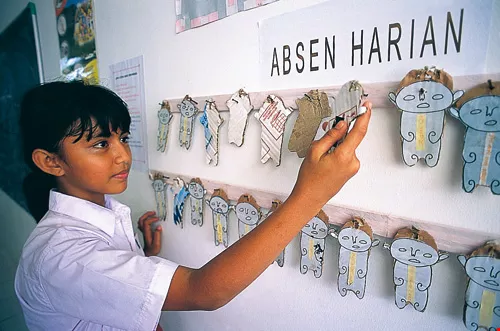
The reforms of the Creating Learning Communities for Children program were as inspiring as the construction of the new schools. The photo shows the program's lively new way of taking attendance.
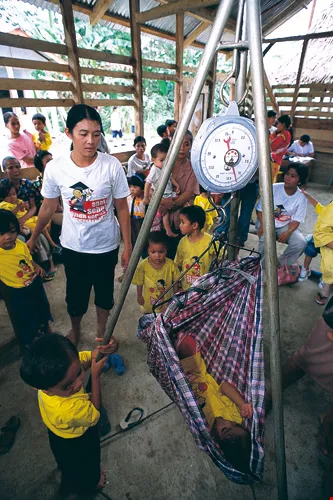
In addition to building schools, World Vision recruited volunteers from the villages to rebuild the overgrown and abandoned health centers that locals call posyandu. With the help of public health nurses, it turned them into clinics providing checkups to expectant mothers and young children. The photo shows children being weighed.
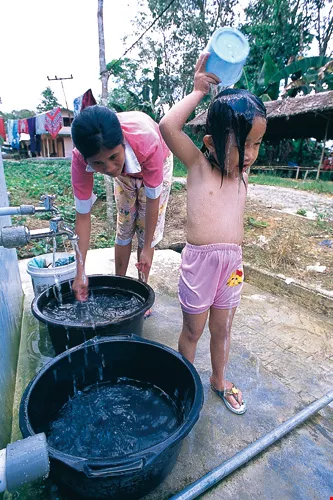
World Vision built water tanks and pipes in six villages in the Mandrehe subdistrict to provide mothers with more time with their children.
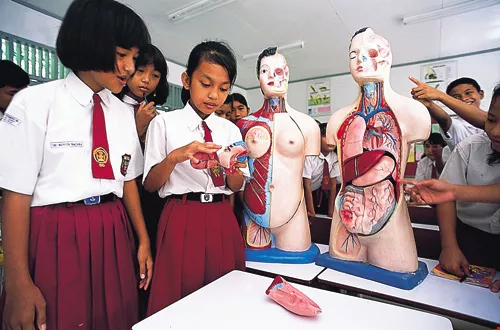
World Vision Taiwan has also provided isolated village schools with new educational resources in the form of posters and other educational materials.
@List.jpg?w=522&h=410&mode=crop&format=webp&quality=80)

@List.jpg?w=522&h=410&mode=crop&format=webp&quality=80)


@List.jpg?w=522&h=410&mode=crop&format=webp&quality=80)

@List.jpg?w=522&h=410&mode=crop&format=webp&quality=80)
