Songstress A-Lin Visits Malawi
Eric Lin / photos courtesy of the Bjørgaas Foundation / tr. by Scott Williams
July 2013


In late May, Taiwanese pop star A-Lin visited Malawi at the behest of the Bjørgaas Foundation. She went both as a volunteer and to see the work that Pingtung Christian Hospital, with which the foundation is affiliated, has been doing there for the last several years.
The United Nations ranks Malawi as the eighth poorest nation in the world. Some 82% of the nation’s populace lives below the poverty line, its infant mortality rate is 7.9%, and one in eight of its children dies before the age of five. Plagued by malnutrition, AIDS, malaria, and tuberculosis, its average life expectancy is just 37 years. In fact, as many as 15% of Malawians are infected with AIDS, and roughly 80,000 of them die from the disease every year.
So many Malawians are borne away in their prime that there are too few workers, the nation’s economy is in decline, and the number of orphans is ever growing. Nonetheless, A-Lin says she saw much to be hopeful about during her 10-day visit.
We finally touch down in Lilongwe after two changes of plane and 26 hours of flying. Looking around, we see none of the prosperity we’d expect in a nation’s capital. The situation is much the same during our five-hour bus ride to the north: there are no developed areas or even streetlights, only yellow earth and blazing sun.
The volunteers and doctors from Pingtung Christian Hospital (PCH) are used to such long journeys: they’ve made the trip to Mzuzu, the city in northern Malawi where the Taiwan medical mission built its hospital, many times.
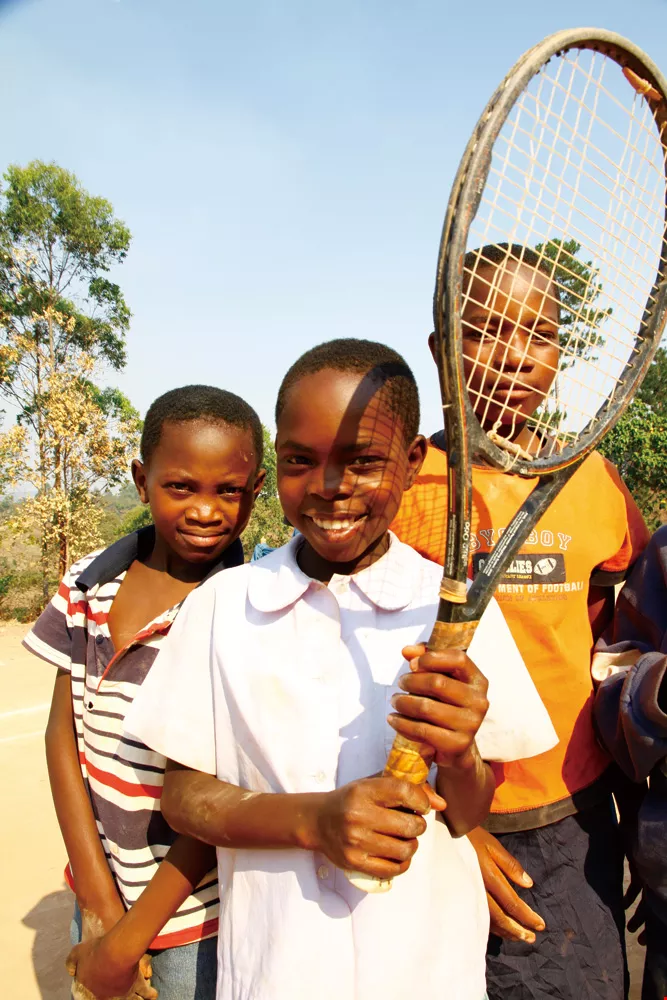
The Bjørgaas Foundation is promoting tennis and ping pong among Malawi’s young people, hoping to guide them to a better future.
Taiwan and Malawi used to have formal diplomatic relations. Towards the end of that period, the government asked PCH, which had a great deal of experience with international medical relief work, to establish a medical mission in Mzuzu. During its five years of operation (2003–2008), the mission delivered ordinary medical care and founded the Rainbow Clinic, the city’s first AIDS clinic. As part of its efforts to help local residents become more self-sufficient, it also created a microlending system and became deeply involved with the local community, women’s groups, and schools.
Malawi broke off formal ties with Taiwan in early 2008, a move that required all government-affiliated organizations to leave the country. Unwilling to see all its work go to waste, the PCH team established a partnership with Luke International, Norway (LIN), and continued its work as an NGO.
A-Lin’s first stop during her visit was the Rainbow Clinic, the AIDS clinic that PCH staffer Wu Zongshu oversees at Mzuzu’s Central Hospital.
In contrast to the typical international medical relief team, the workers here are largely Malawian locals. Most of the medical personnel trained in Taiwan at PCH, while most of the receptionists and patient support staff are themselves AIDS survivors who have undergone treatment. These workers help new patients get past their fear and embarrassment by patiently relating their own experiences with the disease.
Sinya, a patient support worker, is one of the clinic’s success stories. When she came in for treatment in 2006, she was an emaciated widow who weighed just 30 kilograms and whose children were wandering the streets begging for food. The clinic provided her with the AIDS drug cocktail and nutritional supplements, and she is now a full-figured Malawian beauty. Her work at the clinic has also greatly improved her economic situation, enabling her to again provide for her two children.
Sinya isn’t the only one to have benefitted. PCH’s medical relief program has rescued thousands of local AIDS patients from the brink of death.
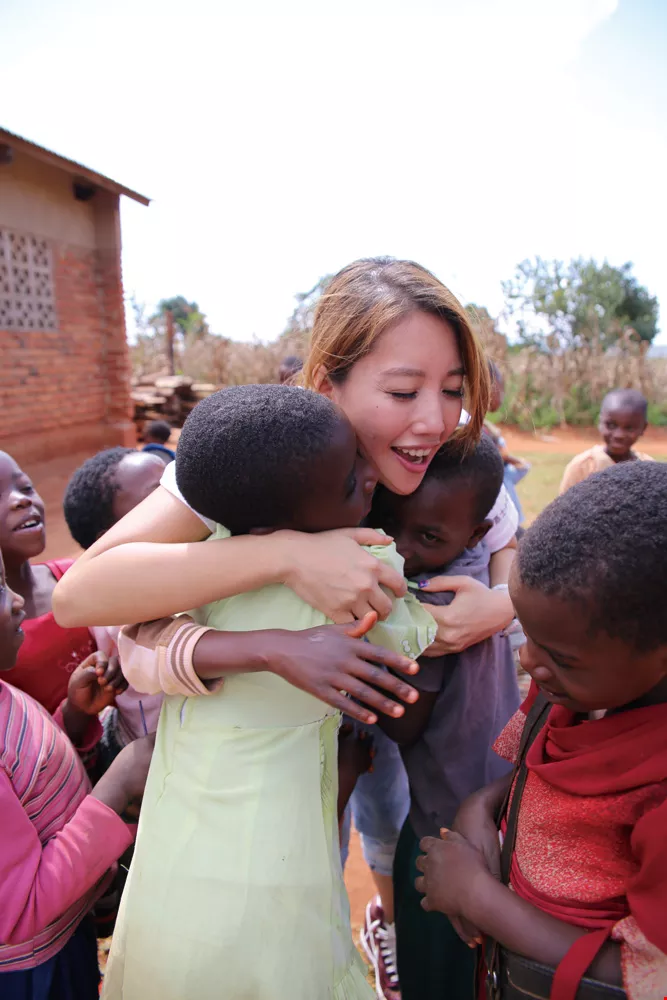
A-Lin visited a group of widows and orphans, learning with them how to make soy milk. Embracing these children with AIDS, she saw great optimism in the midst of adversity.
A-Lin’s second stop was with an AIDS patient support group.
Once PCH’s AIDS patients have undergone the drug cocktail therapy and recovered some immune function, their most pressing needs become emotional support and nutritional supplementation. PCH addresses these together by training groups of patients to make organic soy milk. They then go on to open their own soy milk stands, meeting their own nutritional needs while also becoming economically self-sufficient.
“Everyone knows that the AIDS virus is only transmitted through the exchange of bodily fluids,” says A-Lin. “But knowing that and actually dealing with AIDS patients in person are two different things.” She recalls that many people tried to discourage her from traveling to Malawi, telling her it was too risky. She chose to go anyway, and came to understand the courage it took for these patients to operate their businesses in the face of the social stigma associated with the disease.
After meeting with the support group, A-Lin’s next stop was a widows’ community.
Women have very low social status in Malawi, and widows are particularly disadvantaged. In fact, they are often shunned, which makes it that much more difficult for them to survive. But widowed mothers possess great strength.
In 2005 a group of motivated Mzuzu widows, assisted by Taiwan’s medical mission, formed a group aimed at fostering their own economic independence and aiding orphans. They chose to do so by raising and selling chickens, and even built the coops themselves. The group then spent all of its profits on community construction efforts, opening a daycare center for orphans.
In 2011, PCH began offering microloans to the chicken farmers, assisting them with strategy and operations, and helping them build a brand. These efforts enabled the widows to increase their production capacity, enhance their reputation, and improve their return on capital. The widows have consistently made their loan payments on time—as of late October 2012 they had repaid more than 97.5% of their debt—while also earning a reputation for producing high-quality chickens and eggs.
When A-Lin’s group visited the widows’ community, the women welcomed them with a song of thanks that demonstrated the Malawians’ natural talent for harmonizing: “Thanks to the Earth / Thanks to all the creatures on it / Thanks to the people we meet every day / Thanks for the grace in everything.”
The name “widows’ community” had led A-Lin to expect a place filled with hardship and worry. Instead, she heard a tenacious optimism in their song that made her heart pound and her blood race.
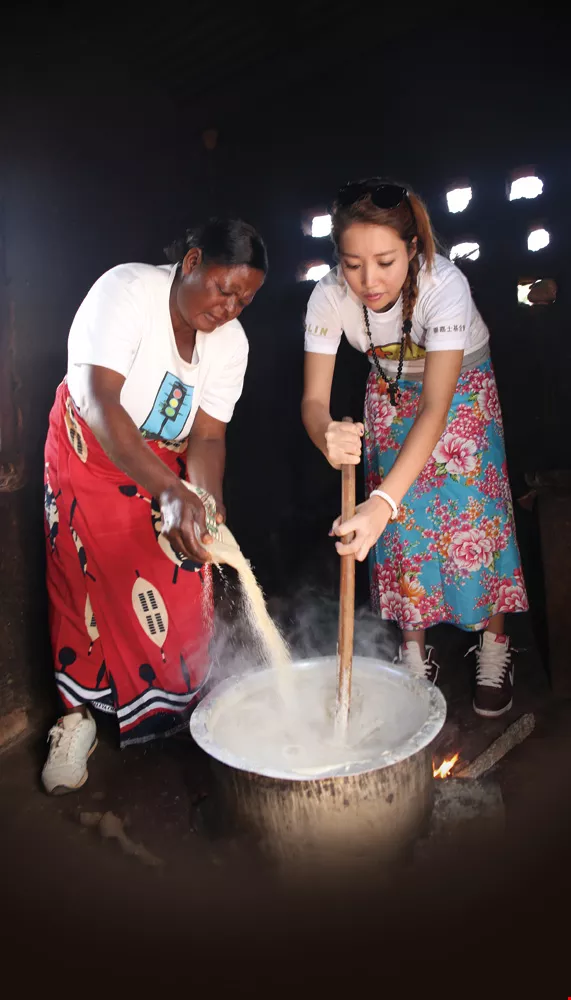
A-Lin visited a group of widows and orphans, learning with them how to make soy milk. Embracing these children with AIDS, she saw great optimism in the midst of adversity.
Children are our hope for the future, so A-Lin and her group were particularly interested in seeing the educational opportunities available to Malawi’s young people.
A-Lin learned about some of the fundamental issues confronting Malawian education soon after arriving at a Mzuzu elementary school. The country lacks educational resources, children frequently drop out to help their families with household duties, and teenage girls are often compelled to stay home during their menstrual cycles because they have only one small piece of cloth to use as a sanitary pad.
“I saw book bags without any books in them,” says A-Lin. “At first, I thought the school was just concerned that the books were too heavy for kids to tote around. When I asked about it, I learned that many kids simply can’t afford to buy their schoolbooks. Instead, they share texts at school, texts that they can’t bring home to review.”
According to the Malawian government only 42% of six- to 13-year-olds will complete the eighth grade, and gender inequality means that most girls will never even attend school. AIDS only makes the situation worse, as children with the disease are so overwhelmed by their health problems that they have little energy left to pursue an education.
The Bjørgaas Foundation therefore plans to introduce a scholarship program and what it calls a “Saved by the Ball” program in 2013.
Chou Wen-chen, the foundation’s CEO, says that Bjørgaas intends to offer students scholarships for primary, secondary, and tertiary education to encourage outstanding young scholars and to reduce dropout rates among low-income students.
Recognizing that educating girls promotes equal rights within families and improves the productive capacity of half the population, the foundation is also seeking to get more girls into the education system. To that end, it plans to offer twice as many scholarships to girls as boys.
Bjørgaas is also working on a new approach to education in Malawi: promoting tennis and ping pong in the community. The idea is to take advantage of team practice sessions to inform teens of how to prevent AIDS, thereby reducing their infection rates when they become adults.
As of late October 2012, the foundation’s community sports program had trained six national champions in ping pong, and four in tennis.
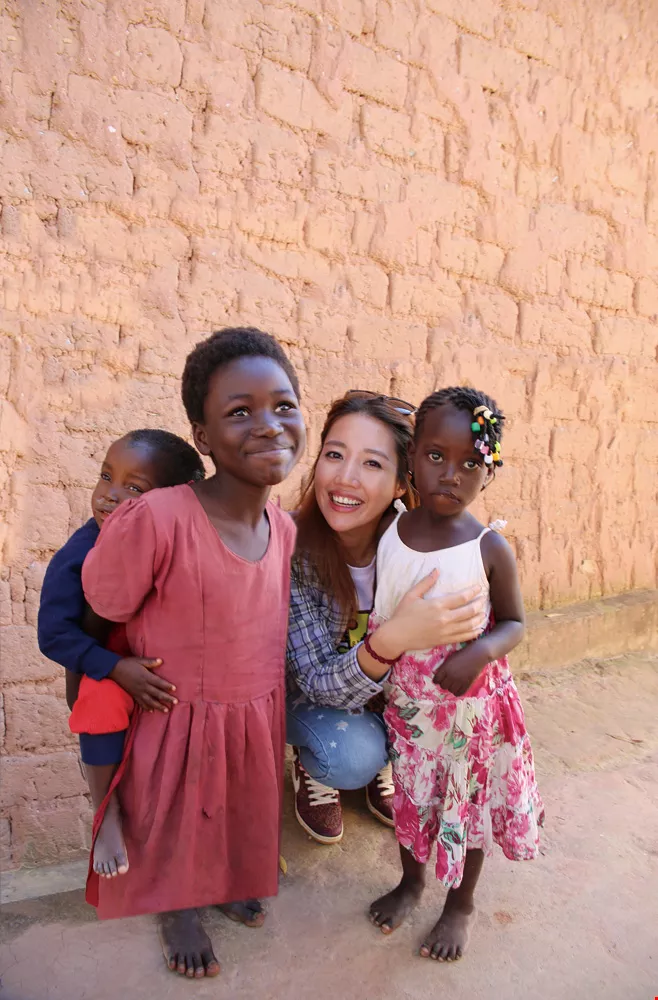
A-Lin visited a group of widows and orphans, learning with them how to make soy milk. Embracing these children with AIDS, she saw great optimism in the midst of adversity.
In recent years, the concept of foreign aid has gradually transformed from offering “handouts” to lending a “helping hand.” It’s also begun to emphasize the idea that groups and volunteers don’t just labor on behalf of others, but themselves learn lessons of lifelong significance. Taiwan’s foreign aid efforts have similarly developed beyond government-led agricultural and medical missions to include highly localized NGO-managed endeavors.
“This was my first trip to Africa,” says A-Lin, “and my first experience as an international volunteer.” She vows that she won’t limit herself to being just an observer in the future, and hopes that her fans in Taiwan will, through her, be able to participate vicariously in international relief work.
The sun was again scorching hot on the day A-Lin left Malawi, but the pop star departed the country filled with gratitude. In just 10 days there, she had had her eyes opened far wider than she had expected. She had glimpsed Africa’s immensity, bathed in its brilliant sunlight, and found its people’s future to be brimming with hope.

@List.jpg?w=522&h=410&mode=crop&format=webp&quality=80)


