Hatching the Dream of “Eggspert” Stone Chiu
Chen Hsin-yi / photos courtesy of Sunny Eggs / tr. by Chris Nelson
November 2012


Who says eggs are all the same? And who says egg farmers are doomed to a life of toil?
Eighteen years ago Stone Chiu, born and raised in Chang-hua County, took over the family egg business. Since then he has applied his experience as a former art broker and his head for management and marketing to raise egg production to an art form, which has helped drive the recent trend of brand-name farms. In the process he has rewritten the rules of the game for the egg industry.
Within the 2.5-hectare Sunny Eggs estate, located in Beidou Township, Changhua County, the chirping of wild birds replaces the expected clucking of chickens. A rich expanse of vegetation opens up before the eyes, and two fine horses enjoy a leisurely graze in an enclosed pasture, revealing the operator’s outdoorsy lifestyle.
Looking into the yard, there stand three rows of factory-style buildings: seven meters tall, 15 m wide and either 80 or 100 m long. With their closed white exteriors you can’t see what’s going on inside, but if you look up you’ll find that between each pair of factory buildings, separated by 30 m, is an elevated conveyor belt, steadily transporting eggs from the two chicken sheds in the rear to the egg washing and sorting facility at the front.
This is Taiwan’s first farm with modern, fully enclosed chicken sheds and washing/sorting equipment, and is the place where the dream of Taiwan’s first farm-operated brand of eggs, Sunny Eggs, was hatched. Farm operator Stone Chiu’s residence is on the farm property. Living near the chicken sheds day and night, he demonstrates that farming is also a lifestyle.
.jpg?w=1080&mode=crop&format=webp&quality=80)
Unlike the average egg farm with stinky odors, Sunny Eggs is like a picturesque estate. The elevated “bridge” is a conveyor belt joining a chicken shed (on the right) to the washing and sorting facility.
Stone Chiu, 48, tall and refined in appearance and frank and unhurried in speech, is often invited to give talks on marketing and management at schools and businesses. He is also chairman of the Taiwan Excellent Egg Development Association and a board member of the Taiwan Premium Agricultural Products Development Institute. And in addition to being a leader in the agribusiness community, he frequently offers advice to government agricultural agencies.
Though he now devotes such incomparable passion to eggs, when younger he once vowed, “I won’t raise chickens!”
Long ago, Chiu’s father raised broilers in Yongjing Township, Changhua County. Then in 1969 he moved his farm to its current location in Beidou Township and switched to the egg business. At the highest point, he had 60,000 hens in over 20 sheds.
But Chiu, who grew up shoveling chicken manure and gathering eggs, didn’t care much for coops choked with the odor of bird feces or the sight of feathers flying everywhere; moreover, he was aware of the meager incomes earned by toiling farm laborers. Unwilling to relegate his future to raising chickens, he flew the coop and headed north to study tourism at the Tamsui Institute of Business Administration. After graduation he served as a tour guide, traipsing around the world, and later worked as an art broker, all the while hoping to go far and fly high.
When he turned 30, Chiu learned of his father’s disappointment at his reluctance to follow in his footsteps and his determination to steer clear of the chicken farming business. Gently coaxed by his mother and sister, he returned home, a decision that shocked his friends. “My colleagues at the time said I was going from heaven to hell, and bet me that I would be running back to Taipei within three months,” he says.
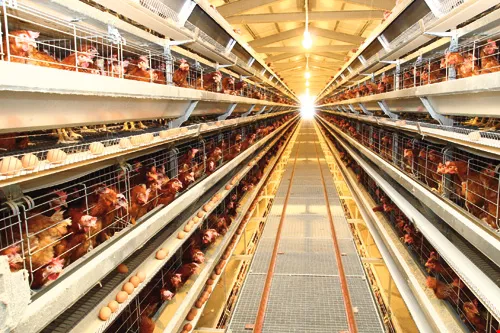
Modern sheds (above) help keep viruses at bay, protecting the health of the hens. Sunny Eggs chairman Stone Chiu (facing page, photo by Chuang Kung-ju) produces prime quality eggs using the latest technology.
But Chiu, confident in his ability to excel in whatever he does, plunged in. For the first six years after coming home, followed traditional chicken raising methods to hone his his skills. During that time he was also chosen to take over as head of Changhua’s laying-hen production and sales cooperative. His frequent meetings with industry, government and academia showed him in greater depth the condition of the industry, and he began to give thought to solving critical problems facing the industry.
Chiu discovered that traditional chicken sheds, which are open to the outside, are susceptible to the introduction of viruses; no wonder traditional chicken farmers rely on drugs for disease prevention. Also, egg production and marketing have long been run on a system of “firm commitment offerings,” in which egg wholesalers set the conditions. The farmers don’t bear the risks and costs involved in managing distribution channels, but they lose leverage in price negotiations. Plus since all the eggs end up being sold together anyway, egg farmers are not motivated to improve quality.
After gaining his father’s approval, Chiu decided to undertake reforms. His primary task was to construct modern enclosed chicken sheds in order to improve the comfort and ease of management of the hen-raising environment and create higher-quality eggs.
Reform requires courage. Chiu recalls that in 2000, right when egg prices were at a low, they brought in German-made sealed-environment, temperature-controlled egg laying sheds. The total cost of the equipment, demolitions, ground preparation, construction and the purchase of 80,000 chickens was over NT$50 million, with the capital coming from low-interest Council of Agriculture loans and funds borrowed from relatives. Moreover, it was a six-month period with no revenues.
“While under such great pressure, tears came to our eyes as my dad and I watched the excavator tearing down the old chicken sheds. We realized there was really no turning back,” says Chiu.
.jpg?w=1080&mode=crop&format=webp&quality=80)
Eggs bearing ID marks (upper picture) is a new trend in the egg industry. Good eggs (lower picture) have robust yolks, with distinct layers of yolk, thin albumen, and thick albumen.
Sunny Eggs then erected two sealed temperature-controlled laying sheds. Their main advantage is that the water curtain environmental control and negative pressure ventilator system is effective at screening out pathogens and disease-carrying mosquitoes, plus the air inside the sheds is kept fresh and clean so the chickens won’t become sick and so don’t require any preventive or curative drugs.
In addition, the chicken sheds are spacious, each shed having eight stories and able to hold 80,000 chickens. The average space for the hens ranges from 458 to 580 square centimeters, far more than the 250 square centimeters of traditional battery hens. The larger enclosures reduce the hens’ feeling of confinement, producing healthier eggs.
Sunny Eggs also pioneered the use of computer-automated washing and selection. Eggs are washed free of contaminants and then sorted. “Since eggs and feces both pass through the same opening in the hen’s rear end—the ‘cloaca’—the surface of the eggshell is vulnerable to bacteria. Washing and sorting minimizes the risk of salmonella and other contaminants,” says Chiu.
Sunny Eggs’ newest egg washing and sorting machine, made in Denmark, can process 36,000 eggs an hour. The washing and sorting process is an in-house operation that includes visual inspection, cleaning and disinfection, drying, ultraviolet disinfection, candling inspection to eliminate bloody and broken eggs, acoustic crack detection, grading, packaging, refrigerated transport and storage.
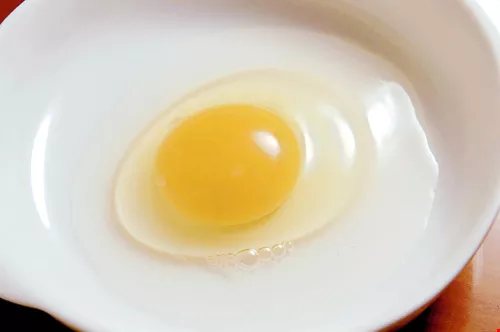
Eggs bearing ID marks (upper picture) is a new trend in the egg industry. Good eggs (lower picture) have robust yolks, with distinct layers of yolk, thin albumen, and thick albumen.
Other goals Chiu seeks besides safety are nutrition and flavor.
When held in the hand, a Sunny Eggs egg has heft. The shells are relatively thick, and when cracked open, the yolk membrane is elastic, the yolks full and plump, even rolling around in the hand. The inner thick and outer thin albumen layers are distinct and don’t blend together or disperse. Eggs like this are denser, more nutritious and more flavorful.
But though eggs are known as natural storehouses of concentrated nutrition, it’s also true that they’re high in cholesterol. To address this, Chiu developed a feed additive that “increases eggs’ nutritional value while reducing their cholesterol.” This helped win him the Shennong Award in 2004.
Chiu is happy to share his feed additive formula with his competitors. He adds beta-carotene, green algae, and garlic powder to boost nutrition, as well as living microbes like Lactobacillus to promote digestive tract absorption and reduce fecal odor. Extracts from Chinese medicines such as stout camphor fungus (Taiwanofungus camphoratus), after dilution, are added to drinking water to improve the hens’ respiratory function and boost immunity. And recently he has also added bromelain (a pineapple enzyme) to the feed, which acts as a natural anti-inflammatory.
“Automation is all well and good, but when it comes to the chickens themselves you’ve got to really care, right from the heart.” Chiu is thankful to his father for making sure he stays in touch with the complete production process, so that now he knows how to judge for himself the condition of the chickens.
When he enters the chicken shed, the first thing he does is close his eyes and quietly listen: “Are the chickens active? Or too inactive?” By observing the chicken manure he can see if there is anything amiss with the hens, and he can make appropriate seasonal adjustments to the feed additives.
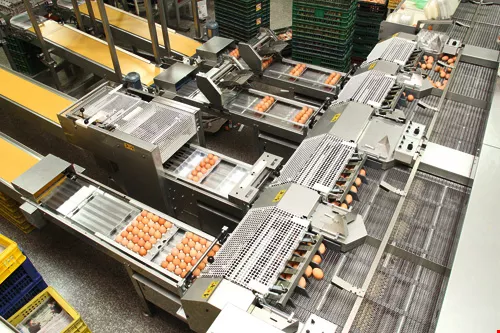
The fully automatic egg washing and sorting equipment standardizes selection, disinfection, crack detection, grading and packaging, processing 36,000 eggs an hour.
Like carving a fine work of art, developing good eggs incurs considerable expense. In 2001, Chiu registered the trademark Sunny Eggs and set the sales price at NT$9 (now NT$11) per egg. Though his care is reflected in the cost, the product still had to survive the test of the market.
Taiwan’s eggs have long been priced around NT$3 each, with little variation, since barriers to entry to the industry are low, there’s high supply, and prices are controlled mainly by egg wholesalers. In order to find a niche, Chiu’s marketing strategy was to set his own sales prices and establish a distribution system, first selling them through Taipei’s high-class department stores and organic food shops, and later to general markets. To mold an image of quality eggs, the cartons bear the farm name and address, a QR code, a product description, and an after-sales service phone number.
On top of this, Sunny Eggs is one of Taiwan’s first egg farms to receive Taiwan’s Certified Agricultural Standards and Traceable Agricultural Product certifications, and has also passed ISO 22000 and HACCP international safety standards. In 2008 the company secured the OVN nutrition certification long prevalent in EU countries but rare in Asian countries, further reinforcing its brand image.
In retrospect, Sunny Eggs’ marketing strategy has been quite a success. Their sales volume has steadily grown by the year, and their eggs are the chosen ingredients of many restaurants and food processing companies that flaunt their rigorous standards. For example, the pineapple cake brand SunnyHills, the venerable egg roll company Fu Yishan, donut seller Mister Donut, and gourmet bread shop Paul all use Sunny Eggs.
Chiu believes that besides having a clear target market, brand building requires a diversity of products and sales channels. As they say, “Don’t put all your eggs in one basket.” But he is dubious about cooperation with convenience store chains, whose parent companies are usually big food companies, despite their superior selling power. Such cooperation comes at a price: egg farmers are required to use feed supplied by the parent companies, they don’t have a say in pricing, and the cooperation must be exclusive. What begins as a partnership may end up like a dependent relationship.
Creating a “blue ocean”Throughout this time, the trend of brand-name eggs has been growing. Chiu doesn’t worry about competition; instead, he holds that improved product quality and organized marketing will help the industry as a whole make reasonable profits while providing consumers with superior egg products.
Under the leadership of the Excellent Egg Development Association, where Chiu is in his fourth term as chairman, currently Taiwan has 19 fresh egg product farms, eight liquid egg factories (processing plants that package egg yolks and whites separately) and three “thousand-year-old egg” factories which have received the CAS mark. Although the total output of CAS certified eggs only accounts for 6–8% of the fresh egg market, this segment is the new cutting edge in the industry, bringing brighter prospects to Taiwanese egg farmers.
In the course of his life from “I won’t raise chickens!” to his mission to upgrade the industry, Stone Chiu is grateful for his father’s quiet yet steadfast support. “My father exemplifies the true spirit of industriousness. He had the forbearance to let me go away and live an itinerant lifestyle, and because of that I had the courage to break out of the mold, so we could create a new dawn for the industry together,” says Chiu.
The story of Sunny Eggs is the story of a father and son sharing the same ideals. This once again proves that by injecting new thinking into management and development it is possible for traditional industries to achieve success.

@List.jpg?w=522&h=410&mode=crop&format=webp&quality=80)
@List.jpg?w=522&h=410&mode=crop&format=webp&quality=80)


