The Black Eagle: Dark Warrior of the Wilderness
Coral Lee / photos Chuang Kung-ju / tr. by Chris Nelson
June 2012


“What is the power of a dream?” The documentary Phantom of the Forest, released in March 2012, tells the story of raptor researcher Lin Wenhorn and his associates in their 20-year quest for the black eagle, deep in the forests of Taiwan.
Boasting a wingspan of 180 centimeters, the black eagle (Ictinaetus malayensis) lives in rugged, misty old-growth forests, but with no fixed domain, it’s not well known by the people of Taiwan. In the 1990s, Lin founded the Raptor Research Group of Taiwan (RRGT), with the aim of uncovering the mysteries of Taiwan’s birds of prey. It was thereafter that the riddles of the black eagle’s life gradually came to light.
It’s early May. The Fu-Shan Botanical Garden is teeming with life: butterflies flit about, the nonstop calling of birds and buzzing of insects fill the air, and the trailside grasslands bear traces that wild boars have been digging there. From there, Lin Wenhorn enters the Hapen Nature Reserve, where Taiwan shoveljaw carp flash their ruddy fins in the crystal-clear streams to attract mates. After an hour of trekking through mountains and streams, Lin arrives at a spot in an open meadow to observe raptors.
Surrounded by lush old-growth forest, Lin points out 1,700-meter-high Mt. Ayu in the distance, telling us that a pair of black eagles make their home on the mountainside, a pair of mountain hawk-eagles live near the peak, and several crested serpent eagles reside here and there.
Fu-Shan Botanical Garden, straddling Yilan County and New Taipei City, occupies 1,100 hectares in this mountain range, varying in elevation from 400 to 1,400 meters. This mountainous region is one of Taiwan’s few protected old-growth broadleaf forests.
This happy hunting ground for wild animals is the base from which the RRGT has been conducting long-term observations of four raptor species since 2004. The researchers monitor changes in raptor numbers and the effects of environmental factors.
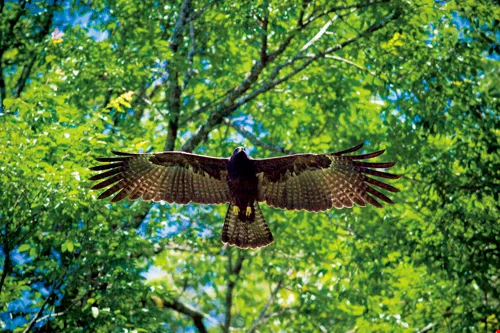
The black eagle, with its large wingspan, is a master of flight, often cruising majestically above the forests.
Braving the bright sun for an hour or two that morning, Lin spots courting crested goshawks, a circling crested serpent eagle, and a fleeting black eagle. He notes down the positions and behaviors of all three raptor species.
In the afternoon, he drives to a road within the boundaries of the botanical garden to wait for black eagle, but sees nothing. The next day he treks high up the mountain to his private eagle-viewing point, a 25-meter-tall steel-frame tower, which he painstakingly climbs.
“Black eagles like to fly along crest lines, and this place has the best view. You can observe and photograph eagles in detail from a short range. If we’re lucky, we might see a black eagle driving away a mountain hawk-eagle,” says Lin, who estimates that on a clear day, the chances of seeing a black eagle are quite good. After sitting atop the rickety tower for a couple hours, we see only a crested serpent eagle circling a few times in the sky. No black eagles show up. Later, a fog rolls in so we have to get going.
“When the weather is fine, the chances of seeing eagles aren’t. I’ve been in the field hundreds of times, and this is a common situation,” says Lin. Raptors are quite hard to fathom.
Of Taiwan’s eight resident diurnal raptor species, the black eagle is the most mysterious. Although it had been identified during Japanese rule, it wasn’t until the 1980s that birdwatching started to become popular in Taiwan, but even then hobbyists and academic researchers learned little about the black eagle.
Now the black eagle’s secrets are being uncovered one by one, and Lin’s two decades of constant research have much to do with it.
Lin served as a volunteer guide for the Wild Bird Society of Taipei while still in high school. After graduating from National Chiao Tung University, he worked as a computer engineer at the Chung-Shan Institute of Science and Technology. But answering the call of the wild, at age 27 he decided to become a full-time birder. In 1989 he served as an assistant with the Chinese Wild Bird Federation, and was a pioneer in counting the tens of thousands of grey-faced buzzards in Kending.
Lin formed the RRGT in 1994 with like-minded enthusiasts, and thanks to a cadre of volunteers, they were able to conduct detailed observations and compile breeding records of raptors from small besras and mid-sized crested goshawks to large crested serpent eagles and black eagles.
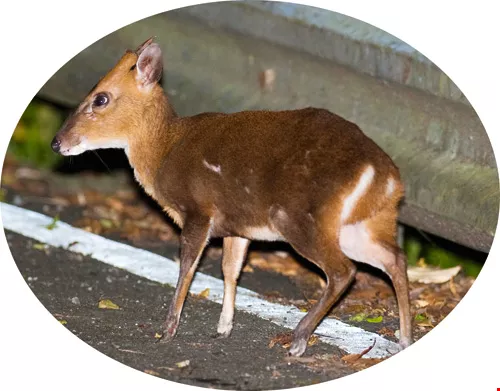
Fu-Shan Botanical Garden is home to many wildlife species. The emerald green tree frog (Rhacophorus prasinatus), bronzed drongo, Formosan macaque, and Reeve’s muntjac can all frequently be seen there.
Of all the raptors, why does Lin favor the dark-bodied, less-than-gorgeous black eagle, and why does he cheerfully sacrifice countless hours in its pursuit, so much so that his friends have nicknamed him “Black Eagle”?
“Black eagles are huge yet mystical. They only live in old-growth forests. I also find their black forms flying slowly and gracefully amid the treetops to be an especially strong draw,” says Lin.
Unlike the crested serpent eagle, whose territory has a diameter of about one kilometer and which maintains a set daily flight pattern, the black eagle’s domain extends to about five to 10 km. Moreover, they tend to mysteriously vanish and reappear, often disappearing without a trace after scouting around a certain area for several days, only to be seen later at another mountaintop. Eventually, Lin realized this is a rotational hunting strategy: when the eagles’ hunting activity has scared away small animals in the forest, the birds move to another area. Once their prey have let their guard down, the eagles revisit their previous hunting grounds.
In 1994 Lin started conducting a black eagle survey. During the early years he trekked forests throughout Taiwan, and in 1997 he drew a black eagle distribution map which showed that the eagle was widely distributed in Taiwan but spread out thin. Later, he aimed the focus of his research at Fu-Shan Botanical Garden and the mountains of Pinglin and Wulai, and he gradually accumulated basic biological data on the black eagle.
Lin says it’s too hard to catch black eagles and tag them for follow-up research, so he had to go old school, piecing together their ecological status by comparing and generalizing data bit by bit. For instance, to identify individual eagles, it’s necessary to look through binoculars and compare with photographs to identify damaged feathers. To conclude whether the birds have changed mates requires long-term observations.
After many years of recordkeeping, Lin has formulated initial outlines of black eagle ecology.
“Black eagles usually pair up, and outside of dense old-growth forests they can also be found deep in forests cut by highways,” says Lin. Unlike the mountain hawk-eagle, which is extremely sensitive and keeps far away from humans, the black eagle is rather tolerant of people. Along Provincial Highway 9 between Taipei and Yilan, black eagles can be found foraging for food in the precipitous forests on either side of the road.
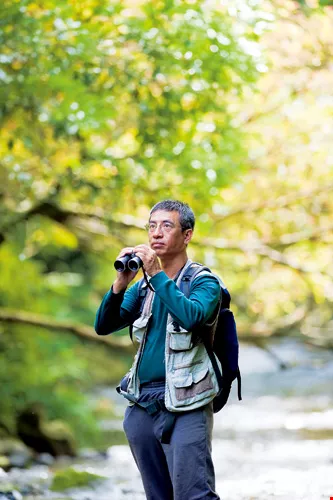
RRGT founder Lin Wenhorn has studied black eagles for 20 years, often trekking deep into the woods in pursuit of these birds.
With a wingspan of 180 cm but weighing in at only 1.6 kilograms, the black eagle is a slender bird. “It’s a perfectly designed flying machine,” says Lin.
Lin describes the black eagle’s long primary feathers as being advantageous for slow flight, but it can transform at any time from a slow-flying glider into a high-speed dive-bomber.
Also, when seeking a mate or asserting its territory, it flies in a wave-like dance.
“One spring I saw two males taking turns flying in great wave-like patterns to woo a female. The female glided along with perfect composure. It was quite amusing,” says Lin. And when it drove away an intruding mountain hawk-eagle, the black eagle behaved differently from other raptors, making threatening gestures by means of a vigorous nosedive. “It flew slowly toward the mountain hawk-eagle, gently yet daringly sticking with its flight path. The intruder, apparently frightened, left without making any trouble,” says Lin.
Lin knows full well that years of collecting data is nothing compared to directly observing an eagle’s nest during breeding season. Not long after the RRGT was founded, they set out to find black eagle nests. Though they located the nests of other eagle species, they were unable to even find one black eagle nest.
One spring, they observed a black eagle that would frequently enter and leave a Pinglin-area forest, evidently bringing prey to feed to its young. But despite scouring the wilderness, they were unable to find the nest. Having seen young eagles flying far from their nests, they didn’t give up hope, and continued with their hunt. Thankfully, one sharp-eyed fellow trekker spotted a birds-nest fern with withered branches sticking out of it up in a 20-meter-tall tree, and they surmised that it may be a black eagle nest. They returned to Taipei to ask a friend who had climbing gear to check it out, and found that the birds-nest fern did indeed contain an eagle nest.
“We came to realize that the black eagle uses these large epiphytic ferns as a base, which it covers with twigs to form a shallow concave platform,” says Lin. At first they thought the black eagle, like most raptors, built its nest out of twigs in the crotch of a tree, which is what made their search so arduous.
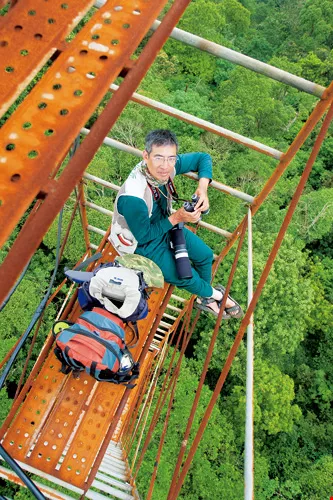
This 25-meter-high tower at the top of a mountain, with its sweeping views, is Lin’s outpost for observing eagles.
The next problem is that researchers on the ground simply can’t see the treetops when looking up, and they can’t climb every tree to take a look. So, how are they to find a nest complete with young?
It was as if these birders were divinely favored. In 2004, the RRGT received grants from the Forestry Bureau for a three-year project to survey black eagle ecology. That March, volunteer raptor scholars happened across a black eagle nest while doing other research at Fushan.
The nest was located in a precipitous area, so the researchers were unable to get up close to observe it. Therefore the RRGT installed a monitoring system in a tree, which transmitted wireless signals to a relay receiver 400 m away. This allowed Lin to gain a better outline of black eagles’ lives.
The black eagle raises one offspring at a time. During this time, there is a division of labor with the male in charge of external tasks while the female takes care of the nest. The male hunts for food to give to the female, and after finishing the duties of the day he comes to rest at a nearby guard post. When the eaglet is still small, the female remains mostly at the nest cleaning up and feeding and sheltering the young bird. When the fledgling grows older, it will fly to the nearby guard post, sharing guard duty with its father.
The video monitor recorded the eaglet being harassed by five jungle crows when it was just two weeks old. Defending the nest, the mother spread her wings halfway to protect her offspring. The male returned to the nest, and seeing this, immediately engaged in an air battle with the intruders. After 50 minutes of fighting, the father, near exhaustion, descended to a treetop to rest, and then finally drove the crows away.
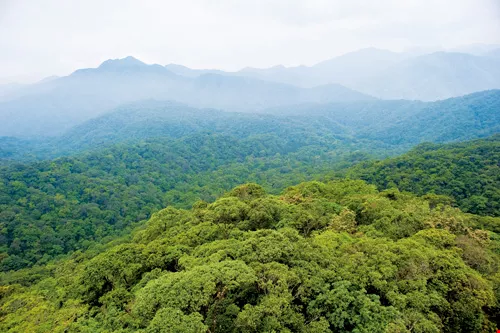
Expansive natural broadleaf forests form a stable habitat for the black eagle. Pictured here is Fu-Shan Botanical Garden, the base for the Raptor Research Group of Taiwan’s long-term survey of black eagle ecology.
The riddle of the black eagle’s hunting habits was also unlocked during this research project. Besides recording video, Lin placed a net under the guard post to gather pellets.
“Raptors lack the ability to chew, so they swallow food in big gulps. Material that can’t be digested is regurgitated in the form of pellets,” says Lin. Analyzing the pellets, he found that black eagle prey consists entirely of mammals (e.g. red-bellied tree squirrel, spotted giant flying squirrel, Coxing’s white-bellied rat) and birds. They don’t eat snakes, frogs, or other reptiles or amphibians; thus they can peacefully coexist in the same domain as the crested serpent eagle, which feeds on cold-blooded animals.
From his long-term observation of black eagle foraging behavior, Lin found that the black eagle flies slowly amid the forest canopy layer and the spaces between big trees, then speeds toward targets amid the leaves and branches of the canopy. From his pellet analyses, he determined that the black eagle feeds mainly on mammals and birds found in the mid to upper level of the forest. This includes many sleeping nocturnal animals as well as young birds and animals waiting to be fed. Sometimes they even take an entire nestful of eggs, complete with the nest.
As the eaglet grows, the female also starts hunting away from the nest. One day, an eaglet was being harassed by a troupe of Formosan macaques, and it had no choice but to take flight prematurely, half flying and half leaping. Thus began 20 days of vagabond behavior.
The day after the eaglet was gone, the RRGT mobilized a search party, but they found nothing the next day or night. Looking at the sky, Lin caught sight of the father eagle, which he followed until he found the eaglet. “The eagle eye is eight times keener than the human eye, so it can easily see what’s happening on the ground,” says Lin. After the frightened eaglet was found, the surveyors observed that no matter where the eaglet moved to, the father would bring it food. A month or so later, the eaglet was finally able to soar high in the sky with its parents.
In 2008 Lin and his partners were in the mountains of Pinglin when they saw for the first time black eagles pairing; they also were lucky enough to find the nest. This time he had a better vantage point from which to observe the nest. The RRGT recorded the entire brooding process, and confirmed the black eagle’s life history, including the fact that they breed once every two years, each time raising an “only child.” They also found that the main staple for all three black eagles during the breeding season was squirrels, consuming 300 altogether, 80% of them juveniles. This shows that the black eagle has a key effect in controlling the numbers of squirrels in the forest.
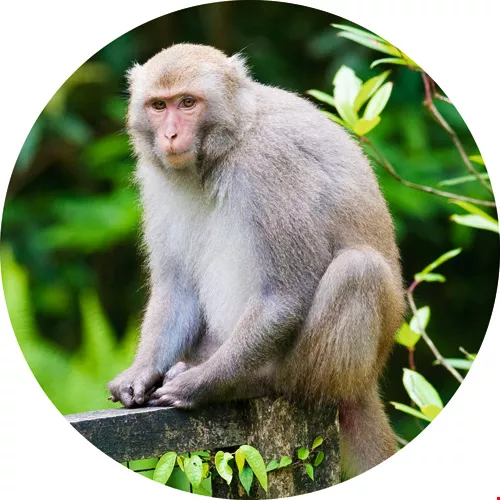
Fu-Shan Botanical Garden is home to many wildlife species. The emerald green tree frog (Rhacophorus prasinatus), bronzed drongo, Formosan macaque, and Reeve’s muntjac can all frequently be seen there.
At the end of the documentary, as the camera shows an eagle’s-eye view of a journey from primeval forest to a populated mountain area, we see lush mountains give way to fields and orchards. “How many areas of pristine wilderness are left on ‘Ilha Formosa’?” asks Lin worriedly.
Over the years, Lin has considered the wilderness his home. Though he has gradually unmasked the secrets of the forest over two decades of eagle chasing, he is more concerned about the stewardship of Taiwan’s woodlands. “If the black eagle were to vanish, what we would lose is not merely a species of eagle, but also Taiwan’s pride: its environment.”
Lin, himself somewhat of a loner like the black eagle, collaborated with seasoned nature film director Liang Chieh-te so more people will learn about the black eagle. Through the documentary, which presents many findings of his research, he hopes everyone will join together to safeguard wildlife, and ensure that the stately and graceful sight of black eagles soaring in the sky and shuttling amid the forests will continue forever in Taiwan.
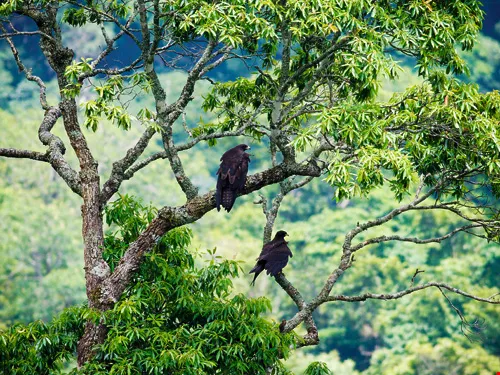
Lin’s research shows that black eagles form monogamous pairs, and command a territory of about 5 km across.
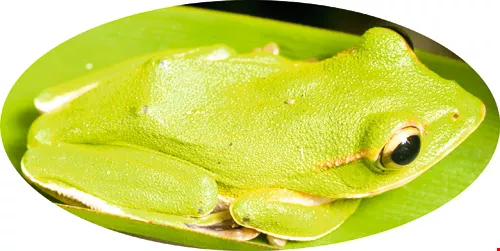
Fu-Shan Botanical Garden is home to many wildlife species. The emerald green tree frog (Rhacophorus prasinatus), bronzed drongo, Formosan macaque, and Reeve’s muntjac can all frequently be seen there.
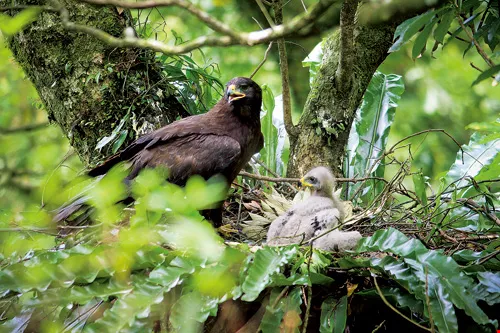
The black eagle builds its nest in epiphytic ferns (such as birds-nest ferns or rock ginger ferns) perched high up in broadleaf trees. This special nest-building method added a twist to Lin’s search for the nests.
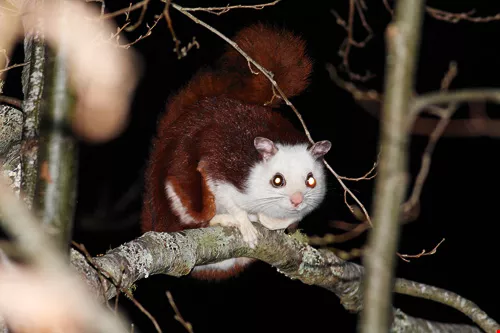
When nocturnal animals like flying squirrels and owls sleep in hollows and treetops by day, they become easy prey for black eagles.

@List.jpg?w=522&h=410&mode=crop&format=webp&quality=80)

@List.jpg?w=522&h=410&mode=crop&format=webp&quality=80)


