

As 2011 draws to a close, two of Taiwan's top sporting stars on the international scene-one a baseball pitcher, the other a golfer-have brought major events to Taiwan, not only sending the country sports mad, but also successfully marketing Taiwan abroad.
At Taiwan's first ever LPGA tour in Yang-mei, Tao-yuan County, Taiwan's own -Yani Tseng climbed to the top of the world rankings in front of her thousands of adoring hometown fans. As Taiwan hosted a series of games pitting Taiwan's best baseball players against the MLB Allstars, US-based Taiwanese pitcher Wang Chien-ming took to the mound, putting the final polish on an amazing comeback from injury.
"Hi everyone! I'm Yani Tseng, and I'd like to welcome you to Taiwan, my home." In late October, Taiwan hosted the Sunrise LPGA Taiwan Championship, and this was how Taiwan's golfing queen welcomed media from across the globe to Taiwan, putting the world's eyes on the island.
An avid golfer since the age of five, Tseng joined the Sunrise Golf Club in Yang-mei at age 12, "training" alongside golfers there. Since then, she has gone on to create a stellar story, defeating golfing superstar Michelle Wie at the US Women's Amateur Public Links in 2004 at just 15 years of age, before going on the next year to become the first Asian winner of the 103-year-old North and South Women's Amateur Golf Cham-pion-ship.
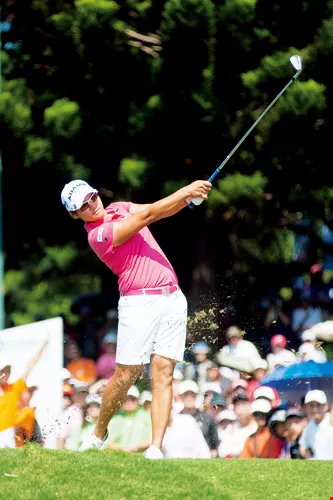
Yani Tseng began golfing as a child, and her hard work and natural talent have helped her reach the top of the sport and become the LPGA's Player of the Year for two years running.
After Tseng's string of amateur victories, pioneering Taiwanese women's golfer Tu Ai-yu remarked that Tseng's passion and talent for golf had the potential to help Taiwan once again become a leader in the Asian golf scene.
And so in 2007 and only just 18, Tseng made her formal entry to the professional- world as the only woman to earn sponsorship from Wintek Corporation through the Golfing Hope Project, organized by Acer founder Stan Shih and others.
Their faith in Tseng proved well founded. In 2008, she was signed by the world's largest sports agency, IMG, who planned to put their full energies behind her and make her the next big thing in women's golf. In February 2011, she won the ANZ RACV Ladies Masters in Australia, which after previous wins that month and the previous month saw her move into the number-one position in the Women's World Golf Rankings.
Her powerful stroke owes much to her earliest coach, her father Tseng Mao-hsin, whose training focused on power. Every time his daughter stepped up to the tee, the elder Tseng would tell her to hit the ball as hard as she could, because "you can always work on accuracy later."
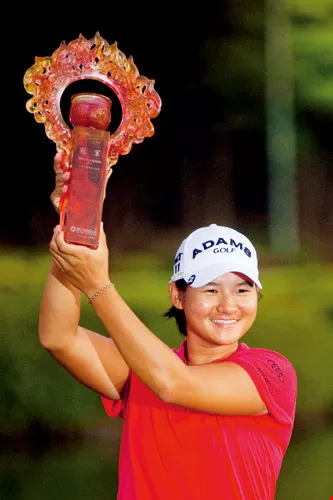
Holding aloft the winner's cup from Taiwan's first LPGA tournament, Yani Tseng smiles broadly after having won even under the pressure of competing on her home turf.
Standing back on the familiar ground of the Sunrise Golf Club, smiling confidently as legions of fans cheered her on, Tseng remarked before the tournament that the pressure was on because she was playing on home turf. Nonetheless, she finished her final round in 66 strokes, making for a 16-under-par 272 for the four rounds, which took the title. Not only did she walk away with US$300,000 in prize money, she also helped ensure Taiwan's first LPGA tournament wrapped up in storybook fashion.
"Being involved with sports, we're proud to have held this tournament and look forward to many more in the future," said president of National Taiwan Sport University Dr. Kao Chin-hsung. The Sunrise LPGA Taiwan Championship, with US$2 million in prize money, has had immediate effects on Taiwan both in the sporting world and in general promotion. It was broadcast to over 40 countries via satellite, and viewers not only got to see excellent professional performances and the passionate crowd, but also Tseng's name on the scoreboard and Taiwanese flags flying, making it "absolutely a successful international marketing scheme," according to Kao.
Sparks flyJust as Tseng was conquering the golfing world, another of Taiwan's international sporting stars was also making his way back to Taiwan after eight months in the United States. Baseball pitcher Wang Chien-ming had returned to take part in post-season friendlies organized by a sports marketing company, matches that would pit Taiwan's best against an all-star team from the American MLB. Wang, who has been playing out of the US, was in the spotlight as he took to the mound wearing the traditional blue of the Chinese Taipei team.
To Taiwanese baseball fans, these all-star matches were the talk of the town. Not only had they brought the best of American baseball from 17 different teams, those players included multi-million-dollar stars like Wang's former teammate from the Yankees, Robinson Cano. Cano's father had himself played in Taiwan 12 years ago as part of the Uni-President Lions, and so both father and son have close ties to Taiwan, earning them extra attention from local fans.
The Chinese Taipei team was largely based around the 24-man Baseball World Cup roster, with eight others brought in from teams in Japan and the US. But even taking into account Wang's major-league salary, this team nonetheless were financially valued far below their American competitors, at a total of NT$1.5 billion. This discrepancy reflects the differences in experience and "combat readiness" between the two sides.
Despite losing the series, the Chinese Taipei team came away with no small benefit-in the last four matches of the series of five, they lost by a total of only nine runs. Their performance improved game on game, staying strong even when they fell behind. Chinese Taipei coach Chen Wei-chen believes the five matches gave young Taiwanese players a chance to see how the game is played in the big leagues, giving them courage and insight that could inspire them to play to their full capacity, as well as teaching them to think on their feet, making it an effective learning experience.
A year in the doldrumsThose watching at home and at the grounds were swept up in major league fever, but amongst all of it what was even more looked forward to was the reappearance of Wang Chien-ming after an absence from the MLB mound of some 700-plus days. Viewers were watching with bated breath to see if he could make a successful comeback from injury and once again stand atop the pitcher's mound.
Back in July 2008, Wang, sporting Yankees colors, sprained a metatarsal ligament in his right foot while running between bases. Since then Wang, once renowned as the fastest Asian pitcher to reach 50 wins in MLB history, star pitcher for the Yankees, and "the pride of Taiwan," has had his career hobbled. When he made a hopeful reappearance in 2009, his abilities seemed greatly diminished, so much so that he was sent back to the minors on several occasions.
"It's been a long and hard year," Wang said to local media about his experience with this injury, having had surgery on his right shoulder, and performing poorly in the season opener. He was dropped by the Yankees and picked up by the significantly less renowned and less accomplished Washington Nationals for US$2 million.
Even as part of the Nationals, word constantly circulated throughout 2010 that Wang was on the mend and about to make his return, but ultimately nothing came of it. In 2011 he suffered yet another blow, being re-signed by the Nationals for only US$1 million in what looked likely to be his last shot at continuing to play in the US.
More will than abilityAfter a long, hard road to recovery, in July 2011 Wang finally made his long-awaited debut in the red of the Nationals. While he may not have walked away with the win and he clearly seemed tense on the mound, this was an invaluable first step back to the top after a long time in the doldrums.
Following this, Wang had several consecutive appearances, although he was clearly performing below his peak, with his speed down to only 93 mph. While this did slow his trademark sinker, it also gave it a sharper angle, showing that if he can keep himself in playing condition, he remains a pitcher with great control and dominance.
Having got off to a late start in the 2011 season, Wang came out with a record for the season of only four wins and three losses. Despite this he boasted an ERA-earned run average, the most important stat for pitchers-of only 4.04, better than his career average of 4.15.
After making his way back into daylight, Wang returned to Taiwan to pitch three innings and advertise his return. It was during this time that word came that the Nationals had chosen to re-sign him, and to judge from information announced by his agent, not only had Wang received the previously reported US$4 million, but also a performance bonus valued at US$4.6 million, for a personal-best contract of US$8.6 million.
Taiwan's new sporting spiritA nation's sporting prowess is a form of "soft power," and Taiwan cannot rely on just these two stars' returns to single-handedly turn things around. However, as professor of sociology at Soochow University Liu Weigong says, the stories of adversity and success of stars like Tseng and Wang, and others like Kuo Hung-chih and Kevin Lin, show that Taiwanese sports stars can generate inspiration tales that have potential commercial value and that could serve as the foundation of a full-fledged sports marketing industry."
These two superstars may once again have left Taiwan's shores, but whether it's staying at number one or returning to the top of their game, the examples of Tseng and Wang continue to inspire, even in the depths of winter.

@List.jpg?w=522&h=410&mode=crop&format=webp&quality=80)

@List.jpg?w=522&h=410&mode=crop&format=webp&quality=80)


