Community Work Helps Sri Lankan Children Build New Lives
Coral Lee / photos Chuang Kung-ju / tr. by Scott Williams
May 2008


Sri Lanka is just as pretty as its name. It is an unspoiled land where the sun sparkles on waves on azure shores, palm trees stretch up towards the blue skies, charming little houses line the streets in green, yellow and lilac, and passing pedestrians always wear sunny smiles.
But this vacation paradise was devastated by the Asian tsunami of 26 December 2004. The waves killed more than 30,000 people and destroyed 70% of Sri Lanka's coastal villages. Three years of reconstruction have largely restored the beauty of the coast. Tourists are once again strolling the beaches. Fishermen are bringing their catches in from the sea. The only reminders of the devastation are a few scattered piles of debris.
In the years since the tsunami, the Taiwan Fund for Children and Families (TFCF), an international NGO operating in Sri Lanka under the auspices of the "Hope for Tomorrow, Love from Taiwan" project, has been engaged in an unusual reconstruction project. Where most relief organizations have focused on rebuilding homes, schools, and other infrastructure, TFCF has taken aim at hearts and minds, focusing on healing the hurts of children and teens affected by the tsunami, rebuilding village social networks, and helping rural Sri Lankans get their lives on track again.
On a Sunday morning in early 2008, Kudawella, a village on the southern coast of Sri Lanka, is hopping. Kids large and small from three nearby villages are gathered at the village's recently completed athletic field for a cricket match.
The southern sun beats down on the bare red earth as the teams take their places on the huge field. The scene bubbles with excitement and enthusiasm as the kids, some standing, others seated on the tsunami-ravaged walls that border the field, cheer on their teams.
The field may not look like much to outsiders-there's no manicured track, lighting, or even seating-but it means the world to the kids.
Mrs. M. M. Nilmiri Derika, president of the Kudawella Child Well Being Committee (CWBC), is as excited as the kids. She says that the site, which is only a couple of hundred meters from the coast, was home to a pretty large elementary school before the tsunami leveled the entire campus. After the waves, the village decided to relocate the school to higher ground. It also banned construction on the school's original site, leaving the land vacant. Nearby villages then began using the site as a dump for building debris, downed trees, and broken appliances. Over time, the junk piled up and eventually covered a couple of hectares.
Worse, even though kids were returning to school, many had been orphaned by the tsunami or were being left to their own devices by parents struggling to make a living. The local CWBC realized that, much to the dismay of area parents, these kids were turning to drink and drugs. It decided to build a recreation center in the hope that it would redirect their energies into competitive sports. Once the committee settled on the former site of the elementary school, it worked with local youth organizations to get government money to acquire it, recruited villagers to help clean up the trash, and eventually converted it into a community athletic field.
The TFCF has been doing community development work in Sri Lanka for the last two years, working through local organizations such as the Sri Lankan branch of the Christian Children's Fund (CCF) and the Child Well Being Committees. Their efforts have ranged from constructing daycare centers to promoting public health events and local nutrition programs.
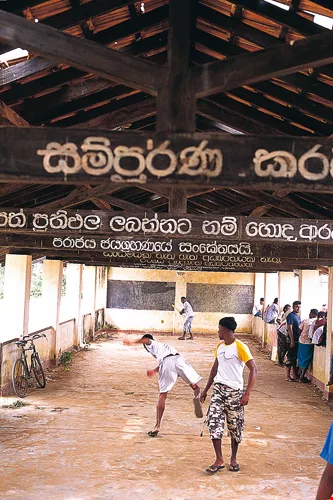
The competition was fierce at this cricket match, with teens waiting to take the pitch squeezing in a bit of last minute practice on the sidelines. The tsunami virtually leveled the school that used to stand on this site, leaving only this one shell standing.
Gamini Pinnalawatte, head of CCF Sri Lanka, says that in the wake of the tsunami, most NGOs focused on reconstruction of physical infrastructure. They ignored the people's psychological wounds which, though invisible, were in desperate need of healing. The Christian Children's Fund has therefore focused on caring for children and families, and rebuilding community social networks. Knowing that the only way to find out what children and families most needed was to have people on site, CCF established Child Well Being Committees in the disaster zone and staffed them with local residents. CCF has provided the committees with early guidance and training, but hopes they will ultimately grow into permanent, independent institutions protecting the children and young people of their communities.
"Administratively, the CWBCs build up from the grama niladari division (loosely "village") level," says Devaka, a CCF Sri Lanka regional manager in Hambantota District. For example, each of the three GN divisions that comprise the divisional secretariat of Tangalle has its own CWBC. The Tangalle committees then separate their children into three age groups-13-18 year olds, 6-12 year olds, and 0-5 year olds-each of which has its own independent organization responsible for planning its care.
CCF began its child welfare work after the tsunami in 57 target communities all around Sri Lanka. Taiwan's Hope for Tomorrow, Love from Taiwan program has provided funding and support for children's centers and other reconstruction projects in 33 of these communities in four southern districts-Ampara, Matara, Galle and Hambantota.
Derika turned to her local CWBC to get help for her children, who were suffering from post-traumatic stress disorder. Soon she was working for her committee as a team leader, and rose from there to become its chair. Over the last three years, she's been an eyewitness to the village's rebirth.
"The tsunami left us almost completely without hope," she recalls. Her village of Kudawella, which had a population of 700 or 800, lost more than 100 people in the tsunami. Derika herself happened to be away at the time. When she returned, she found her home changed beyond recognition. Her father was so shocked by events that he lost his memory, and her once bubbly son and daughter wouldn't speak to anyone. None of her efforts to comfort them seemed to have any effect. "I felt much more despair over this than the loss of my home or the destruction of the school," she says.
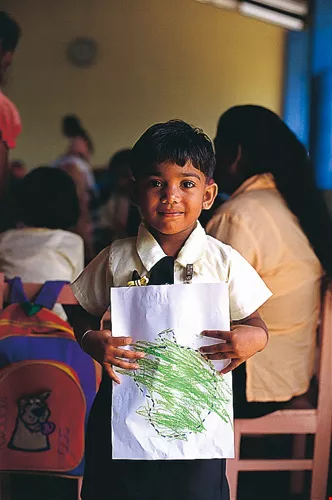
"After sending the kids to CCF's children's center, they eventually learned to draw a little," recalls Derika. "But they always drew pictures of corpses floating on a black sea." Under the patient coaching of the TFCF teacher, her son eventually began to draw prettier scenes and make use of color. To her surprise, she learned that he had artistic talent. The boy also began sharing his thoughts with his father and sister. Her daughter progressed more slowly, but enough that Derika's hopes soared.
Taiwan Fund for Children and Families aid in Sri Lanka
She joined the CWBC six months later, in part to attend a support group for fellow villagers dealing with similar issues, and in part to receive training in child welfare and organizational leadership. The move marked the start of her new life in community service.
On the afternoon of the cricket match, Derika also had to hurry over to the neighboring village of Nawadivipura for a show at its children's center. Two banners were strung over the packed hall, offering the hundreds of parents in attendance advice on dealing with their children. The yellow one suggested, "Speak to us with love and we will obey," while the orange one reminded them, "Hitting hurts."
The show included tea-picking dances performed by ethnic Tamils, other traditional music and dance, and short plays by the children. The performers themselves ranged in age from infants to high-school students. The older and younger kids also danced and sang together in a play entitled Stamping out Alcohol, keeping the audience thoroughly entertained for its entire half-hour length with their humorous skewering of a real social issue.
The play tells the story of a bandit who sneaks into a temple and ends up colluding with its abbot. They store and sell the bandit's black-market alcohol from a place where the police would never think to look for it: the temple itself. The abbot even tricks the devout into helping sell the booze. Later, the bandit's wife inadvertently exposes the scheme when she seeks help for their child at the temple. The play closes with an absurd tale of a drunken father. In reality, Sri Lanka has had a serious problem with alcoholism for many years. According to CCF Sri Lanka's Dinantha Thambavita, much of the money that Sri Lankan women earn working as maids in the Middle East ends up being drunk by their husbands. Their unfortunate children not only grow up with absent mothers, but also have to deal with their fathers' drunken binges.
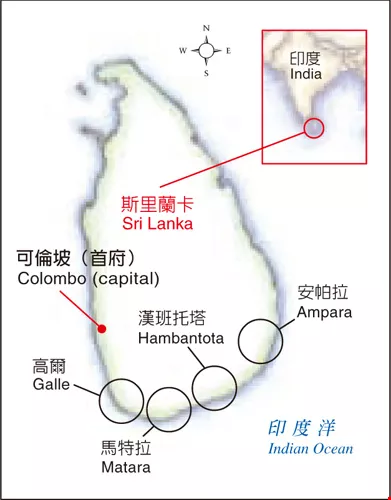
Taiwan Fund for Children and Families aid in Sri Lanka
"We came up with a topic and worked up the script ourselves," says 17-year-old Lasitha, who played the bandit. Lasitha, a member of the Nawadivipura youth club, says that they rehearsed the play for months and have already performed it in four villages. The club hopes to spread its teetotaling message even further in the future.
Lively and charismatic onstage, Lasitha is quiet and withdrawn off of it. Nor can he hide the pain in his large eyes when he discusses the tsunami. He says the waves struck on a Sunday while his mother and little sister were shopping at the weekend market in Hambantota. They were swept away in a flash, as was his best friend. In fact, more than 2,000 people are thought to have died in the market that day. Lasitha was very close to his mother growing up. With her loss, his world came undone. He had no interest in attending school or preparing for the high-school entrance exams. He was absolutely desolate, and all his earlier goals seemed meaningless.
Later, a friend mentioned that many teens in similar circumstances were joining the CCF youth club. Lasitha decided that his deceased mother shouldn't have to worry about him, and forced himself to go take a look. Through the club, he was able to make new friends, find a support group, and slowly recover from the tragedy. The club's many classes, together with its sporting activities and camping trips, helped him let go of the past and get his life back on track. He's now finished his second year of high school, and is preparing for his university entrance exams.
Dinesha, a member of the Kudawella youth club, says that her club has groups devoted to sports, health, the environment and careers. Members join the groups that interest them, and develop different areas of expertise. She herself is a member of the environmental group and has been learning about the ravages of infectious diseases such as dengue fever and malaria on her region. The group frequently invites public health officials and experts to give talks, and itself disseminates information among the villagers. Another of the club's groups is interested in exploration and studies how to read maps and use a compass. It also trains in emergency rescue techniques with the police. Members even occasionally travel to other villages or unfamiliar forests to practice their outdoor skills.
"The tsunami separated many people from their friends and loved ones. Some were killed. Others moved away to I-don't-know-where. I felt lost afterwards. It wasn't until I joined the club that I again found a direction in life." Most of the kids have had similar experiences.
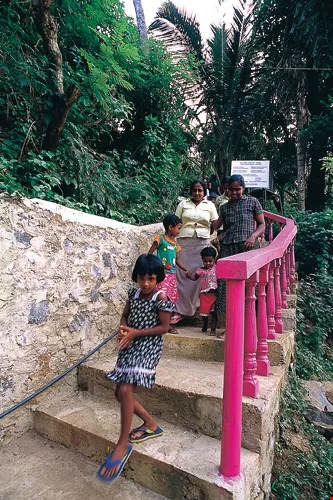
The CCF has also sponsored infrastructure construction. The photo shows the stairway the CCF built to a preschool relocated to higher ground.
While teens are using clubs to recover from the tragedy and develop their individual talents, 6-12 year olds need more direct adult supervision. CCF has therefore been establishing Child-Centered Spaces (CCS) with the assistance of the CWBCs. The CCSs use engaging after-school activities, such as handicrafts, dance, music, group games, sports, competitions, and storytelling, to help kids deal with the pain and trauma of the disaster.
Shihara, a 12 year old who lives in Nawadivipura, attends dance classes on Thursday and English classes on Saturday at her village's CCS. She spends Wednesdays involved in activities for all the village's children. Cute and clever, Shihara often represents her village in dance performances around the area. "I like being the center of attention," she says, her large eyes flashing. "I feel fulfilled when I perform."
When the tsunami destroyed her family's large, pretty home and her father's fishing boat, her father moved them into his mother's house. Shihara found it hard to adjust at first and suffered from nightmares. Fortunately, her CCS friends and performances provided her with an outlet.
"Our reason for being isn't actually arts classes," says Laxshman, who teaches the theater class. "It's to provide the kids with psychological support." He says that when the children's psychological burdens prevent them from expressing themselves, he leads them through casual activities designed to help them get comfortable with one another. Once they've managed that, he begins them talking to one another. Only in the final stages of the course do they begin working with plays, going through scripts, creating props, and rehearsing. Laxshman says that the activities relieve stress and help them develop their potential. The pace is very slow to allow the kids to put aside their hurts when they themselves decide they are ready.
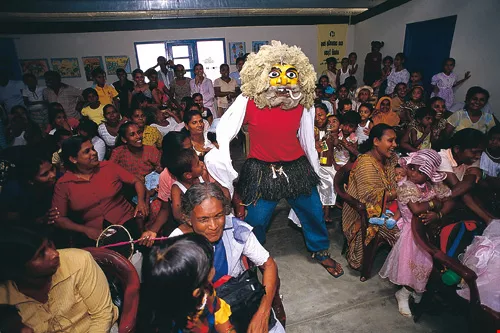
The Christian Children's Fund uses the arts to help children express their feelings and heal their hurts. In the photo, children and teens from Nawadivipura reveal the fruits of those labors.
"Even more importantly, the process teaches kids to work with others and improve themselves. It helps them regain their confidence," says Laxshman.
Kids from 0-5 years of age are the most vulnerable of the tsunami's victims and the most in need of protection. Kibiriti, a child welfare liaison with the CCF's southern regional office, says that there was little oversight of preschools prior to the tsunami. Unscrupulous lowlifes began taking advantage of this situation as soon as the waves receded, seeking money from NGOs for their fraudulent orphanages and preschools. In many cases, their illegal operations even abused and sold children. In an effort to stamp out this kind of exploitation, the Sri Lankan government has now implemented a teacher certification program as well as more stringent oversight of preschools.
TFCF has been implementing health, nutrition, and early childhood development programs for children in the disaster area since the tsunami. It has also introduced local kindergartens to new ideas in preschool education, and organized a variety of talks and events aimed at heightening community awareness of child welfare.
A teacher with the village of Mawella's hillside kindergarten says that CCF's introduction of the Early Childhood Care and Development (ECCD) program to her community led to major reforms in the kindergarten's methodology. "We now use coconut shells and coconuts as educational aids, and even use pebbles to teach mathematics," says the teacher. "We also take the children to the beach to play in the sand and listen to the waves to lessen their fear of the sea." Other changes include discussing the curriculum with students' mothers, and having mothers who've taken a nutrition class take turns preparing snacks for the kids.
Daisy, Hambantota's ECCD officer, says that ECCD has also provided teachers, parents and CWBCs with child-protection training, creating a community-wide safety net for the kids. The training aims to make community members aware of potential dangers to children. For example, do local residents recognize the risk that a rough road represents and do something about it? Does a teacher notice and take action when a three-year-old child cries continuously after entering kindergarten, even after the normal two-to-three-week adjustment period? In one such instance, when a teacher followed up by visiting the child's home, she discovered that the child's father regularly beat the mother. The child cried because he feared for his mother when he was away at school. The community must similarly get to the root of a child's troubles if it is to address and resolve them.
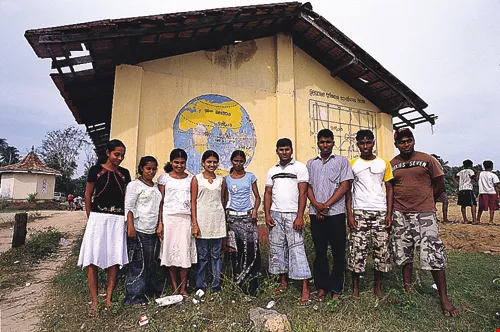
Youth clubs provide teens with the opportunity to make friends, develop skills and gradually get over the trauma of the tsunami. The photo shows members of the Kudawella youth club.
CCF regional manager Devaka has been living in Hambantota rather than in his home of Colombo for years in order to better direct the area's reconstruction. In fact, most of the professional people CCF has hired-the ECCD, CSS, youth-club and CWBC officers-have stayed long-term in the communities to which they have been assigned. They provide training and advice to the adults, teens, and young children of their communities, and work side by side with them to develop and strengthen their community organizations.
For example, youth-club officers act as a kind of big brother to the clubs to which they are assigned, guiding the growth of the clubs' teenage members. The officer keeps an eye on members, and provides help and advice as necessary. "When the kids have a problem, we don't tell them what to do. Instead we guide them towards their own solution," says Devaka
Community mobilizers, meanwhile, shuttle between the age-based groups. Their role is as liaisons on projects that require the participation of several community organizations, such as the construction of the Kudawella athletic field and the organization of inter-village competitions and performances.
"I've watched conditions in my village improve over the last three years," says Derika. Guided by their deeply committed CCF officers, village residents have gotten their lives back on track, and are now active students of and participants in community affairs. Their local organizations have built excellent relationships with NGOs and are themselves maturing. Derika is convinced that her community will continue to improve on this foundation even after TFCF departs.
"We've made progress, but shouldn't feel like we've done enough," she says. "There's a better future out there, and we should be striving to create it." If the determination showing through her smile is any indication, that future won't be long in coming.
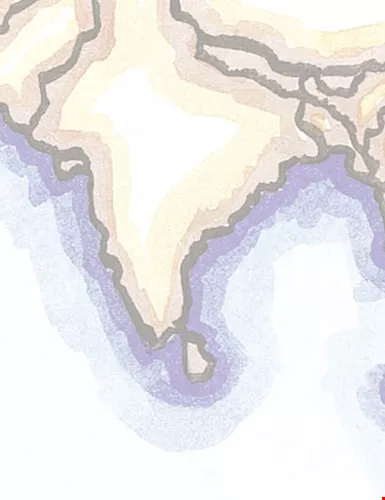
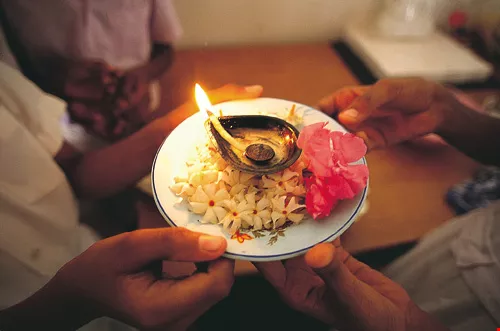
The TFCF will bring some of its community work to a close in July, when it hopes to pass on the torch to the Sri Lankans themselves.
Since the tsunami, revisions to government regulations have greatly improved the quality of preschools. Now you often see children playing on rope swings decorated with colored coconut shells.
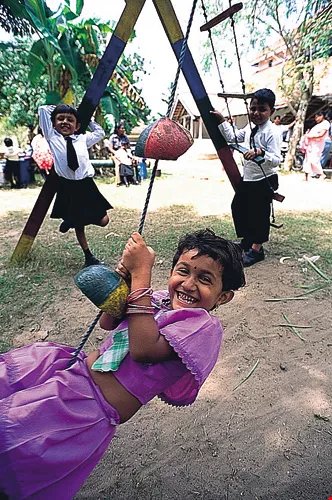
Since the tsunami, revisions to government regulations have greatly improved the quality of preschools. Now you often see children playing on rope swings decorated with colored coconut shells.
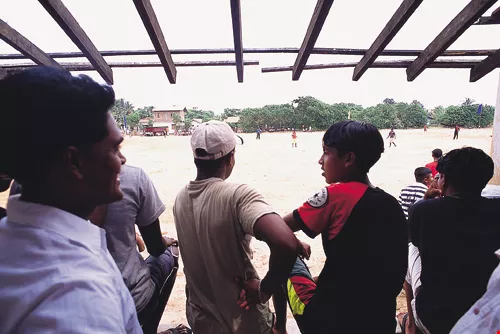
Area residents used this site to dump junk and debris after the tsunami. Now that villagers have cleared it and turned it into Kudawella's community athletic field, it is once again filled with the sound of children's laughter.
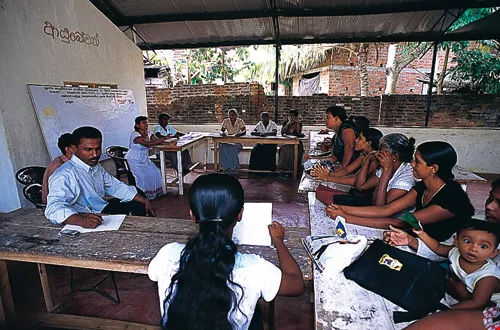
Child Well Being Committees (CWBC) hold an average of one meeting per week in each village. Their enthusiastic discussion of this week's issues reveals the depth of the ties holding their community together.

@List.jpg?w=522&h=410&mode=crop&format=webp&quality=80)


