Hong Kong: Emerging Political Rights
Vito Lee / photos Chuang Kung-ju / tr. by Geoff Hegarty
July 2007


Reform of Hong Kong's semi-demo-cratic political system to institute direct elections for the position of chief executive has been a continuing issue since 2003. However, with half the seats in the Hong Kong Legislative Council (LegCo) controlled by the Beijing government, the people of Hong Kong are naturally pessimistic about being able to achieve a fully democratic system.
Although citizens have little say in major political decisions, the opportunity to engage with more minor political issues is gradually emerging, bringing new hope to the people of Hong Kong.
Every year at the end of May, LegCo member Lee Cheuk Yan has a particularly busy schedule. This day, the most important item for the Legislative Council to consider was the Unsolicited Electronic Information Ordinance. After the legislation was passed by LegCo, Hong Kong residents who don't want to receive annoying advertising material through phone calls, fax or mobile text messages can register their names with the Office of the Telecommunications Authority. Businesses will not be permitted to disturb registered residents with unwanted electronic advertising material.
Pervasive electronic marketing is a common problem of most sophisticated societies, and Hong Kong is no exception. However, achieving a balance between protecting residents from unsolicited advertising and maintaining annual returns of HK$7.2 billion for Hong Kong's e-marketing businesses was a difficult process. Legislators espousing differing opinions expressed their positions with pedantic gravity.
"Although our Legislative Council is semi-democratic, we still have important decisions to make," says Lee in his basic Mandarin. In a corner of his office, an old 14-inch TV shows serious discussions in English under way in the chamber, the scene reminiscent of Britain's House of Lords.
Democracy and nationality
Fifty-year-old Lee Cheuk Yan's electoral district is in Tuen Mun in the northwest corner of Kowloon, but he was born in Shantou, Guangdong Province. The Lee family were formerly landowners, and when they were at their most prosperous they actually installed a very rare tennis court in their courtyard. But just then China was taken over by the Communist Party, whose policies included persecution of the moneyed classes. So because of their landlord status, the family were in desperate straits. In 1959, Lee Cheuk Yan and his family were exiled to Hong Kong, losing all their property in the process.
In the 1970s, social activist friends opened Lee's mind to new ideas, and as a result, he got to know a lot of fishermen living on their boats and laborers. To the present day, he has proved himself a brilliant legislative councilor who has real concerns about social issues. Besides labor issues labor, Lee has played an important role for a number of years in the "reverse the verdict on June 4" protests, commemorating events in Tiananmen Square in 1989, a major issue of concern for Hong Kong residents.
At the end of May 1989, seeing that support was needed for the university students protesting in Tiananmen Square, he took HK$3 million in cash donated by Hong Kong residents to Beijing to present to the students. When the Beijing authorities began using military force to suppress the protests, Lee was arrested at Beijing airport while waiting for his plane back to Hong Kong.
The experience of supporting the protest and being arrested by the Beijing government has allowed him to see clearly the real character of the Chinese communist autocracy. When he was released after three days in custody, he decided immediately to take an active part in the protests. This decision meant that he could not return to his hometown for the next 18 years. Says Lee, "Except for once when all the Hong Kong legislative councilors were invited, the communist government has never allowed me to enter China. That's why they won't let the chief executive be directly elected; if one of our kind gets elected, it would cause big problems for Beijing."
Deadlock
In the 1980s, when China and Britain announced the return of Hong Kong to China, and the Basic Law defining the 'one country, two systems' solution was still under discussion, most Hong Kong residents held an emotional attachment to China as their native home, so they did not participate actively in the discussions and there were few protests. Recalls Lee, "The people of Hong Kong stood by and watched as their own future was decided by the two big powers. When Tiananmen Square happened, they suddenly became aware of the terrible nature of the Chinese government. But it was too late--the ink was long since dry on the agreements."
According to the Basic Law of Hong Kong, of the 60 LegCo seats, 30 are elected by the residents of local districts, and the other half by 'functional constituencies' (composed of business and professional sectors) who are appointed by the Hong Kong government. The term for legislators is four years. The chief executive is elected by a special electoral college, the 800 seats of which represent 38 sectors of Hong Kong society. Nominally the members are elected from different sectors, but in reality almost all are appointed by the Chinese government. This means that the administration and legislature are basically under the control of the PRC, hence the description "semi-democratic system."
The Basic Law originally set out how the chief executive would be selected for the first two terms of office, and it was assumed that the third term (beginning in 2007) would see a gradual opening up of the process to eventually achieve direct fully democratic elections. This system proposed that eventually the residents of Hong Kong would be able to make their own decisions. However, worried by a surge in Hong Kong people's desire for self-determination since 2003, the Standing Committee of China's National People's Congress vetoed direct elections for the leadership this year.
"This is the reason for the current deadlock in political reform in Hong Kong. Even though the SAR government has attempted reforms, with no support from the 50% of seats appointed by Beijing, reforms will never gain the required two-thirds majority," explains Leung Kwok-hung, another democratic legislator. "The incumbent chief executive, Donald Tsang, began his second term in March this year, and has promised to introduce a policy of direct elections for the chief executive and all LegCo members. But we have no confidence in him because he's not holding all the important cards. Because of Beijing's unwillingness to give up their monopoly on power, Hong Kong residents, especially those in the poorer areas, are giving up any hope of change being achieved through the political system."
Recalling the 2004 LegCo elections, the most affluent district, Hong Kong Island, had the highest voter turnout of 58%, compared with the two lowest-income areas--Kowloon West and New Territories West--which had the lowest turnouts--55% and 53%--of all five electorates.
"Those who have been exiled from China to Hong Kong all well remember the political oppression of the Communist Party of China, and they know that it is wiser to keep away from politics," says Susanna Cheung, a well-known Hong Kong journalist. As the western areas of Kowloon and NT West have the greatest number of new immigrants, she believes that this is why the residents of these areas clearly lack faith in the system.
As well as memories of communist oppression, the people of Hong Kong under British colonial rule were never allowed or taught to make decisions for themselves, and this is also a key factor.
"Donald Tsang is absolutely typical of the colonial government elite," says Susanna Cheung. Unlike businessman Tung Chee Hwa, Tsang is from the administrative elite trained by the colonial government. "These people are proud of their professional administrative and executive skills, and believe that these qualities will create an efficient government that can achieve the best results."

Debate in the Legislative Counsel of Hong Kong takes place in a peaceful atmosphere, often making legislative Councillors a little sleepy. This is in contrast to the Legislative Yuan in Taiwan where discussions can often become quite violent with people seizing the microphone and jumping on tables to more forcefully express their opinions. Both chambers undergo the painstaking processes inherent in the development of a successful democratic system.
However, while there is little doubt about their administrative abilities, their political judgement tends toward following rather than leading. They were in charge of the implementation of colonial policies under British rule, but were never given the opportunity to create their own policies or make independent decisions for the good of Hong Kong's future.
However, Hong Kong people themselves should shoulder most of the responsibility for Hong Kong's current woes.
Lam explains that, after the experience of Hong Kong's return to China, "In Hong Kong, people started to rethink what had happened, especially those of the cultural elite. It's an interesting question: did the political system cause the people's lack of interest in their own self-determination, or did the lack of interest cause of the gradual disappearance of their rights?"
Hong Kong writer Chan Koon-chung (a.k.a. John Chan) reflects that the post-war generations in Hong Kong, and he includes himself, haven't worked together to strive for their rights in political affairs, but have rather acted individually.
"The people of Hong Kong haven't had the opportunity to learn how to make their own decisions, and most don't even want to discuss it," says a Mr. Wang, who has just moved to Hong Kong from Taiwan and now works in the media. "Even though their private lives are being invaded, they don't protest."
Wang, who lives in Tung Chung on Hong Kong's Lantau Island. "I don't mind the limited space so much; what really bothers me is the design of the environment." He gives an example. He can't survive without the subway system, but after he gets off the subway, he has two choices--to risk his life crossing the street with no pedestrian crossing, or to spend more than ten minutes battling his way through a shopping-mall-cum-overpass in the combined commercial and residential development with which the station is "integrated."
People are not fully conscious of their rights, and consequently allow the government and business to ride roughshod over them. "Hong Kong residents, including my wife, don't feel that there's anything wrong. This is a terrible situation," sighs Wang.
Better late than never
"Hong Kong is developing in a similar way to Taipei before the 1980s. The economy has always come first in Hong Kong," points out cultural commentator Danny Yung. Cultural and intellectual groups played an important role in the emergence of Taipei citizen action in the 1980s. "In Hong Kong, residents' calls for the right to control their own living environment are developing in a similar way through such groups and residents working together."
With its many terraced houses dating from the 1950s, Lee Tung Street in Wan Chai is a good example.
Half a century ago, the printing industry was brought together in this district by the colonial government. Their reasoning was that it was easier for the government to oversee the industry, thereby preventing the publication of inflammatory documents. The building style, combining industry and accommodation, was quite characteristic. This business district was also the place where young people came to order their wedding cards. In 1999, the Hong Kong government was planning a huge multi-stage development in Lee Tung Street. From the old colonial era to today's SAR, the government of Hong Kong has always followed the same redevelopment model: demolish, sell, and reconstruct with multistory towers. But then all of the old memories are destroyed. The residents, who had known each other for years, got together and employed an architect to design an alternative reconstruction proposal, hoping to preserve elements of their old neighborhood while benefiting from the development. This was the first time in the history of Hong Kong that residents had offered their own proposals for a redevelopment.
Although their proposal was finally refused, the case of Lee Tung Street has become a model for many other reconstruction proposals in Hong Kong, where residents take the initiative to participate in public affairs and determine their own futures.
Besides the case of Lee Tung Street, after the march of July 1 2003, many NGOs protested against the developments of west Kowloon and reclaiming land from Victoria Harbor.
"The July 1 appeal for direct election of the chief executive was not realized, but voice of the people transformed general awareness of the situation across the city," says Eric Ma, an associate professor at the School of Journalism and Communication in the Chinese University of Hong Kong. At the same time, the increasing consciousness of the people resulting from events on July 1 gradually evoked the concern of the government.
With regard to the long-term controversial issue of removing Queen's Pier, Amie Tan, who will take the position of Director of the Lands Department in early July, argues that government officers cannot continue to sit in their offices making decisions. "We have to speak to the people and find out what they want," says Tan.
"In contrast to what has been the inflexible attitude of the Hong Kong government in regard to issues of redevelopment, Ms. Tan's ideas represent a new beginning," agrees Ivan Choy, senior instructor of the Department of Government and Public Administration at the University of Hong Kong. "This change will even more encourage the people of Hong Kong to participate in their society, and will also figure strongly in the push for direct election of the Chief Executive and Legislative Council."
Lee Cheuk Yan agrees, "If we can see more cases like this, we will really be able to feel that Hong Kong belongs to us."
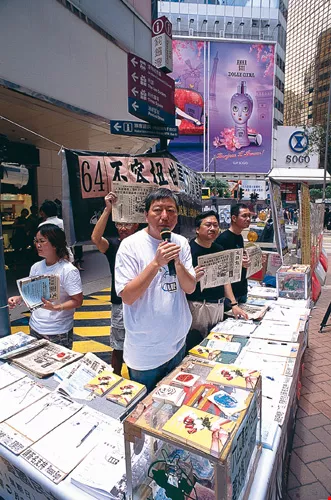
It was getting close to the June 4 date of the Tiananmen Square events. Huge crowds were milling around in front of the department stores in Causeway Bay. Lee Cheuk Yan was there as usual with his assistant to announce activities to mark the Tiananmen Square anniversary, something he has been doing for the past 18 years.

@List.jpg?w=522&h=410&mode=crop&format=webp&quality=80)


