In Tune with Mainstream World Opinion--First Anniversary Interview with President Ma Ying-jeou
interview by Laura Li / tr. by Phil Newell
May 2009


President Ma Ying-jeou, who has accepted numerous interviews from the domestic and international media over the past half year, can be said to be the president who most wants to communicate his ideas to the public. Faced with reporters, perhaps he doesn't lay it all out on the table without reservations, as it were, but his enthusiastic tone and his frequent use of numbers and facts to support his arguments leave a powerful impression. Many issues that are bandied about in the streets, like the negotiation and signing of an Economic Cooperation Framework Agreement with mainland China, become very clear from his responses. And his insistence on peace, prosperity, human rights, and dignity are all in line with main world trends.
On the eve of the first anniversary of his inauguration, Taiwan Panorama asked President Ma to look back over the accomplishments and impressions of the past year. Below is the collated record of our exclusive interview.
Q: How are you, President Ma? Since taking office do you feel that the overall national situation or the thinking of people and society has changed, compared to when the KMT was last in power [2000]? What changes do you feel gratified about, and which do you feel concerned about?
A: Basically, when we first thought about running in the election, the main goal was to make appropriate changes in the direction that the Democratic Progressive Party had taken the country during its eight years in the executive branch, to waste less time on meaningless symbolic things, and to create more opportunities for the future. So even during the election we had clearly laid out a blueprint for the future governance of the country. For example, even before the financial tsunami hit we proposed the "i-Taiwan 12 Infrastructure Projects," which are designed to expand domestic demand. This is the same approach that Chiang Ching-kuo adopted at the time of the first oil crisis [1973], and the result was that Taiwan's per-capita national income rose steadily, in fact it nearly tripled. This approach is also the current thinking of Paul Krugman, 2008 Nobel laureate in economics, and it is the strategy adopted by the G20. So our overall economic direction is in line with the world's.
In addition, in those areas over which the president exercises direct authority, such as national defense, foreign policy, and cross-strait policy, we have undertaken even more reforms. In terms of cross-strait policy, we have returned to the 1992 consensus of the previous KMT administration. That is to say, we believe that in the short term it is impossible to resolve the dispute over sovereignty between the two sides, but it is possible to manage it, so that it doesn't become, as it was during the DPP administration, a constant source of tension and of restrictions, which led to wrong turns in the direction of the country's development.
After taking office I initiated the "big three links" policy. This policy not only reduces the time and costs of travel and transport [to the mainland], even more importantly it creates a new regional springboard, or you could say that it means the appearance of a new regional hub. Thus once we began direct cross-strait flights, the Japanese were immediately willing to establish a link between Songshan Airport [in Taipei] and Haneda Airport [in Tokyo], and beginning next year there will be four flights per day each way. This was previously inconceivable. In the past everyone wanted more interaction with Taiwan, but they were afraid of angering mainland China. Now we tell them relations between Taiwan and the mainland have improved across the board, so you have even less reason to refuse us. A lot of countries feel that there is much to be said for this logic, and have one after another developed new relationships with us. Now Taiwan's natural geographic advantages can finally be brought into play.
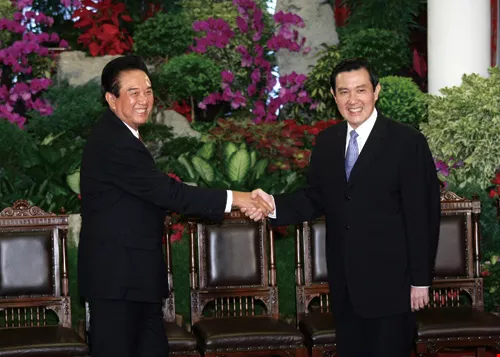
Last year on November 6, after the second "Chiang-Chen talks," Chen Yunlin, chairman of mainland China's Association for Relations Across the Taiwan Strait, met with President Ma. Although the Democratic Progressive Party held continuous demonstrations, the door to cross-strait exchanges has been opened wide, and Taiwan's space has been broadened.
Groundbreaking achievements
I feel that the early 1990s provide a good model. On the one hand we were promoting domestic reform, including revising the constitution, adopting the 1992 consensus, and launching the Koo-Wang talks in Singapore, while on the other we were buying F-16s from the US and Mirage jets from France, and the economic growth rate was up around 7%. Today, we perhaps are unable to bring back those economic glory days, but that is not for lack of effort, but because of the decline in the overall global environment. But for those things within our control, we have been very pro-active. For example, once we turned the cross-strait situation around, we were then able to move ahead on foreign policy.
So, looking back over this year, things are certainly a lot different than they were in the past; what wasn't done in the past, we have done. This is because we have transformed and altered objective conditions through subjective will, creating a situation in which all sides benefit.
As for those who criticize us for "loss of sovereignty," this is simply a straw man-the problem absolutely doesn't exist. So far no one has been able to concretely say in what way we have "lost sovereignty." Take for example the argument that we shouldn't use the name "Chinese Taipei" to join international organizations. In 2002 when the DPP was in power and we entered the WTO, we used the short-form name "Chinese Taipei." Why wasn't it a loss of sovereignty when the DPP used it but it is when we use it? Similarly, we permitted charter flights to begin on a daily basis, which was an extension of the charter flights that were originally limited to the Lunar New Year holiday. Who was it who started those charter flights in 2003?
Moreover, in the 11 months we have been in office, so far we have not added a single item to the list of permitted agricultural imports from mainland China, but in the DPP's term, they added a total of 937 items. During the same period cross-strait trade grew by 280%, and Taiwanese investment in the mainland grew by 380%, the fastest rate of increase over the years. At the time of the 2000 transition of power [to the DPP], exports to mainland China accounted for 24% of Taiwan's total exports, but by the time we got into office, that figure had grown to 40%. We are not criticizing the DPP, we just point to these things to explain that cross-strait economic interaction is a trend that no one can stop. There is no way at all to block this "investment-driven trade," as it is called.
Q: But the green camp [the opposition DPP and Taiwan Solidarity Union] has many reservations, for example the dispute over "loss of sovereignty" that you just mentioned. Where do you feel the crux of the problem lies? Is it that, on the issue of national identity, if there is this fundamental difference of views between "the country of Taiwan" and "the Republic of China," this crisis of confidence will still exist no matter what you do in practice?
A: Let me give an example to explain. Right after the election, in February and March of 2008, the DPP's strategy was to deprecatingly relabel the "cross-strait common market" that was proposed by incoming vice-president Vincent Siew as the "one-China market," saying we were surrendering, that 5 million mainland workers would come to Taiwan, that huge amounts of agricultural products would come. Then they put up cloth banners all over Taiwan, green with white lettering, so all we could do at that time was, wherever they put up a green banner, we put up a red banner. Ultimately we won the election, so you can see that public opinion was in fact very clear. At that time the underground radio stations said I would eliminate the NT$6000 monthly pension for elderly farmers, but in fact I not only haven't eliminated it, I have scrapped the policy, as was originally intended when the national pension plan was implemented, of incorporating farmers' benefits [which have less rigorous requirements] into that program. Instead we have kept the farmers' benefits independent, to ensure that farmers' interests will not be harmed, and we have gone ahead with the National Pension system and the Labor Pension system, which are both defining new moments and have far-reaching importance.
Or take the legislation passed in the last couple of days. The amendments to the Local Government Act promote reorganization and merger of cities and counties to bring synergies into play and raise competitiveness. We have also added an offense to the Anti-Corruption Act called "refusal to clarify origin of assets." These are things that people have wanted to do for years, but didn't dare do or couldn't do, but we have done them.
I especially stress the development of human rights. At the end of March of this year, the Legislative Yuan ratified the International Covenant on Civil and Political Rights and the International Covenant on Economic, Social and Cultural Rights, and also passed an act governing their implementation. This is something the DPP talked about for eight years but never got done, but I did it in the first year. How did I do it? Because I was really focused on this, and I was very firm about it, letting everyone know that this was my intention, that if I was president we would have to do this, and would have to implement them thoroughly. Once everyone understood that, everyone stood together, and we succeeded.
Some of the criticisms made by the green camp don't really hold water. For example, with the Economic Cooperation Framework Agreement, hardly any of their criticisms are factual. For example, they say we are selling out on Taiwan's sovereignty, but in fact the ECFA is just an economic cooperation agreement, and doesn't involve sovereignty. Just like in the past 11 months we have signed six agreements with the mainland-have any of these sold out our sovereignty?
They even said that as soon as we do this, 500,000 people in Taiwan would lose their jobs. But it's exactly the opposite. Next year after the reorganization of the "10+1" free trade area including ASEAN and mainland China, many ASEAN products going to the mainland will enjoy a zero tariff. But there will still be a tariff on our products going into the mainland, such as the rate of roughly 5-15% for petrochemical products. So I ask you, how can companies survive if this keeps up? All kinds of industries, including petrochemicals, machinery, textiles, auto parts, and so on, will be forced to leave Taiwan and relocate elsewhere. If we don't deal with this situation quickly, more than 100,000 people could lose their jobs. Think about it-when neighboring countries are all proceeding with economic integration, can we stay outside and just live off of nothing? The consequences would be very severe.
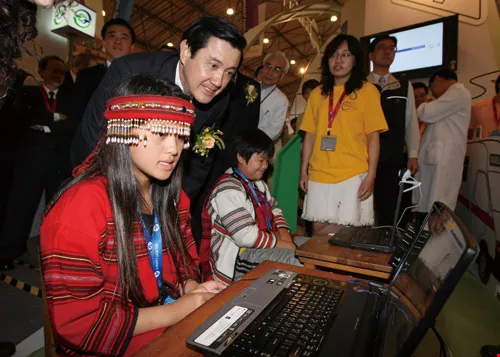
The information technology and electronics industries are Taiwan's backbone. Recently the Ma administration adopted the principle of "rescuing industries, not rescuing firms" in order to deal with the crisis in the DRAM industry. It has been seen as a successful effort. The photo shows President Ma attending Computex Taipei.
Three ECFA negotiating principles
In fact at one time DPP chairwoman Tsai Ing-wen and myself were both teaching international economic law at National Chengchi University, and we both understood very well that the GATT-which later became the WTO-involves multilateral trade negotiations in which, so long as any two countries reach an agreement, all the other member states can enjoy the same privileges. For a diplomatically isolated country like ours this is the best possible thing, because we can just go along for the ride. But unexpectedly the WTO multilateral negotiation structure got stuck, and the Doha Round that started in 2001 was called to a halt in 2006. Since then the situation has returned to bilateral negotiations, with the main trend being the signing of free trade agreements, but Taiwan is weakest in this respect.
But the government can't just do nothing, we must think of a way to get through this. What is the main bottleneck to a breakthrough? The mainland. So long as the mainland doesn't act, other countries don't dare to act. So there is no other way but to solve the problem starting with the mainland. We are very pragmatic, we want to solve problems at the root. So is the mainland willing to sign an agreement with us? Right now they are willing! So you tell me-are they sure to devour us? That depends on how we negotiate. So we have designed a "framework agreement" based on three principles. The biggest advantage is that there is orderly progression, we don't have to do everything in one step.
The first principle is that, on the domestic front, we establish a consensus. The Ministry of Economic Affairs and the Mainland Affairs Council have held public hearings and seminars, and we welcome opinions from all industries. This is how we find out where the problems are, so we can investigate and solve them. For example, the cloth-towel and shoe industries both hope that we will not open up to imports of these goods from the mainland. In fact, given the WTO framework, this is not a question of whether to open up or not, but of whether to lower tariffs or not. So we just won't lower those tariffs. And if the mainland says that is not acceptable, that both sides have to benefit, then we can use other things to negotiate with them. In other words, in the areas where there is no consensus we will not liberalize for the time being, and this is something that we can control.
In fact, there's a quite big difference in the scale of the markets on the two sides. For example, the mainland can do something like allow 15 kinds of fruit from Taiwan to be imported tariff-free, and then cut the domestic tax in half, but we can't, and we don't have to. Why? Because Taiwan's market is small, and the mainland's agricultural products won't be targeted at Taiwan. Under these circumstances, we have some room for maneuver.
In fact, during the DPP era Taiwan signed free trade agreements with five Central American countries, and at that time nobody said that they had to be approved by the Legislative Yuan before they could be signed. It's just that sadly, Taiwan's trade volume with these countries is not that large. Right now we hope to sign agreements with our top five trading partners: mainland China, the US, Japan, ASEAN, and South Korea. These are the ones that will really be useful. At least when we face competition we will be able to fight on an equal footing. So we are not talking about putting all our eggs in the mainland basket; rather, we will start from there and gradually expand.
Secondly, as far as cross-strait relations go, we must proceed step by step, we don't have to do everything at once. We will only sign when there is something that benefits us, and what is disadvantageous for us we will put on the back burner. Or if there are some items that cannot be avoided, that must be signed, we will offer import relief, or extend the implementation period longer, delaying by five or 10 years. Of course some countries want to do everything at once, just like the US negotiated with Singapore for three years. Also, the US and South Korea have been talking about a free trade agreement for a good many years, but still the US Congress has not ratified it, and it may be stuck on just one or two things. But we are adopting a so-called "framework agreement." The two sides will first talk about those things on which there is a consensus and which are beneficial to both sides. There are certainly a great many such things, and we will put into effect first those things we can get through first. If there are disputes, we can put these to one side for the time being. This may stretch the negotiations out for a long time to come, but both parties will be more at ease.
Thus, for example, if the third Chiang-Chen talks can reach agreement on a general direction, then at the end of this year we can sign an "early harvest" agreement. That can at least address the tariff problems related to petrochemicals, machinery, and the other industries I mentioned earlier.
Third is to build more friendly relationships internationally. Assuming that after we sign an ECFA with the mainland other countries are also interested, we will open negotiations, and then our businesspeople can feel more confident. Without such a guarantee, they won't even want to invest in Taiwan because they will be afraid they won't be able to sell their products in other countries, or won't be able to compete because of high tariffs, which would be a dead-end street for them. We are an export-oriented country, and that won't change any time soon, so we have to have stable export markets. But you can't just sit there and expect the other guy to say, okay, we will let you import now. You have to take the initiative to break into markets, sign all kinds of agreements, and guarantee that trade will be able to proceed smoothly. And if we want to do this, we have to start by breaking down barriers with the mainland. Therefore, what the DPP used to say-that we shouldn't pay any attention to the mainland, that we should start elsewhere, that we should first internationalize-is impossible. They wasted eight years and didn't achieve a thing, and we can't go on the same way.
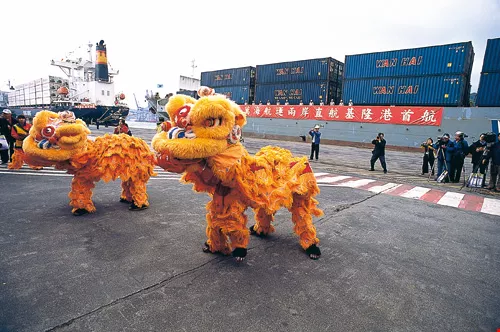
Last December 15, a ceremony was held at the West #14 pier at Keelung Harbor to mark the maiden direct cross-strait voyage. It is hoped that Taiwan's shipping industry will get a boost and Taiwan can develop into an Asia-Pacific regional shipping hub.
Maximize opportunity
In fact, Taiwanese businesspeople are very pragmatic. They don't talk about ideology, they are very flexible, and they know what they want to do. For example, during the election campaign I visited the Changhua headquarters of one firm, Vogmate Hosiery, and the owner came out and asked, Mr. Ma, why is it that South Korea can sign an FTA with the US but we can't? He also said that if things kept up the way they were going traditional industries would be finished. At that time the Ministry of Economic Affairs said, don't worry, after South Korea signs Taiwan will lose only 21 traditional industries. But what would happen to Vogmate and all the firms like it? Officials talked as if it was all so easy, as if hi-tech industries wouldn't be affected, but what were traditional industries supposed to do? If they faced different tariffs than their competitors, then it would be hard going. This is a problem the government should solve for them. Our responsibility is to give them a good trading environment, so they can concentrate on bringing their creativity and competitiveness into play. So we are very pragmatic, we don't just look at ideology. If you worry all the time that signing an agreement with the mainland is a loss of sovereignty or a national shame, you won't get anything done, so you just sit at home waiting to die.
As for worries in the green camp that Taiwan's economy will be overly dependent on the mainland, in fact dependence is inevitably mutual. You buy and I sell-the two parties are both willing. So on one hand we depend on them, and on the other they depend on us. Under these circumstances, the most important thing is to find a foundation of items that are beneficial to both sides, and then build a systematized relationship based on this foundation. So I say that the mainland is a risk for Taiwan, but it is also an opportunity for Taiwan. The government's role is to minimize the risk and maximize the opportunity, and not to reject the opportunity because of fear of the risk.
Q: You just mentioned that there has to be benefit for both sides in order to sign an ECFA. Do you think that mainland China will raise some items that will create pressure for us?
A: Right now we don't know. At this point, we only know what we want, and of course the things they want could be different. For example, with regard to tariffs on petrochemical products, they are willing to give us what we want. Why? Because the number of Taiwanese firms that have invested in China is, at a low estimate, at least 70,000, and perhaps more than 100,000. I recall an estimate from the Institute for Information Industry that roughly 60-70% of the mainland's ICT industry is run by Taiwanese firms. These Taiwanese firms naturally import the raw materials and semi-finished goods they need from Taiwan, so if the mainland gives us what we want, that is the same as helping Taiwanese firms in the mainland. Currently after these semi-finished goods get to the mainland, they are generally processed and exported to the US. Of course in the future we want to build up a market in the mainland based on domestic demand there, and sell in the mainland.
Q: You earlier mentioned that the cross-strait common market has been mislabeled as a "one-China market." So what's the situation now?
A: Right now we merely want to sign a trade agreement with the mainland, that's all. That's still a long way from a common market. It's too early to be talking about that.
At present the most successful common market is of course the European Union. But the EU started out as just a coal and steel community with only six countries. It then turned into the European Economic Community with the signing of the Treaty of Rome in 1957. The EEC was a customs union, with no customs duties between member states, and adoption of a common customs policy towards non-members. That is to say, both internally and externally all the members had uniform positions. The single currency only came about with the Maastricht Treaty that took effect in 1993, and now they want to have a European constitution and move toward political union, but they haven't been successful yet. So just imagine, even European countries with their high level of similarity still haven't been able to complete integration after half a century, so this is not an easy task.
So when the green camp says that right off the bat we are going to have a one-China market, that's utterly wrong. And they say that all at once mainland labor will come to Taiwan-whereas in Europe, although the common market was launched in 1957, more than two decades later, in the 1980s, only a few countries allowed free mobility of labor. The labor issue remained very sensitive, so individual countries reserved the right not to open to foreign labor. This was based on the spirit of mutual agreement, that you cannot coerce the other party. This is just common knowledge, but in Taiwan you see distortions everywhere and you can't reason with some people.
Boosting Taiwan's popularity
Q: I would also like to ask about the upcoming World Health Assembly meeting in May. Both home and abroad, whether Taiwan can finally attend the WHA as an observer is being seen as an indicator of the success or failure of your cross-strait policy. What is your view?
A: As a multilateral organization, the WHO is of course an indicator for observers, but it is not the only one. For example, at the 2008 APEC meeting held in Peru, current KMT honorary chairman and former vice-president Lien Chan attended in his capacity as National Policy Foundation chairman. This was a major breakthrough, something that could never be done in the past.
Secondly, after six years of effort, in December of 2008 we finally got the agreement of the WTO to accede to the Agreement on Government Procurement (GPA). When the news came out, there wasn't much of a reaction in Taiwan, but the US and European chambers of commerce were very excited, because they felt that their firms would get fairer treatment here, so they would be willing to come here. As for Taiwan firms, should they be concerned that government projects will be taken away by foreign firms? In fact, with this kind of construction contract, foreign firms will generally seek a local partner, and through this we can upgrade the standards for public infrastructure. The most important thing is that the parties to the GPA are 20-plus wealthy countries, so with our accession we have opened up a pathway for Taiwanese firms to bid for contracts overseas. This is a major breakthrough.
Also, in early October of last year, US President Bush notified Congress of willingness to sell US$6.5 billion in weapons to Taiwan, indicating that Taiwan-US relations are also very stable. But on the same day a policy analyst from the green camp said in the newspaper that the Ma administration's policies were creating distrust between Taiwan and the US, and that weapons sales to Taiwan had been frozen. When you see ill-informed speculation like this, you don't know whether to laugh or cry. This is also why, after Raymond F. Burghardt, the chairman of the American Institute in Taiwan, came to Taiwan and met with me, he specifically kept the media for five extra minutes because he had something he wanted to say clearly. He said that the US has "warm feelings and high regards" for the improvement in cross-strait relations, and he certainly did not say that the US is worried that Taiwan will lean excessively toward mainland China.
Just think, right now there are troubles in the Korean Peninsula, but the Taiwan Strait is calm. Now which do you think the US and Japan prefer? Thinking back to the presidential election a year ago, because of the two referendums on "returning to" and on "joining" the UN, the mainland was really enraged, and the US was also very nervous, which of course was not good. Peace is, after all, the main axis of international society, so the path we are taking is to seize hold of mainstream world opinion, peace and prosperity. We hold fast to this axis, it is the foundation for everything. This development is beneficial for everyone. Right now not only is no one in the international community criticizing Taiwan, even faraway countries like those in Scandinavia are praising us. The methods we have adopted have already made us more popular in international society, which now even more sees Taiwan as a positive model.
Q: You have talked about a lot of policy achievements. In closing, please tell us whether there is anything you are dissatisfied about.
A: There is. Economically, we've run into the global financial storm, so it has become very difficult to fulfill our the "6-3-3" campaign promise. It is something that no one anticipated. But I think we will still go ahead with the 12 "i-Taiwan" infrastructure projects as planned, because these are for basic infrastructure, and they are especially important when the economy is in a downturn, so that you are ready to take advantage of the change in the wind when the economic situation turns around. This is what Chiang Ching-kuo did back then. When prices were skyrocketing, when gas had gone from NT$3 per liter to NT$13, he went full speed ahead with the Ten Major Projects. When the infrastructure was in place, national income immediately went up several times over. Projects like Taoyuan Air City promise huge commercial opportunities in the future, so right now you can't just look at the present, you have to look at the situation three to five years from now.
In this year alone we are investing NT$600 billion to stimulate the economy and help the unemployed. My only concern is efficiency of implementation. After all, the budget that a public official can administer is limited, so we have to plan carefully. If we can spend this NT$600 billion effectively, there should be quite good results.

@List.jpg?w=522&h=410&mode=crop&format=webp&quality=80)


