Warming the World
Taiwan Down
Chen Hsin-yi / photos Jimmy Lin / tr. by Jonathan Barnard
February 2013


You may not know it, but the down found in many international brand-name luxury products, whether bedding that can run over NT$100,000 or warm winter clothing for snowy climes, is supplied by Taiwan.
Taiwan’s exports of down and feathers account for one-fourth of the world’s total. It trails only mainland China and the European Union. And the more than 100 members of the International Down and Feather Bureau have elected to hold their June meeting this year in Taiwan, a choice that demonstrates the important role that Taiwan plays in the global market for down and feathers.
The Fukushima nuclear accident in Japan in 2011 affected the entire nation’s power supply. Steps taken to compensate included reducing the opening hours of retail stores, switching to LED light bulbs, turning off all lights in office buildings at night, and using more down products.
“There was already a high usage rate of down comforters among Japanese families,” explains Jian Xiumei, vice president of Hop Lion Feather Works. “But after the events of March 11, families began to use more down pillows, down mattress pads, and comforters with even higher quantities of down. That’s because if you wrap yourself in warm down, which also breathes well and wicks away moisture, then you don’t need to turn on electric heat.” With greater demand from the Japanese market, down factories in Taiwan been working at full capacity to keep up with Japanese orders.
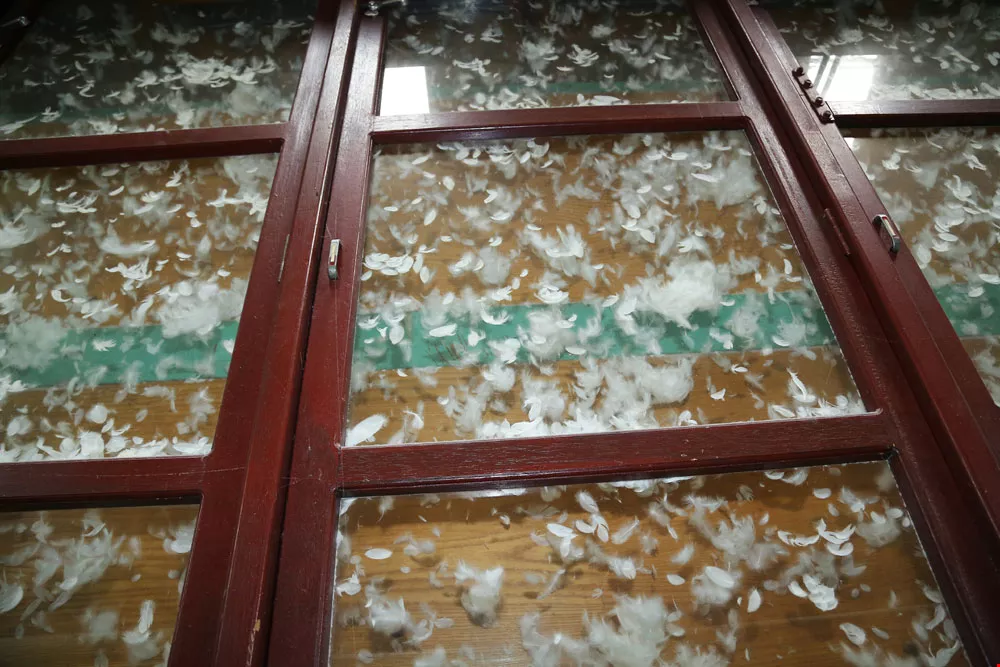
Machines that separate feathers from down blow air through the mixed feathers and down, sorting them by weight into chambers that are positioned at different distances.
How does one distinguish between feathers and down? And why is down such a great insulator?
First of all, only waterfowl, such as ducks and geese, have down of commercial value. Land birds such as chickens and pigeons do not. Feathers are flat with a stiff shaft in the middle, and are distributed all over a bird’s body. Down, on the other hand, grows thick on the chest and belly of water birds, and can also be found at the base of the wing and under the feathers of mature birds. The structure of down helps to maintain warmth, with the down at the breast and belly in particular used to insulate eggs or insulate birds from cold water.
Down feathers look like small round dandelion fluff. Each ounce (about 28.35 grams) of down has about 2 million individual soft filaments, which have a loose structure that radiates from a vestigial quill point (rather than a true shaft). This structure allows down to trap air and makes it a good insulator. Consequently down keeps people warm and keeps cold air out. Feathers, on the other hand, aren’t nearly as good insulators, but their elasticity makes them well suited for mattress pads, throw pillows, sofa cushions and so forth.
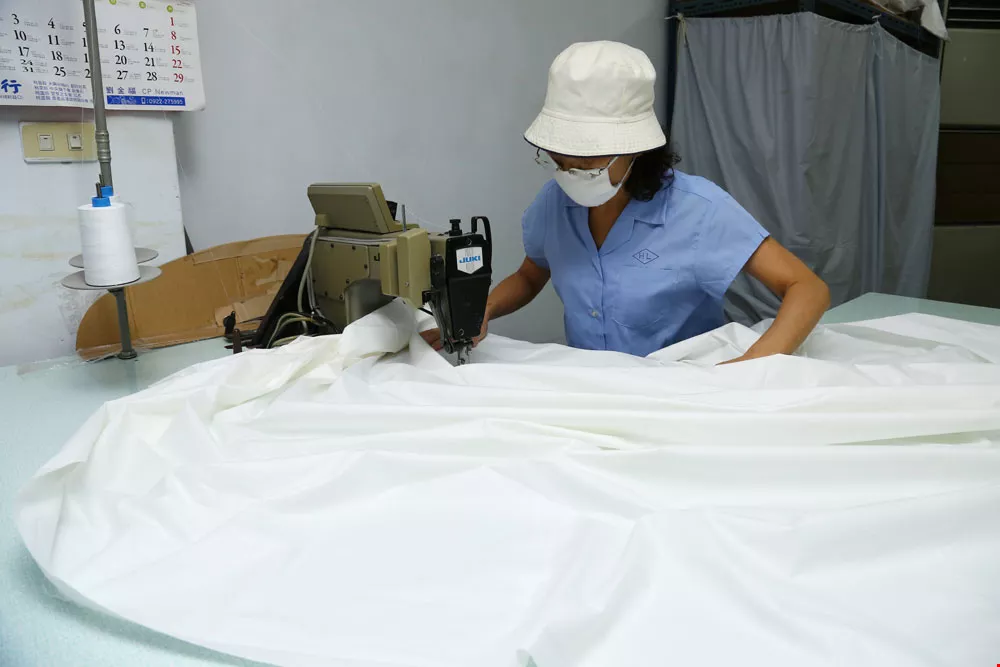
The “shells” of down comforters should be densely woven to keep the down from escaping. With a baffled box construction, walls are sewn into the interior seams. These prevent clumping and allow the down to reach its maximum “loft,” thus increasing warmth.
The down and feather industry could be described as a form of highly skilled recycling.
According to the Ministry of Finance, in 2012 Taiwan imported 21,646 metric tons of semi-processed down and feathers, and exported 11,163 metric tons of finished (fully processed) down and feathers. The imports and exports were valued at US$180 million and US$229 million respectively. When you account for the difference in unit price, the amount of value added to finished down is 140%. The industry is like an alchemist of yore, turning stone into gold.
Jiang Wenquan, poultry industry section chief at the Council of Agriculture (COA), points out that processing can substantially raise the economic value of down and feathers. In essence, the processing can be divided into three steps: cleaning, grading and mixing. And cleaning can be further divided into preliminary and secondary cleanings.
The preliminary cleaning takes the unprocessed down and feathers and cleans them of foreign matter. The sand, dust and blood mixed in with the down and feathers must be washed out, and then the semi-processed down and feathers must be dried within a couple of days in order to ensure that they don’t rot from moisture. Imports to Taiwan are all semi-processed, with the preliminary cleaning performed in their place of origin.
The stages from the secondary cleaning to the high-temperature sterilization are integrated and mechanized operations at which Taiwan excels. Specialized agents are used to purify and deodorize the down. After about eight cycles of rinsing in water, the down is then spin-dried, then air-dried at 130°C. By that point, all the dust, dirt, odors and germs have been eliminated. It’s important to precisely control the drying time, because too little or too much could affect the shine, flexibility and “loft” of the down and feathers.
Separating down and feathers, on the other hand, is a semi-mechanized process. It makes use of the science of fluid dynamics: The process employs sorting machines which can exceed 10 meters in height, and which allow one to adjust the quantity and speed of airflow so as to separate clumps of mixed down and feathers into different grades based on how far they float before falling into chambers partitioned with wood. These machines are key to controlling quality and cost.
Mixing is carried out only after the down and feathers have first been sorted and inspected, and it’s done to meet the ratio of down to feathers requested by the client.
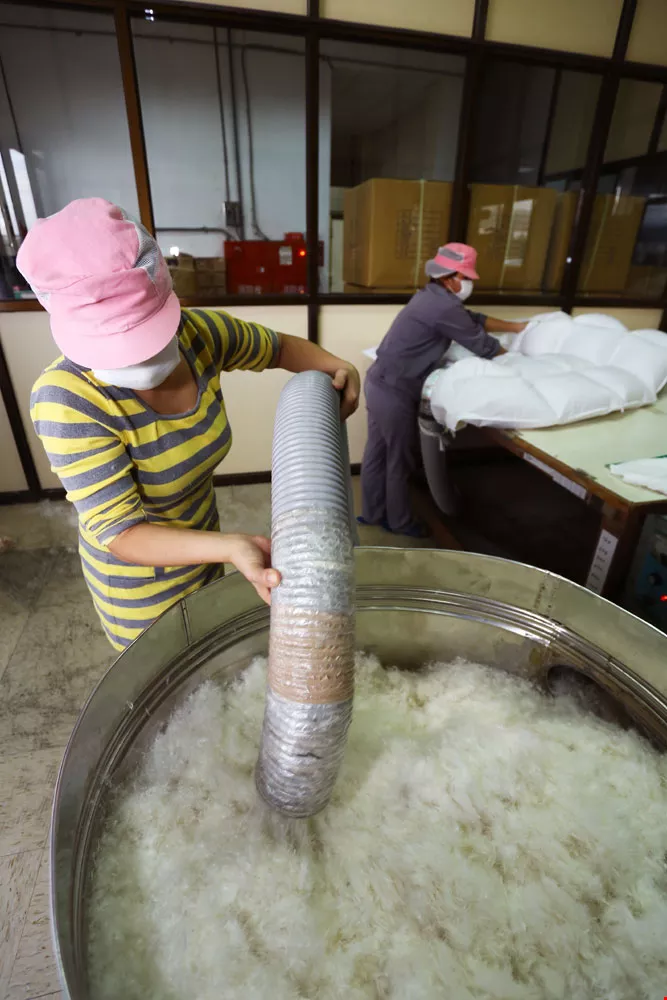
The “shells” of down comforters should be densely woven to keep the down from escaping. With a baffled box construction, walls are sewn into the interior seams. These prevent clumping and allow the down to reach its maximum “loft,” thus increasing warmth.
The COA’s Jiang Wenquan points out that throughout the 1950s, 60s, and 70s Taiwan was among the world leaders for down and feather processing. Even today the value of its exports of down and feathers account for one-fourth of the world’s total, behind only mainland China and the EU, both of which produce abundant quantities of raw feathers.
“Built up for generations in family firms, Taiwan’s down and feather processing industry has cutting-edge technology and global reach,” notes Jiang. “In fact, the 10 largest processors in Taiwan are all family businesses. Many are interconnected through marriage, or were founded by someone who used to work at one of the other firms.”
Hop Lion’s 100-year history offers a glimpse at how Taiwan’s down and feather industry has evolved over the generations.
Hop Lion has factories in Taoyuan and on the Chinese mainland in places such as Shenzhen, Jiangxi, and Heilongjiang. Important international clients include Zegna, FILA, Coach, and Ralph Lauren.
Yao K.Y. Chen, Hop Lion’s 59-year-old chairman, traces the company back a century to when his ancestor Chen Shunfeng arrived in Taipei’s Dadaocheng and opened a stand as a junk dealer. Later he would acquire a special recycler’s license and purchase waste feathers, alcohol bottles and scrap metal from the Japanese colonial government. That’s how the family got into the feather processing business.
In 1950, when the Korean War broke out, the United States was closed out of feather supplies from Communist mainland China and Eastern Europe, both major suppliers. Because the US military had a big need for down jackets and sleeping bags, anti-Communist Taiwan became an important supplier.
In the 1960s, demand for down bedding in wealthy Western nations increased by leaps and bounds, and Taiwan’s down and feather processing and down garment industries flourished.
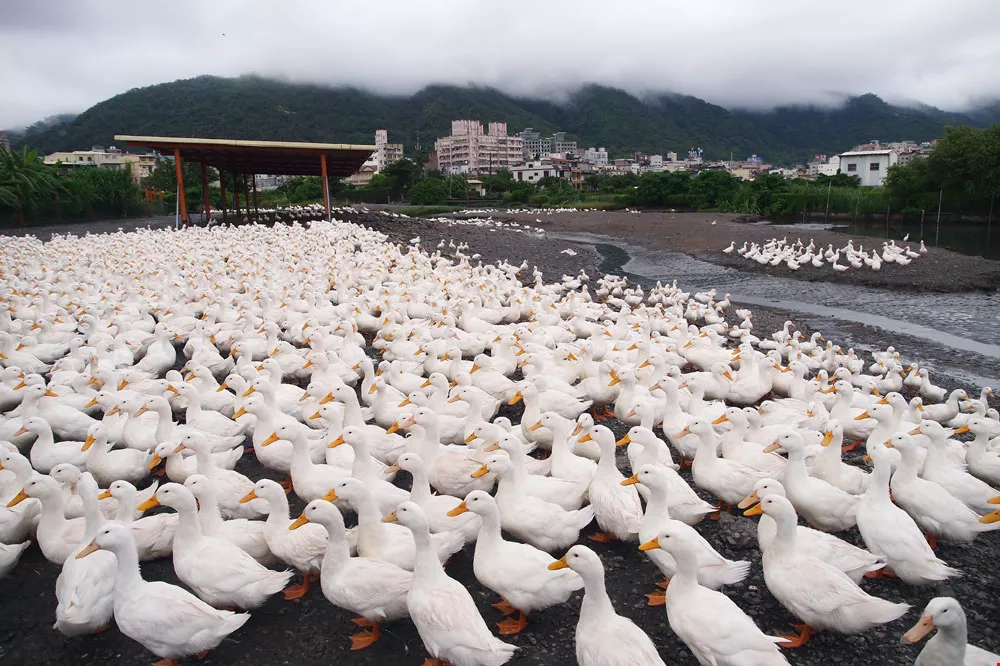
Because raising ducks and geese has always been an important sideline business for Taiwan’s farmers, there has long been a steady and abundant domestic supply of feathers and down. These account for about 20% of all feathers and down processed in Taiwan.
In 1964 Hop Lion’s third-generation leader Chen Yunxi decided to establish a factory in Singapore, laying the groundwork for the global network that the company would build in the future, and also providing access to down processing techniques and technology used internationally at a time when Taiwan was still quite closed off from the international community. In 1972 Hop Lion’s Singapore plant acquired a used German feather washer and dryer, which it then transferred to the company’s Taiwan factory in Dayuan, Taoyuan County. The company used the machine as a model for washers and dryers of its own manufacture and successfully developed techniques for sorting feathers, spurring a great leap forward in the secondary cleaning of down and feathers within Taiwan’s domestic industry.
In the 1970s Japan’s economy took off, resulting in much greater demand for down and an increase in the capacity of Taiwan’s down and feathers industry.
Since 1988, with the opening of mainland China and the evolution of Taiwan’s domestic economy, traditional industries have moved to the mainland and Southeast Asia. Under Yao K.Y. Chen, Hop Lion’s fourth-generation leader, the company built a plant in Shenzhen and then expanded to other manufacturing strongholds in mainland China. Even more importantly, Hop Lion gradually established partnerships with Canadian, German and American companies, gaining footholds in down-producing regions around the world. These have enabled it to build a comprehensive raw material supply system and become more attuned to market trends.
Today Hop Lion supplies some of the world’s pickiest customers with 12 classic product lines.
Geese raised in northeast China share the same climate as geese raised in Canada, and both are matured by grazing for relatively long periods of time. In both places, the produced down is extremely pliant and warm.
And yet, Northeast China used to lack basic infrastructure, and so it wasn’t until Hop Lion established a factory in Heilongjiang’s Dumeng that the company was able to obtain supplies of its highly sought-after and expensive goose down.
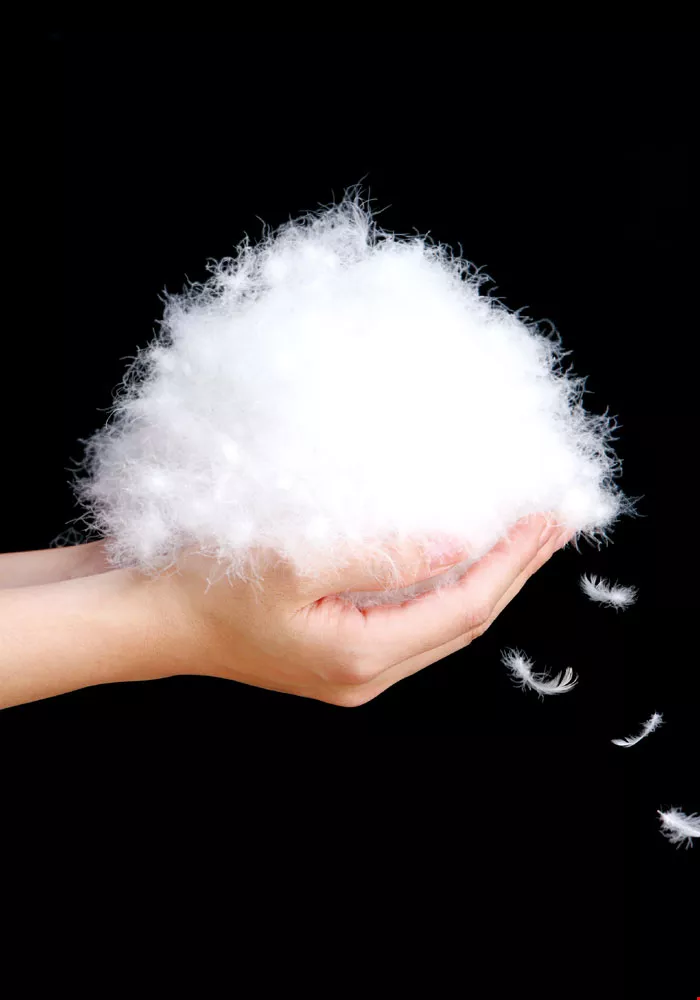
Down is the world’s softest and warmest natural material, and is widely used for outdoor gear, bedding and clothing. Taiwan is a major down processor and exporter of processed down.
Yao K.Y. Chen believes that Taiwan’s down and feathers industry has been able to endure due to a sense of mission within the industry that it “must survive and penetrate global markets.” With its strategy of global purchasing and vertical integration, it wants to play a central role in the international supply chain as a “transfer center.”
In order to get a feel for the pulse of the market and customer needs, Chen has for many years accustomed himself to the life of a frequent flyer, zipping back and forth among production regions (Canada and Germany), major markets (the US and Japan), and processing bases (Taiwan and mainland China). He has earned the distinction of ranking 13th among Cathay Pacific’s customers for air miles accumulated with the airline.
Since 2006 Chen has chaired the technical committee of the International Down and Feather Bureau (the industry’s largest global group). He has simultaneously chaired the Taiwan Feather Exporters’ Association, in which capacity he lobbied successfully to get the IDFB to hold its annual meeting in Taiwan this year. “I want the world to recognize the contributions of Taiwan’s down and feather industry.”
From walking farmhouse to farmhouse to collect feathers in years past to assembling vast overseas networks today, Taiwan’s down and feather industry has never abandoned its determined and diligent approach.
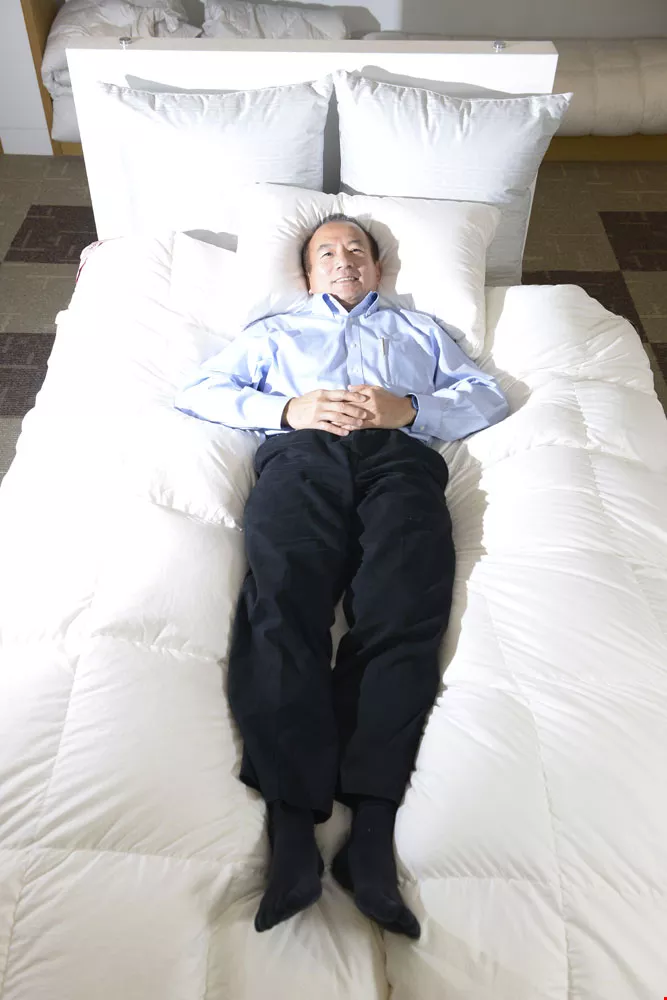
Quilts with a high proportion of down in their filling will quickly bounce back into shape after being pressed flat. Yao K.Y. Chen, Hop Lion’s chairman, puts some of his own company’s products to the test. They look pretty comfortable!
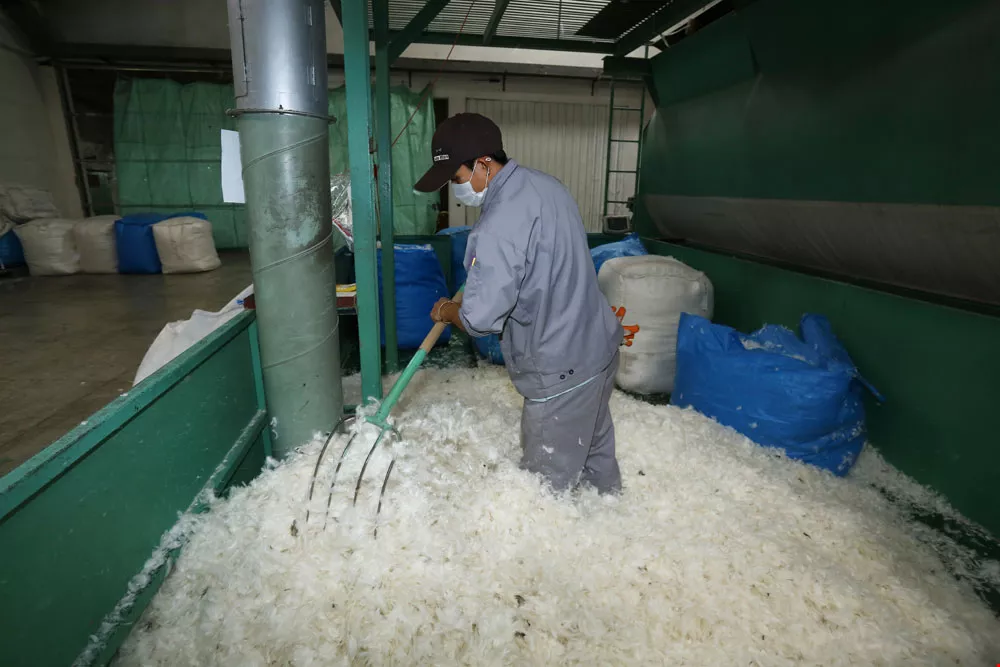
Machines that separate feathers from down blow air through the mixed feathers and down, sorting them by weight into chambers that are positioned at different distances.
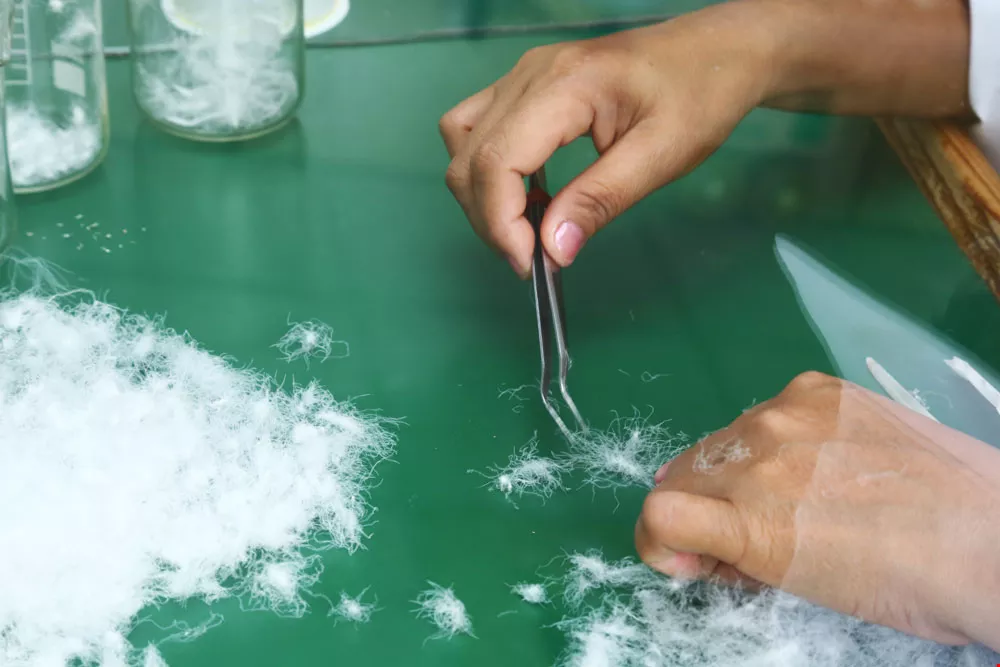
Down filled products are priced based on their down content, and their composition must be accurately measured. Samples of just 3.5 grams are painstakingly teased apart in the lab into down, down fibers, feathers and foreign materials. These are then weighed and their ratios determined.
@List.jpg?w=522&h=410&mode=crop&format=webp&quality=80)

@List.jpg?w=522&h=410&mode=crop&format=webp&quality=80)
@List.jpg?w=522&h=410&mode=crop&format=webp&quality=80)


