Tugou Rural Village Art Museum
Revival of a Village
Chen Hsin-yi / photos Chuang Kung-ju / tr. by Chris Nelson
February 2013


Tugou Village, at the northernmost end of Tainan City, covers only 4.1 square kilometers, with fewer than 1,000 residents, 30% of whom are senior citizens.
At first glance it looks like an ordinary village, with nothing of historic interest. No buses or railroads pass through here; it’s slow-paced and even monotonous. But in mid-December 2012, the official opening of Taiwan’s first “rural art museum” was proudly announced!
What is rural art? Where is the museum? And how will it be run?
The Tugou Rural Village Art Museum had just opened, and on the ride to Tugou from the Chiayi High Speed Rail station, the cabbie couldn’t resist playing the tour guide for the passengers: “I live in the neighboring town, and I admire Tugou’s artistry. It’s so full of life! And they designed and built it all by themselves, without any government help!”
Sure enough, the village’s main street is festooned with art: a rest spot by the roadside where old men sit and shoot the breeze occupies a narrow space left after garden walls were torn down. A wooden deck, complete with driftwood-built chairs and benches, forms a functional public space. The community gathering spot, Country Parlor, includes a cultural classroom, a traditional old kitchen, and a tea brewing area. The remaining squat redbrick wall makes known that this was once a pig shed.
It’s opening day, and on display in the main exhibition area (namely, post-harvest paddy fields) are huge black-and-white photos by photographer Zhang Liangyi. A closer look reveals the faces of farmers, tranquil but marked by lives of hardship.
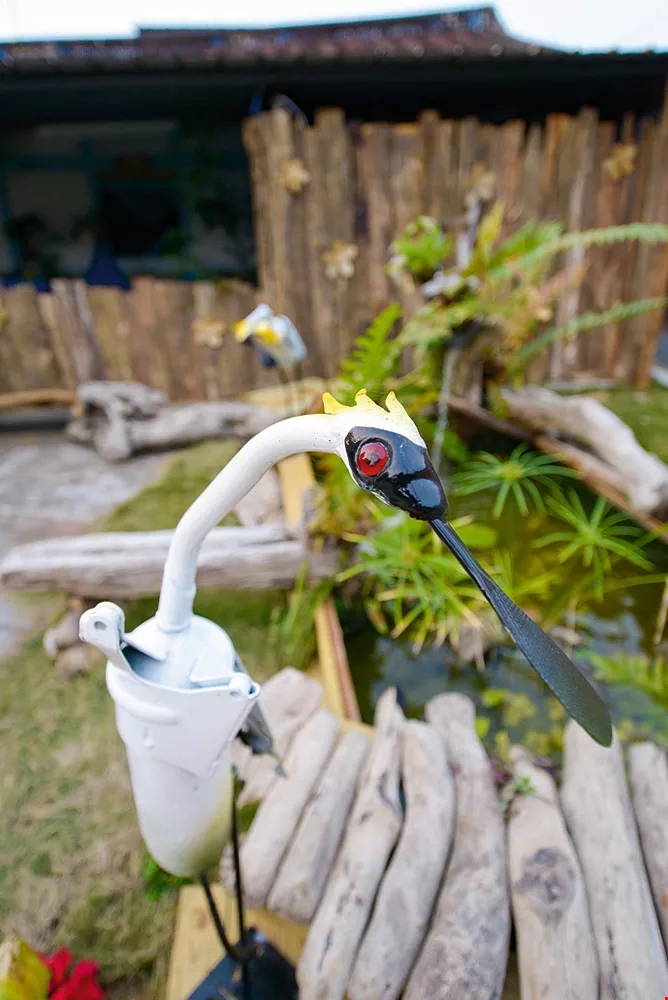
The artistic spirit of Tugou springs from the experience of country living, which has long permeated all corners of life here. The right photo is Black-Faced Spoonbill by artists Huang Yajuan and Maya.
“The fields are the exhibition area.” This isn’t just an abstract slogan, but a call for visitors to explore, consult maps and even ask the way. With a little effort, a visitor might happen across one of 17 specially planned exhibition areas hidden in sanheyuan courtyards, vacant lots, walls along roads, and even private storehouses and homes, as well as about a dozen art installations that have long been part of the residents’ lives.
The living room of Chen Yuexia is also an exhibition area. Though it’s the noontime break, a “Welcome” sign still hangs over Grandma Chen’s doorway. She laughs, “If people make the trip all the way out here and see a ‘Closed’ sign, they’ll be disappointed. I might as well just let them come in, because I’m home anyway!”
Chen, an octogenarian who never had a formal education, took up a brush four years ago under the guidance of outside artist Chen Shuhui and started creating oil paintings of her childhood memories of village scenes and laboring water buffaloes.
The exhibition space of stone carver Hou Jiafu is located in an art studio amid the fields. Hou, 61 and originally from Chiayi, won first prize at the Chiayi City Outdoor Stone Sculpture Exhibition three years in a row. Ten years ago, he was commissioned to carve a water buffalo sculpture for Tugou, and falling in love with the human touch of the village, he and his wife moved here. They still contribute to the rural art development movement.
Tugou Rural Culture Development Society (TRCDS) chairman Wu Guanlin says that the purpose of the Rural Village Art Museum isn’t to promote tourism, but so that more people will come to appreciate the beauty and simplicity of country life as well as the value of rural villages.
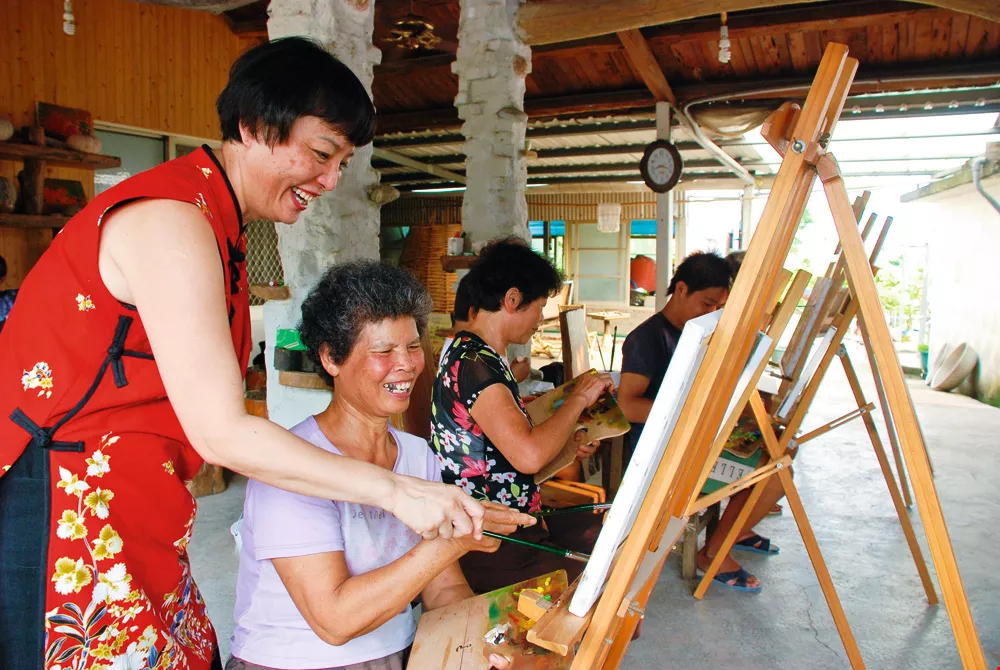
Moved by the human story of the Tugou residents, Kaohsiung painter Chen Shuhui (first left) came here to teach painting to the residents, paying for her own move. Her classroom is a converted pig shed.
Where did the energy and self-assurance of Tugou’s village art museum come from?
The story began a decade ago, when a group of local residents crossed paths with a team of students and faculty from the Tainan National University of the Arts (TNNUA).
Su Chaoji, 48, who has served as director of the TRCDS for many years, wears multiple hats: he’s a carpenter, a farmer and a volunteer firefighter; he’s also one of the few younger villagers who never left. “In the past, abandoned houses were everywhere in the village, because so many people went away. Garbage heaps and weed growth were common by the roadside, and were becoming an eyesore. And the remaining old folks were too busy tending their farmland to have any energy to beautify the environment,” says Su.
Another pillar of the community, Liao Guoxiong, served as an assistant animator in Taipei when young. After coming home he worked as a local correspondent for a cable TV station, where he observed many community development projects. Says Liao, “Tugou villagers used to tell people they were from the nearby town of Baihe, because they felt there was nothing special about their town, and it seemed to have gone to ruin. They wondered if outsiders could even find it.”
The TRCDS had only been running for a few years when former Tainan County deputy magistrate Tseng Shu-cheng, who teaches in the Graduate Institute of Architecture at TNNUA, brought a team of community development students on an internship to Tugou in 2002. Four of the students developed especially good friendships with the Tugou residents, and soon considered the village a second home.
Chen Yuliang, 29, recalls that the earliest movement to combine everyone’s efforts was the construction of a shed for the last water buffalo.
Tugou had its golden age four or five decades ago, when the villagers kept over 300 water buffalo. They were part of the farmers’ lives, and a symbol of rural sentiment. By 2005, only one water buffalo remained, kept by a villager known as Uncle Qingxiu. After securing the old man’s agreement, the TRCDS and the students from TNNUA appealed to the villagers to restore an adobe shed for the aging bovine. Before that they had repaired seven or eight old farming vehicles and organized an ox cart parade and other activities in honor of the buffalo.
“In the process we pretty much mobilized all the villagers. The old folks rolled up their sleeves, and together we hacked through the undergrowth, moving bricks and planting trees. We channeled the spirit of the buffalo: steadfastness and a willingness to take on burdens,” says Chen Yuliang.
After building the buffalo shed, they embarked on a series of beautification and art installation projects. “All the plans were thought up and hammered out through chats over tea. We continued the tradition of local hiring and purchase of local materials. But the important thing wasn’t the structures we built, but the teamwork and autonomy involved,” says Chen.
Consider the public art project called Peaceful Zhuzaijiao, which won a “best public participation” prize at the Public Art Awards, staged by the former Council for Cultural Affairs (now the Ministry of Culture). What really blew the judges’ minds was that the subsidy was a trifling NT$650,000, but they still managed to complete an upgrade of the village’s overall environment, with art installations ingeniously incorporated into living areas.
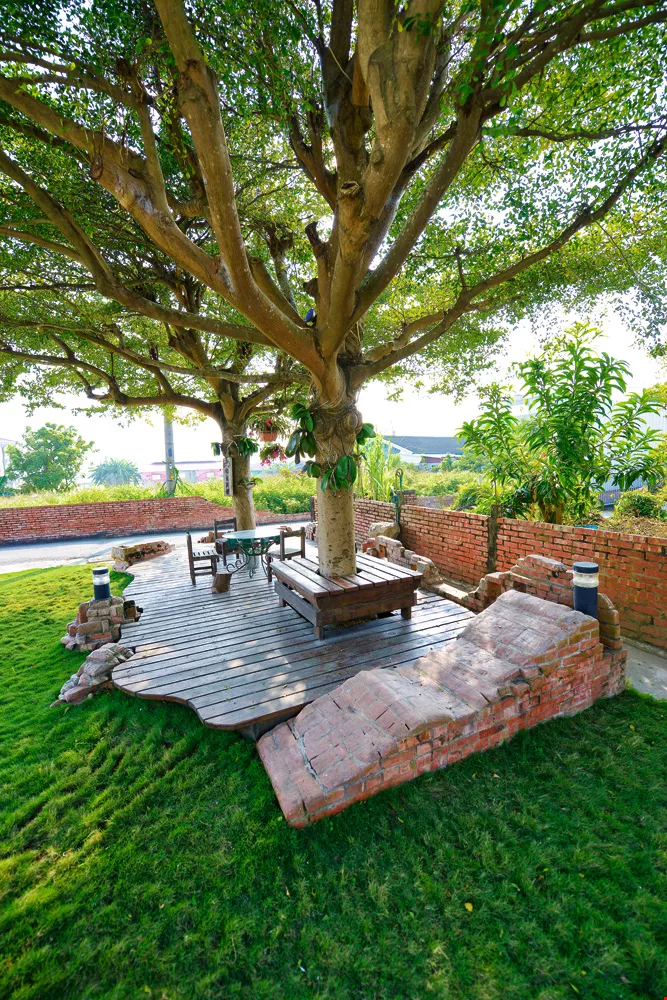
The artistic spirit of Tugou springs from the experience of country living, which has long permeated all corners of life here. The right photo is Black-Faced Spoonbill by artists Huang Yajuan and Maya.
A more avant-garde work of art is Tao Yuanming Sitting for 10 Minutes, which took Chen Yuliang three months to complete. Using steel-reinforced concrete and mosaic, he built a gorgeous tea table and chairs of riotous form and color. The legs of the chairs and table straddle a water channel, and rice paddies stretching as far as the eye can see form a backdrop that varies with the seasons. It’s a work that’s both practical and original.
In addition there are refurbished spaces under large trees, complete with pools, plants, and sculpted landscapes, tables and chairs, which are all on private land. The landowners generously provided the spaces rent free, with a guarantee to be open to the public for at least 10 years and maintained at the owners’ expense.
“After the refurbishment, what changed the most in Zhuzaijiao and the entire village of Tugou was public sentiment,” says TRCDS director Su Chaoji. With the “every man for himself” mindset gone, the villagers now spontaneously sweep up and maintain the surrounding area. And because there are so many more nice recreation areas, people care about each other’s well-being more, and young people on visits home are drawn back by the new public spaces, taking more pride in their hometown.
After four TNNUA graduates opened businesses and made their homes in Tugou, the dreams of the village continued to grow.
Chen Yuliang says that the Tugou experience forged in them a drive for self-reliant participatory community development. He and classmate Huang Dingyao started a business, working on weekdays at planning community spaces under government-sponsored projects, which allows them to support themselves while also hiring one or two local workers. During evenings and days off they continue to do community work in Tugou.
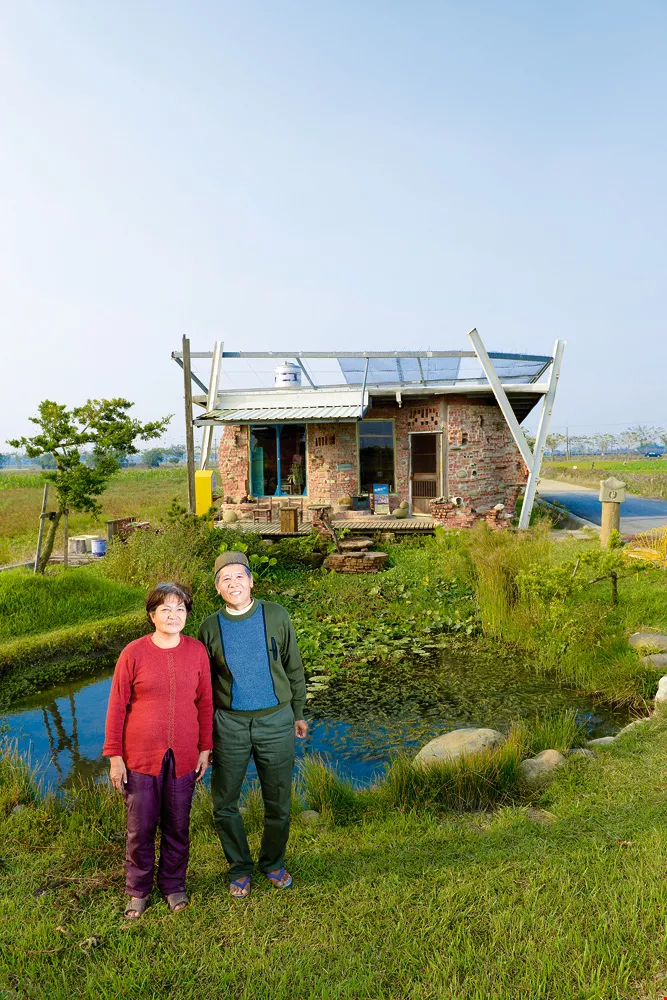
The workshop and home built by stone carver Hou Jiuafu (right) and his wife is constructed mostly of recycled material. During the creative process, Hou puts the stone shards left over from his carving work directly onto the dirt floor. The right photo shows his piece Mother and Child.
“Community development requires long-term communication and contact with people, and by designing and implementing projects ourselves we can reduce the budget. Despite the hard work, we’ve earned a sense of accomplishment and cohesion,” says Chen Yuliang.
The Rural Village Art Museum project was in preparation for almost a year. Privately funded, without government subsidies, it wasn’t an easy task.
“The reason for funding it privately was to ensure autonomy and avoid pointless administrative interference. We pledged to foot the bill for what we couldn’t raise, then work hard later to earn it back,” says Chen. Fortunately, their industrious, persevering manner moved the Tainan Enterprise Culture and Arts Foundation and the Shiner Education Foundation, who became the two major patrons behind the scenes of this exhibition.
The next big issue is how Tugou will deal with the population drain and revive its rural economy.
These dream-builders agree that the revival of rural villages must be done through policy planning and reform from the ground up. One village alone can’t do it; only by working together can they achieve greater power.
“The Tugou Rural Village Art Museum is like throwing out a cheery invitation, inspiring more workers who care about rural areas and agriculture to find power in the land and to believe the village has unlimited possibilities,” says Liao Guoxiong.
Lately, the art museum has made its own Facebook page, and young villagers working elsewhere have been discussing hometown matters through this platform. Says Liao Guoxiong, “Though they’re not back yet in person, their hearts are. One day, the new generation will finally forge a beautiful relationship with the land.”
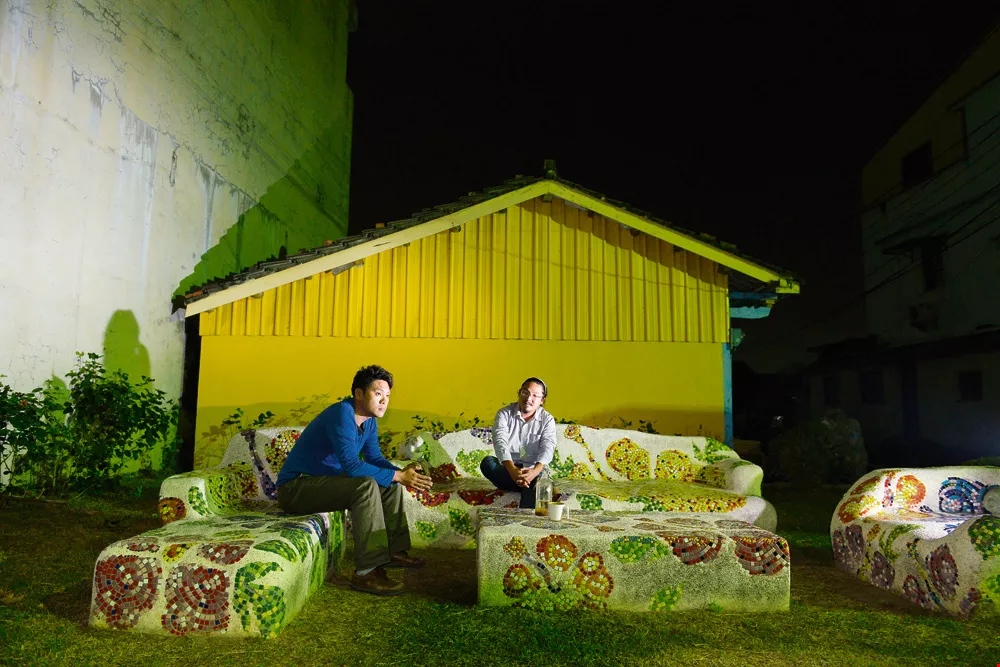
Chen Yuliang (right) and Huang Dingyao carry on with their student-era dream, setting down roots in Tugou. Pictured here is their hibiscus-themed work Warm Parlor. They transformed a plot of discarded land into a small living room, fine both in form and function.
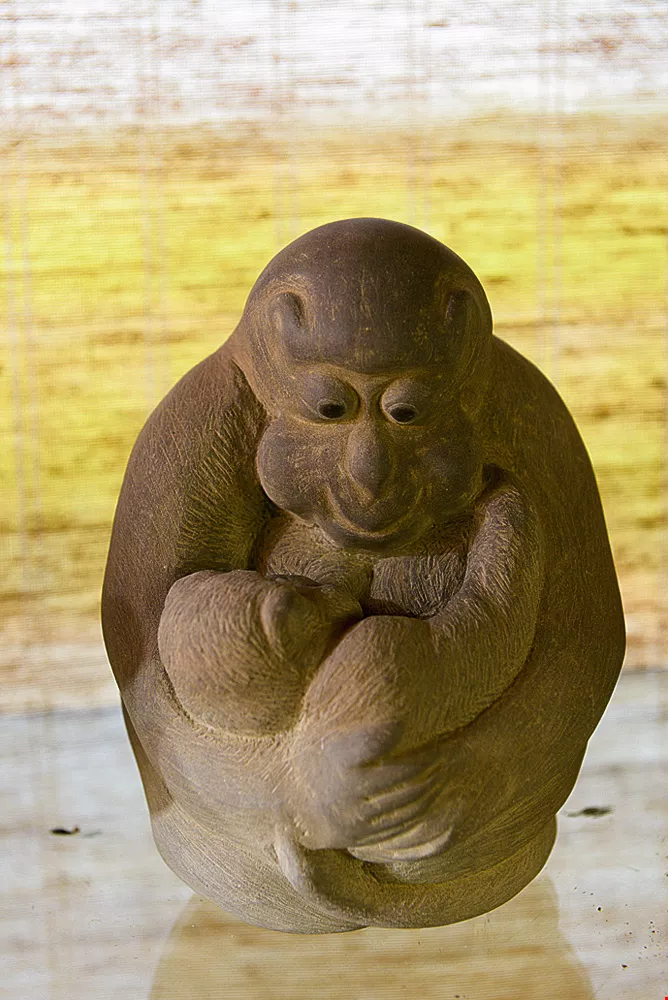
The workshop and home built by stone carver Hou Jiuafu (right) and his wife is constructed mostly of recycled material. During the creative process, Hou puts the stone shards left over from his carving work directly onto the dirt floor. The right photo shows his piece Mother and Child.
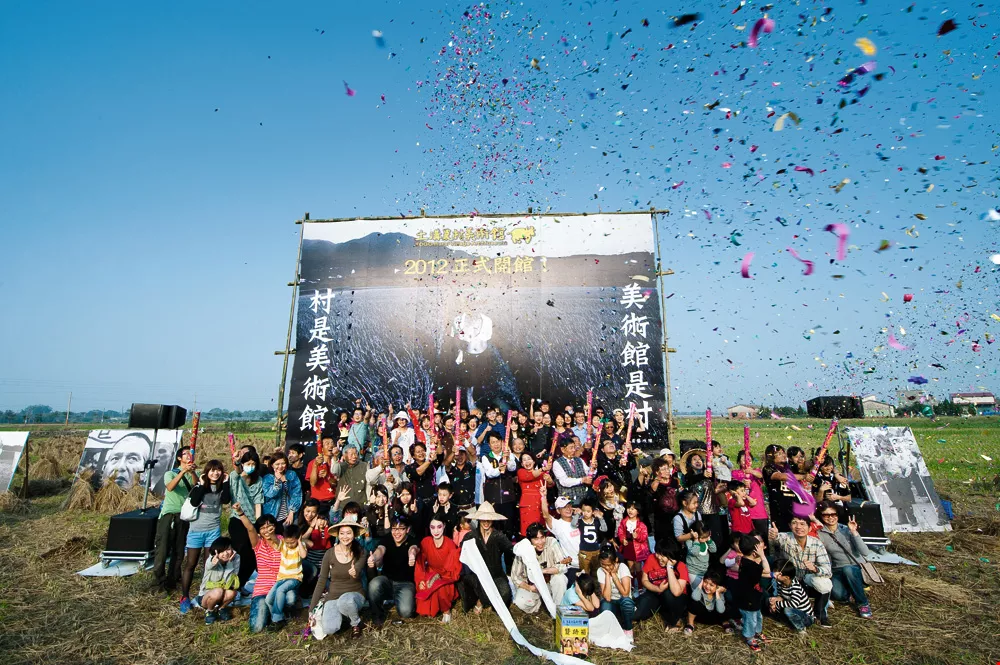
On opening day of the Tugou Rural Village Art Museum, theater troupes and bands take the stage, the participants themselves becoming part of the art amongst the fields.


@List.JPG?w=522&h=410&mode=crop&format=webp&quality=80)


