International Volunteer Li Shang-ju:Doctor in Taiwan, Teacher in Peru
Kobe Chen / photos courtesy of Aquarius Publishing / tr. by Jonathan Barnard
March 2014


From among the various methods of connecting to the international community, young Taiwanese are more and more often choosing to become volunteers. They travel to distant lands, where they demonstrate their passion for service. The Ministry of Foreign Affairs and documentary filmmaker Wu Yi-feng have worked together on three different continents to shoot a documentary that conveys Taiwanese volunteers’ passion for the world.
Li Shang-ju is just one of the many volunteers featured in the film, but because he has a medical degree, he gets a lot of attention. What motivated him to travel to a poor area of distant Peru to run a school? What ideals pushed him to leave his job at a hospital to become a teacher (one who became much loved by locals)?
In a remote mountainous district that is some 29,450 kilometers away from Taiwan, a raucous Christmas party was about to begin. Under an ROC national flag, little children were talking animatedly in Spanish in anticipation of getting presents, while their parents were gathered at the side of the room, setting out the food. Just then cries of “Teacher Li” rang out as a young Taiwanese man, covered in sweat, walked in carrying a toolbox. The children swarmed around to give him hugs.
The celebration was in the village of Villa Flora Tristan, a Peruvian town with no asphalt roads, where even running water is a rarity. Li flew from far across the sea to serve as a volunteer “principal” of a local English school there. He received no salary and in fact ended up spending his own money, earned from his previous job as a resident at Linkou Chang Gung Memorial Hospital. First a doctor and then an international volunteer, Li is now studying global health at the University of Washington. The book Where There Used to Be Anger: Finding Inner Clarity in a Mountain Village recounts his story of self-discovery.
Although Li couldn’t speak fluent Spanish when he first arrived, he never had problems communicating his meaning as he accompanied his young charges in drawing pictures or playing games.
Under a sky filled with dust, Li walked home, hand in hand with two young children.
In Peru, the regular elementary schools let out at 2:00 p.m. In 2007, with the aim of providing children with a safe place to go afterwards, a British traveler and locals worked together to build a language school and founded Traveler, Not Tourist (TNT). In addition to the English-language school, the organization also sponsored an orphanage. It recruited international volunteers to come to Peru to teach English and look after the children as they study and play. No child is refused, and the school is completely free.
After just a few years of operations, the English-language school had nearly 50 students and ten international volunteer teachers. After a time, the founder returned to Britain but the organization continued with its work in Peru.
When Li first arrived in 2011, he started by teaching English to the youngest students and by learning Spanish from them.
Aiming in part to broaden their own horizons with enriching experiences, international volunteers stay and help for a variety of timeframes, from as long as a year to as short as several days. With the high turnover, there is an unwritten rule at the school: Whoever stays the longest becomes the principal. The principal leads meetings, puts on lectures, and manages volunteers, but also has to do hard labor: He is responsible for flushing toilets, repairing tables and chairs and weeding in the gardens.
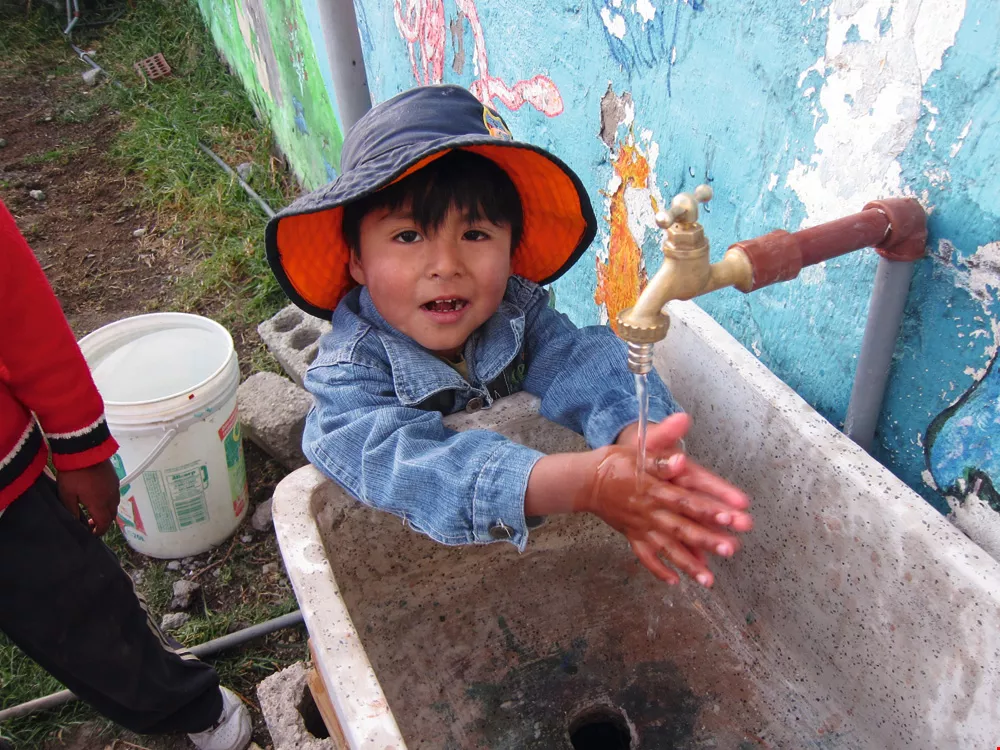
Li became principal after nine months, and as he got to know the locals better, he found they lacked a modern understanding of sanitation. The discovery awakened the doctor in him, and he began to instruct families and children to brush their teeth and wash their hands. Working with local clinics to offer some free services, he became the district’s emergency care doctor.
Apart from teaching English, he also taught math and science to the older students, taking no salary at all. He earned a fair measure of renown, and calls for “Teacher Li” were frequently heard. No matter how busy or tired, Li never complained, because he was doing what he wanted to be doing.
.jpg?w=1080&mode=crop&format=webp&quality=80)
The smiling faces of innocent young children are the best medicine for relieving stress among international volunteers.
The fact that Li, who turns 32 this year, would leave his high-status job as a doctor, a much-envied career, to serve as a volunteer abroad is something that many can’t wrap their heads around.
In the seventh year of his medical studies, Li did an internship at a hospital, where he found the behind-the-scenes machinations and ill treatment that senior practitioners inflicted on their juniors much like that portrayed in the novel and television series The Hospital. Feeling alienated from the medical profession, Li decided to leave it.
“It’s very difficult for doctors just out of medical school to find employment outside of hospitals,” Li says. He applied for non-medical jobs at many non-profits with no success. Passing a year unemployed, he eventually returned to a hospital to serve as a resident. His family breathed sighs of relief, believing that he was finally behaving “normally.”
But seeing more of what residents had to go through caused him only further struggle: “Is this what I’m going to be in ten years?”
One night at nine, his mother called out of concern: “You haven’t eaten yet? You’ve got to get three square meals….” The emotions that Li had suppressed for so long suddenly erupted: “This is the normal life you wanted for me!”
That evening Li tossed and turned in bed and began to plan to leave his job at the hospital and go travel, go find himself, go look for something that would resonate with his passion, which had never died out.
He spent more than three months gathering information about international volunteer opportunities, setting two goals for himself: to study a foreign language and to come in contact with the local people. Eventually he came across a photo of the Incan ruins of Machu Picchu in Peru. He declared that he would have to visit the site at some point in his life. And learning Spanish and interacting with young children met his goals well.
“You enjoy yourself for a year, then come back and be a good doctor,” his father told him at the airport, still hoping that Li would get “back on track.”
“I don’t want to go back to being a doctor,” Li responded firmly. He inwardly made a wish: If he was going to go abroad and “enjoy himself,” then he would also have to have some real accomplishments to show for it. After spending more than a year as a volunteer, that desire only grew more intense.
.jpg?w=1080&mode=crop&format=webp&quality=80)
The allure of Machu Picchu is partly what brought Li to Peru, an experience that in turn set him off on a new journey in the realm of global health.
The founder of TNT, which was the organization Li had joined as a volunteer, left Peru, remitting back to Britain some money that had been raised on behalf of the language school. That decision caused a lot of dissatisfaction among the volunteers. When they looked into the organization’s finances, they discovered a lot of irregularities. Registered as a travel agency, it wasn’t even officially a non-profit.
In 2013 Li and several senior volunteers decided to leave TNT and establish HOOP (Helping Overcome Obstacle Peru). As a founder, Li pushed to better serve the entire community with a broader range of services aimed at promoting health, families, and education.
Li never stopped wondering: “Will all that we’re doing really make a difference in these children’s lives?”
In order to attain an ideal, he and the other volunteers put up the money themselves to establish a scholarship, so as to allow a student with good character and academic achievements to be able to attend a high-quality private school without concern for the expense. In Wu Yi-feng’s documentary, the scholarship recipient Brigitte says: “I want to have a chance at a different future.” Before she even finishes the sentence, tears are welling in her eyes. To her, education isn’t a duty but rather a rope of hope dangling in front of her that she can grab ahold of to escape her impoverished existence.
But the money that Li and the other volunteers put forward was only a stopgap measure. HOOP would survive long-term only by seeking contributions from outside.
Li even used his own clumsy calligraphy to raise money, writing people’s names in Chinese for 2 Nuevo Sol (equivalent to NT$25). He ended up raising about NT$2,500 in four hours, roughly his living expenses for a month. Henceforth, whenever Taiwanese would ask him how one could make a living in Peru, he would answer in jest: “Just write calligraphy!”
After serving as an international volunteer, Li deeply realized that his practical experience and academic knowledge were insufficient. It prompted him to consider continuing his education. He ended up applying to a graduate program in global health at the University of Washington in Seattle, aiming to gain expertise connected to his passion for international medicine and non-profit organizations. In the future he hopes to work in public health connected to international aid, refugee assistance, or disaster relief.
.jpg?w=1080&mode=crop&format=webp&quality=80)
Children left behind their handprints on this piece of canvas. It is one of HOOP’s most precious keepsakes.
“This world is worth making dreams for,” Li says. HOOP can help create opportunities for Peruvian children. It can help them believe that they can change their futures.
Director Wu Yi-feng, who came to Peru to shoot scenes of “Team Taiwan” (HOOP’s name for its Taiwanese volunteers), says: “It is the mission of doctors to help people. Li is engaged in medicine and is expanding the scope of what medicine means.”
Li’s next stop? “Central Africa, South or Central Asia, even Haiti, are all possibilities.” Li says that only time will tell. Within, the soul of a traveler and the soul of a doctor are both restless.
.jpg?w=1080&mode=crop&format=webp&quality=80)
In 2012 Li Shang-ju (left), Eddy Chen and fellow volunteers founded the non-profit HOOP (Helping Overcome Obstacle Peru).

@List.jpg?w=522&h=410&mode=crop&format=webp&quality=80)

@List.jpg?w=522&h=410&mode=crop&format=webp&quality=80)


