The Mudstone Badlands of Moon World: Nature’s Geology Classroom
Amber Lin / photos Chi Kuo-chang / tr. by Chris Nelson
May 2014


In the Forestry Bureau’s 2013 online poll of Taiwan’s Top Ten Landscapes, the mudstone badlands of Kaohsiung’s Moon World, which took sixth place, were the top choice among southern Taiwan’s distinctive landforms. They form part of an area dotted with badlands that stretches from southern Chiayi County down to Zuozhen and Nanhua in Tainan City and to Tianliao and Yanchao in Kaohsiung City. These desolate lands boast a rich variety of geological features.
Take Freeway No. 3 to the Tianliao Interchange, then get onto Highway 28 heading toward Qishan, and an unforgettable vista unfolds before the eyes.
It’s an expanse of undulating hills capped with jagged ridges and knife-sharp peaks, practically devoid of vegetation. Slate-grey layers of earth add to its harshness. The Erren River snakes through the area, with crescent-shaped oxbow lakes in certain sections. The stark landscape reflected on the water forms a poetic contrast with the thorny bamboo growing by the lakeside.
In geological terms, Moon World’s landforms are called “mudstone badlands.” Badlands are areas of rugged terrain whose surface is characterized by gullies and erosion, and which lacks vegetation.
Taiwan, though small, has a rich variety of landforms, and these include both conglomerate and mudstone badlands. The most famous area with the former type is Huoyanshan in Sanyi, Miaoli County, while the latter is found in Liji, Taitung County, and in southwestern Taiwan. In fact, four locations in Taiwan go by the name of “Moon World”: one at Taitung’s Liji; one at Caoshan on Tainan’s border with Kaohsiung; and two in Kaohsiung, at Tianliao and Yanchao. It is these last two that featured in the Forestry Bureau poll.
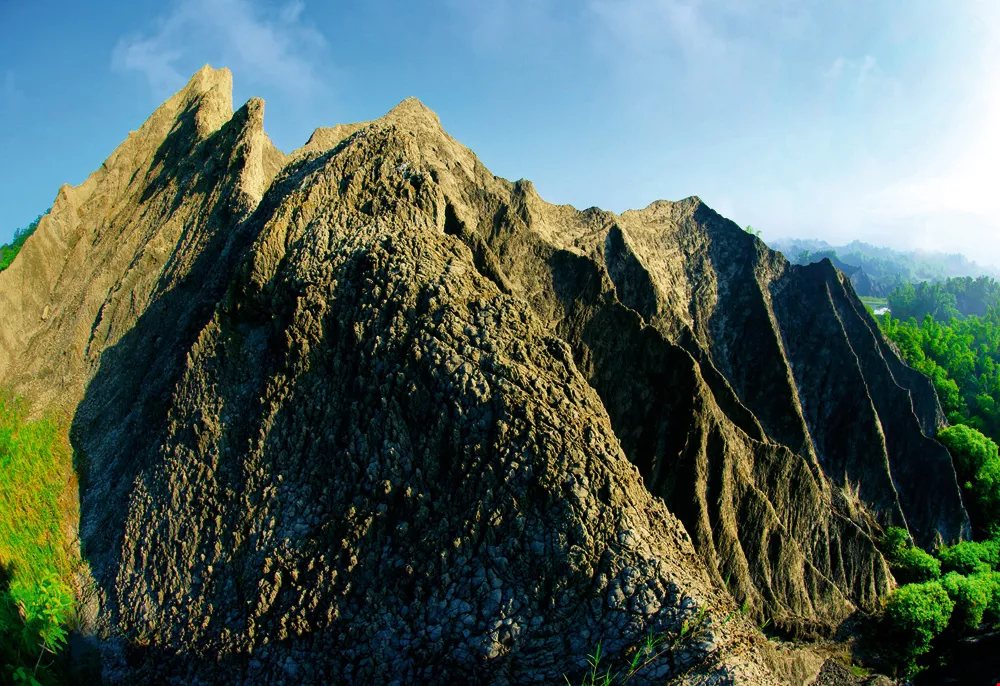
The mudstone badlands of Moon World are the top pick among southern Taiwan’s unique landforms.
The mudstone strata underlying these sites belong to the Gutingkeng Formation, which dates to the Pliocene and Pleistocene epochs. The Gutingkeng Formation is mainly distributed within the boundaries of Tainan and Kaohsiung Cities in southwest Taiwan, from Yujing in the north to Yanchao in the south. It’s about 30 kilometers long, with an average width of 8 km.
According to geological research, the Gutingkeng Formation is divided into two layers: upper and lower. After millions of years of deposition, the upper layer is about 500 meters deep, while the lower layer extends downward over 4,000 m.
The formation’s origins can be traced to the early Pliocene epoch. Five million years ago, orogenic processes gradually uplifted Taiwan, the east side bulging up quickly while the west side sank to form a foreland basin in a bathyal environment (1–4 km deep in the ocean). Millions of years ago, the area of today’s Tainan and Kaohsiung was several thousand meters below the ocean surface, as evidenced by the plankton and shellfish fossils that permeate the mudstone.
However, over several million years of erosion in the ancient Central Mountain Range to the east, great quantities of silt were scoured out, settling into the foreland basin of southwestern Taiwan, which at that time was in the bathyal zone. This deposition gradually solidified into the thick Gutingkeng Formation mudstone we see today.
Lastly, the ongoing orogeny lifted the Gutingkeng mudstone of southwestern Taiwan out of the ocean and pressed it into folds and thrust faults. The exposed surface was subsequently eroded by wind and rain, creating the “Moon World” landscapes we see today.
Gazing at the expanse of curious hills, it’s hard to imagine that this was at the bottom of the ocean eons ago.
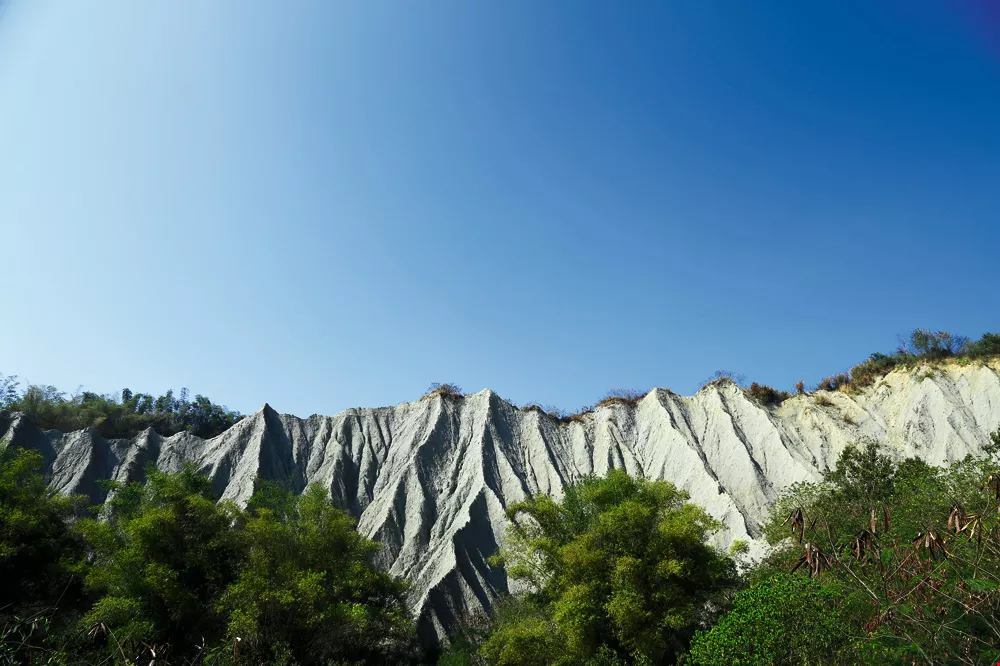
Orogenic processes lifted the mudstone Gutingkeng Formation of southwestern Taiwan out of the ocean, and pressed it into folds and thrust faults. The exposed surface was eroded by wind and rain, becoming the Moon World we see today.
The Gutingkeng mudstone is greenish grey and geologically young. Having never been buried deeply enough to be subject to high pressures, it is only weakly lithified. With mudstone’s weak cementation and low water permeability, it softens into mud when exposed to water. This mud cracks and flakes when dry. And the high salt content of what was once marine silt makes it hard for plants to grow.
Besides these geological conditions, climate is also an important factor that shapes the appearance of Moon World. Due to southwesterly air currents and tropical low pressure zones from July to September, there are often heavy rains. The exposed mudstone is eroded by the rain, which flows downward from the slopes as runoff, creating gullies and ravines on the hillsides.
However, with so little vegetation cover to absorb water in the area, why are there so few landslides in Moon World?
“Most landslides occur in hilly or mountainous areas where there are large differences in elevation across the terrain, and are caused by excessive water content in the soil. But with mudstone’s low permeability and the smaller differences in elevation in the terrain of this region, landslides are rare. That said, flooding in this area is not uncommon,” says Chyi Shyh-jeng, professor of geology at National Kaohsiung Normal University.
Due to both soil type and climate, Moon World is worn away by wind in the dry season and by rain in the rainy season. Battered by this repeating cycle of wet and dry, the surface flakes away, eroding into forms such as knife-edge peaks, caves, natural bridges, pinnacles, mud cracks, and V-shaped valleys. And the Erren River, which also scours the area, forms typical river landscapes such as meanders, oxbow lakes, and river terraces.
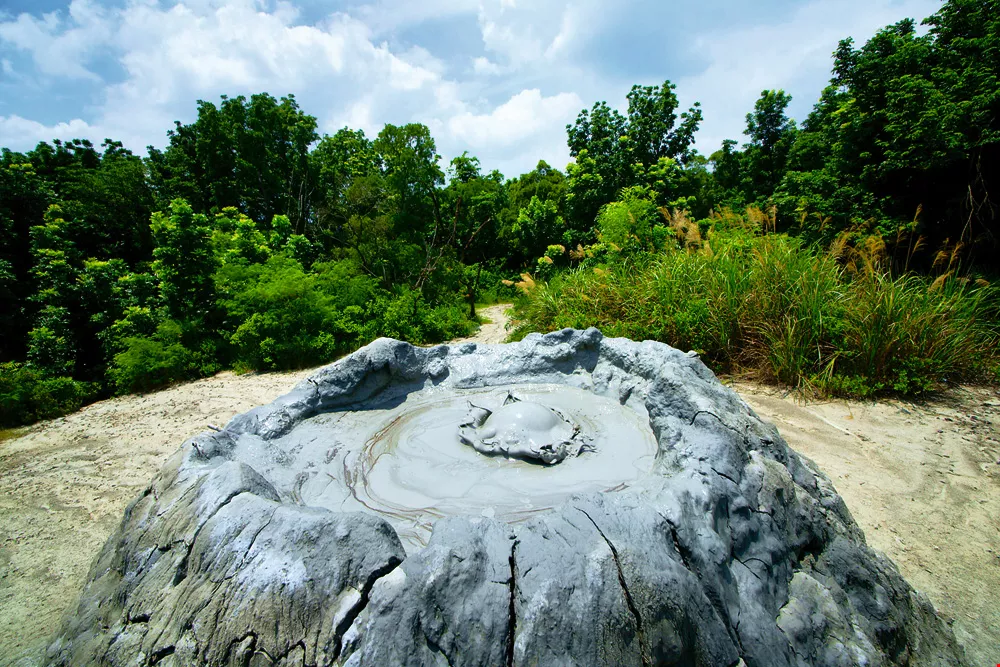
The mud volcanoes of the Gutingkeng Formation are well-known sights. Of these, the Wushanding cone volcanoes are the most impressive.
“In Moon World, you can see the whole gamut of geological phenomena including mudstone, mud volcanoes, meanders, ponds and limestone, all within a 30-minute drive,” says Professor Chyi, noting that the mud volcanoes are among the most impressive of Moon World’s rich and varied landforms.
“Not all mudstone badlands have mud volcanoes. For these to occur, the badlands need to be located in new orogenic areas,” says Chyi. Besides mudstone, water and natural gas, the key condition for the existence of mud volcanoes is being located in a fault zone; this provides enough pressure for mud eruptions. Mud volcanoes in other countries are distributed mostly near coasts, but Moon World is located in the Qishan fault zone, providing all the necessary conditions to create this scenic wonder.
According to surveys by National Taiwan University geography professor Wang Shin, nine of Taiwan’s 15 mud volcano zones are in Kaohsiung City. The Gutingkeng Formation boasts cone volcanoes, shield volcanoes and mud basins.
The most famous mud volcanoes are the two conical ones at Wushanding in Yanchao. Because its mud is more viscous, allowing it to gradually accumulate in height, the tall one on the right (as you enter the area) once reached four or five meters high. But now it’s becoming dormant. The one on the left still emits sounds, bubbles and mud. This area has been designated as a nature reserve by the Council of Agriculture, forbidding all development.
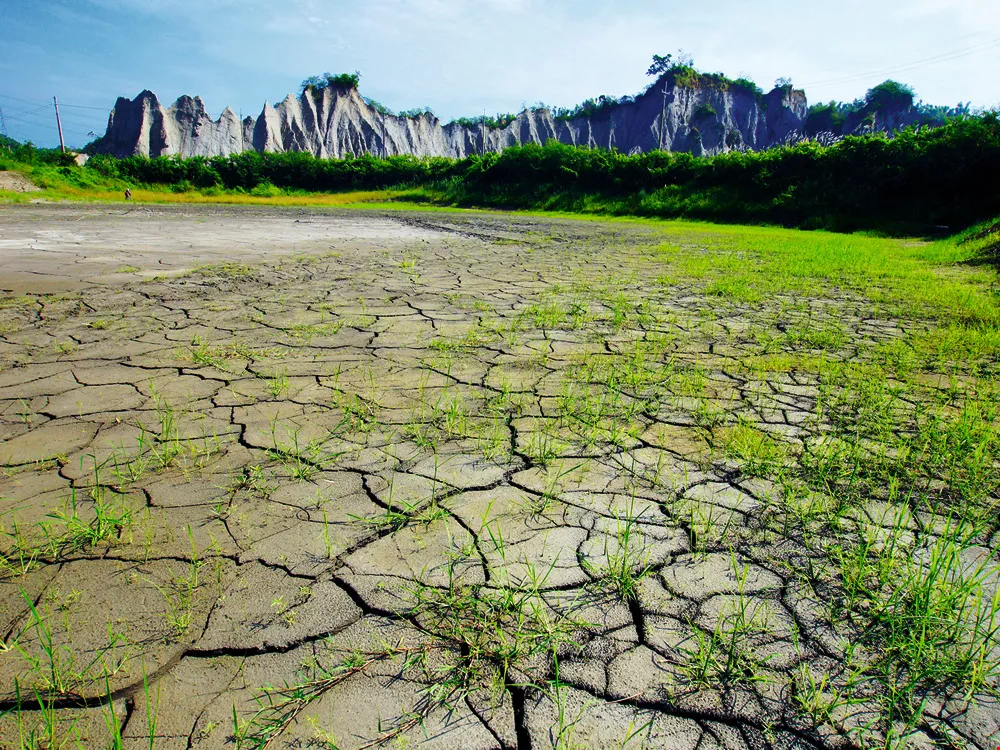
Mudstone is weakly cemented and has low water permeability, so when it’s exposed to water it softens into mud, which cracks and flakes when dry. It’s hard for plants to grow here.
Indeed, Moon World’s geological richness and rarity meets UNESCO Geoparks standards.
Lin Shunfa, director of the Tian Liao Moon World Mud Rock Geology Tourist Center and retired principal of Chenggong Elementary School in Qieding District, is a native of Tianliao. In 2012, after the Kaohsiung City Government opened the tourist center, he called together over 20 elementary school principals and more than 30 volunteers to serve as docents, introducing the landforms of their home to tourists.
Says Lin, the Moon World badlands may seem forbidding, but people still built earthen dams here long ago to collect river water, and erected check dams in the small valleys. And the soil properties are good for farming produce such as bananas, jujubes and longans as well as raising honeybees. This is an embodiment of the simple, rugged character of the local people.
Next time you have the chance to come to Moon World, as you check out this natural geology classroom and marvel at nature’s superb workmanship, don’t forget to sample the “three jewels” of Yanchao: jujubes, longans and guavas. Their sweetness is a reward for the struggles of the Taiwanese people and their coexistence with nature.

@List.JPG?w=522&h=410&mode=crop&format=webp&quality=80)


