Going to the Dogs: The Pet Products Industry Takes Off
Coral Lee / photos Chuang Kung-ju / tr. by Phil Newell
April 2012


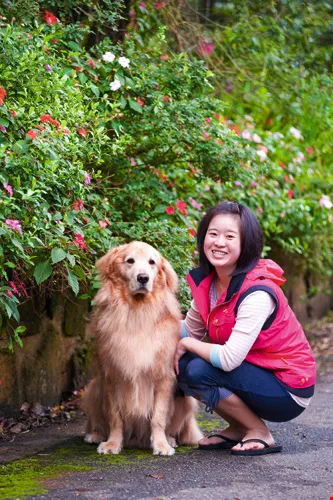
“Then the cat jumped into my lap as I sat opposite my guest, drinking tea. The cat listened attentively, eyes shining with a gentle brightness….” The author Xin Dai, who loves cats to the point where the term “addiction” might not be excessive, treats her cats as if they were her children, but she also sees them as teachers from whom she can learn. Chen Qianru, who works in advertising, once fell down and injured herself at home, and her dog spent the whole day pacing around anxiously, which she found very touching. The love between pets and their owners makes the latter willing to spend exorbitant sums of money for the former, and to become servants who delight in fixing meals for their animals and cleaning up after them.
The pet industry in Taiwan has been growing rapidly in the 21st century, and has now reached the stage of steady and mature development, with an estimated value of some NT$20 billion. And because the “daddies” and “mommies” of Taiwan’s 1.27 million domestic dogs and 280,000 domestic cats are paying more attention than ever to the health and happiness of their “little ones,” they don’t quail when it comes to opening their purses, so the future looks as bright as ever for the pet products industry.
Sunny Dog, located on Xiwan Road in Xizhi, New Taipei City, advertises itself as a “pet paradise.” Located in a compound surrounding an abandoned concrete fishing pond that has been turned into a huge doggie pool, Sunny Dog is now a “pet sports park” (complete with a “pet restaurant”) well-known in the animal-lover community. On weekends and holidays, if the weather is good, you will see 40 or 50 dog owners bring their canines—often large breeds like Labradors and Golden Retrievers, but with lots of others as well—for a swim and a romp.
Sunny Dog is a pet swimming pool and playground located in the mountains of Xizhi, New Taipei City. Dog “parents” are happy to have such a huge site where their “little ones” can play to their hearts’ content.
“It’s so nice to get a sunny day for a change, so I just put my work aside and brought the dog outdoors,” says Mr. Su. He has come out with his wife, both dressed for recreation, and their nine-year-old Golden Retriever, Tango. Tango’s owners have decided not to have children, and they are raising Tango with all the devotion they would give to a baby. Besides his regular dog food and snacks, he also gets nutritional supplements including glucosamine to ameliorate some of the effects of aging, fish oil to prevent cardiovascular disease, and another product for a glossy coat. The Sus spend at least NT$5000 a month on Tango.
In addition, Tango’s mom takes him out for a run for at least half an hour per day. “You see a lot of obese dogs around these days—exercise is a must.” On weekends and holidays, they get together with friends and their dogs and go hiking or to the big, open riverside park where dogs can run to their hearts’ content. While their dogs play, the humans swap seemingly inexhaustible anecdotes of their pets’ antics.
“In general, a typical Golden Retriever will start getting white hair on its face at about four years of age. But we’ve been very conscientious about nutrition and exercise since he was a puppy, and now he has a lot more energy and a much healthier coat than similar dogs his age,” says Mr. Su with obvious pride.
Mrs. Su adds that dogs need to socialize, and they can only learn social skills by interacting with other dogs. “If a dog is usually introverted or hostile to being approached, that means the owner hasn’t done a very good job raising the dog.”
From time to time, Tango’s mommy throws a ball into the water and Tango dives in after it, never failing to enjoy a leisurely swim, with the ball in his mouth, before returning to his master’s side to seek attention, play, or lie down for a well-earned rest.
Over at the other end of the pool, two mixed breeds—part Black Lab and part Golden Retriever—are bursting with energy. Their owner, Ms. Huang, has come prepared, clad from head to toe in waterproof clothes. She throws a ball into the water again and again, and the inexhaustible brothers plunge into the pool to grab it and bring it back to her. This lasts for an hour or two, but still they show no signs of flagging.
Ms. Huang’s children are studying overseas, and since retirement King and Kuro have become the center of her life. She comes to the pool regularly twice a week, rain or shine, summer or winter. “They have a double layer of fur, so they actually prefer cold weather to hot,” Huang explains, “and what does it matter if it’s raining—they get wet in the pool anyway.” The two dogs have enormous energy, and come here to burn some of it off. Here they can relax and he happy, unlike when they are being walked by the roadside, where they are nervous and have to stay alert to possible danger.
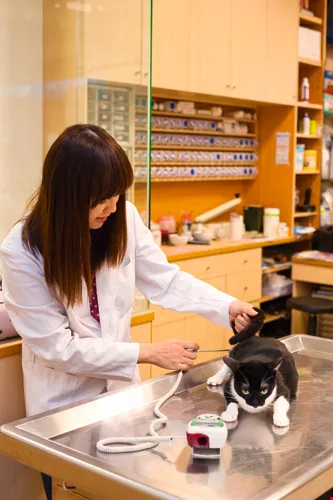
Taking your cat to the vet when it is sick…
Statistics show that there are now 810,000 married couples in Taiwan with no children at home (“DINK” couples plus “empty nest” homes), an increase of more than 300,000 in just 10 years. The need to fill the resulting emotional void has presented the pet industry with growing commercial opportunities over this same period, as well as good prospects for the future.
Zou Songdi, top dog at the Taipei Pet Appliances Association, says that a couple of decades ago, the pet industry was mainly dedicated to the sale of dogs and cats, while sales of dog or cat food, kitty litter, and the like, were purely peripheral. (Traditionally Taiwanese fed their dogs and cats with table scraps.) For every NT$1 million in business for pet stores, probably NT$800,000 was for breeding and sales of puppies. Pet food salesmen were generally chased away as annoying and unwelcome visitors.
Now the wheel has turned, and today 80% of a pet store’s business comes from pet food and pet products. There are more than 70 different dog-food products alone, and more than 50 for cats, while there has been continual “evolution” in pet snacks, toys, clothing, and nutritional supplements.
Zou says that in the realm of dry and canned pet food, which accounts for 60–70% of the total value of the industry, the latest trend has been toward “organic” and “refined” products. The former means that the food contains no ingredients sourced from foods with hormones or growth stimulants. The latter refers to the addition of particular ingredients like salmon, potatoes, or glucosamine.
Other new-fangled items include imported raingear that is permeable to air, and there are also hand-built doghouses that give off phytoncides (natural repellants that ward off attacking insects or other organisms) and are cool in summer, warm in winter, and moisture resistant.
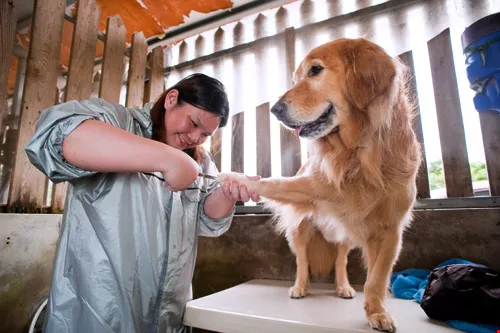
Patiently washing, blow-drying, and cutting the nails of your Golden Retriever… Owners are willing to do anything for their beloved pets.
There is also a clear trend toward the development of chain pet-product stores, and corporate groups are jumping into the fray. In response, some traditional mom-and-pop operations are joining forces in a struggle to stay alive. One of the most prominent examples is Coo Coo G Pet, which now has 15 stores across Taiwan.
“Originally we were separate independent shops, but we discovered that there is strength in numbers,” says Gu Erkang, the chain’s general manager. Considering that they could get larger discounts from suppliers if they could come up with larger orders, and seeing the overall rise of brand consciousness in Taiwanese society, nine years ago five investors put up the cash to start the collective company. Once they had achieved stability, they began to open stores directly operated by corporate headquarters.
Competition is fierce in the pet-product industry, and one of the best ways to build up customer loyalty is with grooming services. The complete beauty treatment—ear cleaning, washing and blowdrying, nail clipping, hair trimming, and anal cleansing—runs about NT$500 (roughly US$15) for a small dog, to about NT$800 for a large-sized dog.
“The grooming and kennel departments have high profit margins, but the work is correspondingly very challenging,” says Gu Erkang. Because owners today are so hyper-protective, if the animal gets even the slightest scratch there’s almost nothing you can say that will placate the owner. And if a pet is sick without the owner’s being aware of it before the animal checks in to the kennel, and its condition worsens or the animal even dies while staying over, you might as well go jump off a building as try to prove your innocence.
Gu adds, “All pet stores face the problem of high turnover among professional groomers.” In general, a groomer will work for a few years in a store but then, after building up a big enough personal clientele, will go out on their own. To make things worse, the ever-growing number of groomers has led to vicious price-cutting wars.
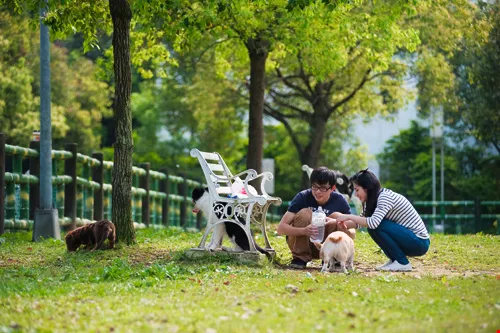
Pets make great companions for modern people. Elevated to the status of family members, their well-being is now essential to their owners’ own quality of life.
With pets being like family members, owners’ thoughts naturally turn to educating and training them, and more and more dogs are being sent to school. There are now more than 20 such academies in Taiwan, with classes in everything from basic obedience to special tricks, and courses running from as little as two months to as long as a full year.
Some people may wonder why dogs that are not doing some special task—like seeing-eye dogs or working dogs—need training. Gu Jiakui, the director of a training academy for working dogs in Banqiao, says that dogs these days spend a lot of time with humans, and if they do not have good behavioral standards, they can be hard to control. For example, the dog might see something interesting on the street and just bolt off in pursuit, injuring its owner in the process, or may be noisy and hyperactive at home, causing problems with the neighbors.
There are also countless books on the market on raising and training dogs. But many people, lacking sufficient time or sufficient determination, still choose to have their dogs trained professionally.
Gu Jiakui, who has been training dogs for 30 years, says that basic obedience training includes following oral commands to sit, lie down, stand up, and so on, and at a more advanced level includes teaching dogs to halt on command, lie down and wait, or stay at their owner’s side at whatever speed the owner is moving. Owners can thus take their dogs out for a walk without worrying too much about having them run out of control or into danger.
“The main point of training is to teach the dog to distinguish between right and wrong,” says Gu. For example, chewing anything that comes to hand or jumping up on people are wrong, while carrying something to the owner is correct behavior. These days rewarding correct behavior has replaced the outdated practice of training through punishment.
In general, if you want to send your dog to “boarding school,” the training takes at least two months, at a cost of about NT$18,000 per month in tuition and board. Advanced skills include guarding moveable property or cars, protecting the master, waiting patiently for long periods of time, and climbing and clearing obstacles. Dogs can even be taught specific skills tailor-made for the owner.
The right to healthcareLike all living things, pets age and get sick, and veterinary medicine is a growing market that cannot be ignored. Right now there are over 3000 veterinary clinics in Taiwan. Many have gone beyond one-man operations and the basic repertoire of shots and prescriptions to large-scale hospitals with full staffs and the capability of doing complex surgeries.
Zhang Yishen, director of the Yong Chun Veterinary Clinic, who enjoys a certain level of fame in the pet community, says: “The advancement in the technical level of veterinary medicine reflects a transformation in the attitude of Taiwanese society toward raising pets.” In the past, he says, only livestock were considered to be animals of value, while others were left to their own devices. But now people care a lot about the health of their pets, which creates opportunities for veterinary science to advance. For example, in days gone by when people brought a sick domestic animal in, they would simply ask, “Can he be saved?” Now they ask, “Doctor, how do you plan to treat him?” People are trying to make sure that their pets get a level of care and consideration that puts them on a plane with human patients going to the doctor.
However, the services offered by these hospitals do not come cheap. For example, a hip replacement costs NT$250,000, cataract surgery with intraocular lens implantation goes for NT$30,000 per eye, and a heart ultrasound means a bill of NT$8000.
“Pets are like mirrors, reflecting who we are.” Zhang appeals to everyone to think beyond the happiness that animals bring to human lives, and consider what we can do for animals. For a start, we could, through education and the full enforcement of the identity chip system, reduce animal abuse and abandonment. This would tell us for certain that we live in a progressive society where animals enjoy dignity and affection!
@List.jpg?w=522&h=410&mode=crop&format=webp&quality=80)

@List.jpg?w=522&h=410&mode=crop&format=webp&quality=80)
@List.jpg?w=522&h=410&mode=crop&format=webp&quality=80)


