No Place Like Home? Taiwanese Immigrants Face Challenges in Oz
Chang Chiung-fang / photos Jimmy Lin / tr. by Scott Williams
July 2011


Taiwanese immigrants pursuing an education or better life in Australia are having a tougher time than they expected.
Some are compelled to fly all the time to keep their careers going, while their wives stay behind as "solo mothers" to manage the family on their own. Others give up careers or businesses in Taiwan in the interest of keeping their family together, and instead live idle lives in this foreign land. Still others see immigration as a one-way ticket, let go of their old lives, seek new opportunities, and put down roots in Australia.
Taiwanese immigrants differ greatly. They emigrate at different points in their careers, have different attitudes, and encounter different luck. They're like a handful of seeds cast onto Australian soil, blossoming into myriad varieties of flower.
Among the biggest questions for immigrants are: "Should I put down roots?" And, "How do I put down roots?"

Like this classic Beetle, neither Alex Chiang nor his wife have any intention of letting themselves become rust buckets. Having launched their son on his way in the world, they continue to work as hard as ever.
Research by Hsu Jung-chung, a professor at Taipei Municipal University of Education, shows that unemployment tends to be high among Taiwanese immigrants to Australia. In 1996, for example, the unemployment rate for Taiwan-born immigrants was 19.6%, well above Australia's average unemployment rate of 9.2% and higher than the 9.7% and 13.4% rates seen respectively among immigrants from Hong Kong and mainland China.
The rate in Australia is also greater than the 4.8% and 14.2% rates among Taiwanese immigrants in the US and Canada, respectively, in the year 2000.
Hsu's A Comparative Study of Contemporary Taiwanese Immigrants in the USA, Australia and Canada also shows that some 33.8% of Taiwanese in Australia have no local income (2001), versus just 15.7% in the US and 18.6% in Canada. The pri-mary reason for this is likely that most of the Taiwanese immigrants to Australia and Canada are current or former business owners who are relatively well off and therefore unwilling to do menial work.
But a few years of living from savings often creates a certain anxiety. These anxious individuals are then further upset by the realization that they are likely to have trouble restarting their former careers and that starting a business is no cakewalk.

Yang Ting-sheng, Wang Jin-wan, and their daughters have been in Australia for five years, where they live a meticulously managed and comfortable (though not luxurious) life.
Chen Jin-huang and Wang Xiu-zhen, a couple who emigrated first to South Africa then to Australia, are among the few people we met who were willing to work their way up from the bottom.
"Immigration is a one-way ticket. You can't look back," says Wang, a 15-year resident of Brisbane.
Prompted to leave their South African home of 10 years by a changing political climate, the family moved to Australia on a temporary residence visa and started afresh. Their hard work paid off. The family began by working in restaurants, and in a few short years had three homes.
"Some Taiwanese and mainland Chinese immigrants are swimming in money and sneer at working for a living," says Wang. "We weren't and had to make our own way here."
Nowadays, each of the four members of the Chen family has their own job. Daughter Chen Pin-hui is a nurse. Son Johnson Chen works for the Queensland Education Department. Wang manages two residential buildings that the family rents to foreign students. And Chen Jinhuang delivers bread and pastries to large retailers.
The delivery business was particularly hard to come by. Wang says that the family had to wait seven years for someone to retire, then spent A$75,000 to acquire the rights to that person's route. Chen drives their truck from 2-10 a.m., earning about A$2,000 per week (roughly NT$60,000). "If we hadn't asked around, we'd never have known that delivering bread and pastries was so profitable." Wang has been keeping an eye out for other retirements in hopes of introducing an-other Taiwanese immigrant to the business.
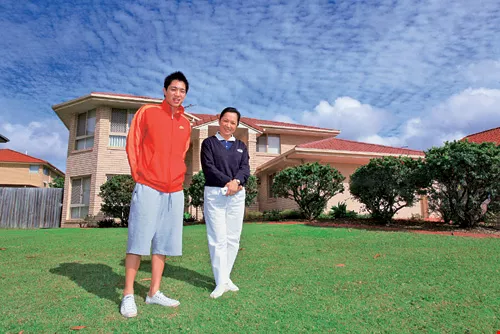
Once Anna Chu had fulfilled her childrearing responsibilities, she began volunteering with Tzu Chi as a means of serving others.
It was hard work, willingness to bear hardship, and an active eye for opportunities that enabled Wang and her family to wring a living from their adopted home (and a better one than many natives).
An Australian report on income and wealth shows that immigrants from Eng-lish-speaking countries have the highest average incomes at A$1,358 per week (about NT$40,740), A$92 higher than Australian natives. Incomes of immigrants from non-English-speaking nations are lower even if they are well educated, at just A$1,145 per week (about NT$34,350).
Taiwanese immigrants are usually uninterested in doing manual labor because they tend not to lack for funds. But what can those who want to work do?
Hsu says that immigrants wishing to work in one of Taiwan's most respected professions (medicine, law, accountancy, architecture and education) have to seek a new license in Australia. That leads to many who worked in these fields in Taiwan to take up new careers. "One well known Taiwanese doctor ended up selling water in Australia."
Immigrants who want to start a business also face difficulties, including unfamiliarity with local law, insufficient language skills, and lack of recognition of their professional credentials.
Sunny Chuan, owner of the Lai Lai Chinese Gourmet Restaurant, has tried his hand at many trades, but none has been a long-term success.
Chuan's parents emigrated to Australia in 1988, but weren't able to drive a car there. They encountered numerous difficulties, prompting Chuan to join them there in late 1992.
Early on, Chuan invested in real estate, but, lacking an understanding of the local market, failed to profit. He then opened a CD shop. In its heyday, the shop sold 450 copies of Jacky Cheung's True Love alone. But the good times didn't last. With the development of the Internet, CD sales nosedived and Chuan began importing magazines and comic books. But then the publishing business went into decline as well. Chuan shuttered his shop in 2005 and opened a restaurant the next year.
Chuan acquired Lai Lai from a Taiwanese chef and did well for a time. But the rise of the Australian dollar and the poor economy in the wake of the Queensland floods caused business to plummet. Nowadays, revenues are less than one-third of their former highs. "We do less than A$4,500 in business even on big holidays like Mother's Day," he says.
Chuan introduces new dishes every two months and plans to see how the restaurant does with Taiwanese-style -mala hot pot. If the new menu fails to increase sales, he's going to pack up and go back to Taiwan.
"I was highly functional in Taiwan," says Chuan. "Here, if I get sick, I have to find an interpreter to help me communicate with the doctor." He says that his 95-year-old father recently suffered acute appendicitis, causing his liver and kidneys to fail. His father's inability to communicate well in English resulted in mistreatment at the hospital. Now that his father has been discharged, Chuan is looking into the feasibility of moving both parents back to Taiwan.

The family of Sunny Chuan (rear, left) is one of the few in the immigrant community to have "three generations under one roof." But when his father got sick, he began thinking about returning to Taiwan.
Chuan is thinking about returning after 18 years in Australia because he still has difficulty communicating with locals. He isn't alone in that.
According to a 2000 survey cited by Hsu, some 31% of Taiwanese immigrants to the US have a masters degree or -higher, versus just 3.9% of those to Australia. This reflects the fact that Taiwanese immigrants to Australia, who generally do not go there to pursue their education, may be less proficient in English and less adaptable than those to the US. According to the Australian Bureau of Statistics, in 1996 some 31.1% of Taiwanese immigrants considered themselves to have poor English or no English at all. While this figure had decreased to 24.3% by 2001, it was still far higher than the 14% for immigrants from Hong Kong.
Xie Tianxiang, a former businessman who used to import and export zippers, moved to Australia in 2006 to save his son from compulsory military service. Xie was among the last to emigrate under an entrepreneurial visa program and obtained permanent residency by buying some A$600,000 in government bonds.
But Xie's elderly parents also needed caring for. Xie and his wife, Zheng Yugui, therefore live separately, with one managing their Taiwanese home and the other their Australian. They switch places twice a year.
Xie's daughter, already a graduate of the foreign languages department of a Taiwanese university at the time they emigrated, has a good command of English. But his son, who was in eighth grade when they moved, has had more dif-fi-culty. Now a university junior, he's still trying to get his language skills up to speed.
Xie had high hopes at the time of the move. He was going to study English and the Bible, and spend time gardening. But his dreams were shattered by the stroke he suffered in June 2008.
"Getting sick here was terrifying," confides Xie. He says that even with private health insurance, he still had to make a A$60 copayment for emergency services and wait more than an hour for the doctor. Worse, he couldn't understand what the doctor said. It was truly frightening, he says, adding "Taiwan is a medical paradise in comparison."
When Xie's daughter, who has the best English in the family, went back to Taiwan to work, he lost the person he most depended on. Now he can't answer the phone, doesn't understand what's on the TV, and fears a breakdown every time he takes his car out on the road.
Xie is counting the days until his son's year-end university graduation, when he'll at last be free.

Xie Tianxiang shuttered his business and moved to Australia so his son could have a better education. Now he's counting the days until his son's graduation from university at the end of this year and looking forward to reclaiming his "freedom."
Men without work seem to lose their spark, and live as if they are breathing their last. Some have described the jobless life as "slow suicide."
But even those who want to start something new in Australia soon find that it's not as easy as they had imagined.
"The skills you bring from Taiwan don't apply here; you're like a hero who's lost his sword," says Wilson Lu, who heads the Taiwanese Chamber of Commerce in Queensland. Lu, who runs a business that trades in rugs and artificial turf, travels to Taiwan five times a year.
He notes that the rules are different in Australia: you can't just start a business or open a shop. You have to file applications. "You can't rely on connections or loopholes. Australians really stress professionalism." Moreover, residential areas are genuinely residential: you can't just open a shop wherever you feel like it. Nor can you run a business out of the ground floor of your home.
Then there's the problem of being unqualified for high-status positions and too proud for low-status ones. Taiwanese immigrants have a deeply rooted sense of the relative status of jobs. "Supermarket clerks may be well paid, and miners make more than doctors," says Lu. "But no Taiwanese are willing to take either job."
Zheng Yuqin, who moved to Australia with her family in 1999, tried hard to adapt to local life when she arrived in Brisbane. But her husband, whose English was poor, had a rough time of it. He moved back to Taiwan alone four years ago, leaving Zheng a "solo mother" in Australia.
"My husband didn't go out much," says Zheng. "I was the one out earning money." In addition to volunteering with the Tzu Chi organization, she also made regular visits to nursing homes, and helped out at an academy and with an organization that arranges activities for Taiwanese young people. Her reason for keeping so busy was her belief that she needed good English, a job, and a social life to enjoy life in Australia.
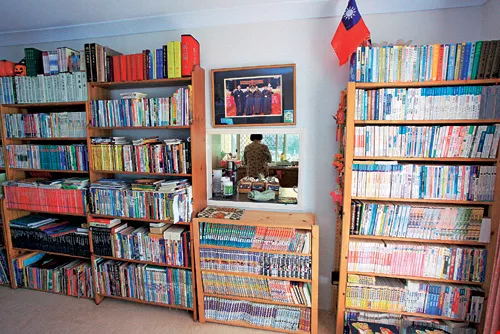
Chinese-language books, old Taiwanese songs, satellite TV.... Though far from home, all are Chen-family staples.
For people who don't work, Australia is beautiful but boring. But for Alex Chiang, who's lived here for 20 years, opportunities abound.
Chiang shuttled between Taiwan and Australia for a decade, but recently decided to give up his business in Taiwan and become a full-time Australian.
One of -Chiang's two sons is set to graduate from medical school this year. The other is a systems engineer. Both have completely adapted to life in Australia, and speak only an awkward English--influenced Mandarin, even at home. -Chiang's sons couldn't work in Taiwan, and -Chiang himself has sold his properties in Taiwan. As he puts it, "Taiwan is a dead end for us."
Two years ago, Chiang paid NT$10 million to acquire management rights to the townhouse complex where he lives, becoming the onsite manager. This makes him responsible for managing and maintaining shared facilities, and renting out empty units. He estimates that, discounting interest, he will earn back his investment in just three or four years.
Chiang also runs a polystyrene molding business. "In Australia, you can say 'see you tomorrow' at two in the afternoon. There's just nothing that pressing, which leaves you time to diversify into other businesses."
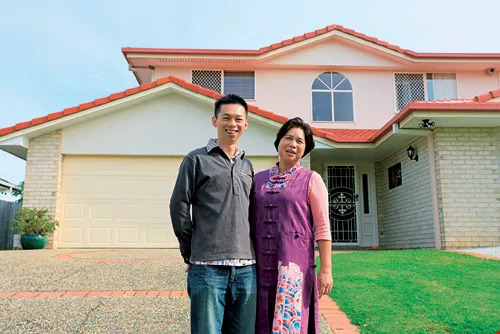
Having moved to Australia to start over after first investing in South Africa, Wang Xiuzhen encourages her son Johnson Chen by reminding him, "Only those who have what it takes can succeed abroad."
In Brisbane, there aren't many Taiwanese immigrant couples who both work. In most cases, a "solo mother" keeps things running on her own.
Jenny Chen came to Brisbane with her two children in 1999, and has been a solo mother for 12 years. Her husband, a property developer in Taiwan, is like a migratory bird who flies in to see them every couple of months. Most of the time, he just talks to them on the phone. "We spend more than NT$10,000 per month on just the phone bill."
"It was very stressful at first," says Chen. To qualify for immigration, she became an investor in a wholesale rug business, while also looking for schools for her two sons, then seven and three and without any English. She also had to take English classes of her own.
Playing the role of both mother and father kept Chen busy all the time. She turned to medication to get a good night's sleep, and even suffered a bout of depression. It was only after a friend got her involved with Tzu Chi as a volunteer and a member of a study group that she began to get herself back on track.
Over her decade-plus as an immigrant, the Australian dollar has strengthened from being worth NT$20 to being worth NT$31. "Earning your living in NT dollars while paying your bills in Australian dollars is tough." Her sons, one in 10th grade and the other a university sophomore, are likely to stay in Australia, but she wants to move back to Taiwan to be with her husband.
"Sooner or later, this migratory life has to end!" exclaims Chen. She says she constantly hears stories about marital problems among the "solo mother" couples. Some fathers continue to pay child support after divorcing their wives, while other less well intentioned ones cut off all ties, leaving their ex-wives as single mothers scraping by on assistance.
A Ms. Yeh ended up divorced from her husband after a long period of living in different countries. Left in Brisbane with virtually nothing, she had to do the best that she could for herself and her middle-school-aged daughter.
Seeking to earn a living, she and her Australian boyfriend left the largely Taiwanese Sunnybank in April of this year, moving to a predominantly white neighborhood where they opened a cafe and restaurant. Yeh, who has fluent conversational English, says red wine gives her the courage she needs to open her cafe every day. "Drinking gives me a thicker skin, and keeps me from getting tongue tied."
No extravagancesYang Tingsheng and Wang Jinwan, a married couple from Puli, Nantou County who emigrated to Brisbane five years ago and are still in immigration's honeymoon phase, still find everything fascinating. But, having heard many tales of immigration train wrecks, they planned their own emigration with meticulous care.
Yang, Wang and their two daughters keep their home as immaculate as the bed and breakfast they used to have in Puli. They are also intensely interested in how to best live in Australia.
Yang fell in love with fishing after coming to Australia, buying fishing handbooks and studying up on fish species and fishing regulations. "You have to release fish under 25 centimeters in length," he says. "If you don't and get caught, it's a A$150 fine."
The family has no income from work and instead relies on the A$40,000 or so in interest they earn every year on their bank savings of A$750,000. "We can't afford to travel or live extravagantly," says Wang.
Yang and Wang have been slowly learning how to pinch pennies. For example, where most Australians make Thursday (the usual pay day) their shopping day, Yang and Wang do their shopping on Wednesdays, when stores offer the most deals. They also stock up on cold and stomach medicines whenever they're back in Taiwan as a means of limiting their medical expenses.
Like most immigrants, the family has a backup plan. "If we really can't get by any longer," says Wang, "we'll go back to Puli and open a bed and breakfast." She says they have a friend who reached that point after seven or eight years in Australia and is moving back to Taiwan next month.
The newer generation of Taiwanese immigrants have economic advantages. Knowing that they'll have few opportunities to earn money in Australia, they bring substantial resources with them, resources that help invigorate the local economy. However, many are nonetheless compelled to split their time between their motherland and their new home.
Taiwanese have been immigrating to Australia for more than two decades, exchanging, absorbing and passing on information and experiences all the while, increasing mutual understanding and forging closer ties between our two lands.
Immigration is a difficult undertaking, one that involves losses as well as gains, but is never a waste of time.
@List.jpg?w=522&h=410&mode=crop&format=webp&quality=80)

@List.jpg?w=522&h=410&mode=crop&format=webp&quality=80)


@List.jpg?w=522&h=410&mode=crop&format=webp&quality=80)

@List.jpg?w=522&h=410&mode=crop&format=webp&quality=80)
