SL Towel: Rebirth Through Creativity
Chang Chiung-fang / photos Hsueh Chi-kuang / tr. by Chris Nelson
February 2010


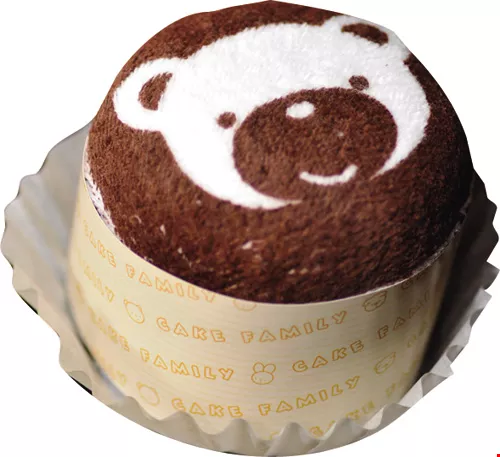
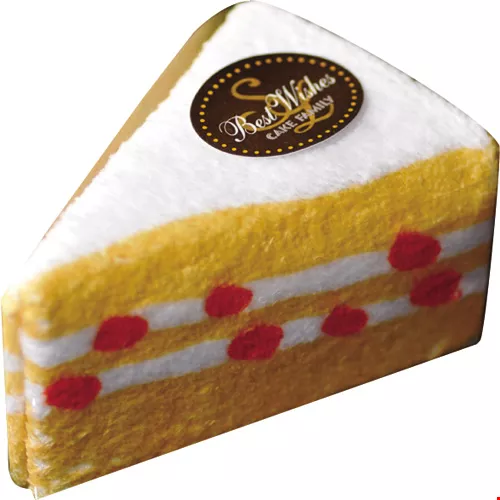
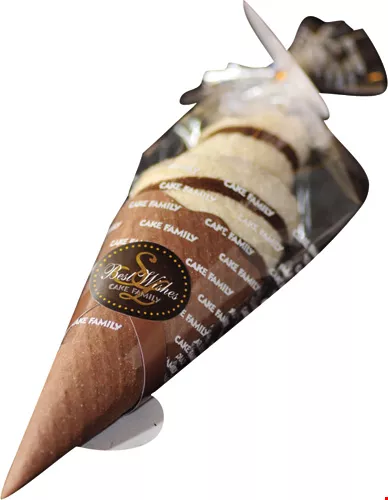
Chocolate cake, Swiss rolls, ice cream, fruit yogurt, lollipops, rice dumplings... the tantalizing treats in the display window look delectable. But don't try to eat them!
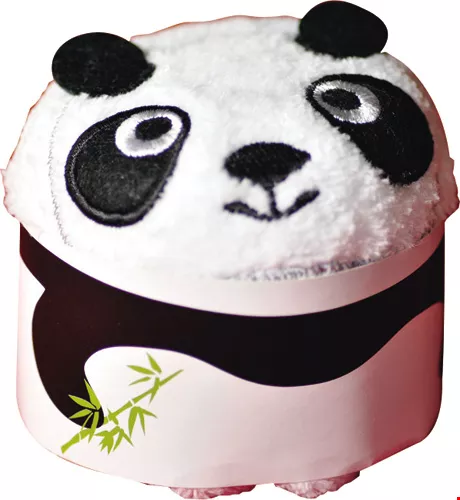
Like the pandas, Santas, reindeer and poinsettias displayed nearby, it's hard to believe that these delightful, lifelike items are actually made from towels.
As towel manufacturers fretted about whether they'd be placed on the so-called "early harvest list" during the Economic Cooperation Framework Agreement (ECFA) negotiations with mainland China, Shing-Long Towel Industrial Co. (or SL Towel), located in Huwei Township, Yunlin County, was busy spending the past couple of years extricating itself from its economic woes, reshaping its troubled enterprise into a creative and dynamic tourist factory.
As the Chinese New Year holidays approach, let's go take a look at SL Towel, and avail ourselves of the miracle of a Taiwanese towel company challenging fate and forging a new lease on life.
The memorable watermelon boxes at last May's Yunlin County Watermelon Festival, the tiramisu rolls at Hualien's Farglory Hotel, the little cakes sold at Hualien Farglory Ocean Park, the cake souvenirs given away by Intel, and the 404-centimeter Christmas tree in the lobby of the Janfusun Prince Hotel: these are just some stunning examples of the originality displayed by SL Towel.
For the Christmas tree, Michael Lin, SL Towel vice president, originator of the company's tourist factory and current CEO of Intelligent Marketing Innovative Co., spent an entire month planning before leading six employees in building it over three days. They took a store-bought artificial Christmas tree as a base, onto which they tied together 41 white bath towels and 408 small colored towels, stacking them to look like a snow-covered Christmas tree. Quite a feat!
Though the company has yet to sell these creative items in the overseas market, one of SL's primary novelty products, the Cake Towel, has been sold indirectly in the UK, Australia, New Zealand and Denmark, as well as in such US locales as Hawaii, New York, Chicago and Los Angeles, testament to the manufacturing prowess of Taiwan's textiles industry and the creative potential of Taiwan's people.
From bathrobes to cakes, from manufacturing to the service industry, SL Towels president Lin Kuo-lung's insistence on quality towels has remained consistent.
Former policeman Lin Kuo-lung, together with his wife, who worked at a towel factory, founded SL Towel in 1979. The twin rows of sweetgum trees they planted in front of the factory still stand erect today, having stood with the company through the trials of its three-decade history.
The history of SL Towel is a reflection of the rise and fall of Taiwan's towel industry.
The period leading up to 1991 was the heyday of Taiwan's towel industry. SL Towel president Lin Kuo-lung notes that there were over 200 towel factories in Taiwan's towel capital Huwei back then, with fully equipped production lines engaging in all manufacturing processes from warp knitting to embroidery, with a total annual output exceeding NT$2.5 billion.
"At that time we exported dish towels and cloth for athletic shoe insoles to the US. Business was booming," says Lin. Back then, SL Towel operated three shifts a day, outputting over 20,000 kilograms of towels a month.
But in 1993, overseas orders dropped markedly. Traditional industries were moving overseas in droves, and Taiwan's towel makers started vying for the domestic market.
Starting around 1996, vast quantities of low-priced towels from China flooded Taiwan's market, being either smuggled in or passed off as originating in other countries, and local factories began closing their doors in the face of this dumping. The towel industry shrank so much that now there are less than 30 towel factories left struggling in Huwei.
After Taiwan entered the World Trade Organization in 2002, mainland Chinese towels could be legally imported into Taiwan; yet even so, some were falsely labeled "Made in Taiwan," causing a further blow to Taiwan's towel industry.
Lin sighs when speaking of the hardships of that time. Says he, "The towels in our factory were stacked high back then, covered with a thick layer of cotton fiber after sitting untouched for ages. Factory employees worked only half-day shifts, and at the end of each workday they would ask, 'What time do we come in tomorrow?'"
From bathrobes to cakes, from manufacturing to the service industry, SL Towels president Lin Kuo-lung's insistence on quality towels has remained consistent.
To survive, towel manufacturers banded together in late 2004 to found a self-support organization. They held a public hearing in Taipei to petition the government to ban the import of fake-labeled mainland Chinese towels, and asked government agencies (such as the military) to purchase Taiwan-made towels.
Lin Kuo-lung formed the Yunlin Towel Industrial Technology and Development Association, serving as its first executive director, and petitioned the government to increase import tariffs on mainland Chinese towels. In March 2006, he chartered 25 tour buses to bring more than 1,000 towel makers to Taipei and protest the Taipei visit of Chen Yunlin, president of the Association for Relations Across the Taiwan Straits, fighting for the industry's right to survive.
Soon afterwards, the Ministry of Finance carried out an investigation, confirming that the mainland had dumped low-priced towels in Taiwan, and announced that starting September 2006, an anti-dumping tariff of 204.1% would be imposed on towels for five years. Taiwan's towel industry has bounced back under this protective umbrella.
However, the umbrella cannot remain open forever; the industry has to change to stay afloat. As Lin struggles to fight for Taiwan's towel industry, his son Michael has been vigorously searching for ways to transform the industry.
In fact, the popular Cake Towel was something that Michael Lin's wife folded together by hand during a family meeting.
But the road from idea to finished product was fraught with pitfalls. After several attempts and improvements, SL Towel was finally able to secure a Taiwanese patent for the Cake Towel via a cylindrical paper mold. Once that was in place, profits began to rise such that a small square towel worth little more than NT$10 tripled in value after being transformed into a cake.
A former Internet firm employee, Michael Lin returned home in 2004 to help the family business set up an online sales channel, and soon orders started pouring in, not only creating a market for the Cake Towel, but also boosting the added value of the towel industry.
In 2007, Michael Lin learned that the Ministry of Economic Affairs' Central Region Office was launching a tourist factory support program, and this jibed with Lin's ideas. Soon he began transforming the 30-year-old SL Towel factory into a tourist factory.
A towel is born
Unlike at other companies in the service industry, the guides at SL Towel's tourist factory do it the old fashioned way, carrying megaphones as they personally describe the process through which a towel is born, from design through weaving, eliciting the visitors' support for Taiwan's traditional industries.
SL Towel takes cotton imported from Pakistan and feeds it into the loom for warp knitting. To strengthen the yarn and prevent splitting, it's sized with cornmeal, then woven into cloth mechanically. After dyeing, it's cut into three or four strips, and then embellished with embroidery and other techniques. The towel thus becomes a finished work.
Cotton fibers fly around during the manufacturing process, so not only do employees need to be fully equipped with safety clothing, but visitors are only allowed to observe the weaving and production process through a glass partition.
But visitors can't view the dyeing and embroidering processes. Lin Kuo-lung explains that there are no longer any towel manufacturers in Taiwan whose manufacturing is entirely in house, and the work is farmed out to other small companies.
The manufacturing process for a tiny towel is complex, with eight processes altogether; moreover, if they're not carried out meticulously, numerous problems can crop up. Lin Kuo-lung says that towels are products that people apply to their skin daily, so quality is of utmost importance. A towel must be absorbent, colorfast, soft to the touch, and also non-toxic.
Have you used towels that become stickier and less absorbent the more you use them? Have you ever washed your face only to find colored dye on it? Lin Kuo-lung elucidates: some makers use artificial gums in place of food-grade cornmeal for sizing, making the towels stickier the more you wash with them. And before dyeing, the fabric must undergo six hours of steaming in order to bleach it white and cook away the sizing agent; otherwise impurities will render the towel less absorbent. As for colored dye ending up on your face, it's due to poor quality bleaching and non-colorfast dyes.
Moreover, dye safety is vital. If residues of inferior dyes on the towel are absorbed through the skin into the body, there's the risk of bladder cancer.

A father brings his daughter to the DIY workshop to fold towels. The girl's glowing smile is part of the added value that the tourist factory strives for.
In December 2008, when SL Towel began offering free factory tours to visitors, word began spreading through the writings of bloggers and the e-mails of friends and family. Increasing numbers of people have been drawn by the endearing Cake Towels, with monthly visitations surpassing 30,000. The throngs of visitors have boosted on-site revenue and towel sales, saving SL Towel, once NT$30 million in debt, in the nick of time, enabling them to pay off their debts in full and make a profit.
The main event for a factory visitor is selecting cakes in SL Towel's gift shop to bring home as souvenirs, or perhaps visiting the DIY shop to make a shaped towel for oneself.
In the DIY shop, you can learn to make four styles: fruit yogurt cakes, ice cream cones, bunny rabbits and cake slices. To make a rabbit, first fold a small towel along the diagonal, leaving two "ears." Roll it up, then fold it across, and pull out two flaps to serve as feet. Secure the feet with rubber bands, tie a ribbon around in a bow, and voila! A bunny rabbit! As the teacher gives the instructions and demonstrates the techniques, the participants work earnestly, and though their creations aren't as refined as those of a trained professional, at least they're in the ballpark.
Michael Lin stresses that even though most consumers buy these products as decorations, SL Towel does not skimp on towel quality. In other words, despite the complex forms and fine packaging, the products, whether cakes or pandas, are high-quality, usable towels when unfolded.
Just like the company's latest product, the Phoenix, SL Towel, whose fortunes have mirrored those of the Taiwanese economy-from Taiwan's economic takeoff and the export boom, to industrial relocation overseas, mainland Chinese dumping, and finally creating new value from tradition-has risen once again from the ashes!
From bathrobes to cakes, from manufacturing to the service industry, SL Towels president Lin Kuo-lung's insistence on quality towels has remained consistent.
From bathrobes to cakes, from manufacturing to the service industry, SL Towels president Lin Kuo-lung's insistence on quality towels has remained consistent.
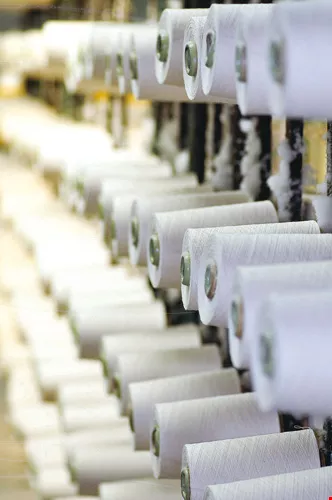
There are no longer any towel factories in Huwei that do complete in-house manufacturing. But amid the sound of SL Towel's looms and shuttles, you can still feel the glory days of Taiwan's towel capital.

@List.jpg?w=522&h=410&mode=crop&format=webp&quality=80)

@List.jpg?w=522&h=410&mode=crop&format=webp&quality=80)


