

Elections are looming in Tai- wan's special municipalities, now to be expanded to five in number. In the bellwethers of Taipei City and Xinbei City (currently Taipei County), where campaign battles are sure to be hotly fought, it's unclear whether the KMT's Hao Lung-bin and Eric Chu or the DPP's Su Tseng-chang and Tsai Ing-wen will prevail.
Pitcher Wang Chien-ming, the "pride of Taiwan," is rehabilitating from an injury. What chance does he have of making a big-league appearance this season with his new team, the Washington Nationals? And if he does play, will he make his first appearance in August or September?
Over the course of their lives, people demonstrate concern for a wide variety of future events. Everyone would like to be able to predict outcomes for these events as soon as possible, but apart from throwing divination blocks at temples, or perusing polling data, or taking the word of experts, is there a predictive method that is both convenient and scientific?
You bet! And it's probably something you never anticipated-namely, the turning of possible outcomes into tradable futures contracts, which are sold on prediction markets open to the public. When participants are convinced of an outcome, they will buy its contract even at a high price; and, conversely, if they're sure it won't happen they'll sell even at a low price. With large numbers of people buying and selling, a "consensus price" emerges on the market. And eventually, the price can be regarded as indicative of the likelihood of the event happening.
It may sound a little strange, but that's exactly how the Exchange of Future Events works. A synergy of the Center for Prediction Markets at National Chengchi University, the Institute of Information Science at the Academia Sinica and Swarchy Inc., the exchange predicted vote percentages for elections in Taiwan from 2006 to 2009 with more than 90% accuracy. Moreover, three days before this year's Golden Melody Awards it correctly predicted that A-Mei and her album "AMIT" would win for "best Mandarin female vocalist" and "best Mandarin album" (with probability rates set at 62.5% and 84% respectively). It's consistently been close to its marks.
How exactly does this "prediction market" operate? And what are the secrets behind its remarkable record of success?
Traditional "futures markets" are places where buyers and sellers trade commodities to be exchanged at future dates. Both parties sign contracts in which they agree to buy or sell amounts of actual commodities at a specified price and time in the future.
Because a future price is what's being set, these contracts are typically made for commodities that are produced in large quantities and that require a long time to mine or reap-such as gold, crude oil, and grains. Either to lock in an advantageous price or to avoid risk from market unpredictability, investors spare no effort in performing due diligence and analyzing trends. Then they add in their own personal experience, insight and intuition before carefully making a trade. In other words, prices in futures markets reflect the judgments and predictions of large numbers of investors.
Futures markets can be traced at least as far back as the Tokugawa Shogunate in Japan, where rice was by far the most important medium of exchange. Officials' salaries, the value of money and the territories assigned to various levels of samurai were all defined in quantities of rice. Fluctuations in the price of rice, whether caused by overproduction or shortages induced by natural disasters, would have a big impact on the overall economy. Consequently, the Do-jima Rice Exchange, a market for exchanging futures in rice, opened in 1730 in Osaka, the center of an area where annual rice taxes were imposed.
At Do-jima, globally recognized as the world's first futures market, rice traders would decide, based on variables such as the expected future market price for rice and actual harvests, on how to market rice and how much to store in their granaries. And, based on the fluctuations in the price of rice and its impact on the economy or its potential for creating a military crisis, the decision-making shoguns would make preparations of their own.

Will A-Mei win a Golden Melody Award? When will Wang Chien-ming return to the big leagues? What nation will win the World Cup? The Exchange of Future Events has hosted trade in prediction contracts on all of these topics. The rise or fall in the price of a potential outcome's contract reflects the changing consensus on that outcome's likelihood. The photo above (by Hou Gengnian) shows A-Mei at the Golden Melody Awards ceremony.
After 280 years of development, the kind of products traded via futures contracts have grown increasingly varied. They broadly can be put into the following categories: agricultural (especially grains), metals (such as gold, silver and copper), energy (crude oil and its derivatives), and soft futures (cocoa, coffee and other specialty crops). Factors that can influence prices for these futures include the weather, supply and demand in the area where the commodity is produced, government policies, international market fluctuations and so forth.
The rise or fall of the price of a futures contract could be described as representing a change in the "collective prediction" about the future price of that commodity. In fact, the economist Friedrich August von Hayek, who won the Nobel Prize for economics in 1974, essentially said as much back in 1945: "The mere fact that there is one price for any commodity brings about the solution which... might have been arrived at by one single mind possessing all the information which is, in fact, dispersed among all the people involved in the process."
The idea of price reflecting information is behind the "prediction markets" that came into being many decades later. Moreover, "prediction markets theory," which uses market mechanisms to make observations about various social trends, has for two decades been growing by leaps and bounds around the world.
The world's first predictions market was the Iowa Political Stock Market, which was founded by three professors-George R. Neumann, Robert Forsythe, and Forrest Nelson-at the University of Iowa's business school in 1988. The professors were pushed to action after Jesse Jackson, an African-American that was behind in the polls, wound up winning the Democratic primary in Michigan with 55% of the vote.
Harboring doubts about the accuracy of polling, the three Iowa economists came up with their path-breaking concept by extending the economic theory that regards market prices as manifestations of "collective consciousness." It was the first time that the economic model of commodity futures markets was used as a blueprint for creating an exchange to predict election outcomes.
So as to get participants to take a more diligent attitude to these "trades," the founders had to jump through bureaucratic hoops to get authorization for players to use real money (with the amount that any one player can invest restricted to a range of US$5-500). Playing with real money, it was thought, would get people to throw themselves more diligently into this new activity.
At first, participation in the Iowa Political Stock Market was restricted to students and professors, but after its accuracy engendered a lot of interest, in 1992 its name was changed to the Iowa Electronic Market, and participation was opened up to "players" from around the world. Moreover, contract topics were no longer restricted to America itself. For instance, in 1999 two kinds of contracts were offered about the following year's presidential elections in Taiwan. The first predicted who would win the election, and the second predicted the share of the votes that the three main candidates would receive.
When the market closed on March 16 of 2000, the prices for the first set of contracts showed Chen Shui-bian's chance of winning at 55%, James Soong's at 38%, and Lien Chan's at 28%." The second set of contracts, which estimated vote totals, had Chen getting 39%, Soong 37.5%, and Lien 26%. In the actual election, they ended up at 39.3%, 36.8% and 23.1%. The Iowa market was pretty close to hitting the bullseye.
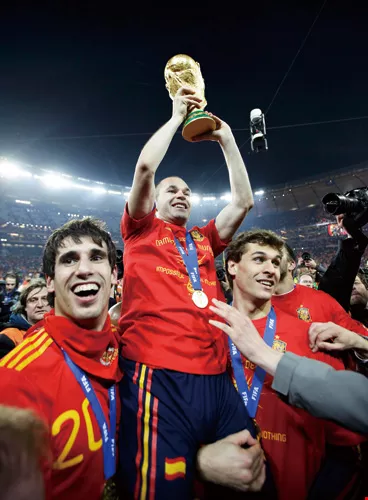
At this summer's soccer World Cup, the Spanish team, despite losing to Switzerland in group play, performed brilliantly from the round of 16 on. It ended up the eventual champion. For the finals, the Exchange of Future Events, like Paul the Psychic Octopus, predicted that Spain would win. Spanish victory contracts ended up trading for as high as NT$65.8. (left:) Paul the Octopus, whose unbroken run of eight accurate predictions brought him global fame during the World Cup. (facing page:) The Spanish team celebrates.
It was impressive that an electronic market in distant Iowa could accurately predict election results in Taiwan. In fact, according to a long-term research study that was published in 2008, the electronic market had predicted American election results from 1988 to 2004 with 74% greater accuracy than Gallup, Harris, The New York Times, and other established pollsters. It could fairly be described as the United States' most accurate predictor of elections.
The success of the Iowa Electronic Market spurred interest in prediction markets in other nations, including Austria, Australia, Canada, Germany, and the Netherlands. One after another, prediction markets that offered contracts predicting election outcomes were established in those nations. Other kinds of prediction contracts offered include those for sporting results, box-office takes, product sales, and even infectious disease rates.
In 2003 the Institute of Physics at the Academia Sinica established Taiwan's first prediction market: the Taiwan Political Exchange (TAIPEX). Its goal was to handle trading on predictions for the Taiwan presidential elections. It came into operation during the 2004 presidential election campaigns. Back then all the media polls saw the KMT's Lien-Soong ticket well ahead of DPP incumbents Chen Shui-bian and Annette Lu. Only TAIPEX had Chen-Lu ahead of Lien-Soong, by 50% to 48%. Eventually Chen and Lu won by a margin of 0.2%. The accurate prediction demonstrated the masses' wisdom and intuition, and it shone a spotlight in Taiwan on the powers of prediction markets.
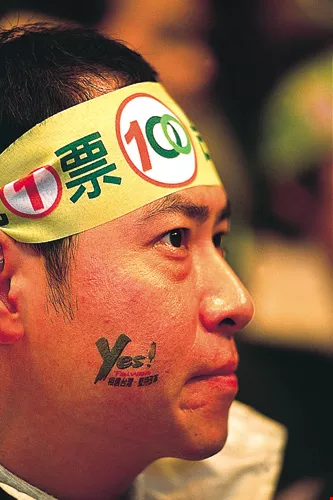
Since the ROC presidential elections in 2000, various prediction markets, including the Iowa Electronic Market, The Taiwan Political Exchange, and the Exchange of Future Events, have accurately predicted election outcomes in Taiwan. (left and facing page:) DPP and KMT rallies during the 2004 ROC presidential election campaign.
Although it produced accurate results, TAIPEX had a narrow focus on Taiwan's presidential elections. In order to collect more research data, National Chengchi University established its Center for Prediction Markets in 2006. Moreover, in July of the same year, the university, along with the Institute of Information Science at the Academia Sinica and Swarchy Inc., established the Exchange of Future Events (Xfuture) and its website (xfuture.org), which serves as an exchange for prediction contracts on a wide variety of issues, including politics, elections, finance, cross-strait relations, society, international relations, sports and entertainment.
Xfuture has attracted participants from more than 121 nations and 4,842 cities around the world. Its total membership of players is approaching 70,000. About seven-tenths are from Taiwan, one-tenth from mainland China, and two-tenths from other nations. Currently, it is the only general prediction market in Taiwan.
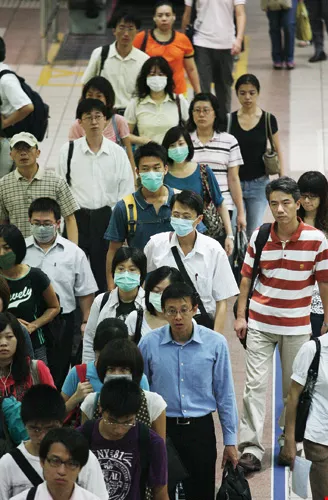
Through the participation of front-line medical workers, epidemic prediction markets can help people prepare ahead of time for outbreaks of infectious diseases. The photo shows people wearing masks on the street during the major outbreak of the H1N1 flu virus in 2009.
Because the ROC's Futures Trading Act only recognizes trading in "commodity futures" and "financial derivative futures" but not "prediction contracts," real money can't be used to buy and sell those contracts. Consequently, points that possess only theoretical value (or value for bragging rights) are used instead. When a member joins, he receives 100,000 points, and then he goes on to gain or lose points depending on the accuracy of his predictions. It's akin to gaming sites that keep a running tally of how many times players have killed or been killed.
And though the site still does not allow for real money to be put on the line, it has nonetheless attracted players with strong interests in the future. By the end of April, the site had issued a total of 1969 sets of contracts on future events and 13,437 individual contracts. These had been traded a total of 214 million times. Players have seemed to show just as much enthusiasm as those trading contracts worth real money.
The site has turned out to be most accurate when it comes to elections, which have typically garnered the greatest attention. For instance, with regard to the 17 elections for city and county executives in 2009, XFuture predicted the winners with 100% accuracy (compared to 88.2% for media polls). When it comes to the percentage of the total vote that candidates received, the accuracy level was 87.9% 10 days before the election, rising to 90.53% on the day before the election. Its record has truly been impressive.
Its success in comparison to traditional polling or expert opinion can be ascribed to the following factors:
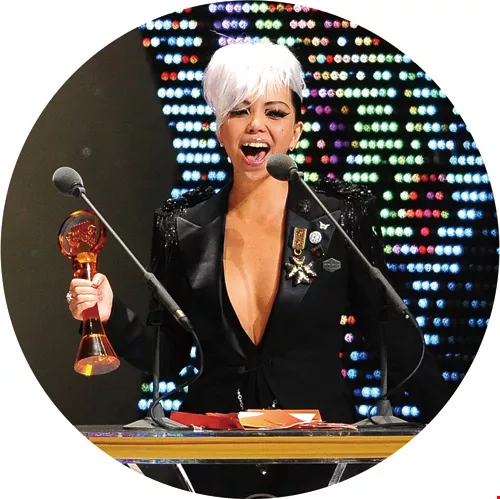
Will A-Mei win a Golden Melody Award? When will Wang Chien-ming return to the big leagues? What nation will win the World Cup? The Exchange of Future Events has hosted trade in prediction contracts on all of these topics. The rise or fall in the price of a potential outcome's contract reflects the changing consensus on that outcome's likelihood. The photo above (by Hou Gengnian) shows A-Mei at the Golden Melody Awards ceremony.
Tung Chen-yuan, director of the Center for Prediction Markets and a professor at the Graduate Institute of Development Studies at National Chengchi University, points out the mechanisms used by prediction markets are quite unlike the techniques employed by traditional polling organizations (such as random sampling and asking of questions), which offer neither rewards for being right nor punishments for being wrong and consequently suffer when respondents answer untruthfully. Aiming to "win" more points, when participants place orders, they typically don't purchase contracts based on the outcomes they personally desire. Rather, they place their bets after assiduously gathering information and making the best possible assessments. If they wing it and make a hasty decision, they may well end up paying for it with a loss of points.
The mechanism for rewards and punishments imperceptibly lowers the rate of dishonesty among participants, and, consequently, with regard to predicting future outcomes, "mass wisdom" often surpasses "expert assessment."
Tung cites an example: On June 13, 2008 Taiwan and mainland China signed tourism agreements, and the ROC government optimistically predicted that an average of 3000 mainland tourists would come per day. XFuture simultaneously issued six contracts for predictions about how many mainland tourists would come to Taiwan before the end of the year: "under 100,000," "100-200,000," and on up to "more than 500,000."
Unexpectedly, the contract for "under 100,000" immediately began to attract the most buyers when trading started in August. At its peak, the price for that contract exceeded NT$90 (meaning that it had an expected probability of over 90%). The prices for the other contracts, meanwhile, were stuck in the single digits. Eventually, 89,000 mainland tourists-or 244 per day-came by the end of the year. Once again "the people" had beaten "the experts!"
"The result shouldn't surprise anyone," says Tung, an expert on cross-strait relations who was once vice chair of the Mainland Affairs Commission. "When I participated in XFuture myself, I lost a lot of points." Tung holds that when it comes to trading prediction contracts, the "experts" aren't necessarily the winners. That's because there's a lot of first-hand information that isn't publicly disclosed but is only passed among "insiders." Experts that try to serve as objective outsiders don't have opportunities to learn this inside dope. Take the aforementioned example about the number of mainland tourists. The players buying contracts may have been tour guides, travel agency personnel, mainland tourists, and even policy makers on both sides of the Taiwan Strait. Because these players want to win, they of course make judgments that are closest to reality. It's what is meant by the Chinese idiom: "Three stinky cobblers will beat one master strategist such as Zhuge Liang." The common consensus formed from the collective intelligence of the masses will naturally "not be far off the mark."
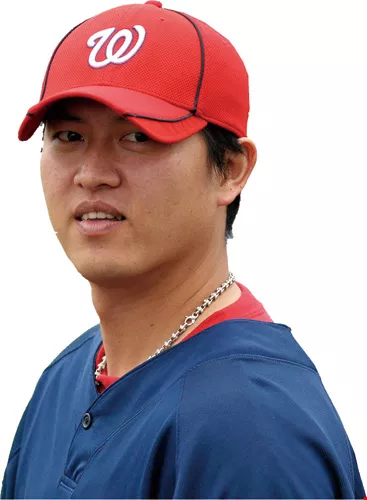
When will Wang Chien-ming make his first appearance back in the majors after rehabilitation? That question is on the minds of his many Taiwanese fans. According to the value of prediction contracts at press time, the most likely time for his return will be September, the last month of the regular season (36-39%). But the next most likely outcome (28%) is that he won't appear at all this year. Only time will tell what really happens.
Another underlying reason for the success rate of prediction contracts on XFuture is that new information is constantly having an impact on the price.
Tung explains that events that can affect election outcomes are constantly occurring during campaigns. The slightest bit of news can have an impact on a candidate's support. Take, for instance, the upcoming elections for Xinbei City (currently Taipei County), one of the new special municipalities to be created in December 2010 when the number of municipalities will be expanded to five. On May 10, the contracts that picked the winner as the KMT candidate (Eric Chu) cost NT$65, whereas those picking the then-unnamed DPP candidate, were going for around NT$40. But once Tsai Ing-wen announced as the DPP candidate, KMT-victory contracts dropped to NT$50-51, and the DPP-victory contracts rose to NT$49-50. Ever since, they've been right around 50-50.
Another interesting example of these "continual corrections" occurred for World Cup outcomes. The South American nations of Brazil and Argentina both fielded "dream teams" that had seemed unstoppable in group play, and before the quarter finals they had continuously been highly regarded among those trading prediction futures. Right before the quarter finals, the highest-priced contracts were for Brazil (NT$38) Argentina (NT$37), and Germany (NT$17.5).
But on July 2 and July 3 Argentina and Brazil were defeated, pushing the price of a German victory to a NT$41, the highest among the four teams in the semifinals. The orange squad of the Netherlands was next at NT$29.1 (whereas it had been at only NT$11.9 before the quarter finals). Meanwhile, Spain, which had narrowly defeated Paraguay by a one-goal margin, was trading at only NT$23.8 (it had been at NT$16, higher than Holland, before the quarter finals). Spain, however, played extremely well in defeating Germany in the semi-finals. What's more, Paul the Octopus, who had shown a perfect record of predictions at the World Cup, picked a Spanish victory. Consequently, victory for Spain ended up trading at NT$67.8, whereas victory for the Netherlands ended up trading at only NT$32. Paul and the Xfuture masses ended up on the same victorious side.
The constant fluctuations in price for these prediction contracts in fact reflect changes to the general consensus. Tung points out that players can make trades on the website 24 hours a day, and that the computerized transactions are processed every day from 9:00 a.m. to 11:00 p.m., so that the price constantly reflects the current situation.
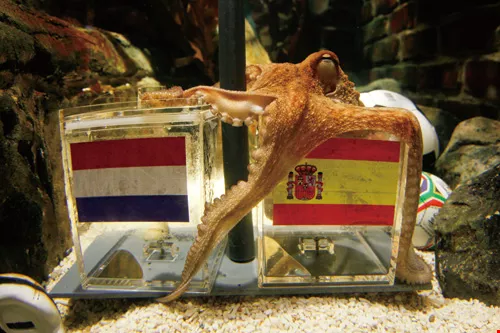
At this summer's soccer World Cup, the Spanish team, despite losing to Switzerland in group play, performed brilliantly from the round of 16 on. It ended up the eventual champion. For the finals, the Exchange of Future Events, like Paul the Psychic Octopus, predicted that Spain would win. Spanish victory contracts ended up trading for as high as NT$65.8. (left:) Paul the Octopus, whose unbroken run of eight accurate predictions brought him global fame during the World Cup. (facing page:) The Spanish team celebrates.(courtesy of Top Photo Group)
After building public trust, the Exchange of Future Events also became a focus of media interest. But just as it's hard for traditional futures markets trading commodities to avoid market manipulation, the exchange, with its growing renown, began to attract players with ulterior political motives, who were registering under multiple aliases with the intent of elevating or depressing the contracts for certain candidates. They were aiming to influence others' judgments about the election situation. XFuture's record had a rare blemish in February, when it correctly predicted the outcome of only two county elections: those in Taoyuan and Chiayi. It fell markedly below its historical batting average.
To put an end to these abuses, in April the exchange shut down for 10 days to implement new controls. Now, as soon as a player uses the same IP address to register twice, the system will withhold all rights to play from that address. Even better protection against fraud is provided by the stipulation that players who haven't played more than 10 contracts or who have never won more than 1000 points can't participate in election futures, political topics or other "especially sensitive" futures topics.
"We are sparing no effort to maintain a stance of objectivity," Tung says with great sincerity. "There's absolutely no value in fake predictions!"
Humankind has long held a keen interest in the ultimately unknowable future. By combining the wisdom of the masses, prediction markets provide a methodology for prediction that is both convenient and scientific. But because prediction markets are based on the idea that "price reflects information," a rigorously designed trading mechanism and a sincere attitude among the participants are essential. These are preconditions that the widely respected Exchange of Future Events is diligently striving to meet.
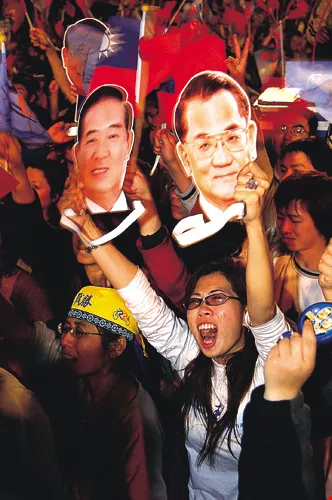
Since the ROC presidential elections in 2000, various prediction markets, including the Iowa Electronic Market, The Taiwan Political Exchange, and the Exchange of Future Events, have accurately predicted election outcomes in Taiwan. (left and facing page:) DPP and KMT rallies during the 2004 ROC presidential election campaign.

@List.jpg?w=522&h=410&mode=crop&format=webp&quality=80)
@List.jpg?w=522&h=410&mode=crop&format=webp&quality=80)


