

Of the myriad products produced in prisons, affordable and delicious sauces, candy, cookies, and snacks have stood out for the positive response they have met with in the outside world.
However, there are some prisons where, instead of pandering to the tastebuds of the populace, prisoners work on intricate, creative handicrafts. These, too, have met with rave reviews from those in the know, and the most representative of these is the traditional lacquerware produced by inmates of Taichung Prison. Taichung Prison holds the largest number of convicts in Taiwan, but behind its towering walls, lacquerworking is bringing warmth and a deeper sense of values, healing hearts through art.
Central Taiwan has long suffered a relatively high crime rate for Taiwan-according to statistics from the National Police Administration, in Taichung City in 2007 there were 3,275 incidents for every 100,000 people. This is the highest crime rate in Taiwan, approximately 15% higher than in second-placed Chiayi City.
This high crime rate is also reflected in the high occupancy of the regional prison. Taichung Prison, which occupies 20 hectares, currently holds the largest number of people of any Taiwanese detention center: in total, over 5,500 inmates are serving their sentences here (1,500 over capacity), and at one point that number soared to over 7,000. The vast majority of inmates here are serving sentences of 10 years or longer for serious crimes.
With so many violent criminals in the prison, naturally the educational work projects they undertake must also be especially carefully considered.
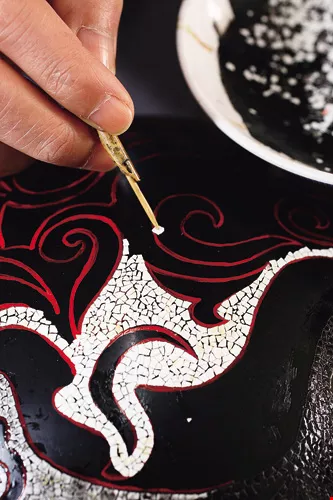
As cashew-based lacquer can't be used to create white designs, the white parts of this design must be done with shell inlays.
Once known as Huludun, the city of Fengyuan in Taichung County was the hub of Taiwan's lacquerware industry during the Japanese occupation. The industry continued to prosper afterward, reaching its peak in the 1970s, when annual sales of lacquerwork totaled NT$600 million or more. Unfortunately, as Taiwanese industry began to change and as lower-priced Chinese lacquerware became available, Fengyuan's lacquer industry began to decline, along with the number of its practitioners.
While everyone else was lamenting the imminent loss to history of this lacquerware and its combination of artistry and artisanship, Taichung Prison unexpectedly took on Fengyuan's mantle.
"As the saying goes, an iron pestle can be ground down into a needle, and similarly the inmates here have almost unlimited potential!" exclaims Taichung Prison deputy warden Lin Wanyuan. When the Ministry of Justice implemented the "one prison, one product group" policy, prisons were particularly encouraged to develop their own industries, preferably ones that are related to endangered traditional arts or crafts in the areas where the prisons are placed. Of course, the most iconic traditional craft in central Taiwan is lacquerware.
"Craftwork like this, which demands a high level of skill and a long time to train, is pretty well suited to the inmates we have here," he jokes.
And so since 2005, Taichung Prison has run three lacquerwork training courses, even hiring people like award-winning lacquer artist Shi Jiaxiang to teach. Thus far, 67 lacquerists have gone through the training successfully, and now the works they produce are generating an annual revenue of around NT$6.5 million.
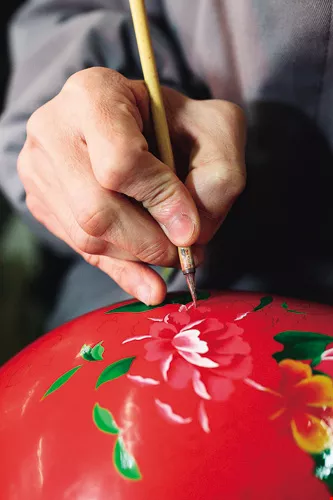
The technique of creating a design directly on the lacquer's surface is known by the Japanese name "maki-e."
Most prison training courses are designed specifically with inmates serving sentences of two years or less in mind. Because of the high technical threshold, the lacquerwork courses are limited to serious offenders serving at least two years with no chance of parole, and those with a background in the arts get priority.
Trainees start with the fundamentals, including composition, painting, calligraphy, and color theory, before moving on to classes in using a potter's wheel, lacquering, and sculpting. Finally, they test their skills with advanced techniques like maki-e (a technique where gold flakes are sprinkled into fine lines in the lacquer before it dries), raden (where shells are ground into powder and/or inlaid into the piece), and hyoumon (where thin sheets of gold, silver, copper, or other metals are cut into the shapes needed and stuck to the lacquerware).
Supervisor of the lacquerwork operations at Taichung Prison Wu Wenrui explains that lacquerwork is highly intricate, and to train someone to become professional at it can take at least two or three years. That path from knowing nothing to creating aesthetically pleasing, good-quality pieces can test the patience and willpower of the inmates, accustomed as they are to their old ways and with their "get-rich-quick" mindset.
Starting with the clay body, first the clay needs to be shaped, then a base coat extracted from cashew nuts is applied. Rather than traditional lacquer, the inmates use cashew-based lacquers, which do not pose the same risk of lacquer dermatitis, an occupational hazard for lacquerists. Next, gauze is applied to the undried lacquer, with the following layer of base coat filling in the gaps in the gauze. Once the layer is dried, it is smoothed off with waterproof abrasive paper.
These steps need to be repeated seven or eight times, until the base coat reaches a suitable thickness to support the final piece. Then, finally, the piece is filled with water, dissolving the clay body underneath the base coat. This process is the biggest test of nerve in lacquerworking-that of making bodiless lacquerware.
Once the body has been removed, the piece weighs barely a tenth of what it did originally, so you can imagine how fragile it is. With the body gone, the artist can start detailing the piece, a process that is labor intensive and can take at least seven to 10 months to complete.
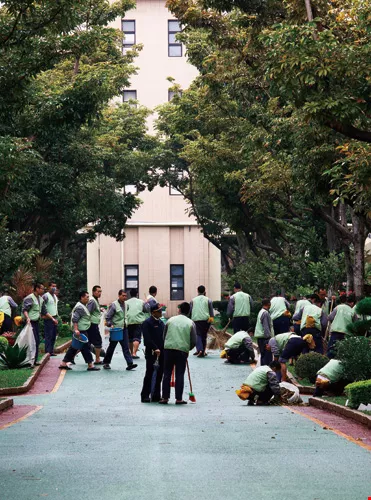
Keeping their surroundings clean and organized is another one of the main "jobs" of the inmates. This photo was taken at Taichung Prison.
"Through lacquerworking, I've learned to be more upfront and to try and confront and solve the problems in my life," says one Taichung Prison inmate, "Wenhua" (not his real name).
Serving a sentence of 13 years and two months for firearms-related offenses, Wenhua originally decided to volunteer for the lacquerworking course because "it's not like I was doing anything else." He never expected to find a new interest in art or have his values changed.
Wenhua explains that while making lacquerware, there are plenty of things that can go wrong-the piece could break, the design might not come out right, the gold powder might end up in the wrong place, shells could be attached crooked.... If you let a mistake make you pack it in, there's nothing at all left to show for your hard work, and so in order to make sure past mistakes aren't in vain, the prisoners have to learn to be patient, fix up the lacquer, or figure out some way to incorporate the mistake into a new design.
"Making something beautiful by having to think positively and solve problems with my own creativity, that's an experience that the old, violent me would never have even imagined!"
Lacquerworking has also honed Wenhua's appreciation for beauty, and now everything the natural world has to offer-flowers, birds, bugs, rocks, everything-is a possible creative subject to him.
"Suddenly my life seemed much more interesting, and I really regret my wild past when I didn't know the value of my life or the lives of others," he says earnestly.
People like Wenhua are certainly not a minority in Taichung Prison. Although maybe not everyone can be a master or create a piece independently, even the inmates working on washing out the bodies can appreciate the work allowances they get, which vary according to how much work each inmate does. And for those who can see the beauty hidden in the raw materials and create a piece worth tens of thousands, even hundreds of thousands, of NT dollars, the sense of pride and achievement is beyond compare.
For inmates, immersing themselves in lacquerwork can make the days and months fly by, and once they leave prison, they have a valuable niche in which to build their new lives. So far, eight inmates trained in lacquerwork have finished their sentences, of which four have found related work. Two are even artists-in-residence at Taichung Folk Park!
Art has proven effective at transforming brutality to goodness, and this year Taichung Prison will hold its fourth lacquerworking course. There are also plans to expand the business to include selling works produced by ex-inmates who have also completed the lacquerworking course.
Laying down their weapons and learning to create things of truth, beauty, and goodness with their own two hands has, for many inmates long lost in the darkness, ignited a ray of hope as brilliant as the rainbow of colors they now work with.
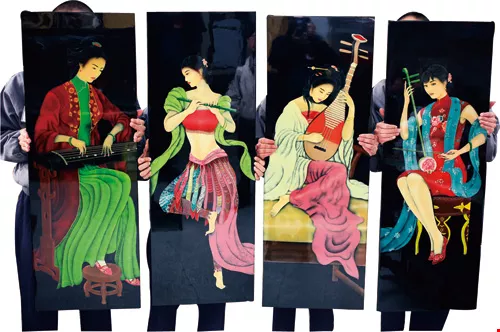
This screen, created by an inmate at Taichung Prison and consisting of four sections, is priced at an astonishing NT$200,000.
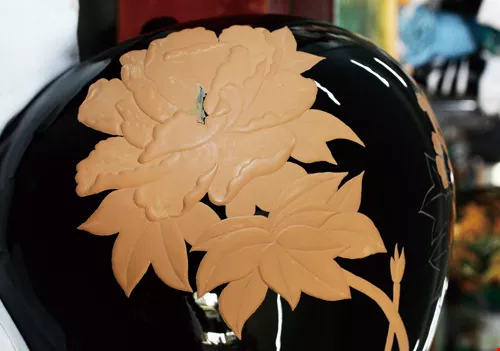
Lacquerwork takes many forms; this style, wherein the artist carves on the clay body first, then lacquers over it, gives pieces a more three-dimensional look.
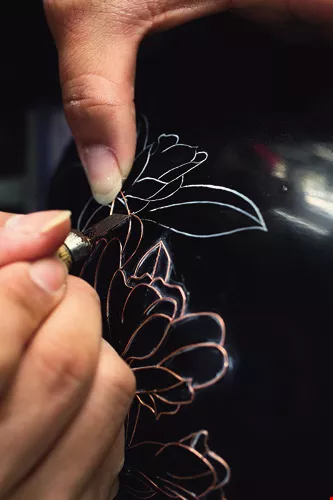
Inlaying a lacquerware piece with metal wires can give the lines of the piece more texture. This technique is known by the French name "cloisonne."
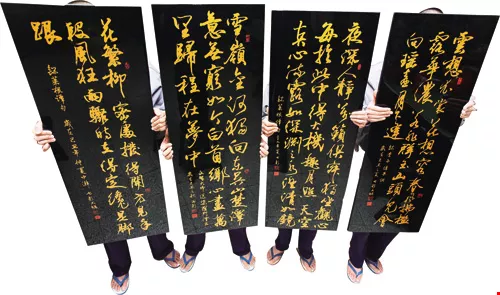
Learning to lacquer also trains you in painting, design, and calligraphy; the calligraphy on this screen, which would rival any specialist calligrapher's, was done by the hand of an inmate at Taichung Prison.
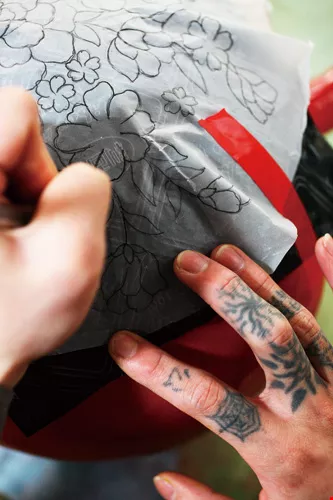
As this inmate works diligently on a detailed design on piece, one is drawn to the interesting juxtaposition of his design and the colorful tattoos on his fingers.

@List.jpg?w=522&h=410&mode=crop&format=webp&quality=80)

@List.jpg?w=522&h=410&mode=crop&format=webp&quality=80)


