Shiang Ye--Prize-Winning Chairs from Kaohsiung
Wang Wan-chia / photos courtesy of Shiang Ye / tr. by Jonathan Barnard
May 2011


Design can have a potential impact on virtually any field, including industries providing necessities such as food, clothing, shelter and transportation. In the face of low-cost competition, Kao-hsiung's Shiang Ye Industrial hasn't followed so many other traditional manufacturers across the Taiwan Strait to mainland China. Instead, it has built on the high standards of manufacturing in Taiwan, leveraging a newly found strength in design to raise its corporate image and add value to the company.
"The truth is that you've been acquainted with us for a long time-you just haven't known it." That's how Elly Huang, the company's 30-year-old director of design, put it in a speech introducing the company.
In 2008 Shiang Ye, which specializes in folding chairs and metal chairs, entered an international design competition for the first time with Novite, a plastic folding chair made without any screws. It ended up winning the prestigious German red dot Design Award. This year the company participated in the International Forum (iF) design awards for the first time with Slim, a lightweight folding chair. Very much a dark horse, the company surprised itself by winning an iF gold.
Earning such impressive plaudits at its first attempts, Shiang Ye has prompted a lot of people in the design community to ask: How is the company achieving such divine feats? And how are they winning with folding chairs, which after all are rather commonplace consumer goods?
The story begins in 1978, when founder Huang Cong-jie created the company in a small metal-clad building in Kao-hsiung's Da-liao during a period of rapid economic growth in Taiwan. The company created various types of folding chairs and also took OEM orders from international companies.
Using the best manufacturing methods and determinedly seeking high quality over the 33 years of its existence, Shiang Ye, which is now based in Kao-hsiung's -Dafa Industrial District, is one of Taiwan's top makers of furniture. It employs 200 workers in three factories, encompassing around 215,000 square feet. It has developed nearly 100 models of chairs, which can be found in Taiwan's schools, train stations, airports, and hotels, and it has also exported to 89 nations. It's fair to say, "Even if you've never heard of Shiang Ye, you've definitely sat in a Shiang Ye chair."
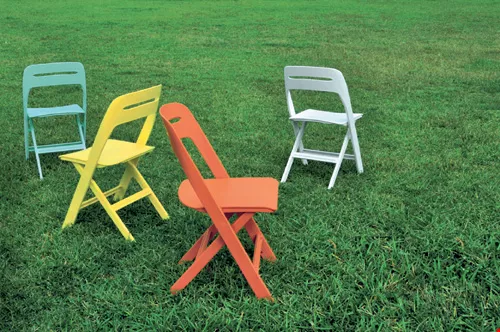
Because Shiang Ye has a large and well-equipped factory, it outsources very little. Electroplating is the notable exception. Because electroplating produces considerable industrial effluent, the company works with electroplaters clustered in Taichung, which possess excellent wastewater processing systems. But the company handles everything else itself-from plastic molding, to metal working, to painting. Its in-house manufacturing content rate of 95% is virtually unheard of, and it's fair to say that it boasts a 100% Taiwan content rate.
Making the most of its comprehensive manufacturing facilities, the company was able to help realize an environmental dream for the world with its chair Novite, which was first marketed in 2008. "There will never be a chair that doesn't break," explains Chairman Huang, "but there is plenty of garbage that won't decompose." Since we live in an era where we can't escape plastic, the company thought it might as well create a fully "recyclable" chair, with plastic that can be used for other purposes in the future so as not to impose environmental costs.
Working with Chen Chun-tung, a professor of product design at Shu-Te University, he researched and developed a polypropylene folding chair that doesn't use a single screw. Constructed from just five parts, it was the first folding chair in the world to be made entirely out of plastic. Design director Elly Huang created the name by combining the English "no" with the Italian for screw: "vite."
Novite's streamlined aesthetic and environmentally friendly concept transcended Shiang Ye's traditional emphasis- on durability- and other functional considerations, moving it onto a new design-oriented track. Widely praised, the chair is representative of the company's transformation.
Continuing to pour resources into design and stress added value, the company in 2008 established a design department, which is headed by Elly Huang-the chairman's daughter-who graduated from Dormus Academy, a prestigious Italian design school.

Novite, winner of the red dot design prize.
The first mission of the new design department was to design a simple and lightweight folding chair. But they also needed to consider costs and price point, so as to make it as affordable as possible. Huang continued with the screwless concept, eliminating the unwanted fussiness engendered by extra parts. The chair is also sturdier than folding chairs with screws.
Using an open-sided-square design with steel tubes that Shiang Ye developed itself, the design team was able to dispense with the time-consuming steps of welding on the seat and back rest. But the chair doesn't stint on comfort, and the savings from reduced labor costs have been returned to consumers in the form of a lower price.
Possessing uniform thickness and width, the Slim's most distinctive feature is the folding structure that the team designed for it. It's quite safe, and doesn't lead to fears about getting one's hand painfully sandwiched. When folded, a Slim lies completely flat. A stack of 30 folded chairs only reaches the height of a single opened one. And because Slims are so thin and light, they're easy to move around or put away.
Elly Huang says that she entered Slim in the iF design competition without the slightest thought of winning. She was simply curious about the assessment that an international design competition emphasizing innovation in technology and materials would give to the design of a folding chair, a commonplace item from everyday life.
It turned out that although the judges thought that the concept was old hat, they were impressed with how each chair -added only two centimeters to a stack. What's more, they found it aesthetically pleasing: "Simple, elegant and stunning."
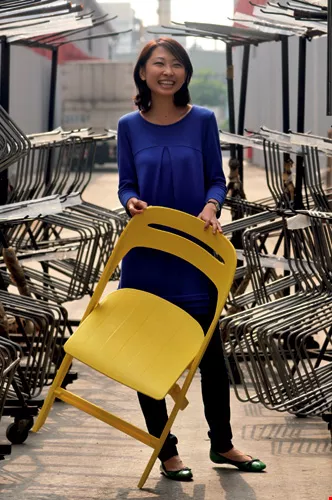
Design director Elly Huang has injected some new life into the traditional chairs manufactured by Shiang Ye.
Although the chair might seem unremarkable, it has demanded great expertise through every step of the process-from manufacturing to overseas marketing.
Steeped in furniture manufacturing from a young age, Elly Huang rattles off some of the considerations: First of all, you've got to think about the environment that the chair will be used in. Inside or outside? Depending upon the answer, the principles regarding the choice of materials and colors are very different. And consumer markets reflect different cultural circumstances. For instance, the Japanese like clean lines, whereas Europeans like playful ornamentation. What's more, because Westerners and Asians have different body types, proportions have to vary for different export markets. And generally speaking, the sitting positions and center of gravity of men and women are different. Consequently, it's important to weigh these different considerations and find happy compromises between them during the design process. Only then will the chair be comfortable and find uses under all different kinds of scenarios.
After achieving renown for the design of those two folding chairs, Shiang Ye, which previously had relied on mass orders from major clients, began to get one offer after another to develop new sales channels. Smiling, Elly Huang says there's no hurry and that they plan on taking things slow.
In her analysis, the furniture market in Taiwan is very polarized. There is high-priced furniture from famous designers sold at retailers like Nordic and the Dragonfly Gallery, and, on the other hand, stores like the TLW DIY chain, which put an emphasis on durability and economy. At NT$999, Slim is a bit more expensive than ordinary folding chairs, but Shiang Ye still hopes to focus on the mass market. Internet sales may prove the best model, and the company is about to set up its own sales website.
The company plans to continue marketing under the name Shiang Ye. A smiling Elly Huang says: "After hearing our name because of the awards, everyone realized that we had always been a trustworthy and reliable manufacturer. We're like an old friend that's somehow both unknown and familiar." Located in Kao-hsiung, this traditional manufacturer is raising its profile and shining a beautiful and powerful spotlight on southern Taiwan.
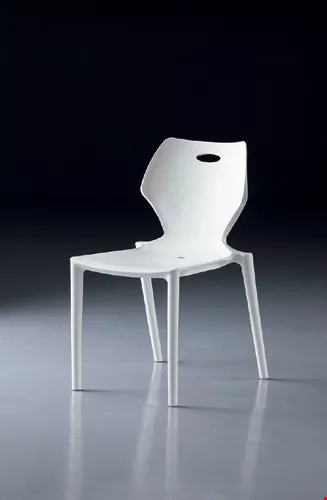
The Rosa chair, which is completely recyclable, garnered the top prize at the G-Mark design competition in Japan.

@List.jpg?w=522&h=410&mode=crop&format=webp&quality=80)
@List.jpg?w=522&h=410&mode=crop&format=webp&quality=80)


