Farmers Who Would Sell Their Own Mums: Taiwan’s Chrysanthemum Industry at a Crossroads
Sam Ju / photos Jimmy Lin / tr. by Phil Newell
December 2012


When the climate in Taiwan is at its most accommodating, it is harvest time for the chrysanthemums of Taitung County and of Miaoli County’s Tongluo Township. The Taiwan hangju chrysanthemum—a hybrid known to scholars as Chrysanthemum x morifolium and commonly called the “florist’s daisy” in the US—is grown by only 70 or 80 farmers on the island, but generates more than NT$100 million in production value. Both white and yellow varieties are the agro-product equivalents of pure gold.
Spring orchids, summer bamboo, autumn chrysanthemums, winter plum blossoms. In Taiwan, each of the “Four Gentlemen” of the horticultural universe—so known because they are the four forms of flora favored in Chinese painting and poetry for their elegance—has its own season, a delight for flower aficionados. But during the transition from autumn to winter, when plum blossoms have not yet bloomed but chrysanthemums have passed their peak, flower growers can get caught with their plants down.
Fortunately, chrysanthemums have not only ornamental value, but also are considered in the context of Traditional Chinese Medicine (TCM) to be “tonic” (i.e. to have health benefits). In particular, the hangju, named after the city of Hangzhou in China (ju simply means chrysanthemum), in dried form, is said to cleanse the liver and also enhance the active value of medicines that improve vision. (The technical term for the latter usage is that the hangju acts as a “meridian guide drug.”) It can also be used as an infusion—chrysanthemum tea—and as an ingredient in cooking.
Tongluo Township in Miaoli County was the first place in Taiwan where farmers began raising hangju chrysanthemums, and it now has the nickname “hangju homeland.” People began cultivating white mums here over 50 years ago, and they have evolved into the area’s most noteworthy agro-product.
Besides white hangju, yellow hangju (also known as “golden chrysanthemums”) are also raised in Taiwan, with most of their production concentrated in Taitung County in eastern Taiwan, on the opposite side of the Central Mountain Range from Tongluo.
In Tongluo, the township farmers’ association set up a production and marketing group (PMG) with its hub at Jiuhu Village, near Mt. Jiuhua, and at present nearly 40 farmers are raising white chrysanthemums as part of the PMG. After being harvested and dried, the mums are sold to TCM pharmacies, or are processed into herbal tea. These dried flowers, each less than two centimeters in diameter, earn in excess of NT$50 million per annum for Tongluo Township’s less than 20,000 residents.
Han Shunxiong, 46, is a household name in Tongluo. Since taking over the family chrysanthemum business over 20 years ago, he has seen this industry go through many ups and downs. When cases emerged of imported hangju being contaminated with pesticide residue, he saw the future business opportunities there would be in organic cultivation of chrysanthemums.
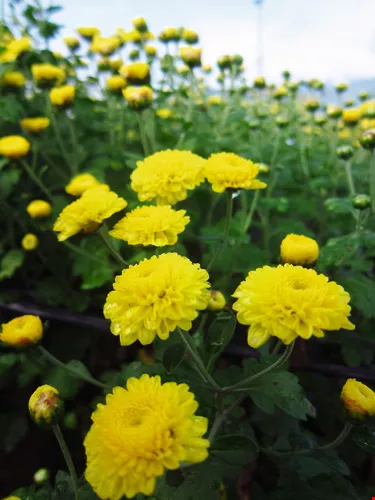
When autumn comes and other flowers wither, the chrysanthemum is in its glory. The yellow hangju of Taitung bloom slightly later than the white hangju of Tongluo, reaching full maturity at the end of November.
Han, who has opened a tourist rest stop in Tongluo’s Jiuhu Village, cultivates both tea and hangju, which he then sells in his own family store. He has planted three hectares of flowers this year, of which two have been given over to white mums and the other to yellow mums that he brought in from Taitung.
“The golden age of hangju here in Tongluo was back in the early 1970s,” sighs Han. “In those days we had more than 100 hectares under cultivation.” In contrast, the highest ever figure in recent years has been about a dozen hectares. The local chrysanthemum industry has been undercut by cheap imports, and there is little hope of ever returning to the glory days of the past.
Customs data indicates that more than 90% of the imported chrysanthemums in Taiwan come from mainland China. Tongluo Farmers’ Association director Ye Jincheng says that imported mainland hangju sell for about NT$300–500 per Taiwanese catty (600 grams), in comparison to NT$1000–1200 for the local product.
Ruthless price competition several times drove Tongluo’s hangju industry to the brink of extinction. Huang says that when they hit rock bottom, farmers in the town were only willing to plant a paltry 1.5 hectares with chrysanthemums. With no flowers being grown, naturally there was no need for the flower processing industry. The township once had 10 drying machines, but as the equipment wore out it was never replaced and today only two are still functioning.
Ye Jincheng tells us that demand for hangju in Taiwan is about 300–400 tons annually. Imports scarf up 80% of this market, with Tongluo and Taitung splitting up what’s left.
Nevertheless, although the unit price for domestically produced chrysanthemums remains high, there is still some hope of enlarging market share. Several times in recent years tests have shown imported hangju to have excessive pesticide residues, or to have been sprayed with unapproved agrochemicals. Over the last two years alone, the ROC Department of Health’s Food and Drug Administration found that two out of 66 samples taken from imported shipments of edible chrysanthemums going through customs failed to meet regulatory standards. It’s no surprise that consumers have been unsettled.
The decisive issue in the domestic chrysanthemum’s struggle to survive despite its high price is this: Can it win consumer trust and loyalty with higher quality?
The nation’s agricultural agencies are playing an active role in advising and guiding farmers in upgrading the quality of the chrysanthemum industry. The trend is toward a production model that does not employ manmade agrochemicals of any kind. In an era of globalized free trade, Taiwanese agricultural policymakers and farmers will have to choose their battles very selectively in order to stay in the game.
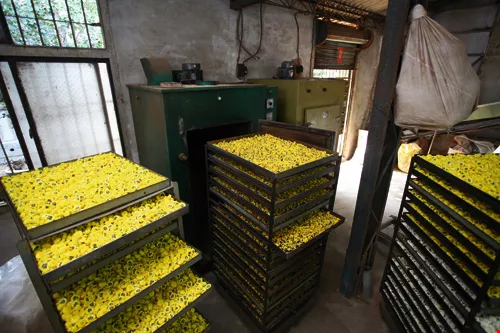
Freshly picked chrysanthemums are dried for 16–20 hours at temperatures ranging from 20–100 ºC. Once processed, they are most often used in Traditional Chinese Medicine or as an infusion. The photo shows “golden chrysanthemums” that are about to be dried.
The production of hangju is seasonal. Farmers complete the “field setting” (planting or “colonization” of a field) around Tomb Sweeping Festival, which falls in early April by the Western calendar. The season lasts until the buds begin blooming in late October, followed by harvesting and drying in mid- to late November.
After setting the field, it is necessary to “pinch” the plants (also known as “stopping”). Every 15–20 days, the farmer strips away the leaves and the growing points of shoots from the top 3–5 cm from each branch, and continues to do so until mid-summer. The purpose is to help the lateral buds grow in profusion, so that each branch produces a brilliant show of densely petaled flowers come October.
In addition, during the entire period from field setting to blossoming, farmers have to weed the fields once a month and also fertilize, turn, and aerate the soil, and add new soil when necessary.
Chrysanthemums are of course not exempt from those ineradicable nightmares of all farmers—diseases and pests. Since the fastest and most convenient way to deal with these is agrochemicals, the production process must also address consumer concerns about food safety. In 2011, therefore, the Council of Agriculture (COA) mobilized the relevant District Agricultural Research and Extension Stations, the Bureau of Animal and Plant Health Inspection and Quarantine, and the Tea Research and Extension Station to advise to farmers in the two chrysanthemum growing areas on safe use of agrochemicals, and to encourage farmers to try non-chemical methods of cultivation.
Han Shunxiong saw the trend toward toxin-free agricultural methods coming back in 2002. Over the years he has steadily reduced both the amounts of agrochemicals he uses per cycle, and the number of spraying cycles. He says proudly that in 2011 he only sprayed his mum fields three times, while the flowers harvested in November 2012 all were grown using non-chemical techniques of disease and pest control. He swears on his honor that they are absolutely toxin-free.
As another measure to ensure that chrysanthemums in the marketplace meet food safety standards, in 2011 the Agriculture and Food Agency of the COA brought chrysanthemums within the “good agricultural practices” (GAP) system that allows qualified products to carry a special GAP label. The hangju is in fact the only product in the entire program that is not a fruit or vegetable. All Tongluo mums are tested before coming on the market, while one of the three Taitung PMGs has received GAP certification and the other two are in the process of getting it. For good measure, Tongluo mums also carry a collective trademark from the township farmers’ association, giving consumers a double guarantee to rely on.
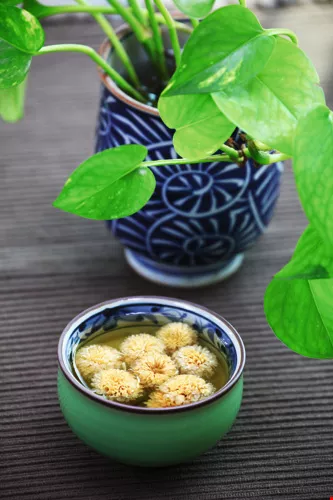
A steaming pot of chrysanthemum tea offers subtle delights to the olfactory senses.
When harvest time finally arrives, freshly picked hangju are put through a 16-hour drying process, during which they are exposed to hot air blown at steadily increasing temperatures ranging from 20 to 100°C. Only then can the processed flowers be sold for use as “meridian guide drugs” or as ingredients in health drinks.
As all herbal tea lovers know, chrysanthemum tea gives off a light, clean floral fragrance. What you may not know, says Han Shunxiong, is that golden mums have a richer, more robust aroma. Each type of chrysanthemum in fact has its own bouquet.
As for the applications of hangju in Traditional Chinese Medicine, besides selling processed flowers directly to TCM pharmacists, Tongluo Farmers’ Association director Ye Jincheng relates that the association is currently developing spice packets combining mums with medicinal herbs like goji berries and astragalus root that will make it very convenient for consumers to bring the taste of Tongluo hangju into their daily lives. They also hope that in the future, the government will lead a marketing campaign to take their chrysanthemums—suitably attired in attractive new packaging—into Japan and Korea, where many people are also connoisseurs of health foods, thereby opening up new opportunities for this local industry.
The only problem is, it is not certain that there will be anyone around to take advantage of these opportunities. Taiwan’s rural population is rapidly aging, and few young people stay in the countryside. Finding a successor generation of farmers is proving to be as big a challenge for chrysanthemums as for other crops. This is especially problematic because hangju are highly labor intensive. Every step from cultivating seedlings to harvesting the flowers requires workers in the fields, and there are no machines that can do their tasks.
At the end of October, Han Shunxiong opened his account books to calculate his overall costs. In 2012 he did weeding five times, each time hiring 15 workers per hectare, paying out NT$30,000 in wages. Harvesting was divided into three phases, and he had to employ 400 workers per hectare to squat next to the knee-high bushes and pluck the flowers one by one, costing him NT$120 in labor costs for each catty of chrysanthemums.
It is no surprise, given all that has been said so far, that the price of Taiwan-grown hangju far exceeds that of imported ones. Are they worth it? Han points to samples of Taiwan-grown and mainland China-grown white mums, and notes that the Tongluo hangju are full and robust, each flower with more than 100 petals, while the mainland ones are rather flat and have few petals, reflecting the differences between the natural growing conditions and human inputs on the two sides. And this comparison does not even take into account Taiwan’s lead in systematic testing for safety and in the management of agrochemicals.
In Chinese culture, the chrysanthemum has both abstract and concrete importance. To the mind, it represents the nobility and integrity of the ideal literatus, with a character that remains unsullied by the mundane world. To the body, in the course of daily life, it is a tonic or a food ingredient.
If you happen to be in Taiwan now that autumn is turning to winter, why not take a trip to Miaoli County’s Tongluo Township or over to Taitung, sip slowly from a pot of chrysanthemum tea, alone or with friends, and gaze out over the fields of snow-white or gilded hangju? Your mind will surely be drawn away from the busy modern world back into the mists of ancient Chinese civilization....
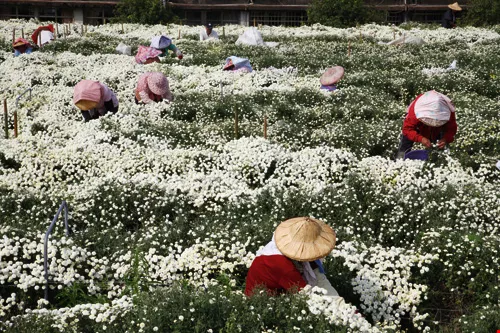
The hangju industry is very labor-intensive, but these days fewer and fewer people want to be farmers. It’s a dilemma for those promoting the industry. The photo shows harvesting of Tongluo white mums.

@List.jpg?w=522&h=410&mode=crop&format=webp&quality=80)

@List.jpg?w=522&h=410&mode=crop&format=webp&quality=80)


