

"It's always these, in Brazil, Tokyo, the U.S. . ." says a tourist looking at the storefront signs on a Taipei street. "These" are McDonald's, IBM, Kodak, Honda, Coca-Cola. . . the list goes on, as international boundaries lose their importance in the world's economy. More and more multinational firms are making their decisions to source their materials here and produce their goods there solely on the basis of price. And as these transnational links expand, so some reason, a third world war becomes less possible, for attacking another will mean attacking oneself.
Sometimes resembling nations unto themselves, multinational companies have an unmistakable impact on the countries in which they operate. According to a survey, foreign firms enjoy majority ownership in over 70 of Taiwan's top 500 companies, many others having substantial foreign minority shareholders.
As multinationals grow stronger, the day might not be far off when tourists from Taiwan can buy Tatung refrigerators in England or Multitech computers in Brazil.
As an island of limited resources, Taiwan must rely on foreign capital and raw materials. Before, capital that flowed out of the country was capital lost. As a result, the government strictly limited the over seas activity of Chinese firms, restricting the amount they could invest and set stipulations on their debt and profit ratios.
The situation today looks a bit different. Assisted by a government subsidy, the Yuen Foong Yu Paper Co. and the Chung Wha Pulp Corporation recently finalized plans to produce and export lumber from Indonesia back to Taiwan. Other firms are looking to the U.S. and other advanced countries for technology unavailable domestically. Still another group tries to fit factories in the Caribbean into their expansion plans. The Central Bank worries over the nation's surplus of foreign exchange. Comments John C. I. Li of the Industrial Development and Investment Center of the Ministry of Economic Affairs, "For years investment was one-way traffic: all from the outside. Only in the past two years has it become a two-way street."
Southeast Asia has long been a favored spot for investors from the ROC The area has had many factors in its favor, including proximity to Taiwan and many overseas Chinese. Initial stakes were small, but grew as labor in Taiwan became expensive and the investment picture there improved as nations competed to attract foreign capital.
The Yuen Foong Yu Paper Co. has been especially aggressive with its foreign portfolio. When the Indonesian government in 1977 moved to protect local paper makers, the firm invested US$560,000 in a factory, which has paid for itself many times over. Later Yuen Foong collaborated with Siam Cement, Thailand's largest consortium, to construct a plant with a total investment of $1.76 million. Plans this year include expansion of the plant, which has already lined up $12 million in orders.
Investment in this part of the world has its drawbacks. Restrictions on foreign ownership is often stricter than in advanced countries, while some parts of the business law remain unclear. Add the threat of political unstability and most businessmen will opt to invest with a local partner for safety's sake.
Robert H.C. Tsao, president of United Microelectronics Corporation, likens ventures in developing countries to camping out. The site, the equipment, and the food must be checked thoroughly before one sets out. Investment in advanced counties more resembles going to the big city, with everything already in place. Just find a good lawyer and accountant and start doing business.
More companies are headed for the big city these days, according to government surveys, with fully half of this capital going to the U.S. One big reason that lures them to advanced countries is easier market access.
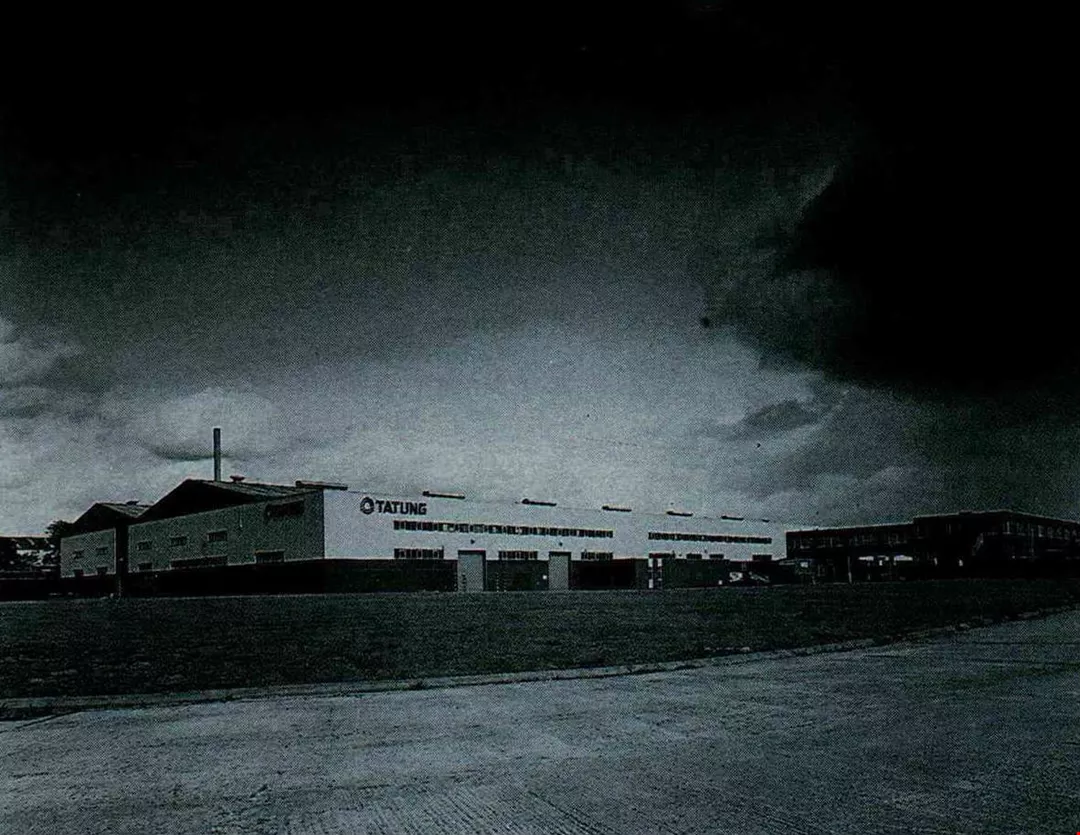
Such prospects helped persuade Tatung to make television sets in England, says A.C. Wang, general manager of marketing. "Non-Common Market products have to pay about a 15 percent tariff in Europe. Then their technical systems are different from ours, but our sets with PAL- systems made in England are covered by the German firm Telefunken's copyright. If you want to sell something there, it's best to make it there." Their English factory's business has expanded to an annual $56 million, and last year, amid continued depression and unemployment in Britain, the plant added 900 workers to its payroll. Soon after, a delegation of English business representatives came to Taiwan seeking additional investment from Chinese companies.
High technology firms, by contrast, tend to look to Silicon Valley. "You can read the technical magazines and go to the exhibits," says Edward Chang, chairman of Multitech's American branch, "but the best source of information is the first-hand rumor." Multitech began as a sales representative for foreign firms eight years ago, and Chang, working at another company, served as the American business manager and market analyst. Two years later he began work full-time at Multitech.
"Maybe one out of ten firms here will survive," says Chang, "and it depends a lot on keeping down operating costs. Production is cheaper in Taiwan, engineers' salaries are a tenth of what they are in the U.S., so Taiwan looks pretty good to American companies looking for overseas partners."
United Microelectronics Corporation has been one company to reap the advantages of having a foot on both ends of the Pacific. With the semiconductor industry already over twenty years old, the work and time involved in designing circuit boards has produced a trend toward more and more custom-made products. Half of the semiconductors sold in 1990 will be custom-made, says one estimate. To save costs, UMC often sends out piecework to American engineers, who are often original ly from Taiwan.
Last year, UMC further consolidated its American connections. The firm selected a work group from Intel Corp. and with $2.7 million founded Unicorn Co. Should an order require sophisticated circuitry design, UMC turns the job over to Unicorn, who sends back the blueprint to UMC after the product is ready for mass production. UMC owns 60 percent of the company, with the remaining shares being held by the engineers themselves.
Though many electronic companies invest overseas, their scale remains limited, with most plants having only a few dozen employees. For an example of large-scale foreign investment, analysts must turn to the petrochemical industry and Formosa Plastics.
Formosa Plastics began looking abroad in the mid-1970s, when its suppliers of EDC, an element needed for the production of polyvinyl chloride, could not keep pace with the company's needs. They first turned toward the oil-producing nations of the Middle East, but the petrochemical industry there was still in its infancy, leading the company toward the oil-rich Gulf of Mexico.
Five years ago, Formosa Plastics began EDC refinement at its Texas factory, sending some of the product back to Tai wan and making remainder into PVC. Later, after its operations stabilized, the firm bought two petrochemical refineries and nine plastics factories, completing its downstream integration. Today Formosa Plastics is the world's largest supplier of PVC, commanding 40 percent of the U.S. market and 5 percent of all global production.
To manage its overseas operations, Formosa Plastics sent staff abroad, but most companies lack such resources and must do their recruitment overseas. School ties often prove to be invaluable when looking for engineers in the high-tech industries. Edward Chang and Wayne Shih, president of Multitech, were classmates at Chiaotung University. Robert H.C. Tsao and his partner at Unicorn, Yang Hsing-hsun, began their friendship at National Taiwan University. But finding personnel often is the beginning, not the end of problems. "They're still in a foreign country," says one manager of an American subsidiary, "and there's still a lot they're unclear about. They're engineers, technical people, and when it comes to business, sometimes we have to start at lesson one."
Management often is another head ache. People at Formosa Plastics like to say their plant in Texas represents the "Asian spirit" in action. "In the West, labor and management are in opposition. When times are bad the workers are laid off without a second thought. When business is good, management lines its own pockets. Here in the East, labor and management are united, and both share equally in the success and failure of the company. The employees over there at first didn't believe it, but when profits started to come in and we raised salaries, then they started to trust us," says C.T. Li of Formosa Plastics' American subsidiary.
At another plant, frequent changes of ownership had left workers apathetic about the success or failure of the factory. After considerable time and effort, however, Formosa Plastics rekindled concern for quality among the workforce, and in time workers began coming in for overtime on the weekends.
Manufacturing aside, marketing abroad also presents problems. Many companies first look for a distributor to help them with the new market, but this approach has its shortcomings, adding cost to the product and unwanted distance between producer and consumer. As a result, some firms find themselves bound to distributors they later find to be unsuited to their product, and must wait until contracts expire before they can better their situation. "It's all part of paying your dues," says Edward Chang.
At present the Council for Economic Planning and Development reports that of the over 1000 firms with capitalization over NT$100 million (US$2.5 million), only 13 percent plan to invest overseas in the next three years. Looked at from another angle though, 1985 was a record year for over seas investment by Taiwan companies, with US$41 million being spent abroad. Such numbers must grow if this "little dragon" of Asia's economy is to continue to breathe fire.
[Picture Caption]
Tatung Co. has built a plant in Telford Indus trial District in England and provided jobs for the area. At the end of last year a delegation from the district came to Taiwan seeking additional investors. (Photo supplied by Tatung Co.)
Tatung's English plant recently added 900 workers to its payroll. (Photo s supplied by Tatung Co.)
From left to right and from top to bottom, the Taiwan companies with major foreign investments: Tatung, Pacific Electric Wire and Cable, Yuen Foong Yu Paper, Far Eastern Textiles, Multitech, Mitac, UMC, Ching Fong investment, Sampo, and Formosa Plastics.
Chinese Companies With Sizable Foreign Investments
Production of semiconductors must be done in a dust-free environment. Workers must wear special one-piece suits and work at separate stations. (Photo by Arthur Jeng.)
Chinese-American engineer Yang Hsing-hsien and the company he started wi th UMC, Unicorn Co. (Photo by Chrissie Lu.)
Many hi-tech firms from Taiwan have invested in Silicon Valley. Above is Multitech's Ameri can subsidiary. (Photo supplied by Multitech.)
Statistics on Outward Investment by Area
Construction of the Formosa Plastics plant in Texas. (Photo supplied by Formosa Plastics.)
The plant is known for its high efficiency and state-of-the-art equipment. (Photo supplied by Formosa Plastics.)
Tatung's English plant recently added 900 workers to its payroll. (Photo s supplied by Tatung Co.)
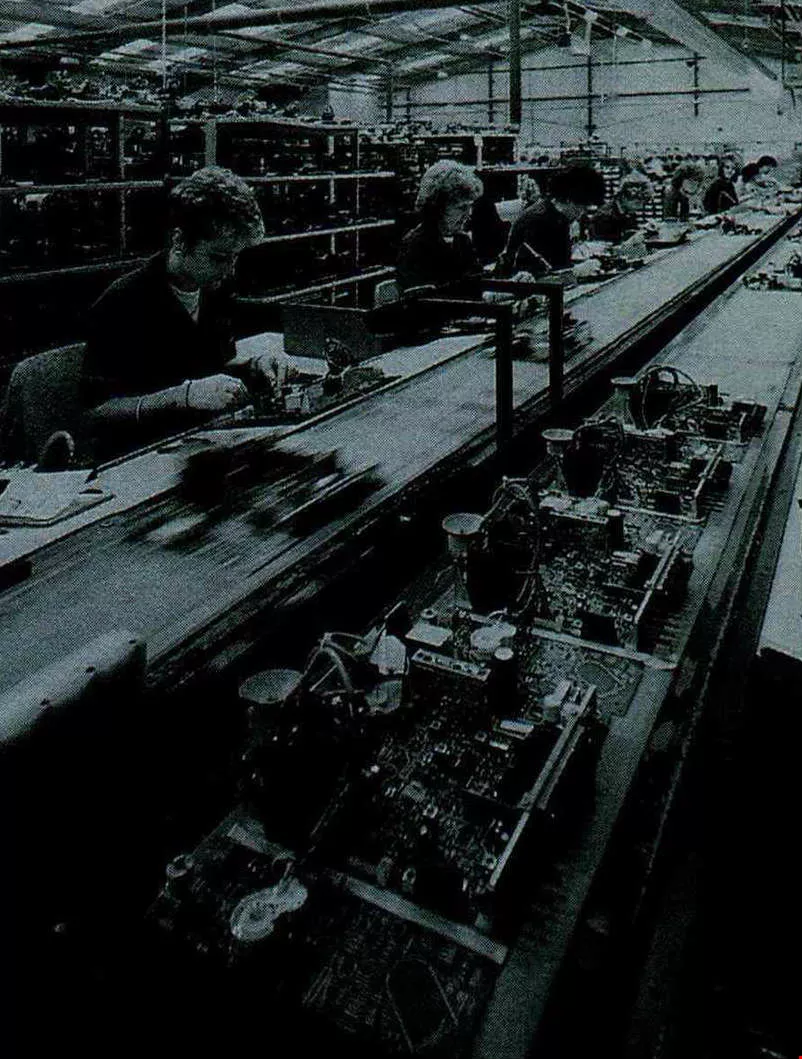
Tatung's English plant recently added 900 workers to its payroll. (Photo s supplied by Tatung Co.)
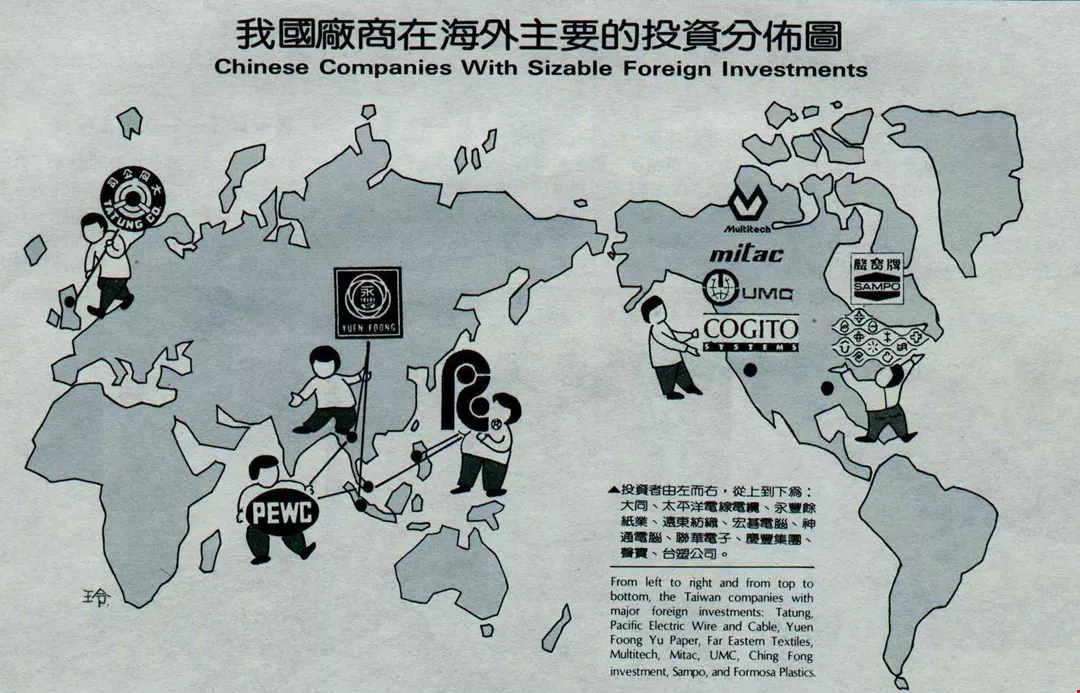
Chinese Companies With Sizable Foreign Investments.
@List.jpg?w=522&h=410&mode=crop&format=webp&quality=80)

@List.jpg?w=522&h=410&mode=crop&format=webp&quality=80)


@List.jpg?w=522&h=410&mode=crop&format=webp&quality=80)

@List.jpg?w=522&h=410&mode=crop&format=webp&quality=80)
