Pushing Open the Door--Taiwanese Firms Tackle China's Book Distribution Market
Eric Lin / photos Jimmy Lin / tr. by Geof Aberhart
November 2003


The Chinese mainland makes up a third of the total Chinese-language publishing market. With so much potential there, various mzajor international publishers are fighting to stake their claim; of these, the leading investors of the Chinese community-Taiwan, Hong Kong, and Singapore-are particularly persistent. Now, with pressure from the WTO mounting, and a general eagerness to establish China's own strong publishing and distribution system, Beijing has taken the first step toward a less regulated market, lifting restrictions on the downstream section of the market. Although the profits to be had from distribution are still meager, there is a great deal of funding being invested from foreign sources as well as from outside the industry, as the players remember that "he who controls distribution controls the marketplace."
Taiwanese publishing houses are comparatively small in relation to their global counterparts, and don't have the resources or capital to tackle the mainland market with the same vigor; faced with the sheer enormity of the task, many simply don't have what it takes to pull off the move. Recent attempts to crack the market have been focused on low-risk, small-scale investments, like the Mintai Shucheng bookstores (a joint venture between Wunan Publishing and the Fujian Foreign-Language Bookstore, which is controlled by the news and publishing bureau of Fujian Province), or the partnership between Linking Books and Tienlung Books that is selling returned Taiwanese books in the mainland. Now, like coy maidens, Taiwanese publishers are making subtle advances on the mainland, wanting to compete in the industry, but trying to avoid the unwanted attentions of the authorities. Already two companies are having a major impact on the market, despite not originally being in the publishing industry-Choice Lithograph, through their logistics arm, and CyberMart with their Infotopia chain of bookstores.
What are the secrets of success for publishers entering the mainland industry? How is funding from Taiwan and Hong Kong being put to use there? Come with us on a trip into the mainland to find out.
In recent years the daily customer traffic in the larger bookstores of major centers like Beijing and Shanghai has often hit the tens of thousands, and several have already been given "must-see" status in travel guides sold in Taiwan. To deal with the stream of visitors, the stores have expanded, improved their air-conditioning systems, taken on huge numbers of staff, and increased the width of the aisles between bookshelves; the luxuriousness and sheer size of the stores is nothing short of amazing. But often, not far from these huge stores, in all the prime locations, sit the state-run Xinhua bookstores. They sport old-fashioned storefronts, old-fashioned displays, and old-fashioned customer service-like museum pieces, they give the visitors a peek into the "olden days."
In the cities, huge megastores, chain stores, mom-and-pop bookstores, and old-fashioned bookstores all sit side by side, demonstrating the continuing "growing up" of the industry, and society in general, symbols of the old and the new tossed together. But when you look at the bigger picture, the publishing industry in the mainland takes on a more disturbing visage. While the publishing and printing sides are both doing well, the distribution and logistics systems are decrepit and inflexible, making it nigh on impossible for millions to easily get a hold of published works. These two weak links in the industry are driving publishers and the media to frustration.
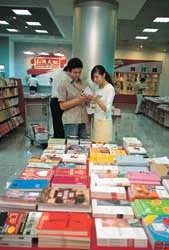
The Infotopia chain of bookstores, the mainland face of Taiwan's Hon Hai Precision Industries, is currently trying to set up its own independent logistics system.
Distribution bottleneck
Under the old system of economic planning, the distribution of published works in the mainland was all handled through a single state-owned channel (known as the "first channel")-every region in the country had a Xinhua bookstore and supply unit. These Xinhua stores held sole control of delivery and distribution, a system entirely inappropriate for a free market.
In the 1980s, a privately run distribution system (the "second channel") was established in an effort to break down these state-imposed restrictions. Although later governments would retroactively acknowledge the legitimacy of this second channel, upstream portions of the industry were entirely dominated and controlled by Beijing. Unable to develop and thrive on the meager profits that they could secure, the second channel became a hotbed of piracy.
The established publication and distribution mechanism couldn't keep up with the needs of the market or with the changing face of the industry. Now the mainland publishing industry is overburdened upstream and overwhelmed downstream: the production of published works is like a torrential river rushing to the ocean-but on reaching the estuary (distribution channels), it can do no more than trickle in. Some merges into the "second channel," while the rest overflows everywhere, unable to smoothly enter the ocean that is the literary market.
After entry to the WTO, Beijing pledged to open the book and magazine distribution markets to foreign interests and to allow foreign companies to invest in the distribution of print media in specified cities and through joint ventures. The first ripples of this were felt just this year.
In early May, Beijing relaxed its thresholds for foreign investment: the total capital that may be invested by a foreign company in a retail publishing firm may not exceed RMB5,000,000, or RMB30,000,000 in a wholesale firm. The capital invested by the foreign company may not exceed 50% of the firm's total capital.
On the surface, this would seem an unavoidable policy measure, given pressure from the WTO on Beijing to gradually start relaxing its restrictions on the industry, especially in regard to the distribution mechanism. On closer inspection though, the introduction of foreign investment could be just what Beijing has been looking for to open up the bottleneck in distribution.
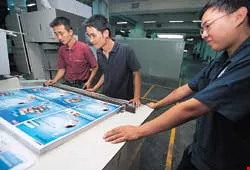
Taiwan's Choice Group set up base on the mainland through their printing workshop, and now are extending their reach into the area of logistics, aiming to become a kind of consultant to the publishing industry.
A daunting task
However, since the lifting of restrictions in early May the new wave of foreign investors has largely chosen to adopt a wait-and-see approach, with genuine applications to invest being few. In the words of the mainland news media, it's like a dog trying to take on a hedgehog: a daunting task, with no obvious way to get started. A number of factors are causing hesitation among foreign investors-the publishing and distribution system isn't great, there's a lack of big local partners, rent in the cities is expensive, profits are low, and so on.
"The first ones to enter the market did so with a 'first-mover' mentality. Now the publishing world is taking on a new slogan: if you want to march on mainland China, you must be mentally prepared for at least eight years of making a loss," says Chen Hsin-yuen, a publishing expert and acute observer of trends in the market. Aside from the previously outlined factors, there have been many politically motivated "special cases," making the competitive playing field less than level, and giving foreign investors more cause to hesitate.
Long before this past May, there were many international conglomerates on "trials," on scouting missions into the mainland, like Germany's Bertelsmann group. Bertelsmann partnered with the China Technical Books Company, under the auspices of the Shanghai Municipal Publishing Bureau, and ran a mail- and Internet-order book club, and this year they set up a small chain of bookstores with stores in several major centers. Furthermore, thanks to an injection of funds from Singapore's Scholar bookstore chain, the chain now has over ten branches in the Shanghai area, and they're leading the way in Pudong with the opening of the first 24-hour bookstore. Hong Kong's TOM Group, in cooperation with Shanghai Joint Publishing, established Shanghai-Hong Kong Joint Publishing Co. Ltd., which holds a dominant position among companies in the book import-export business, selling Taiwanese books and magazines in Traditional Chinese characters.
Looking at these "trial runs," not only was the funding sufficient, but political influence was also negligible, as they stole in before Beijing's opening of the market. They paid special attention to the political connections involved in all mainland investment, and took the "scenic route" into the upstream end of the industry, going by way of distribution and logistics before eventually becoming content providers. That road isn't for everyone, but for Taiwanese businesses, known for their flexibility, a chaotic environment like this can be quite a stimulus for investment.
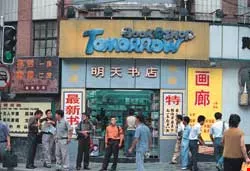
Shanghai's Fuzhou Street was the heart of the publishing industry prior to the Nationalist government's relocation to Taiwan, and since the industry reforms in the mainland, chain bookstores have taken Shanghai as their headquarters, gradually expanding from there.
Infotopia takes on logistics
Last May, Hon Hai Precision Industries, a long-time player in the mainland, established the "store-within-a-store" design with the opening of the Infotopia chain, selling books, music, and stationery in their CyberMart IT stores. CyberMart is the mainland's largest IT retailer, with several stores already opened in each major center. In mid-August this year, a new CyberMart megastore of over 15,000 square meters opened in Beijing, with Infotopia having a floor to itself. According to CyberMart's plan, the bookstores will develop under the auspices of the IT stores, and eventually split off into a separate entity. At present, Infotopia has six branches, spread across cities like Beijing, Tianjin, and Chongqing, and it is predicted that by year-end this will have grown to 50. At this speed, it will soon overtake Xishu Books, currently the biggest chain bookstore in the mainland.
"Infotopia is an investment of Hon Hai and their subsidiary CyberMart, so there are no worries about sourcing foreign capital. Also, aside from the project heads from Taiwan, they mainly hire mainland locals as senior managers, thus minimizing the potential for political hassles," notes one publisher who is well acquainted with the development of Infotopia. "They have the whole Hon Hai group to fall back on should they need funding, and at present their central focus is on setting up a logistics network; come this fall, they should have their Internet-based ordering system online, adding another string to Hon Hai's logistics bow."
At present, Infotopia's purchasing is entirely carried out in Beijing and Shanghai, and then the goods are transported to the various cities by road. "Last year when they signed on their shipping company they were guaranteed a ten-day shipping time between Beijing and Chongqing; this year it's been cut down to five days," says the aforementioned publisher. And by 2008, the nationwide superhighway network is expected to be complete, making shipping even easier and smoother.
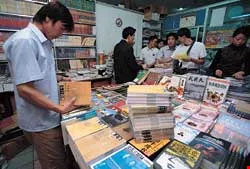
With Beijing's "first channel" of book distribution unable to cope with the needs of a free market, the private sector's "second channel" has taken off in leaps and bounds. This picture shows a "second channel" wholesale book market in Beijing.
Choice Logistics: steady growth
Having already made itself at home in the printing industry, Taiwan's Choice Group is another company looking for new ways of doing business.
Of the three links in the publishing chain-content, distribution, and printing-it was printing that was the first to benefit from the easing of restrictions. In 1994, Choice Lithograph entered the mainland market by setting up a wholly-owned subsidiary there. Since then they have survived a variety of onslaughts, from the imposition of restrictions on wholly foreign-owned ventures by Beijing in 1995, through the 2000 abolition of the preferential exemption from levies on importing printing plant and equipment, to the strengthening of provincial-level publishing houses. In spite of all this, their business continues to go from strength to strength. In 2001, in collaboration with Shanghai Century Group they established Choice Logistics, in which the Choice Group holds a 30% stake, and thus moved into the area of publishing logistics. At the start of this year, they were preparing to expand further into eastern China, to try and dominate the purchasing business, and persuading various small and mid-sized printers, bitter rivals, to integrate under the Choice umbrella-mergers which came at no cost to Choice itself.
However, Choice's main task is the construction of book and magazine centers nationwide; vital logistical centers like those of Hunan Publishing House and the Beijing Institute of Light Industry are entirely built on the work of Choice, from hardware construction to software and human resource management, all on a solid base of Taiwanese know-how. With a solid distribution system being the thing most lacking in the mainland publishing industry, Choice's know-how has attracted the interest of the mainland's local companies, and has led to numerous talks. "Although you couldn't really say that the number of contracts actually signed is huge, we're setting ourselves up for the future as a kind of consultant, helping integrate and strengthen each individual client according to their respective distribution weaknesses," says Choice Group vice-chairman Jimmy Cheng. Choice also plan to set up a new arm, providing specialist help to Taiwanese publishers through their in-depth knowledge of the particular political and commercial environment of the mainland.
Exporting Traditional Chinese books
Compared to the mainland-industry-based approach used by Infotopia and Choice Logistics, the sale to the mainland by Linking Books of books returned to publishers by bookstores in Taiwan seems to be a particularly cautious approach.
Now that publishers in Taiwan have no restrictions on their work, over the past few years they have put out massive numbers of books, and the stores have had to limit the shelf life of their stock, so a great proportion of books are returned to the distributors fairly quickly. Although the major publishing houses occasionally hold returned-book fairs, the books can still sit in the warehouses for lengthy periods, and the pressure on these warehouses is a major headache for the industry. Thus, Linking Books saw a market in the eastern areas of China of 40-50,000 Taiwanese businesspeople, and with the cooperation of Tienlung Books, the NT$69 book chain, it collected up returned books to sell in the mainland.
"The price we gave to the local bookstores for these batches of 'discount' books was RMB10 (about NT$45), and the bookstores sold them for RMB19.90 (about NT$90). The sellers of regular (non-returned) books then were forced to lower their prices, which were anything from 10 to 20% more expensive than in Taiwan. Now each month we're making an average of NT$300,000-400,000, which we're very proud of," says Linking Publishing's assistant general manager Wang Cheng-hui. "Not only have exports of Traditional Chinese books to the mainland allowed us to reduce stock in the warehouses, they've also served as a 'dress rehearsal' in the mainland market. It's let them get to grips with the wholesale and retail process there and get a feel for the tastes of their new readers."
The $69 books and returned books are largely ones that are unmarketable in Taiwan, but now sell in huge numbers in mainland China. Some are concerned that this will destroy the reputation for quality of the Taiwanese publishing industry, but Wang believes that the strength and quality of the industry is beyond question, and the impact this will have on the publishers will be minimal.
Difficulty vs. opportunity
The mainland is a massive country, and the distance between urban areas is huge. Profits from distribution and retailing of books and magazines are small, even though the 'planned economy' is gradually being dismantled, and soon it will be far too difficult to set up a wide-ranging logistics and shipping network. Because of this, some publishers are choosing not to sell through bookstores, instead looking for an alternative way, facing their own technological difficulties on the way.
Germany's Bertelsmann group is trying to open a new path through Internet ordering, hoping to build their own sales network independent of the inherently flawed system of the mainland, and already membership of their book club is in excess of 3 million. But as Choice Group vice-chairman Jimmy Cheng points out, the mainland is very different to other countries, and as an online operator, new mechanisms for payment, delivery, and return of books need to be set up where the infrastructure and consumer climate are ready to accept them.
"In several communities around the mainland there are many people using the same house number, so aside from the postal service, it's difficult for outsiders to develop a presence. This is on top of the fact that we can't use the catalog ordering system employed by the convenience stores, since convenience stores themselves are few and far between here," says Cheng. "There are also problems like the fact that Internet access and credit cards aren't particularly widespread, and setting up customer service stations in all the various areas is a laborious process-all these factors are testing the structure and viability of our mail and Internet ordering systems."
But as they say, every cloud has a silver lining. It's still a pioneering time for logistical systems; if someone can establish a low-cost system, the potential for growth will be boundless-another reason why so many foreign companies are lining up to invest.
The companies have little to do with consumers in the various remote towns and villages across the mainland, meaning a book that sells rapidly in the cities can often take years to make it to rural areas. This is largely so because it is in the interests of the monopolistic state-owned delivery channels and the provincial publishing houses-readers in the rural areas of the mainland can often only read the crudely made books published by local publishing houses. If any business is able to benefit the company involved in it, while simultaneously giving the company the image of being a patron of the nation's education and culture, businessmen will be more than happy to jump in on it. Publishing and distribution is most certainly the industry that can do all that.
With the relaxing of restrictions on the publishing market, mainland China has already taken one step along the path to self-improvement. What happens now? We'll have to wait and see.
@List.jpg?w=522&h=410&mode=crop&format=webp&quality=80)

@List.jpg?w=522&h=410&mode=crop&format=webp&quality=80)
@List.jpg?w=522&h=410&mode=crop&format=webp&quality=80)


