Budai: Bringing New Life to Old Salt Fields
Sam Ju / photos Chuang Kung-ju / tr. by Phil Newell
June 2014


The coast of southwest Taiwan—especially in Chiayi and Tainan—gets plenty of sunshine, making it an ideal location for salt pans, where seawater is evaporated by sun and wind to leave the salt behind. Alas, the last commercial salt pans closed down in 2002. But one locality, Budai Township, has dared to pioneer a new “salt road,” bringing the Zhounan Salt Fields back into operation. They have become an essential stop for citizens seeking “experiential travel.”
With the salt makers lighting the way, other points of light—toxin-free agricultural and fisheries producers—have followed. Thanks to the efforts of some young people who believe in treating the land with respect, Budai is setting a shining example.
Budai Township, once known as Budaizui, is located in the southwestern corner of Chiayi County, adjacent to Tainan City. It had long been an important salt producing region until operations ceased in 2001.
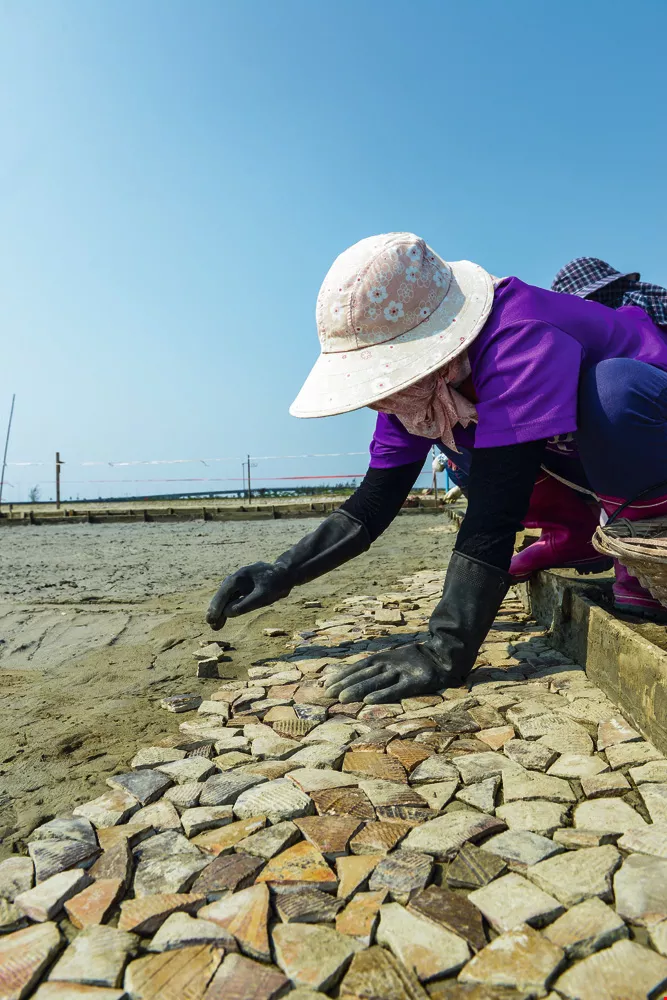
In this photo, a salt worker uses ceramic potsherds to create an evaporation pond.
An industry rises… and dries up
Taiwan’s sea-salt industry dates back to the days of Dutch and Spanish rule. It was in 1648, in what is now the Tainan area, that the Dutch East India Company opened the first salt evaporation pools: the Laikou Salt Pans.
In 1661, after Ming Dynasty loyalist Zheng Chenggong took Taiwan from the Dutch, the new regime opened up two additional salt producing sites: Zhouzaiwei (in modern Tainan’s Yongkang District) and Dagou (in Kaohsiung’s Yancheng District).
After many Han Chinese pioneers came across to Taiwan, the “Six Major Salt Pans” of Qing-era Taiwan came to the fore: Laibei, Lainan, Laidong, Laixi, Zhoubei, and Zhounan.
But due to destructive ocean tides and rivers changing course, some salt operations had to be relocated. The “Zhounan” operation, originally in modern Tainan’s Yongkang District, moved to what is now Qigu District, and finally, in 1824, resettled in today’s Budai Township, Chiayi County.
After World War II and the ensuing end of Japanese colonial rule, the ROC government redefined the six major salt producing areas as Lukang, Budai, Beimen, Qigu, Tainan, and Kaohsiung. Of these, the Budai Salt Pans (including the former Zhounan Salt Pans) covered 1800 hectares, making them the largest site in the country.
Making salt from seawater by evaporation is a labor-intensive endeavor, and starting in the 1970s, one by one the salt-making areas went out of business. In May 2002, the Qigu Salt Pans halted operations, and Taiwan’s 355-year-old sun-dried sea-salt industry passed into history.
The Budai Salt Pans closed down in 2001. But seven years later, the Budai Cultural Association (BCA) relaunched the Zhounan evaporation ponds, giving new life to sun-dried sea salt.
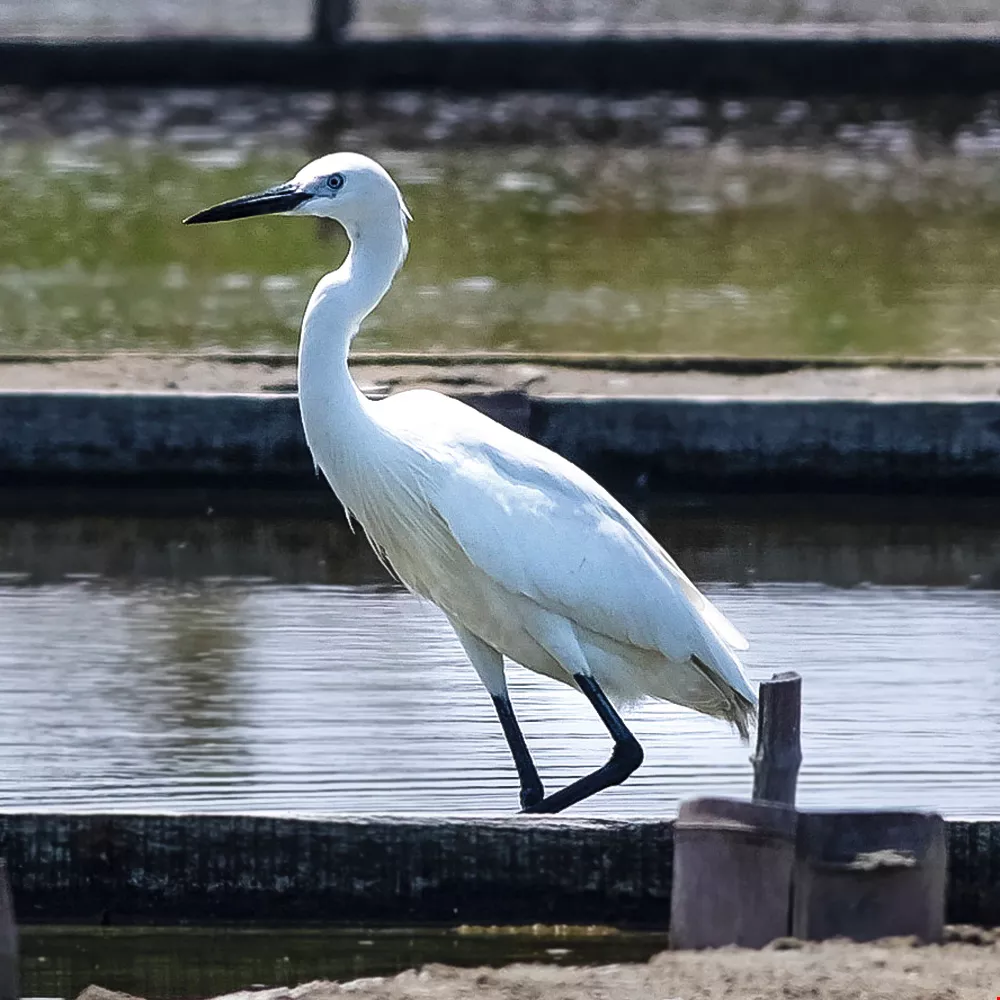
Egrets are frequent visitors to the salt evaporation ponds.
Salt-of-the-earth citizens
Tsai Jiung-chiau, born in 1968, is a native son of Budai. After graduating from university he worked as a reporter for three years, then joined the “Budaizui Cultural Workshop.” Prior to the closing of the salt pans, he was asked by people from his hometown, “What can cultural workers do?”
“Back then I felt powerless, completely incapable of doing anything. I could just take photos of the evaporation ponds, write some essays, and maybe do something perfunctory to mourn their passing,” says Tsai wryly.
Later the BCA was formed and “adopted” the Zhounan Salt Fields, agreeing to take non-profit responsibility for their management. They submitted a proposal to the Council for Cultural Affairs (now the Ministry of Culture) seeking permission to bring the ponds back into operation. However, the salt flats had been abandoned for six years by then, and the soil was cracked and dry so that seawater just drained away. For these reasons, the association had to first buy 300 tons of crude salt and scatter it in the pans, in order to “resalinate” the land.
Despite the difficulties, at least at that time Tsai Jiung-chiau could give his fellow Budai country folk a more positive and concrete answer: Cultural workers could transform the Zhounan Salt Fields into “cultural heritage,” making them a place to produce “cultural salt.” The BCA also aimed to get ordinary citizens involved, because only then would the salt flats have any authentic value in terms of revitalizing local cultural traditions. For the operators of the Zhounan Salt Fields, it is the essential ingredients of salt production—sea, land, wind, sun, and most important of all, people—that are the genuine spiritual icons of the project.
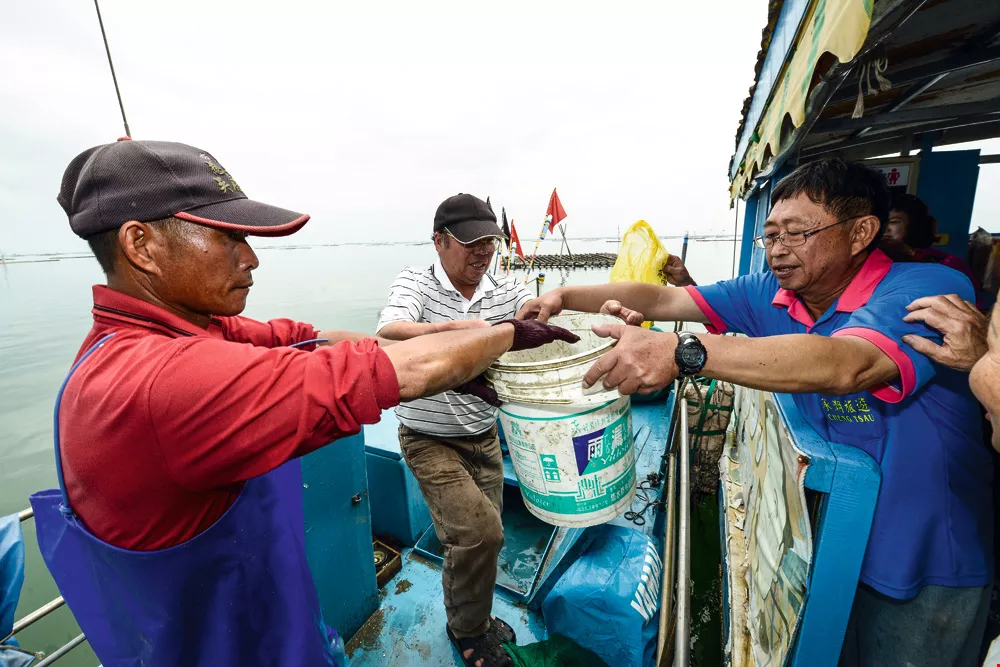
Visitors to Budai can take a tourist boat out to sea, where they can not only admire the scenery but also enjoy the pleasure of buying fresh-caught seafood directly from working fishing boats.
Crystallization of experience
Since 2011 the Zhounan Salt Fields have been opened up to school field trips and tourists, rapidly becoming a popular cultural attraction for Budai. Last year alone nearly 3000 schoolchildren came here to personally experience what it was like to be a salt pan laborer.
Every “experiential visitor” passes through the “big evaporation ponds,” the “small evaporation ponds,” and the “crystallization ponds,” viewing the entire sea-salt production process from start to finish. At the crystallization ponds, they do just what the “old salts” did, using rakes and bamboo scoops to harvest the crude salt, as demonstrated by elderly retired salt pan laborers.
Also to be seen are “salt flowers,” which crystallize in the fields and look like thin panes of glass. Pluck a “petal” and put it on your tongue—it melts in your mouth, releasing a subtle fragrance and a refreshing salty taste.
The BCA is moving toward becoming a social enterprise. They hope to become financially self-sufficient, using the income from their salt products to sustain operations at the Zhounan Salt Fields. Marketing these products under the brand name “Grains of Wind and Sun,” they are getting an especially enthusiastic response to summer salt flowers and winter “frost salt.”
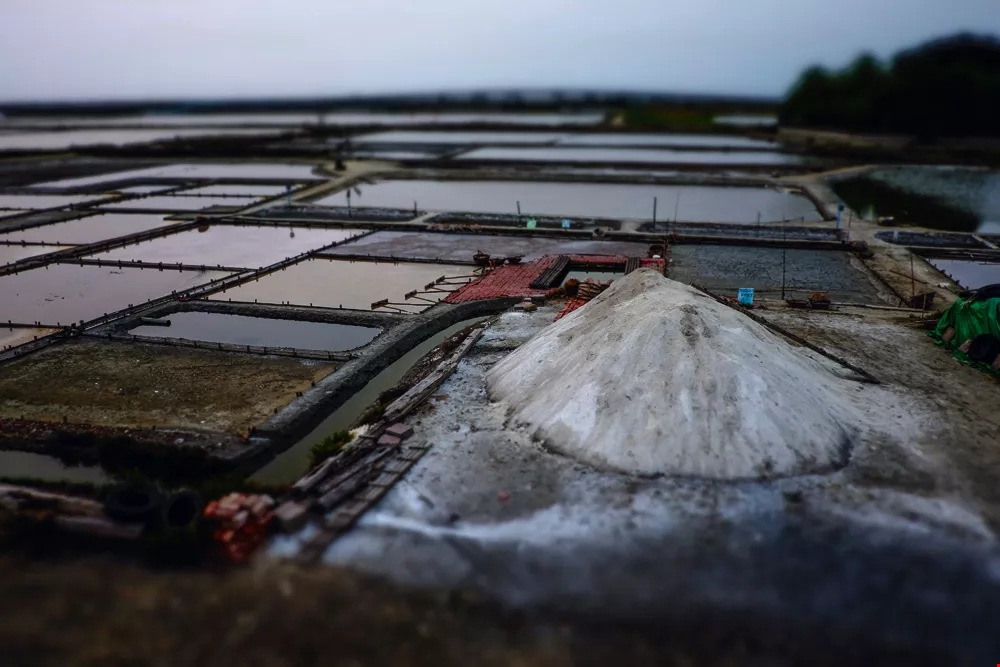
Salt evaporation ponds at dusk; the refracted light produces fascinating colors that tint the tranquil scenery.
Aqua+culture
In addition, they have gotten together with a group of small farmers to form the “Budai Real Food Restaurant” product platform. Their work includes promoting mini-trips to production areas, so that people will be able to see, touch, taste, and especially experience the appeal of Budai.
Qiu Jingyao and his younger brother run an aquaculture operation that is on the Budai mini-trip menu. When you go there you will feel the special appeal of an environmentally conscious small-town business.
The Qiu brothers’ aquaculture operation is situated near a wetland in southern Budai. A few decades ago, this expansive wetland was a shimmering sheet of white salt. Nowadays, it provides a winter home to the black-faced spoonbill, offering beautiful scenes to the visitor.
The aquaculture operation occupies 30 hectares, divided into more than 40 ponds. The land is surrounded by wild grasses taller than a man, giving a first impression that can be summed up as “untamed” and “rough around the edges.”
“The best fish are those that grow naturally in the wild,” says Qiu Jingyao, generously sharing his simple secret: learn from nature! The main lessons are, first use no artificial chemicals, and second, raise a mixed group of fish that form a quasi-natural ecology in the aquaculture pond.
The main earners are milkfish and vannamei shrimp. These are raised alongside other fish that provide “janitorial services,” such as grass carp, bighead carp, crucian carp, and otomebora mullet. For example, says Qiu, the bighead carp eat algae, while the mullet “sweep up” undigested feed from the bottom. Each pond is an independent ecological system.
Because Qiu does not dose his fish with pharmaceuticals, they can only be raised at a low density, to minimize the transmission of diseases. Having adopted chemical-free aquaculture, Qiu has been selected as a supplier by the Homemakers Union Consumer Co-operative, and together they continue to promote toxin-free seafood.
There is one “alternative” mini-trip in Budai that bears special mention: Visitors can take a boat out to sea and buy fresh-caught seafood directly from fishing boats.
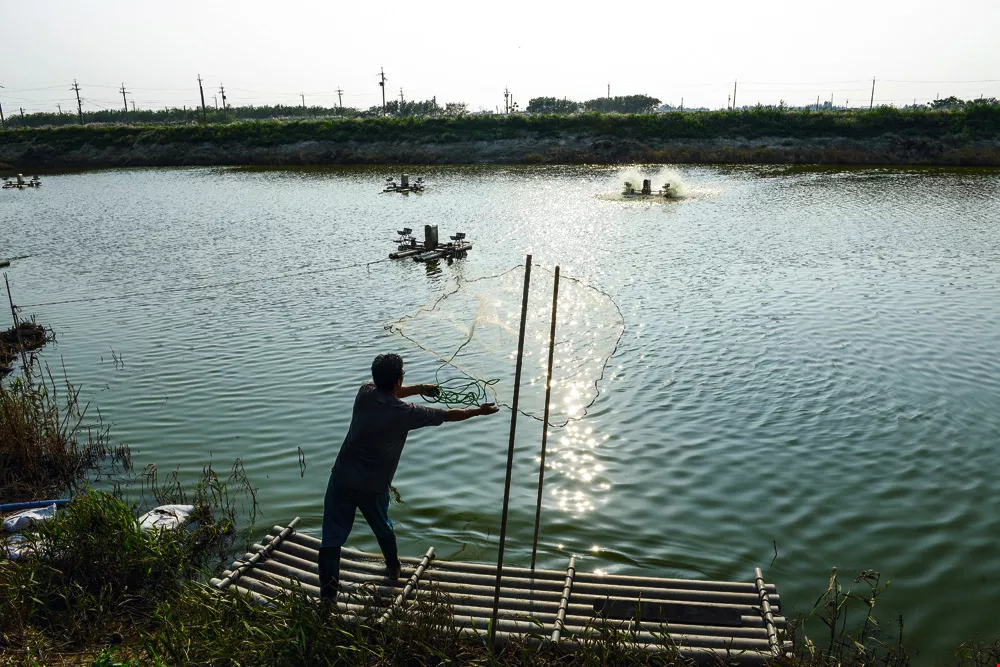
The Qiu brothers run an ecological aquaculture operation in Budai. They raise milkfish and vannamei shrimp in low-density ponds from which they periodically remove algae using filtering nets. They take advantage of this routine to keep close tabs on the environment in the ponds where they raise their toxin-free seafood.
Tourist shopping at sea
Budai has long had a working fishing harbor. Local fishermen continue with traditional activities like growing oysters in offshore pens and fishing at sea, but in recent years they have also turned to the business of “tourist fishing boats.”
On one day in April, veteran fishing boat captain Chen Yongchun, now in his sixties, eases his boat away from the pier at Budai Fishing Harbor, carrying out to the open ocean a group of more than 30 tourists from Hsinchu.
Captain Chen, a semi-retired fisherman who now operates a boat for his son Chen Guankui’s tourist fishing boat company, says that if you are lucky, when you get to sea you just might glimpse the creature known by locals as the “Mazu fish” jumping through the ocean surface. This is the beautiful Indo-Pacific humpback dolphin or Chinese white dolphin.
As Chen brings his craft alongside a boat that is just hauling in its net, some tourists who are seeing a fishing boat in action for the first time show great curiosity about the lobsters, squid, and other catch, and even offer to immediately buy something from the fishermen. They then turn their seafood over to the chef on board the tourist vessel to be prepared for the table.
Chen Guankui says that while of course one reason that they bring the tourist boats out to buy seafood directly from fishing boats is to help the fishermen make some extra money, more important is that the tourists will get a first-hand experience of what it means to depend on the sea.
Budai was long perceived as a community that lived off fishing and salt. Now that the fishing industry is in decline and salt making is of purely historical interest, what is left for Budai? Pay a visit to this community and you will see new and old side by side, and a richness of life that is by no means inferior in depth and content to that of the past.

@List.jpg?w=522&h=410&mode=crop&format=webp&quality=80)

@List.jpg?w=522&h=410&mode=crop&format=webp&quality=80)

@List.jpg?w=522&h=410&mode=crop&format=webp&quality=80)
@List.jpg?w=522&h=410&mode=crop&format=webp&quality=80)

