

Blue-and-white willow pattern porcelain appeared in England in the 1780s. Its universal popularity among people of all tastes can only be described as remarkable.
Even today, from antique shops where age and origin are all-important, to ordinary corner shops, from collectors' display cabinets to working-class dinner tables, there's almost nowhere you can't find these cups and dishes, bowls and saucers covered in pictures of Chinese pavilions and pagodas.
In the late 18th century, when the popularity of Chinoiserie had already waned, why was English willow pattern ware, with motifs closer to Chinese originals, able to burst onto the scene and win lasting popularity?
Two pigeon flying high
Chinese vessel sailing by
Weeping willow hanging o'er
Bridge with three men if not four
Chinese temples there they stand
Seem to take up all the land
Apple tree with apples on
A pretty fence to end my song.
This doggerel verse about willow pattern porcelain unmistakably describes a Chinese landscape of temples and pavilions, little bridges and running water. But somehow the swooping doves and round apples seem different from the scenery of southern China.
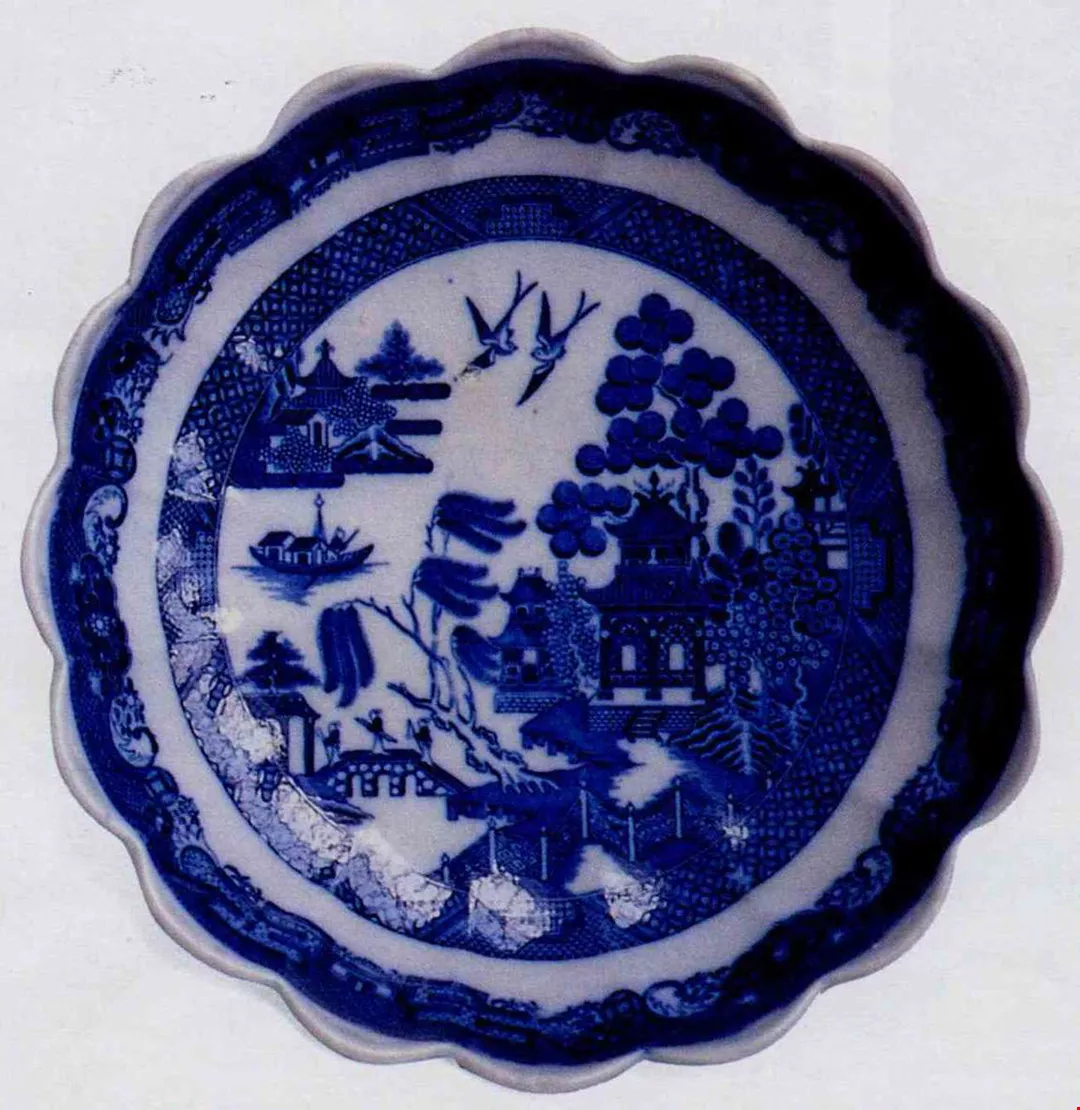
The world represented in the willow pattern plate is interpreted differently in the East and in the West. The canes and zither carried by the figures on the bridge are identified in the West as a distaff, a jewel box and a whip. (photos by Cheng Yuan-ching)
Dinner-table geography lessons
Art historian Hugh Honour wrote that the Chinese landscapes which he got to know from the willow pattern plates off which he ate every day as a child, created his image of far-off China. Even when he later discovered that this version of China was created by Europeans, the original impression still remained at the back of his mind.
Apart from the exotic impression deeply imprinted on their minds by the upturned eaves and meandering fences depicted on this tableware, many Westerners' childhood memories of the dinner table also include a love story passed down through the generations. It comes in many different versions, but they all share the same poignancy.
Living in the "temple" on the right-hand side of the dishes is the beautiful, lovestruck Koong-tse, the daughter of a wealthy family (in some versions, she is a Chinese princess). She is in love with Chang, a flower gardener (or clerk) who works for the family. Koong-tse's father is outraged when he learns of their romance, and immediately betroths her to a wealthy old mandarin. Koong-tse's father shuts her up in the little temple on the left side of the garden, and does not let her see her lover.
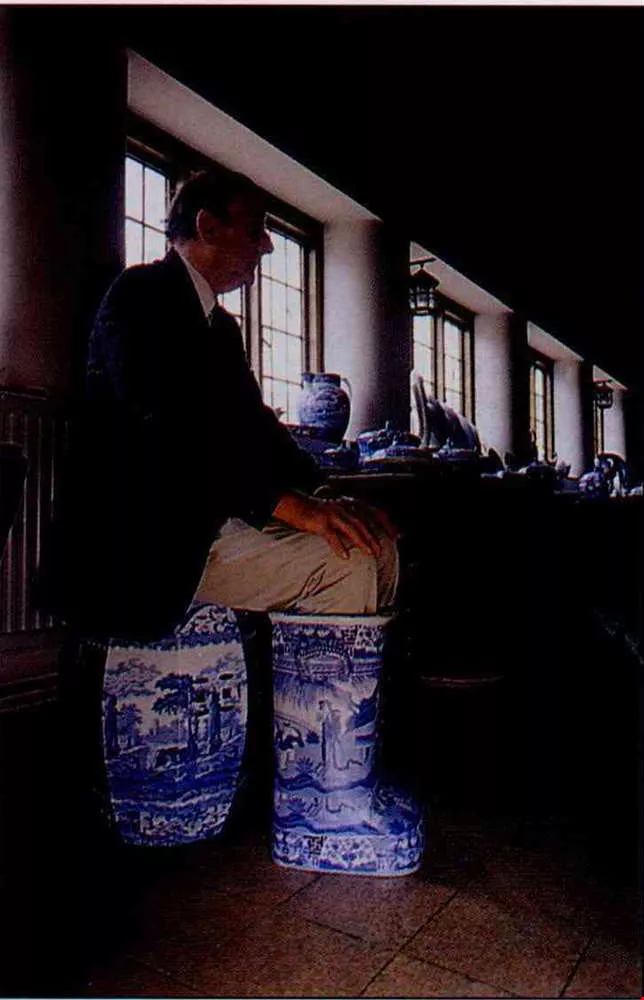
Robert Copeland displays a blue-and-white footbath made by the Spode pottery.
Tragic lovers turn into birds
But the clever gardener knows that a little stream curves around in front of Koong-tse's temple, and sends her letters in paper boats, telling her of his plan for their elopement. The little boat he has hired is waiting by the river bank under the willows, just by the little bridge. When they cross the river in it, they will be able to live happily ever after on the other side!
So on the little three-arched stone bridge we see Koong-tse walking in front of Chang, holding a "distaff" which symbolizes "chastity." Following on behind, Chang holds up Koong-tse's "jewel box," while her enraged father chases after them brandishing a "whip."
The lovers finally get across the river as planned, and are married. Chang studies hard and before long becomes a renowned scholar. But this arouses the envy and hatred of the old mandarin, and he sends someone to kill Chang. The heartbroken Koong-tse finally takes her own life. Heaven is moved by her loyalty, and she and her husband become a pair of lovebirds, gazing at each other across the dish for ever.
This story a la Romeo and Juliet first appeared in the English magazine The Family Friend in 1849. The real name of the author is not known. According to the entry in The Collins Encyclopedia of Antiques, the first willow pattern was a "pseudo-Chinese design" applied to plates by transfer printing in the 1870s. The pictures on the ware, and the legend attached to them, were "of English origin" through and through.
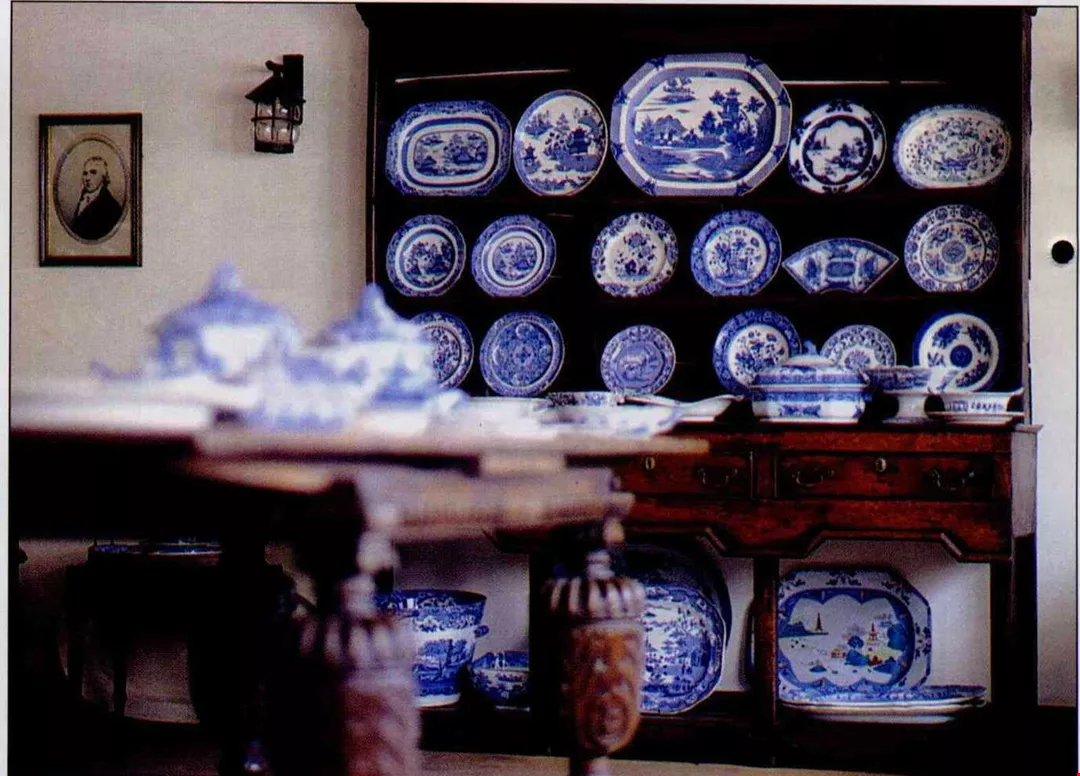
All kinds of blue-and-white ware with Chinese-style patterns, on show in Spode's exhibition rooms. (photos by Cheng Yuan-ching)
A product of the Industrial Revolution
"For me the willow pattern evokes feelings of an ancient China of pagodas, sampans, dragons and of an age-old culture ruled by mandarins. It also reminds me of the birthplace of porcelain, the origins of porcelain in England, and the strong trading links between England and China established centuries ago." So says microbiologist and porcelain connoisseur Dr. Ian Hall, who now lives in New Zealand.
Dr. Hall not only has vivid childhood memories of eating off blue-and-white plates at his greatgrandparents' house, he was also born in a village near the little pottery town of Caughley, in the English county of Shropshire, the home of willow pattern. Thus he has always had a special affection for willow pattern ware. For him, a willow pattern plate is virtually a history of the transmission of Chinese porcelain to the West, and a microcosm of the British Industrial Revolution into the bargain. And so indeed it is.
When the willow pattern was born, Britain's Industrial Revolution was in full swing, and over the River Severn, not far from one of the centers of the English potteries, Britain's famous Iron Bridge was proudly erected. It was an era of constant innovation and experimentation with all kinds of new manufacturing technologies. Another of the legends to do with the willow pattern touches on this very aspect:
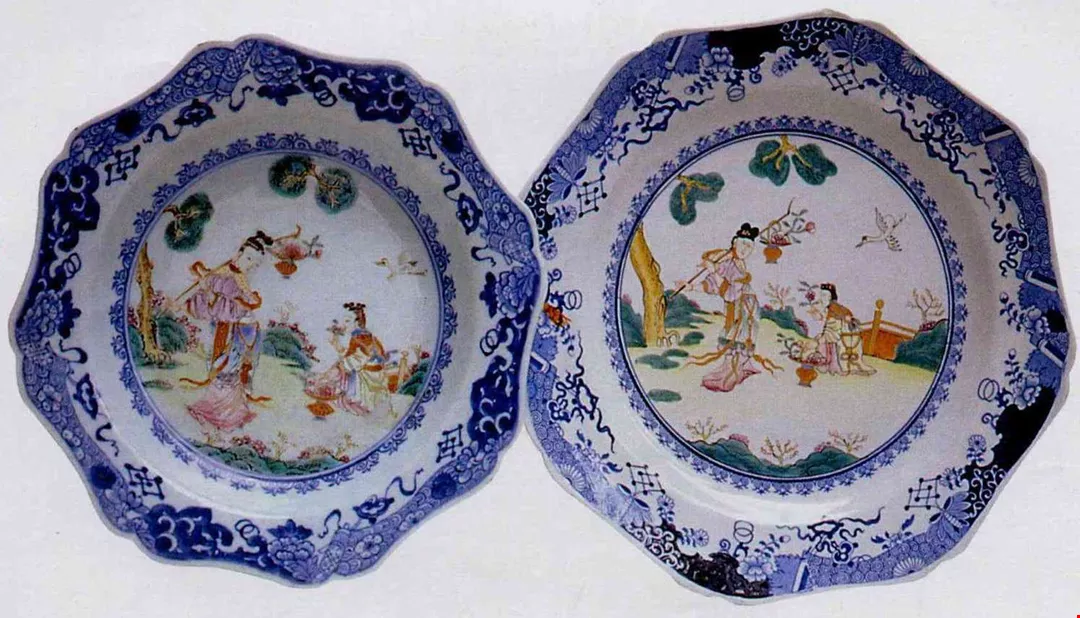
Can you guess which is the Chinese original, and which the Western imitation? (photos by Cheng Yuan-ching)
A working-class hero
The owner of a porcelain factory, Wong Ts'in, has agreed to make 200 identical porcelain plates for the rich and powerful Hien Nan. But one of Wong Ts'in's workers, Fang, along with two others, organizes a strike for higher pay. Wong Ts'in cannot afford to give them a raise and is at a loss what to do.
Only one of the workers, Wai Chang, does not join the strike, because he is besotted with Wong Ts'in's daughter Fa Fai. She is obviously equally fond of him, for she asks him in to sit and talk.
Made lightheaded by this unexpected benevolence, Wai Chang inadvertently sits on a plate Fa Fai has just finished painting; when he hurriedly stands up again, a clear image is imprinted on the seat of his trousers. Naturally this quick-witted pair of lovers immediately realize that they have found the secret by which the order can be finished on time, and together they complete 200 identically patterned plates. Thus the reputation of Wong's pottery is saved, and the two are married with his blessing.
What does this happy tale have to do with willow pattern ware? In fact the rich Hien Nan lives on the island across the river on the plates, and the little junk is taking him the porcelain he ordered. Wong's factory is on the bank under the trees, while the three characters on the little stone bridge are of course the strike organizers, Fang and his two accomplices.
The other side of the bridge is left unpainted, reputedly in the hope that as Fang skulks away he will fall into the water! But don't worry: the artist who designed the willow pattern was clearly a goodhearted soul, for didn't he place a leaning old willow on the river bank by the bridge? If Fang does fall in, the tree's trailing branches will surely save him.
Undoubtedly, this version of the willow pattern legend is an English invention from start to finish. It bears no trace of the poignant mystery of "feudal" China, but revolves around the ingenuity and creativity of the protagonists in inventing the transfer printing technique by which willow pattern ware was produced. But how does this version explain that pair of lovebirds which loiter eternally on the dishes?
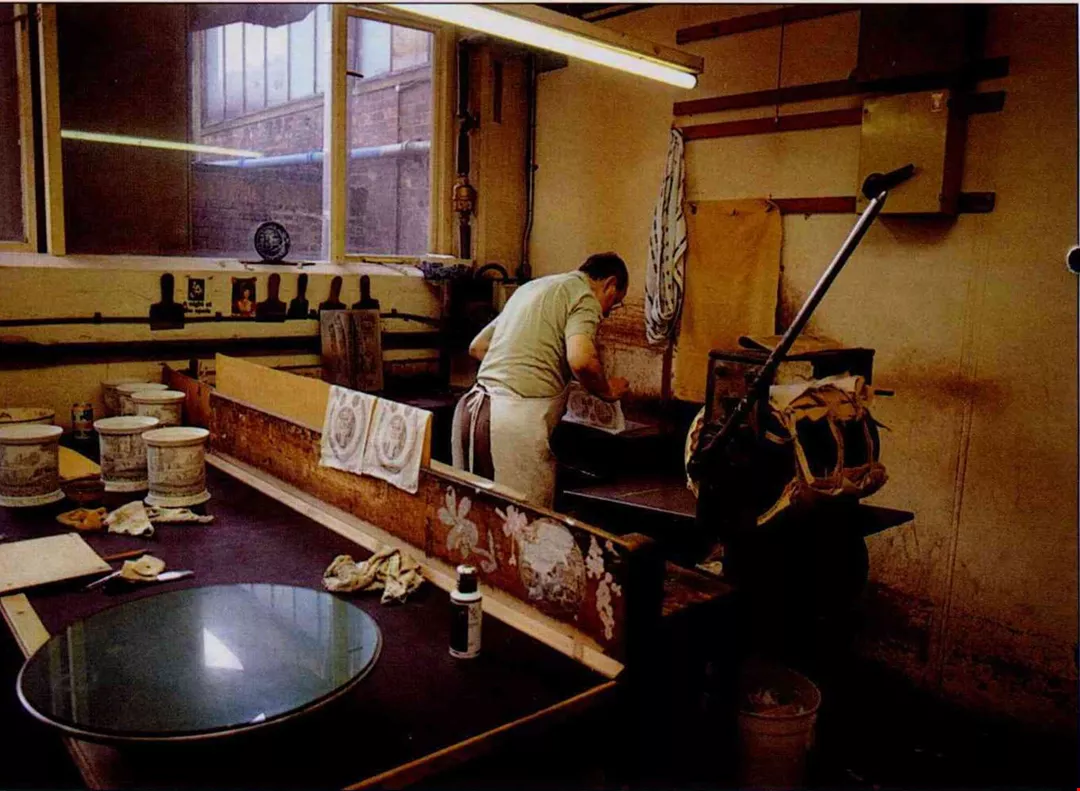
Even today, Spode continues to make tableware by the traditional transfer printing process. But nowadays the most popular designs are "Blue Italian" landscapes. (photos by Cheng Yuan-ching)
Outdated Chinese motifs?
"In fact those birds didn't appear on the earliest willow pattern designs," explains collector Dr. Hall. Willow pattern ware was made by many different potteries, and the "standard" design including two love-birds, which is current today, did not crystallize until around 1830.
But Dr. Hall observes that the story of Fang's strike is closest to the willow pattern's original spirit, because at the time when the ware was born, British trade unions were just beginning to fight hard for workers' rights. The legend faithfully reflects the spirit of the age.
One question which interests Robert Copeland, who was born into a family with a long history in the pottery industry and is currently consultant historian to Britain's Spode pottery, is this: in the late 18th century, when neoclassicism was all the rage in Britain, why should the very different willow pattern ware suddenly be such a success? Furthermore, how was willow pattern, which is not part of the European Chinoiserie style but is closer to original Chinese motifs, able to compete on the market with genuine Chinese ware? The Spode pottery's founder, Josiah Spode I, produced over a score of Chinese motifs, including the willow pattern design. Couldn't he think of anything more original? Why was he so taken with Chinese images?
Mr. Copeland first studied the background of the porcelain trade from documents of the British East India Company in the British Library, and then searched for clues among the Spode company's early purchase orders, pattern books and whatever other information he could get his hands on.
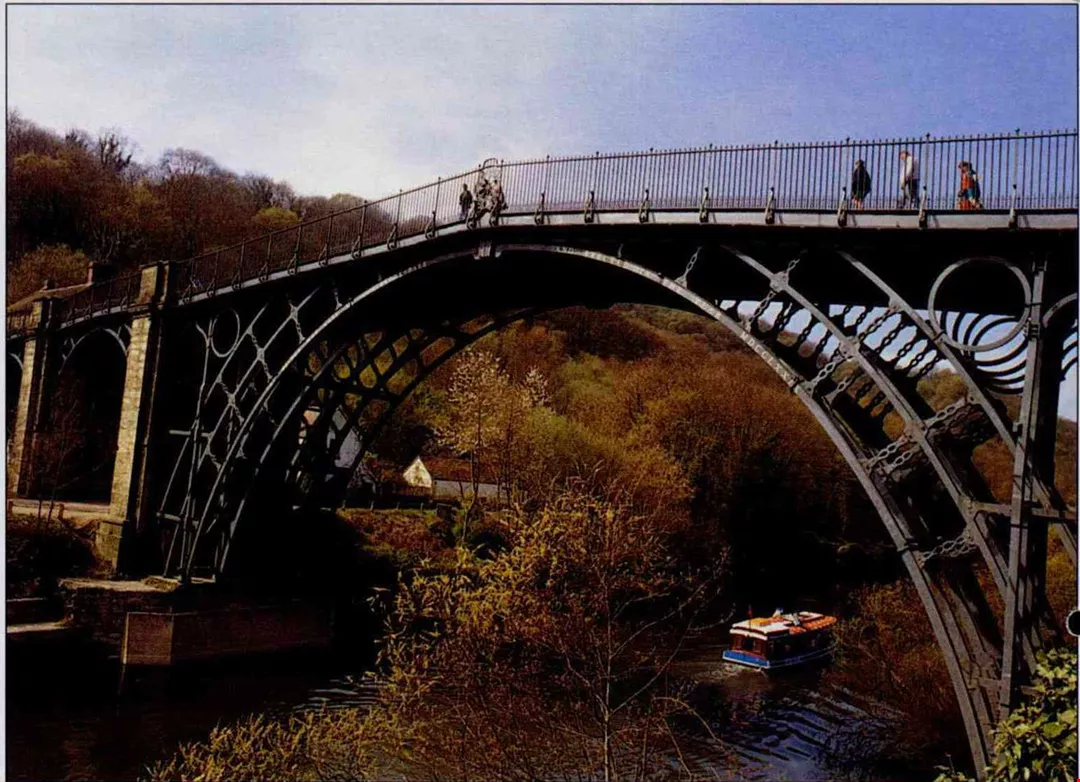
The Iron Bridge proudly erected on the River Severn in 1779 symbolizes the spirit of Britain in the Industrial Revolution.
A fortune built on spare parts
He discovered that before the company started making willow pattern, it had received orders from customers to make "replacement pieces." In other words, when rich families who owned Chinese porcelain dinner services had got one or two pieces broken, or when they wanted additional items not originally included, they asked the potters at their local potteries to make them up a few pieces to the same design.
He says that in mid-18th-century England, the richest families used imported Chinese porcelain, ordinary rich folk used silverware, and the common people used pewter or earthenware. From the end of 18th century, for many reasons including a saturated market, changing fashions and China's own decline, the quantities of Chinese porcelain sold to England fell sharply, until the British East India Company stopped importing it altogether.
By that time, Chinese porcelain did not look right with the new neoclassical interior design which had become popular among the upper classes. Europe's own newly developed porcelains such as German Meissen ware with its strongly European style, or English Wedgwood which imitated ancient Greek designs, became the new favorites. But the families who already owned Chinese porcelain often still needed replacements, and as imports were no longer available to satisfy this demand, local potteries took on the job.
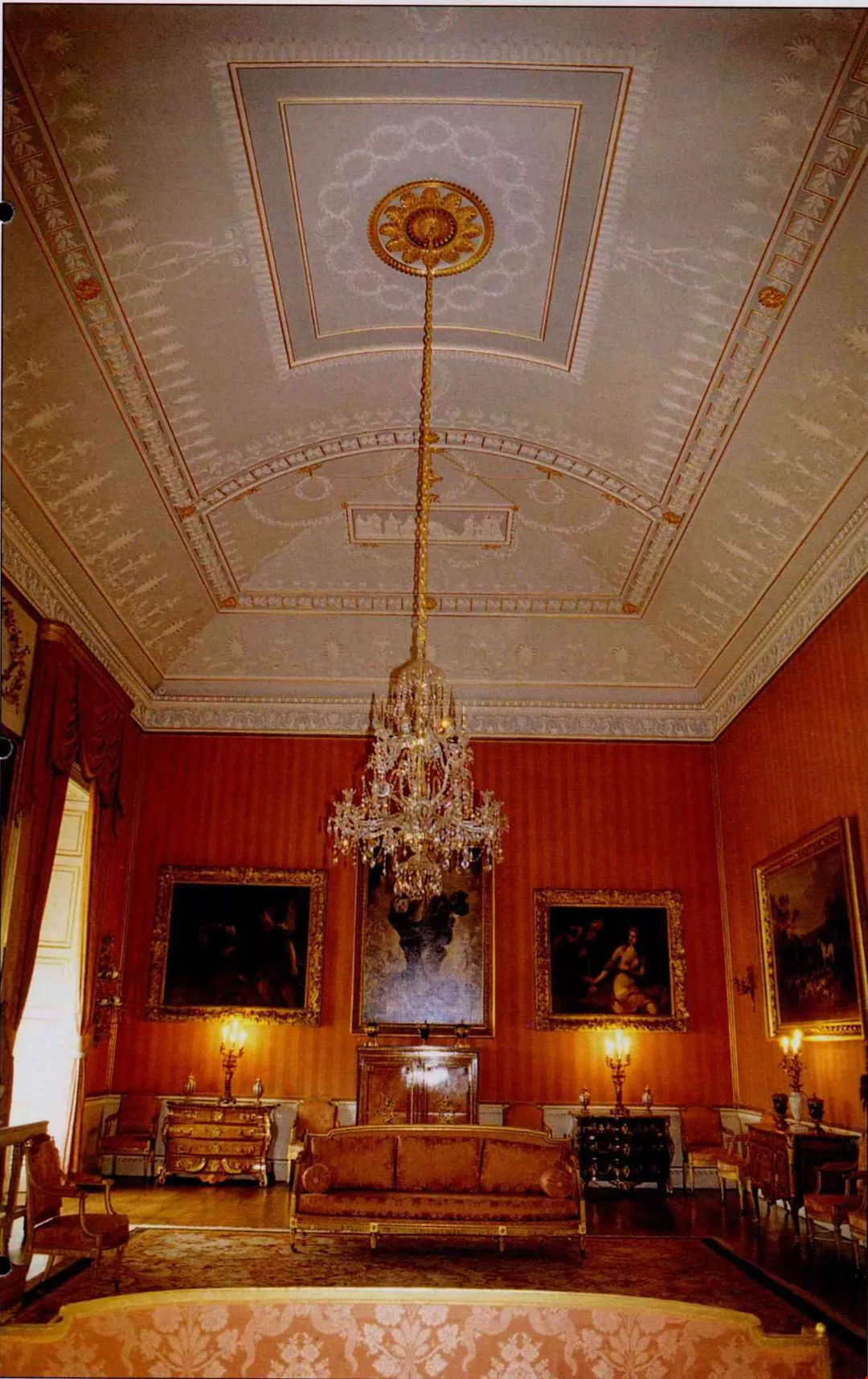
The neoclassicist interior of the Blue Drawing Room in Shugborough House, England, echoes the blue-and-white coloration of Wedgwood stoneware.
Fulfilling a blue-and-while dream
But in fact the professional and merchant classes' dreams of owning Chinese style blue-and-white ware were still unfulfilled, says Copeland, for "what the nobility found acceptable yesterday, the next lower level of society favor today." This is a universal phenomenon.
The blue-and-white pattern represented the lasting memory of the Europeans of the porcelain imported three centuries before, which the English in particular loved. This symbolic coloration was retained even in the new tastes of high society, as for example in the cameo-decorated Wedgwood stoneware, which eschewed Chinoiserie in favor of Greek classicism. The best-known British interior designer of the same period, Robert Adam, left behind designs of the same color scheme in countless luxury residences.
The most extreme example is recounted by Professor Oliver Impey of the Ashmolean Museum in Oxford: the eccentric Sir George Sitwell, a great lover of blue and white porcelain, was also very taken with the pastoral scenery of his estates, but was dissatisfied with the white color of his dairy cows. In an inspired moment he "determined to have all the white cows in the park stencilled with a blue Chinese pattern, but the animals were so obdurate and perverse as in the end to oblige him to abandon the scheme."
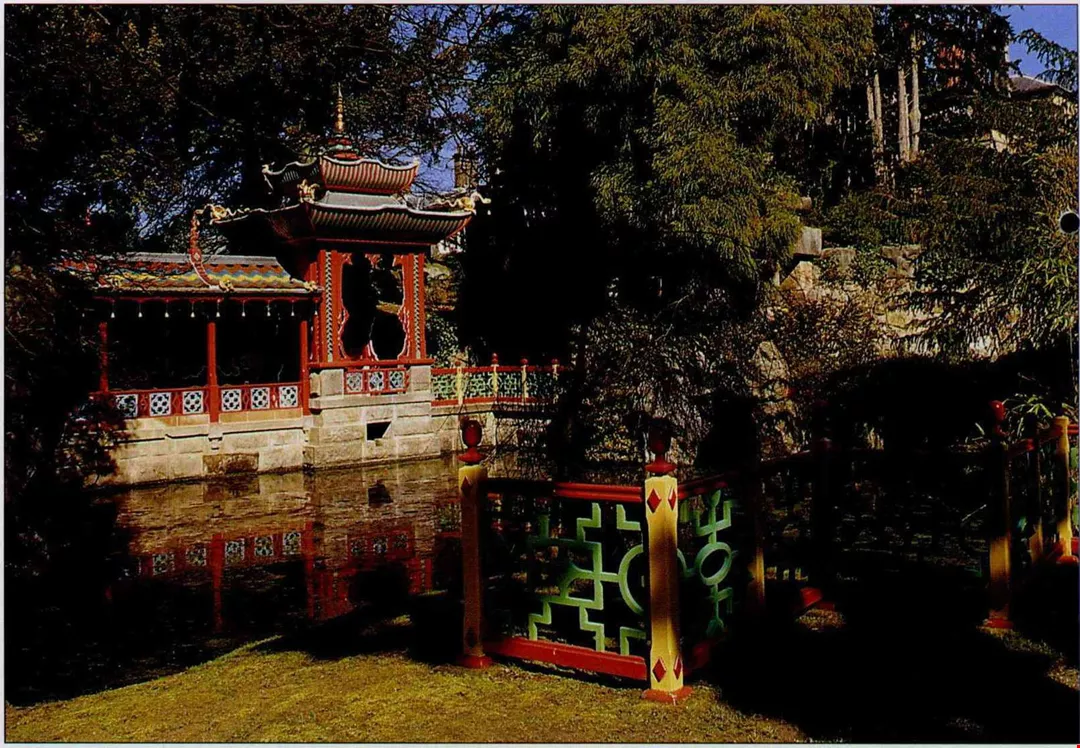
Biddulph Grange's willow pattern garden is called "China." It was renovated and reopened to the public just a few years ago.
"Socialist" plates
With this attachment to blue and white, a number of English potteries such as Caughley and Spode became familiar with the designs of Chinese blue-and-white ware through making replacement pieces. After transfer printing appeared on the scene, they themselves developed Chinese patterns for massproduced ware aimed at middle-class consumers.
At that time the images also included boys riding on buffaloes, two temples, long bridges and so on, but the willow pattern design was the most popular and the best seller among them. "In those days some customers would insist when placing their orders: 'It must be blue-willow in any pattern!'" says Copeland. He points out that many potteries were making willow pattern, and it is very hard to determine which was the original pattern or factory, because the various potteries often helped each other out with the copper plates used in transfer printing.
Thus when browsing antique shops for Spode willow pattern one should make sure there are three little characters on the bridge, and that they are walking from right to left--otherwise the piece may be an inferior one. Thus Copeland loves to jokingly call willow pattern ware "socialist plates." Considering the story of Fang's strike, the name seems strangely appropriate.
Evidence of just how popular the willow pattern was can also be found at the Victorian country house Biddulph Grange, in the English Midlands not far from Stoke-on-Trent, the center of the Staffordshire pottery industry.
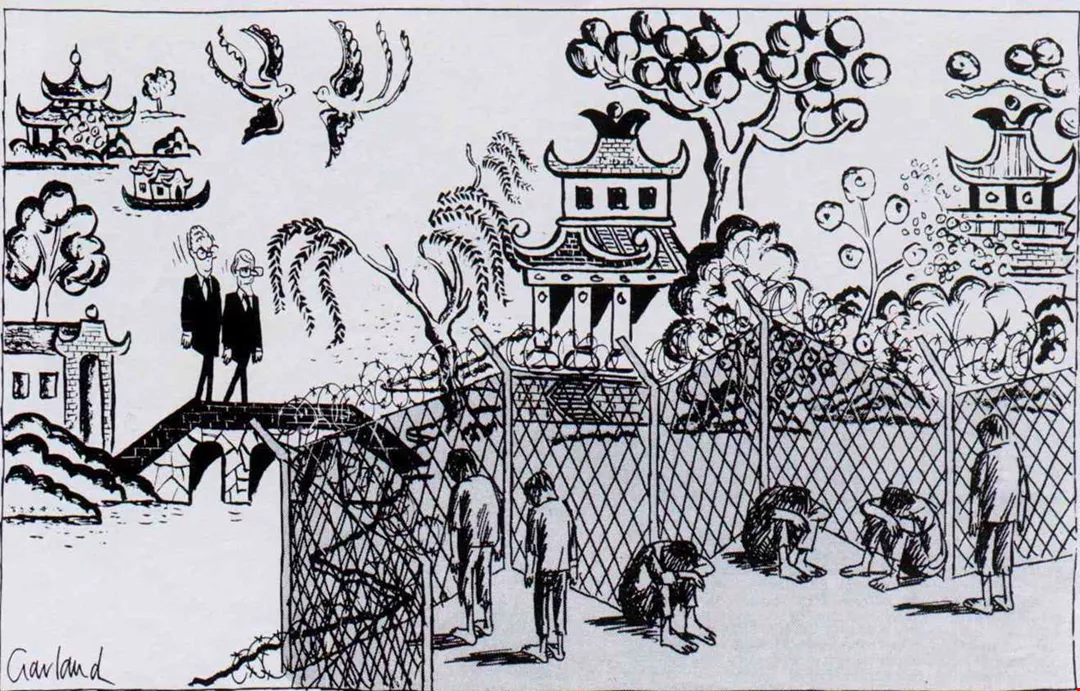
The characters on the bridge are walking the wrong way, as the willow pattern's image hits an all-time low. This cartoon appeared in Britain's Daily Telegraph when the British prime minister visited Beijing after the Tiananmen massacre. (c The Telegraph plc, London, 1991)
The willow pattern becomes a real garden
In Biddulph Grange's park, laid out in the 1840s, there are thematic gardens in Egyptian, Scottish, Italian and other styles. Here the images of the willow pattern have actually been transformed into a real landscape, which is brazenly called "China." Apart from pavilions and twisting fences, little bridges and weeping willows, the garden's creator even marked its boundary with a "Great Wall."
In fact Biddulph Grange's design is very much in line with the spirit of willow pattern's age. Strictly speaking, willow pattern is not a throwback to the pastiche Chinoiserie created earlier by Europeans, for it is modelled faithfully on Chinese originals.
The Britain of Biddulph Grange's time had seen the many accounts and pictures of China engendered by Lord Macartney's audience with the Emperor Qianlong, and was just going through the Opium Wars. Thus the China which the landscape gardener attempted to express was worlds away from the half-imaginary Shangrila reconstructed in the gardens of 18th-century Europe. The Great Wall alongside the willow pattern motifs seems to be a reminder of its "authenticity."
The international character of Biddulph Grange's gardens is said to have been compared by people of that period with the 1851 Great Exhibition held in the Crystal Palace. We can see how once the Europeans' dreams of a distant paradise had been shattered, the atmosphere the Chinese garden exuded was now the imperialist spirit of collecting novelties from around the world and taking them for one's own.
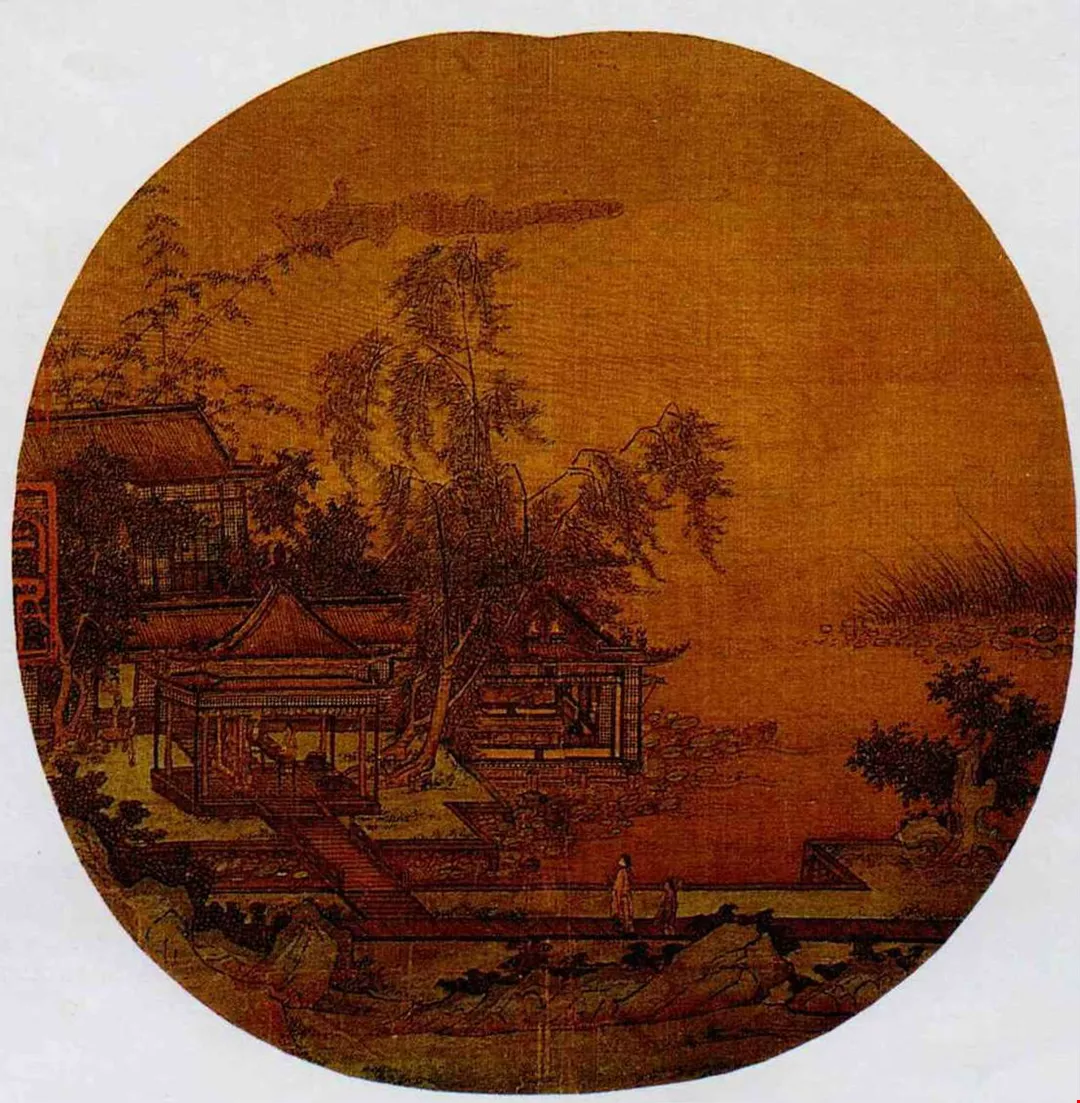
Isn't there something strangely familiar about the pavilions and shady willows, and the scholar taking a zither on a visit to friends, as depicted in this Song-dynasty painting? (courtesy of the National Palace Museum)
Weeping willows
The willow pattern ware mass-produced by the transfer printing method brought the upper-class experience of blue-and-white ware into ordinary people's lives. For this new class of consumers, at a time when the Industrial Revolution was in full swing and the pace of life had changed, whether the pictures depicted garden scenes or boys riding buffaloes, the desire they expressed and the comfort they brought probably lay not in the imagery of faraway Xanadu, but simply in city dwellers' longing for country life.
Of course, willow pattern has also seen its image hit an all-time low. That was in the autumn of 1991, when British prime minister John Major became the first Western leader to visit mainland China after the Tiananmen massacre. The London Daily Telegraph published a cartoon depicting a willow pattern plate. On it, the pavilions are there as usual, and the lovebirds gaze at each other as ever. But the meandering fence in front of the garden has become barbed wire, outside which a few ordinary Chinese, dressed in rags, are weeping. And the little characters on the bridge are not lovers eloping, nor yet the strike organizer Fang, but John Major and the then British foreign minister Douglas Hurd walking "the wrong way"--from left to right. The cartoon is entitled "Weeping Willow Pattern."
In the last few years, as mainland China's economy has taken off, high officials from Western countries have made their way there in a continuous stream. What kind of symbolism will this impart to the willow pattern?
A spring visit to friends
Never mind whether in the Western world the willow pattern represents sad fables or workingclass heroes, a heavenly paradise or bucolic scenes, in Chinese eyes what these plates depict is quite clearly the scenery of southern China in spring, when willows wave and orioles sing, and when in days of yore the educated and the elegant would go with cane in hand, carrying a zither, to pay spring visits to their friends. Such idyllic scenes represent the ideal world which Chinese literati have always yearned for.
Although the humble willow pattern came too late to cash in on the fashion for Chinoiserie among royalty and the aristocracy, it has its place in the story of East-West exchange, and it really did manage to capture the essence of Chinese ideals of life.
[Picture Caption]
p.30
From antique shops to cheap supermarkets, all kinds of willow pattern, new and old, can be found everywhere.
p.31
The world represented in the willow pattern plate is interpreted differently in the East and in the West. The canes and zither carried by the figures on the bridge are identified in the West as a distaff, a jewel box and a whip. (photos by Cheng Yuan-ching)
p.32
Robert Copeland displays a blue-and-white footbath made by the Spode pottery.
p.32
All kinds of blue-and-white ware with Chinese-style patterns, on show in Spode's exhibition rooms. (photos by Cheng Yuan-ching)
p.33
Can you guess which is the Chinese original, and which the Western imitation? (photos by Cheng Yuan-ching)
p.34
Even today, Spode continues to make tableware by the traditional transfer printing process. But nowadays the most popular designs are "Blue Italian" landscapes. (photos by Cheng Yuan-ching)
p.34
The Iron Bridge proudly erected on the River Severn in 1779 symbolizes the spirit of Britain in the Industrial Revolution.
p.35
The neoclassicist interior of the Blue Drawing Room in Shugborough House, England, echoes the blue-and-white coloration of Wedgwood stoneware.
p.36
Biddulph Grange's willow pattern garden is called "China." It was renovated and reopened to the public just a few years ago.
p.36
(left) The Chinese scenes painted by William Alexander, who accompanied Lord Macartney on his mission to visit the Emperor Qianlong, provided the blueprints from which Europeans of the time reconstructed their image of China.
p.36
The characters on the bridge are walking the wrong way, as the willow pattern's image hits an all-time low. This cartoon appeared in Britain's Daily Telegraph when the British prime minister visited Beijing after the Tiananmen massacre. (c The Telegraph plc, London, 1991)
p.37
Isn't there something strangely familiar about the pavilions and shady willows, and the scholar taking a zither on a visit to friends, as depicted in this Song-dynasty painting? (courtesy of the National Palace Museum)


@List.JPG?w=522&h=410&mode=crop&format=webp&quality=80)


