HTC: Putting the "Smart" into Smartphone
Yang Ling-yuan / photos courtesy of HTC / tr. by Phil Newell
January 2010


The year 2009 was a turbulent one for Taiwan's leading maker of smartphones, HTC. In early August, the company finally ceded its title as "stock price king" to Mediatek, which single-handedly sparked the "knock-off phone" fad in China. However, thanks to the hot sales of its own brand name HTC HD2 in Europe, where demand outstripped supply, the company was able to score a victory over its rival.
HTC is not only making its presence felt internationally through its own brand name, the fact that it produces phones for both Microsoft's Windows Mobile and Google's Android, the two major mobile device platforms, means that it can reap rewards from both sides. However, as worldwide competition in the smartphone market hits the white-hot stage, can the vanguard firm HTC keep riding the crest of the wave? Where are its opportunities and challenges?
"Within 10 years, all cell phones will be smartphones! " This was the prognostication made by Steve Ballmer, CEO of Microsoft, when he attended the unveiling ceremony of HTC's Windows platform smart cell phone HD2 in November of 2009.
A lot of people probably remember the first hand-portable phones that came out 26 years ago-they were about as convenient as carrying around a brick, and could do no more than make simple phone calls. But with the arrival of the era of wireless Internet, cell phones have rapidly evolved. Today, with a cell phone in hand, users can-with the soft, agile touch of a fingertip-take photos, listen to music, play games, send and receive emails, process documents, and enjoy high-speed Internet connections and even satellite navigation... it's addictive!
HTC, which got its start doing OEM production of personal digital assistants (PDAs), only turned to developing its own brand of smartphones four years ago. By 2008 production had surpassed 12 million units, accounting for 7.5% of the global market and putting HTC at the top of the list of Taiwan's homegrown smartphone brands. In 2009, the company ranked fourth among Taiwan's top 10 international brand names, and the brand value reached NT$38.9 billion.
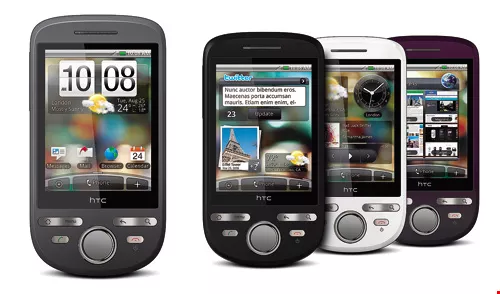
The photo on the facing page shows a "Tattoo" phone with embedded Facebook, Twitter, and Flickr.
Touch vs. iPhone
Twelve years ago, HTC was just starting out as a small factory amidst the rice fields of Guishan Township in Taoyuan County. Although the three-man team that founded the company had worked together at the US firm Digital and had very advanced technology in their hands, they nearly went bust because of difficulty finding customers. As investors pulled out one after the other, only Cher Wang, daughter of Wang Yung-ching (the founder of Formosa Plastics) and now chairwoman of HTC, stayed the course.
Thanks to Wang's efforts, HTC began producing palm-top computers with Microsoft, and eventually became the world's top OEM maker of PDAs, while Wang was named one of the 25 most far-sighted stars in Asia for 2005 by the US magazine Business Week.
The two people who make up the soul of HTC-founder H.T. Cho and CEO Peter Chou-accurately set their sights on the limitless potential of wireless communications, and, exploiting the appeal of the Microsoft name and HTC's firm foundation in PDAs, began to move step by step toward development of smartphones.
In 2006, HTC turned from OEM to producing under its own label. The first item under its flag, the HTC Touch, which offered full-screen touch control, sold more than 1 million units in less than half a year. Then followed the Touch Diamond and the T-Mobile G1, the first cell phone in the world to adopt the Google Android platform. Both finished in the top 10 for sales volume worldwide, a brilliant performance that left others in the industry astounded.
The 2007 launch of the HTC Touch generated one unwelcome surprise, as HTC chief marketing officer John C. Wang still can't forget even today: The phone utilized patented Touch FLO technology, allowing users to scroll by running a fingertip across the screen, with sensitivity so acute that it was said to be able to "distinguish between a man's fingernail and a woman's fingernail." This revolutionary operating technology was HTC's pride and joy, so it was quite a shock when, just before release, on the other side of the globe Apple of the US announced it was coming out with the iPhone, which had not only a contact-sensitive screen but a much hipper design and cooler functions than the Touch. This sent Wang's mood plummeting.
"There's no possibility that either side took anything from the other, because the concept was completely original and innovative. I guess all you can say is, great minds think alike!" Wang says that because HTC could not compete with Apple in name recognition, despite hitting the market a few weeks before the iPhone the Touch didn't get nearly as much media attention. Fortunately, it did quite well in European and Asian markets, allowing HTC to establish its corporate identity in both regions. Success in the European market is especially significant for Taiwanese firms.
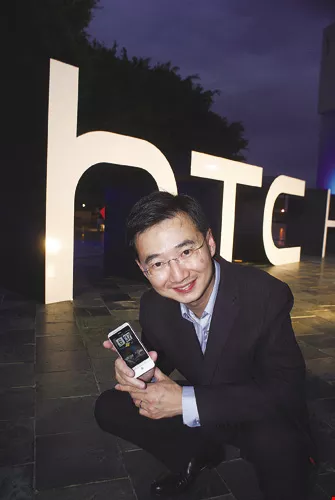
The photo on the facing page shows a "Tattoo" phone with embedded Facebook, Twitter, and Flickr.
People-centric design
"We have always had only one goal-to design a cell phone that is incredibly easy to operate," says Wang, who also heads up HTC's "MAGIC Labs" team. Describing the thinking that lay behind the R&D of the Touch, he recalls that "cell phones were getting more and more complicated in terms of their functions, so that users were getting confused and were unable to use them properly." At first, HTC headed in the direction of new ways of arranging menus and reducing the levels of choices, or of changing the icons and appearance, but after a series of failures they discovered that they would have to "start from zero," which meant designing a phone that even a small child or a granny could operate.
"The most natural solution was to use an interface that people could operate with the touch of a finger, directly turning through menus right there on the screen." Although the Touch's debut was somewhat obscured by the glitter of the iPhone, the hitherto unknown HTC was still able to "draft" behind the Apple fad and draw attention from the media in the US and Europe, becoming recognized as one of the trailblazers in the global trend toward cell phones with touch panels.
Because the price of smartphones is about five times higher than that of ordinary phones with some features (like music or photo functions), they have always been considered a niche market. At present smartphone makers like HTC mostly sell phones through cooperative agreements with telecom firms in various countries.
Wang emphasizes that HTC, which not only has its own brand but designs and manufactures phones for other labels, has a very different model for its original design manufacturing than your typical Taiwanese ODM firm. They don't sit around waiting for customers to bring them demands, they don't poach ideas from others, they don't follow the crowd, and they don't reverse-engineer rivals' products. MAGIC Labs needs only to hear about some new application for cell phones and they organize a task force with the specific mission of coming up with an innovative product for clients. For example, the idea for the function allowing simultaneous reading, receiving, or sending of up to 10 emails at a time on a "Blackberry" produced by the US giant RIM was proposed to this client by HTC. Wang concludes, "All of the cell phones that we develop are flagship phones!"
In order to maintain creative autonomy, HTC makes no prior announcements when it designs new phones, and customers must wait until four months before the new product comes off the factory line before they can see the samples, when they can then discuss with HTC such details as colors or placement of logos. This suggests that they have a very high level of trust in HTC.
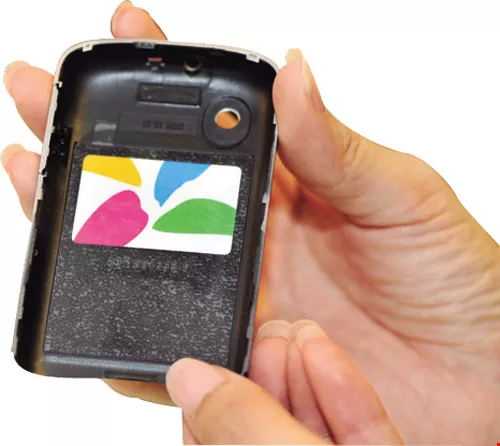
Want to take the MRT? Just swipe with your phone! HTC phones equipped with built-in EasyCards can also show you what convenience stores, parking lots, and shops near your location will accept the EasyCard.
Creativity is our DNA
"Mobile communication is still in the midst of very rapid evolution, and we have to be very fast on our feet. In many ways, including operational objectives and operating models, this year's HTC may be so different from last year's HTC that it is unrecognizable!" relates Wang. What will be the nature of future smartphones? What new looks will be developed? What functions will be added? The people at HTC are constantly exploring and answering such questions.
HTC has made derring-do the norm since the very beginning, when they eschewed the mainstream Palm OS (operating system) in favor of Microsoft, and even today they remain the most important maker of smartphones still using the Microsoft platform. Also, whereas early on HTC was the OEM manufacturer for Dopod, it turned around and acquired Dopod (excluding its China division) and began developing its own brand. In 2007 they came up with the patented Touch FLO technology; in 2008 they combined 3D and Touch FLO to make the Touch Diamond, with high-speed broadband capability and embedded GPS and Google Maps; next they came out with the first smartphone in the world to adopt Google's open-source Android platform; and in 2009 they introduced the HTC Hero with the new Sense interface, conforming more closely to the demand for ever more individualization.
"A lot of firms are always talking about 'innovation,' but because of technological limitations they can only make minor improvements in the manufacturing process or the products. But at HTC innovation is our DNA, and the people here are never satisfied with the status quo." Before developing its own label, HTC was making a fortune doing OEM production of smartphones for various major brands worldwide, but decided to pursue the path of independent branding because of this dedication to innovation.
John C. Wang relates that "even before HTC came out with its own brand name, it already had a lot of fans." Many consumers were aware very early on that HTC was doing outsourced work for the French and German telecom firms Orange and T-Mobile, and would go online to find out when HTC was coming out with a new model, and then specify by name to the telecom firms that they wanted to buy the HTC product. That is why when the Touch carrying the HTC brand name on its face first came out, Orange and T-Mobile took the initiative to seek the right to sell the phones, and put up big posters in their outlets advertising the brand.
Taiwan's world beater
CEO Peter Chou adds that many firms overemphasize market share, and in their rush to expand lose corporate reputation and value. But HTC has never consciously pursued market share, and, regardless of whether following the OEM/ODM model or operating its own brand, has always had a similar goal: to realize its own core value.
"HTC's present core value is 'quietly brilliant.' The people who work here don't go around blowing their own horns, but pay attention to doing things well, to doing them with attention to detail." Through one product release after another, and one report after another in the world's mainstream media, the dream shared by company employees of bringing HTC to the global stage has come ever closer, and their potential has been ever more stimulated and brought into play.
"We not only want to develop a brand name that is known around the world, our real ambition is to become a 'global brand,' a brand name that can represent Taiwan." What's the difference? John C. Wang explains that the US auto firm General Motors has many well-known brand names, such as Buick, Cadillac, and so on. But there is still a big gap between their brand value and that of Germany's BMW. Similarly, while Taiwan has many brand names, which can claim to be a "global brand" that sets the international standard? That's a lot harder. What HTC expects of itself is to become "the BMW of Taiwan."
Ahead of it, the vision of becoming a global brand draws HTC boldly forward, but you shouldn't overlook the impetus coming from the people doing the work behind the scenes.
Many industry analysts opine that when HTC first entered the fray, the market for smartphones was virgin territory, which is the main reason why HTC was able to grow so quickly and become one of Taiwan's top 10 international brand names in such a short time. But these days all the world's information and telecom companies are fighting for a share of the smart cell phone market. Not only the leaders in the field like Nokia, Apple, and RIM, but also Samsung and LG of Korea, Acer of Taiwan, and even Mediatek (the IC design leader that mainly works with low-priced "knock-off phone" factories), are all aiming to stake their claims. Will the presence of all these "great white sharks" in the water threaten HTC's profitability? Everyone is following the action closely.
Wang clearly knows what HTC's future posture will be, but he isn't saying much right now. He only hopes that they can stay in step with the trends as they go, handle things properly, and make their products the best they possibly can, so that HTC will become every consumer's "perfect match" and every new product release will be astonishing. This is the best possible response they can give to outsiders who are skeptical about their prospects.
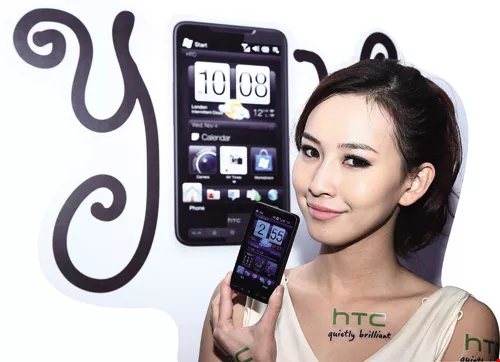
HTC, which previously had "Innovation" as its catchword, has changed over to "quietly brilliant" since advancing to the second stage of branding. It aims to accompany consumers in a low-key, modest way to create a beautiful life together.
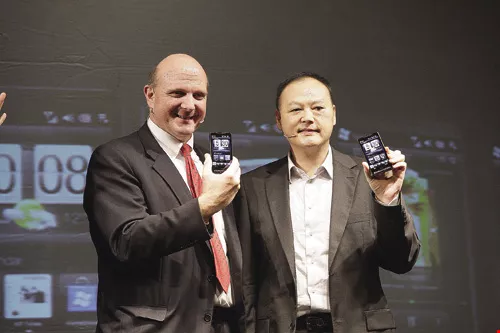
HTC CEO Peter Chou states that a brand name represents trust, and must pass many tests over a long period of time to win the hearts of consumers. At left is Microsoft CEO Steve Ballmer.

@List.jpg?w=522&h=410&mode=crop&format=webp&quality=80)

@List.jpg?w=522&h=410&mode=crop&format=webp&quality=80)


