Taiwan's Love Affair with Gold
Lavai Yang / photos Hsueh Chi-kuang / tr. by Scott Williams
July 2011


Ten years ago, gold prices were in the doldrums and the metal "not worth much more than copper." But times have changed. The alchemy of low global interest rates and currency devaluations has transformed gold back into an essential component of investment portfolios.
Taiwan's gold reserves total 423.6 metric tons (13.26 million ounces). That's equivalent to 33,888 gold ingots of standard international size: 25 centimeters in length and 12.5 kilograms in weight. If stacked atop one another, these bars would reach 8,472 meters into the sky, a height equal to 16.6 Taipei 101s.
As of the end of April, Taiwan's gold reserves were the fifth largest in Asia, behind those of mainland China, Russia, Japan, and India. Placed in a global context, they were larger than those of seven industrialized nations, including the UK and Canada, and much larger than those of Australia and South Africa, both traditional gold producers.
Taiwan's gold reserves account for 4.7% of our foreign exchange reserves, well ahead of Japan's 3.1%, mainland China's 1.6%, and Korea's 0.2%.
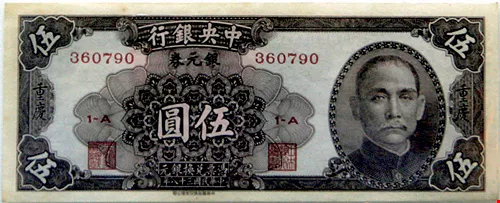
In July 1949, the ROC government replaced the worthless gold-backed yuan with a new silver-backed yuan. The currency's value waned as the Chinese Communists gained the upper hand, and it ultimately collapsed.
Why does Taiwan have so much gold?
The reasons go back to efforts to stabilize Taiwan's economy after World War II and Taiwan's enormous trade surplus with the US in the 1980s.
When China's civil war reignited shortly after the end of WWII, it created financial instability and triggered vicious inflation. When the ROC government took control of Taiwan in 1945, it began supporting the island with shipments of goods. By 1948, Taiwan was suffering severe inflation as a result of the financial crisis in Shang-hai, which caused the public to lose confidence in the old currency-Taiwan dollars issued by the Bank of Taiwan.
In December 1948, President Chiang Kai-shek stated that the government would begin shipping the gold reserves of the Central Bank of China in Shang-hai to Taiwan, and in 1949 the ROC government relocated to Taiwan as the Communists gained control of the mainland. When the Korean War began in June 1950, the US acted to stabilize Asia by sending the Seventh Fleet to protect Taiwan. The US also began shipping aid to Taiwan. This aid helped Taiwan stabilize prices and the currency by alleviating some of the problems arising from government's massive deficit and its lack of foreign exchange reserves.
How much gold was shipped to Taiwan at that time and how it was used have long been subjects of enthusiastic debate.
The historical record shows that President Chiang ordered Yu Hung-chun, then president of the central bank, to use the gold reserves for three purposes: to improve public confidence, in support of the civil war, and to issue New Taiwan Dollars.
Zhou Hong-tao, a former head of the Directorate General of Budget, Accounting and Statistics who had also served as an aide to President Chiang, recalls in his memoirs that the government brought 3.57 million ounces of gold to Taiwan, most of which was used to pay soldiers' salaries. According to Zhou, that left little for other purposes.
The remainder was used to guarantee the New Taiwan Dollar, which was issued to replace the old Taiwan Dollar (at a rate of 1:40,000) and help bring inflation under control.
When the new currency was introduced in June 1949, the government set aside 800,000 ounces of gold in a reserve to secure it.
To allay the public's concerns about the government having sufficient gold to support the new currency, Chen Cheng, then the provincial governor, decreed that NT dollars would be convertible into physical gold at four jewelry shops on Taipei's Hengyang Road.
According to central bank records, when the central bank resumed operations in Taiwan in 1961, it took possession of 1.08 million ounces of gold from the Bank of Taiwan.
The Economic Miracle of the 1970s gave rise to the Four Little Dragons, and attracted attention to the strength of Taiwan's economy. When Taiwan's trade surplus with the US surged in the 1980s, the central bank bought large amounts of gold from the US in an effort to bring trade more into balance. The central bank's gold reserves have remained at the same size ever since.
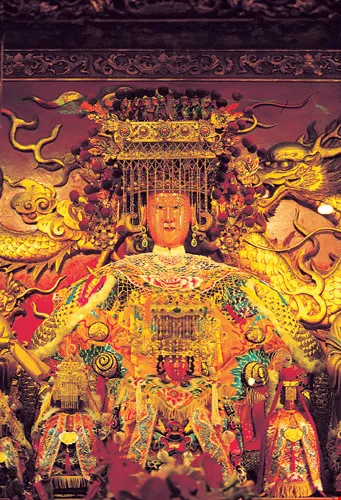
In Chinese societies, gold is closely associated with many important customs and occasions. Even the clothing and headgear of the gods are accessorized with gold to show respect.
George Chou, deputy governor of the central bank, describes gold as "the lifeblood of the nation." How do the gold reserves relate to our forex reserves?
A nation's forex reserves are comprised of the foreign currency holdings of its central bank. Broadly speaking, they include government holdings of gold, convertible foreign currencies, stocks, and bonds, and are used to provide stability during crises, to control exchange rates, and to meet the public's need for foreign currencies.
Forex and gold reserves are an important part of the foundation of a nation's currency, a sort of fiscal reservoir that can be drawn on in financial crises or wartime.
Taiwan's gold reserves used to account for roughly 3-4% of its forex reserves, and have even dropped as low as 2%. Today, they stand at 4.7% (most of the remainder is US dollars), a higher ratio than that of Japan, Korea, Singapore, or mainland China. What do those numbers mean?
Yang Tianli, deputy director of the Bank of Taiwan's precious metals department and a student of gold for more than 20 years, says that while gold holdings accounted for 61% of the world's forex reserves in 1980, they now amount to only 10%. The massive growth in forex reserves in the years since has caused gold's weighting to shrink.
According to the World Gold Council, as of April 2011, gold accounted for an average of about 11.1% of national forex reserves. While Taiwan's 423.6 tons of gold reserves rank 13th the world, they account for a below-average percentage of our forex reserves. Should Taiwan buy more? China, whose 1,054 tons of gold rank sixth in the world but account for only a very low 1.6% of its forex reserves, is buying more.
Yang points out that the emerging economies of the world have seen rapid growth in recent years, and have, especially in the years since 2000, accumu-lated enormous forex reserves. These have been comprised primarily of US dollar deposits and bonds, and secondarily of Euro deposits and bonds. The emerging economies' gold reserves, on the other hand, have accounted for a relatively small percentage, typically less than half the global average.
As a consequence, the world's emerging economies were naturally concerned when problems with sovereign debt and deficits emerged and worsened in the US and Europe, and took action to increase their gold reserves.
Kuan Chung-ming, a distinguished professor with the National Taiwan University Department of Finance, explains that the emerging economies have become unwilling to hold excessive amounts of US dollars. Instead, they have been adding to their gold reserves to preserve value because they see the US dollar as certain to weaken over the long term.
Addressing the issue of whether the US dollar holdings of Taiwan's central bank account for too much of its forex reserves, central bank governor Perng Fai-nan explains that foreign currencies are relatively easy to trade in, whereas gold trading requires complex logistics. He notes further that the central bank's gold holdings account for a larger percentage of our forex reserves than do those of our neighbors, and are already sufficient to reduce our forex risk.
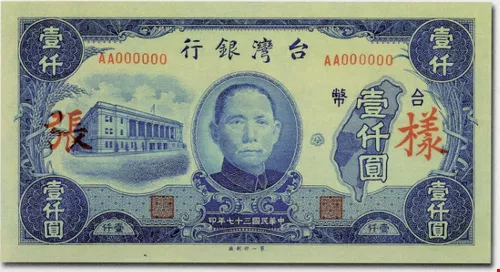
In 1948, rampant inflation destroyed public confidence in the old Taiwan Dollar.
With gold prices having soared from US$300 per ounce to US$1,500 per ounce, the central bank's holdings have quintupled in value. To the general public, this means that the central bank has "made a mint," but they misunderstand a key point.
Kuan explains that to the central bank, an increase in gold prices is a bit like an increase in your home's value. It doesn't matter if your home shoots up to 10 times its original value; you still have only one and need to live there. You may feel wealthier, but you haven't really earned a cent.
Yang says that the central bank's gold reserves don't exist to make money, but to balance the nation's forex reserves portfolio. The bank has to consider whether our reserves are protected from huge fluctuations in the forex market. When such fluctuations occur, gold is the last line of defense.
In addition, the central bank faces the budgetary pressures of a government-run institution. If a portion of forex reserves were allocated to the purchase of gold, that portion would cease to generate interest. In that circumstance, the remaining reserves would have to earn a higher rate of interest to meet the budgeted level of interest income.
After the 2008 financial tsunami swept the world, gold, which is both a "currency" and an "asset," reacquired global allure as a hedge and a means of preserving value.
The financial crisis aside, gold prices have been rising since 2001, quintupling over the course of what has been the longest running bull market since 1920. Harvard economist Kenneth Rogoff has gone so far as to forecast that gold prices will hit US$10,000 per ounce.
Looking at the trajectory of the global economy since 1980, Rogoff believes that factors including the growth in the Dow Jones Industrial Average, inflation indices, and the emerging economies, as well as global interest rates, necessitate this conclusion.
Naturally, many others are bearish on the metal's outlook.
Legendary investor Warren Buffett has noted that the gold mined over the course of human history could buy all the farmland in the United States along with 10 Exxon Mobils, and still have US$1 trillion in cash left over. Gold prices are soaring to new heights and many argue that the metal is experiencing a bubble. Buffett argues that gold creates little in the way of real value, and therefore regards equities as a much better investment.
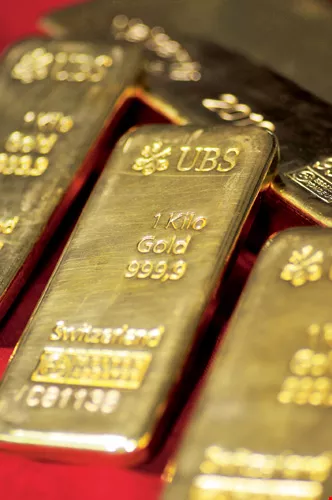
Often purchased as a savings or investment vehicle, UBS's gold ingots are known the world over. The photo shows gold ingots offered for public sale at the Bank of Taiwan.
The factors affecting gold prices are many and complex.
According to Yang, first and foremost are the fundamentals of supply and demand. Next, is the larger environment, including the direction of the US dollar, interest rates, stock prices, oil prices and inflation, commodities -prices, geopolitics and war, other precious metals prices, and market forecasts. The relationships among these various factors can be complex.
The price rises since 2001 have been attributed primarily to changes in supply and demand. The emerging economies of mainland China, India, Brazil and Argentina have experienced rapid growth, driving up demand in those countries for commodities and gold.
Developing nations have a combined population of 5.7 billion, multiplying the development effects of construction and urbanization, and creating tremendous consumption capacity.
Precious metals aren't only used for investment and decoration, but also in electronics and new energy development. This, together with the fondness that consumers in developing nations have for gold, has increased demand for the metal.
For example, India has long been the world's biggest investment market for physical gold. Before gold investing took off worldwide in 2007, India accounted for 62% of global demand for physical gold, versus mainland China's paltry 9%.
By the first quarter of this year, mainland Chinese demand for physical gold had grown to account for 25% of the glo-bal market, surpassing India's 23%. China has also been the world's largest producer of gold since 2007. But China's 2010 production of 350.9 tons was insufficient to meet its own demand for gold ingots, jewelry, and technological applications.
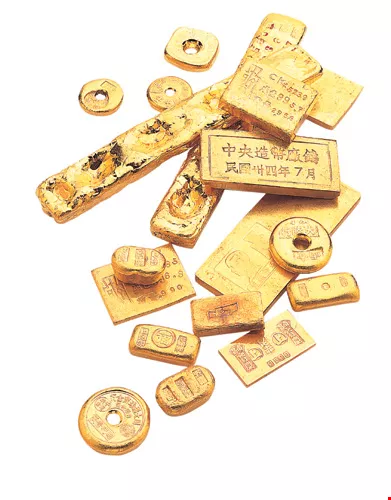
Gold's relative rarity has made it a symbol of wealth and respect throughout human history. Gold enthusiasts often become collectors of coins and ingots from different eras.
In Taiwan, the peak in consumer demand for gold stretched from the 1980s through the early 1990s. It has since ebbed considerably for reasons related to higher gold prices, the state of the economy, and changes to income and consumption patterns.
Lee Wen-chin, chairman of the Taipei Jewelry Industry Association, recalls that gold was relatively cheap until the 1990s (just US$300-400 per ounce). With real-estate and stock prices rising sharply in that period, jewelry stores kept busy.
It was in that period that the government began permitting visits to relatives in mainland China and the importation of foreign labor, both of which contrib-uted indirectly to demand for gold. Many elderly veterans purchased gold rings or gold ingots as gifts for family members they hadn't seen in decades, while foreign laborers spent their days off shopping for jewelry they could bring home when they finished their contracts.
Taiwan's per-capita consumption of gold averaged six to eight grams per year for many years, and rose as high as 9.56 g in 1993, second highest in the world after Hong Kong's 9.96 g. In India and China, currently the world's largest gold consumers, per-capita consumption is less than 1 g per year.
Chinese communities use gold charms, gold necklaces, and other jewelry to celebrate births, wedding, and birthdays, to repay promises made to the gods, and even to create the ornaments and caps on religious sculptures.
Typically, by the time a nation's per-capita income reaches US$12,000, its demand for gold has been satiated. Taiwan passed this threshold in 1996. These days, with gold prices high and individual demand down, many are even selling off their gold.
There's never been anything like gold in 5,000 years of human history. Intimately connected to the evolution of societies and the development of economies, it serves as a currency, a form of wealth, and personal symbol. Gold's allure derives from its universal usability and its durability. From Shakespeare's time through the American Civil War and on into the present day, an ounce of gold has always been sufficient to buy a fine suit, while an equivalent amount of paper currency might provide no more than a sleeve today.
Gold provides people with a sense of security and is even more important to the nation. It's only after you understand gold's role in the history of economic development that you can appreciate why the gold market has entered a new era.
.jpg?w=1080&mode=crop&format=webp&quality=80)

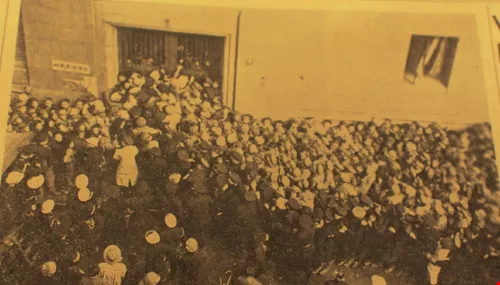
With mainland China experiencing vicious inflation, Shanghai residents gathered at the Bank of China on the Shanghai Bund on Christmas Eve 1948 to demand gold in exchange for their cash.


