Proper Lighting for Beauties' Legs:The Legend of Puli's Water Bamboo Shoots
Sam Ju / photos Jimmy Lin / tr. by Jonathan Barnard
December 2011


Known as the "land of water bamboo shoots," Nan-tou County's -Puli harvests more than 90% of Taiwan's total production of the crop. With the use of artificial lighting to hasten maturation, water bamboo shoots-called "beauties' legs" for their comely shape-are now being harvested four times a year, rather than just twice. These developments in Puli bear witness to the most creative revolution in Taiwanese agriculture over the past decade.
And with the cooperation of farmers and research units, the revolution continues: The recent introduction of LED lights has made those beauties' legs even more shapely.
The use of lighting for growing water bamboo shoots has changed Puli's scenery. During the day, lush green paddy fields still predominate. But at dusk, as if by work of a magician's spell, strings of lights hung from the paddy embankments turn on one after another, illuminating a vast expanse of fields before the veil of night can fall. Stretching for several kilometers along National Highway 6, the enchanting vistas created by those lights beckon to all approaching Puli by car.
According to the Agriculture and Food Agency of the Council of Agriculture, there were 1800 hectares of fields in Puli planted with water bamboo shoots (Zi-za-nia la-ti-folia, a.k.a. wild rice stems) in 2010. Equivalent to 70 Tai-pei Da'an Parks, those Puli fields represented 85% of all land in Taiwan planted with the crop, and they produced 2500 metric tons-97% of the county's and 92% of the nation's total output of water bamboo shoots.
Apart from meeting the demand from Taiwanese consumers, Puli's water bamboo shoots are also exported to Japan, in the amount of 800-1000 kilos per week. Over the last five years, 50 metric tons have been exported on average per year. These beauties' legs from Puli bring at least NT$2 billion in foreign exchange annually.
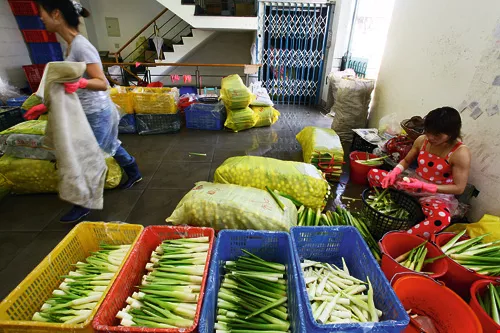
Because "water bamboo" (jiaobai) is a near homonym for "white feet" in Chinese, water bamboo shoots are also widely known by their nickname: beauties' legs. The photo shows farmers from the production and marketing squad of the local farmers' association removing the skin of the water bamboo shoots after harvesting.
Puli's beautiful and ever-expanding sea of lights is fueling water bamboo shoots' nighttime growth. The man behind the lights is Huang Jin-hsing, an assistant researcher at the COA's Agricultural Research Institute. It's worth noting that Huang, whose expertise was pest control, wasn't actually sent to Puli to research lighting for water bamboo shoots.
In May of 2000, Puli experienced its first outbreak of basal stem rot. Several hundred hectares of water bamboo shoots were infected with the disease, and farmers' losses were heavy. Huang was sent to Puli to try to combat the outbreak. Without yet having a handle on the stem rot problem, he was confronted with an additional issue the following year: The growth of the water bamboo shoots was being stunted. The multiple problems had Huang at his wits' end.
Fortunately, he soon discovered that the disease that leads to basal stem rot attacks the water bamboo plants at their harvest cuts. If you drain the paddy fields at the end of the harvest, you can prevent the plants from becoming infected.
With the epidemic under control, experts in various fields who had come in response to the crisis were preparing to leave. But the Agricultural Research Institute asked Huang to stay on and coordinate efforts to battle the dwarfism affecting the water bamboo shoots. Accustomed to dealing with issues involving pest damage, Huang was at first completely flummoxed.
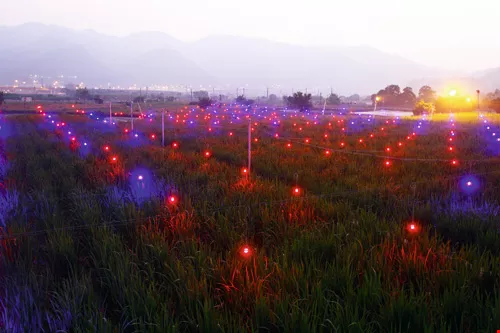
At dusk, when the sodium lamps and LED lights turn on, the water bamboo shoot paddies appear to be filled with glowing pearls and shining gold.
Traditionally, there were two harvests of Puli's water bamboo shoots: one from April to June and a second from August to October. Most farmers adhered to regular schedule, planting the seedlings in the paddy fields after the winter solstice in late December and harvesting them 100 days later in early April.
Yet there were also quite a few farmers planting earlier, with the idea of speeding up the harvest to take advantage of higher prices earlier in the season. Typically, however, the earlier planted water bamboo shoots grew poorly, with the fleshy part of the shoots reaching only 10 centimeters, or only about half the length of normal shoots.
Huang began to look into the problem in 2001. After paying visits to farmers whose water bamboo shoots had faced stunted growth, he discovered by chance that shoots that had been exposed to artificial light were not affected. He thus conjectured that shorter daylight hours slow the shoots' growth, but the smut fungus Ustilago esculenta that the shoots harbor grows only stronger. The result is that the stems thicken prematurely, preventing them from growing taller later.
In fact, U. esculenta makes a great contribution to the growth of water bamboo shoots. In order to propagate the next generation, the fungus directs a large number of nutrients to gather in the water bamboo stems. The process increases the number of cells by three, with the size of any individual cell growing by 15, meaning that a stem grows 45 times in volume. The shoots hold the next generation of U. esculenta within them.
Huang makes an analogy to human pregnancies: "It's similar to how the babies of teenage girls are more likely to suffer from health problems."
Afterwards, Huang began to research how light conditions affect the growth of water bamboo shoots. Returning to the paddies repeatedly over the course of two years to conduct experiments and gather data, he discovered that it was possible to prevent those "early pregnancies" in the stalks by exposing the plants to 14 hours of light per day.
But how could Huang resolve the problem of the winter shoots receiving too little sunlight? He came up with a "subversive" approach to increasing the amount of light they were exposed to, allowing them to be harvested earlier, by moving the planting time for the first crop to mid-November and erecting four-meter-tall poles to hold up 400-watt high-pressure sodium lamps (with two or three lights for each tenth of a hectare). These provide light at night for 60 straight days until the middle of January.
Huang discovered that the water bamboo shoots that were exposed to an extra four to six hours of light at night were not stunted. After the use of artificial light ended in January, the shoots were then allowed to continue to grow under natural conditions for 40 days, so that they could be harvested at the end of February or the beginning of March. It meant an earlier harvest by one or two months and a higher per-kilo price for the crop.
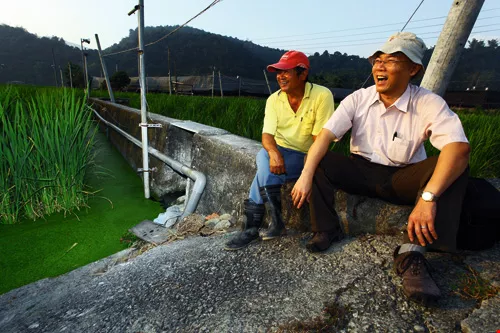
Huang Jin-hsing (right), an assistant researcher at the COA's Agricultural Research Institute, brought the lighting revolution to Puli's water bamboo shoot paddies. Farmer Pan Xingxiong has been an ideal partner for Huang.
Previously, the period from National Day on October 10 until the following March was an "empty window" for water bamboo shoots. Harvests of winter shoots might occur with luck, but they couldn't be counted upon, and the quality would almost certainly be poor. But it wasn't verified that the meager winter production was connected to a lack of sunlight until Huang came to Puli.
Before meeting Huang, farmer Pan Xing-xiong, now 56, would get an itch to plant after National Day, hoping to demonstrate that there was no "evil spell" against winter water bamboo shoots.
His wife, who would accompany him to the fields, recalls that they had a poor rate of success, with a good harvest probably only once every three to five years. When they failed, they could price the poor quality shoots as low as NT$5 per kilo and still no one would buy them. But in those lucky years when the crop was healthy, the shoots would fetch more than NT$150 per kilo.
Cheerful by nature, Pan says sheepishly: "It felt like we were gambling."
Dramatic price fluctuations are commonly experienced by most Taiwan farmers. Once production is concentrated, with everyone planting and harvesting at the same time, supply will exceed demand, and the price is bound to collapse. On the other hand, if a crop is scarce, someone will buy it no matter how high the price.
In 2005, as Huang was attaining a better understanding of how lighting conditions affect the growth of water bamboo shoots, he heard about this gambler of a farmer and promptly asked the way to the Pan farm in hopes of convincing Pan to work with him. At that point Huang had already experienced three refusals. The farmers all had harbored doubts about artificial lighting, believing that turning lamps on "beauties' legs" to increase growth was a fool's dream.
Huang paid five visits to the Pan farm, but each time Pan remained in the fields, too busy to bother with Huang.
Now happy partners, Pan recalls, "Huang looked so smug," and Huang says, "I had to use my expertise in pest control to entice him into working with me."
In 2006 they started on a "mission impossible": To produce in December and January, thus smashing the limitation of only two good harvests a year.
Previously, after the second crop in October, the custom was to let the fields lie fallow, waiting to plant the first crop the following year. In Pan's fields, Huang upended the agricultural orthodoxy.
Huang proposed the following method: Don't leave the fields fallow. Instead, after draining the paddies, cut off the leaves of the water bamboo, leaving only the base and what was underground. Supply artificial lighting for six hours a night, and allow the crop to grow for two and a half to three months (depending on how well the plants grow). Then turn off the lights to spur the thickening of the shoots. After growing under natural conditions for another 15-30 days, the shoots can be harvested.
The new protocol resulted in an historical first for Puli: a third strong season of water bamboo shoots.
For two years running, in 2006 and 2007, Huang met with great success using this revolutionary continual planting method. His partner Pan was overjoyed.
According to the Agriculture and Food Agency, the water bamboo shoots harvested in late 1996 and early 1997 totaled 30 metric tons, with an average value of NT$30 per kilo.
In comparison, during the first year of Huang and Pan's experiment, Nan-tou's total winter production of water bamboo shoots increased to 34 metric tons, and the price rose to NT$50 per kilo. The following year the figures increased further to 35 metric tons, with a sharp rise in price to NT$62 per kilo.
Although Huang's first attempt to use artificial lighting in 2001 was successful, it didn't immediately resonate with many local farmers. By the end of 2005 the total area of water bamboo fields in Puli under lights stood at merely 50 hectares.
Yet after word spread about the "miracle" in Pan Xing-xiong's fields, the masses followed his example, with lamps added to hundreds of hectares each year. Today there are about 1000 hectares in Puli growing water bamboo shoots under lights. Puli nights are bright all year long.
More and more water bamboo shoot farmers have mastered winter growing and are producing three crops a year. According to the Agriculture and Food Agency, Nan-tou's water bamboo shoot crop from November to March last winter set a new record at 160 metric tons. After volatile fluctuations during the previous two winters, the price also gradually returned to stability, with a kilo fetching NT$56.
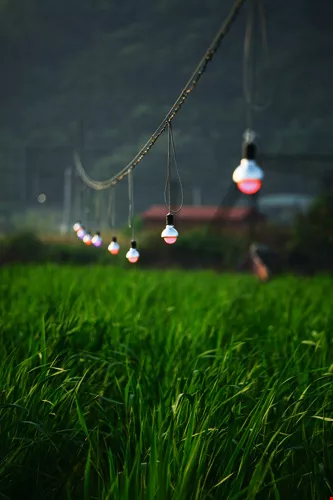
The Industrial Technology Research Institute is testing the effect of LED lights on the growth of water bamboo shoots in Puli's paddy fields.
The adjusted crop schedule for water bamboo shoots in Puli has allowed farmers to harvest at different times and thus prevent price crashes from oversupply. But there's no such thing as a free lunch. Although this agricultural revolution has resulted in more stable income, the six to eight hours of artificial light per day has increased the town's aggregate electric bill by NT$50 million.
What's more, with neighboring farms adopting different schedules, a field on one side of a property line may need the stimulation of light so the shoots will grow taller, whereas the field on the other side may need the lights to be turned off to promote stem thickening. As the nighttime lighting of the former interferes with the biological clock of the latter, it can't help but create disputes among farmers.
Under a plan cosponsored by the Ministry of Economic Affairs and Council of Agriculture, the Industrial Technology Research Institute in October 2010 joined Huang's experiments on the use of LED lamps in water bamboo fields. They hoped to bring down energy costs.
Pan first offered a tenth of a hectare of his land for an experiment, and ITRI provided funding for him to install more than 100 10-watt LED lights, including bulbs at four different wavelengths of light: red, blue, yellow and white. They hoped to find the most suitable combination of LEDs and to measure the impact of "distributed" lighting by hanging LED lights directly above the bamboo shoots. Huang -Tianfu, deputy head of the Functions Design and Composite Materials Research division at ITRI's Material and Chemical Research Laboratories, emphasizes that they took precise measurements on the height and spacing of the lamps with the goal of making agricultural lighting one of ITRI's special areas of expertise.
Huang explains another advantage of using LED lights: The light that the shoots receive is more even, thus improving photosynthetic efficiency.
The first stage of the experiment ended in February, 2011. The use of LED lights produced savings of 50% in comparison to sodium lights, and there was also a 10% increase in yield. Those were outstanding results.
In the second stage of the experiment, the area in Pan's fields has been expanded to one hectare. More than 300 LED bulbs producing either the red or blue wavelengths needed for plant growth have been suspended over the water bamboo shoots. The Agricultural Research Institute anticipates that it will be able to calculate the size of the harvest by the end of December. ITRI is predicting the technique will save 90% on electricity.
Costs are the key consideration for farmers deciding on whether to adopt LED lighting. Huang says that a hectare of LED lighting runs to NT$260,000, compared to NT$110,000 for high-pressure sodium lamps. But using LEDs will save over NT$20,000 a year in electric charges.
Mutual respectThe reason that Puli became the homeland of water bamboo shoots is connected to the variety planted there. It used to be that the "green skin" variety predominated in the Nantou area. The quality was uneven, and the shoots' flesh often had black spots. The price for the crop wasn't high, and it took a long time to grow: After planting in December, you couldn't harvest until April or May.
Nearly 30 years ago, Chen Gan-dang, a farmer in Puli, happened to discover an unusual variety of water bamboo shoot. It could be harvested early-in March-and its flesh was pure white, free from the black spots that so commonly afflict the green-skin variety.
What's more, green-skin water bamboo shoots must be grown in paddies where the water depth reaches one's waist, whereas the variety that Chen discovered only needs water at knee depth-a huge boost in efficiency.
The water bamboo shoots now grown in Puli are of that variety discovered by Chen Gan-dong, which are known as "early ripening green skin." Among Puli farmers, the type is also called "Gan-dong's variety." The name serves as an expression of thanks to Chen for his decision to freely share the plant with other farmers.
It's well known in Puli that Chen's fields were often visited by thieves who would steal his plants. Frustrated at seeing the holes in his fields, Chen decided to give away sprouts to other local farmers.
"If you want them, just come and ask me for them," he would say. "Why do people have to steal them?" Recalling those events, Chen, now 75, laughs heartily.
And because those thieves treated Chen's bamboo like bandits' treasure, the variety is also known in Taiwanese as "the thieves' variety."
"Without Gan-dang's variety, there would be no water bamboo industry in Puli," says Huang. He estimates that Chen has lost royalties on the variety amounting to over NT$10 million per year.
"The balls of light that characterize Puli's nighttime scenery are all Dr. Huang's doing," says Chen, who assigns full credit to the passion and expertise of Huang.
Chen has already turned over care of the paddy fields to his son, who has set up sodium lights. Although 30 years apart in age, Huang and the elder Chen regard each other with mutual respect, like heroes out of a martial arts novel.
One is a pest control expert who adamantly believes that resolving farmers' problems is more important than writing academic treatises. The other is a farmer certain to become an important figure in future histories of Taiwan agriculture. Thanks to their efforts, and to cooperation between farmers and research units in general, Taiwanese agriculture is reaching new heights.

@List.jpg?w=522&h=410&mode=crop&format=webp&quality=80)

@List.jpg?w=522&h=410&mode=crop&format=webp&quality=80)


