Teaching Multiculturalism at School
Chen Hsin-yi / photos Jimmy Lin / tr. by Jonathan Barnard
July 2013


As foreign spouses from Southeast Asia and mainland China are settling in Taiwan and putting down roots, their children are enrolling in schools. These children of transnational marriages are mostly in elementary and junior high schools. In total, they number more than 200,000 and account for 9.2% of all children in elementary and secondary schools.
Since they were young, these new children of Taiwan have grown up together with their fully Han-Chinese peers. They have considerable educational potential, and yet they still carry the cultural inheritance of their mothers. How to allow these children to proudly identify with their mothers’ cultures, and how to leverage schools to create ethnic tolerance, are questions that demand serious consideration.
Every Wednesday this past spring semester, Xu Xiaowei, a third grader at Pingtung County’s Gongguan Elementary School, arrived at school at dawn and went to the science classroom, where she and 16 classmates would say “good morning” in Vietnamese to their teacher. Their teacher To Ngoc Anh, always smiling and dressed in beautiful Vietnamese clothes, would then lead them in singing Vietnamese children’s songs, or she would write a few words on the blackboard before practicing their pronunciation, or would introduce interesting Vietnamese habits and customs, including some that take people by surprise: For instance, did you know that the Vietnamese zodiac is almost identical to the Chinese zodiac, except that the Vietnamese have a cat where the Chinese have a rabbit?
At a ceremony held at the end of the semester, the teacher gave Xu an award and complimented her on her hard work and excellent Vietnamese pronunciation. Xu’s Vietnamese mother was in the audience. She proudly said that she has spoken Vietnamese to her daughter from a young age, and that the opportunity to study the language at school has provided the daughter with a greater command of Vietnamese writing and phonetics. Perhaps, said the mother, Xu will go on to use what she learned as foundation for self study, since she is now better prepared to use a Vietnamese dictionary.
Classes like those in Vietnamese at Gongguan Elementary are one result of the “National New Immigrant Torch Plan.” In the 2012 school year the classes were launched at more than 300 elementary schools across the island.
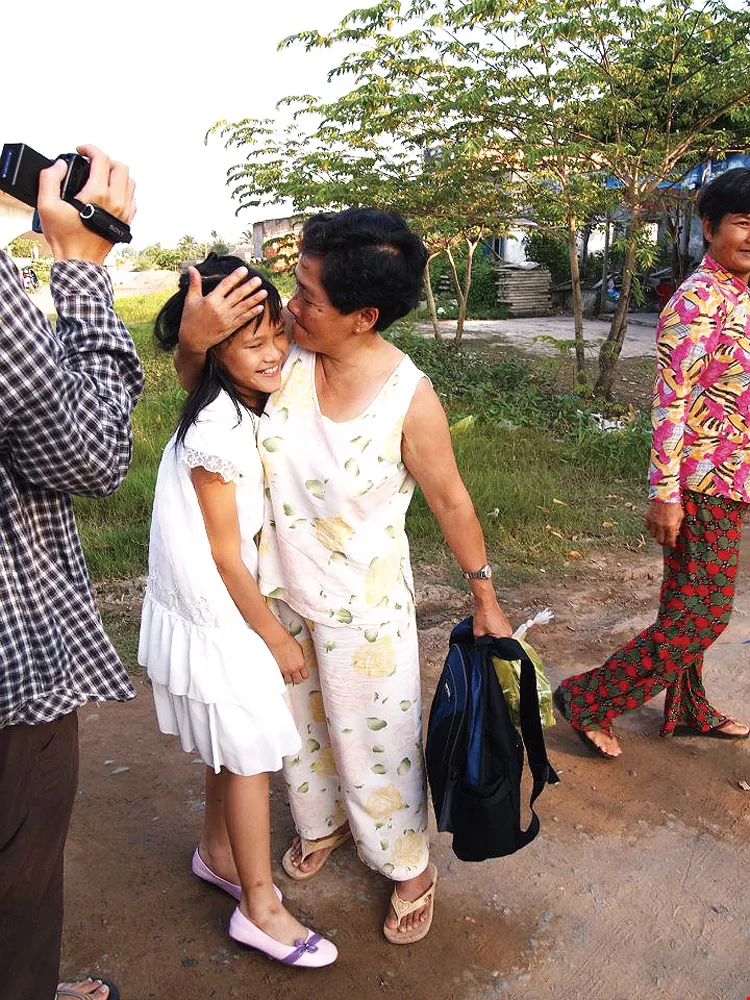
“Dear Grandma, long time no see!” Taiwan’s Vietnamese-language newspaper Bao Bon Phuong and the Chengzhi Educational Foundation joined forces to launch the Maternal Grandmother Bridge Program, which provides financial assistance for Taiwan’s teachers, as well as immigrant mothers and their children, to visit the nations of Southeast Asia where the children’s maternal grandparents live. Promoting cultural exchange and international friendship, the program aims to give participants a chance to experience life in those countries.
According to the Ministry of the Interior, Taiwan currently has 130,000 immigrant spouses from Southeast Asia and 320,000 from mainland China. In almost all cases, they are women married to Taiwanese men. These immigrants began to come in large numbers in 1998, and their influx reached its peak in 2004. At present, there are 161,821 children of immigrants in elementary school and 41,525 in junior high school.
Over the past nine years, the total number of elementary and junior high students fell from 2.84 million to 2.22 million, while the proportion of children of immigrants among the elementary and junior-high student population rose from 1.6% to 9.2%. According to MOI estimates, by the year 2030 13.5% of all 25-year-olds in Taiwan will be the children of immigrants.
Su Huiwen, chief of the Immigration Counseling Section at the National Immigration Agency, says that in light of the increasing global trend toward transnational marriages, cultivating a sense of multiculturalism among the next generation is essential for creating an open, peaceful and competitive society.
With that in mind, the MOI and Ministry of Education launched the National New Immigrant Torch Plan in May of 2012. The plan calls for local governments to select as focus schools elementary schools at which least 100 children, or at least 10% of the student body, are children of immigrants. Under the plan, teachers make visits to immigrant households, language classes are offered in the immigrants’ heritage languages, summer camps are offered for both parents and children, and training is provided to volunteers.
Su points out that in order to prevent negative stereotyping of immigrants’ children, multiculturalism is being promoted for all, not just the sons and daughters of immigrants. Children are very impressionable, and once a concept takes root in their minds, it can remain for a lifetime.
Home visits are also a key component of the Torch Plan. A deeper understanding of children’s life at home and their individual needs will lead to more opportunities for foreign spouses to integrate into society, and also allow more Taiwanese in-laws of immigrant women to understand and appreciate the women’s heritage cultures.
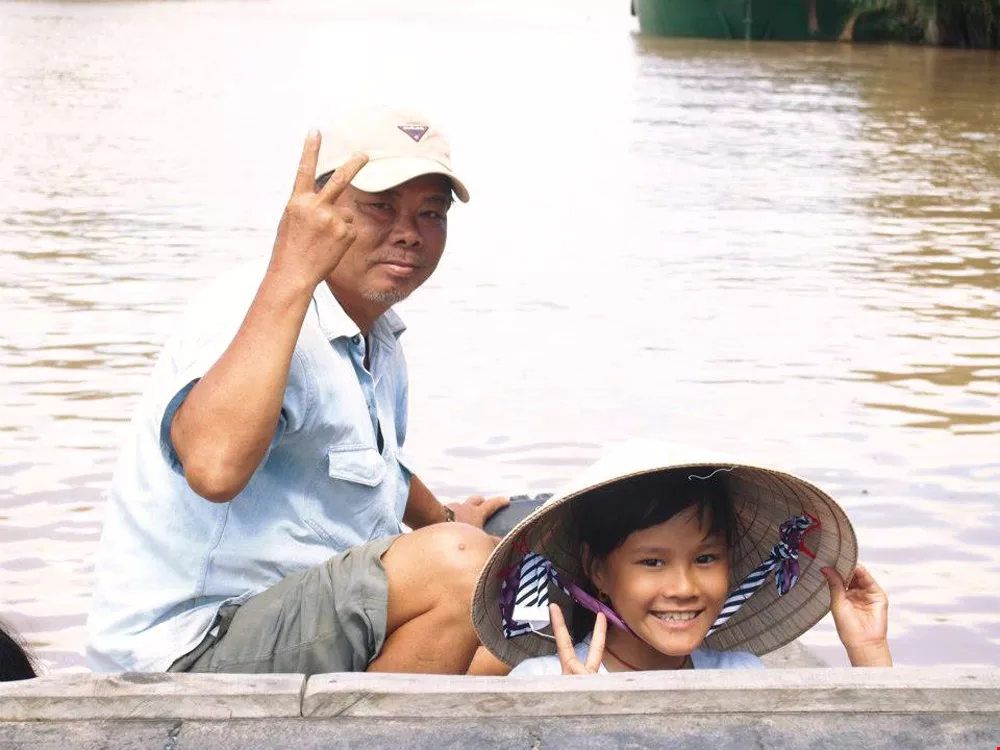
“Dear Grandma, long time no see!” Taiwan’s Vietnamese-language newspaper Bao Bon Phuong and the Chengzhi Educational Foundation joined forces to launch the Maternal Grandmother Bridge Program, which provides financial assistance for Taiwan’s teachers, as well as immigrant mothers and their children, to visit the nations of Southeast Asia where the children’s maternal grandparents live. Promoting cultural exchange and international friendship, the program aims to give participants a chance to experience life in those countries.
In Pingtung County, where the children of immigrants number nearly 100,000, long before the Torch Plan was implemented a group of women with the Juridical Association for the Development of Women’s Rights went up into the mountains and down along the sea, visiting all of Pingtung’s elementary schools. They served as the advance guard of the campaign to promote multiculturalism in schools.
At Pingtung’s Gongguan Elementary, all students are targeted for the Southeast Asian multicultural classes, explains To Ngoc Anh, a JADWRP partner who teaches Vietnamese at the school. The classes are not confined to book learning. Instead, they make education fun with the frequent use of Southeast Asian traditional clothing and accessories, toys, photographs and maps. Sometimes the teachers demonstrate how to cook Southeast Asian dishes right in class. In addition to whetting students’ appetites, these experiences also leave beautiful and tasty memories in students’ minds.
Ho Thanh Nhan, a Vietnamese who married a Taiwanese, says that one of the major reasons she goes to schools to promote multiculturalism is that she wants to help children of immigrants in times of personal crisis to recover their confidence and start smiling again.
She encountered one boy whose parents had divorced. Three years ago the mother returned with him to Vietnam. This past year the father brought him back to Taiwan to live with his family, but having been absent from Taiwan for three years, the boy had completely forgotten how to speak Mandarin. In class he was often excluded, and after class he would mutely sit by himself in a corner. Some unruly classmates would even laugh at him, calling him a “Vietnamese idiot.” His homeroom teacher was at a loss for what to do.
Ho had heard about the situation in advance, and when she arrived at the classroom she told the whole class: This student forgot his Mandarin because he went to live with his mother in Vietnam, but living abroad can broaden our horizons and teach independence. She then invited the boy up to the front and had a conversation with him in Vietnamese. Witnessing the boy’s fluency in a foreign language and his confident manner, the other students couldn’t help but feel astonished and impressed. After a few months, the boy’s Mandarin was much improved. He could joke with his classmates and was well integrated with them.
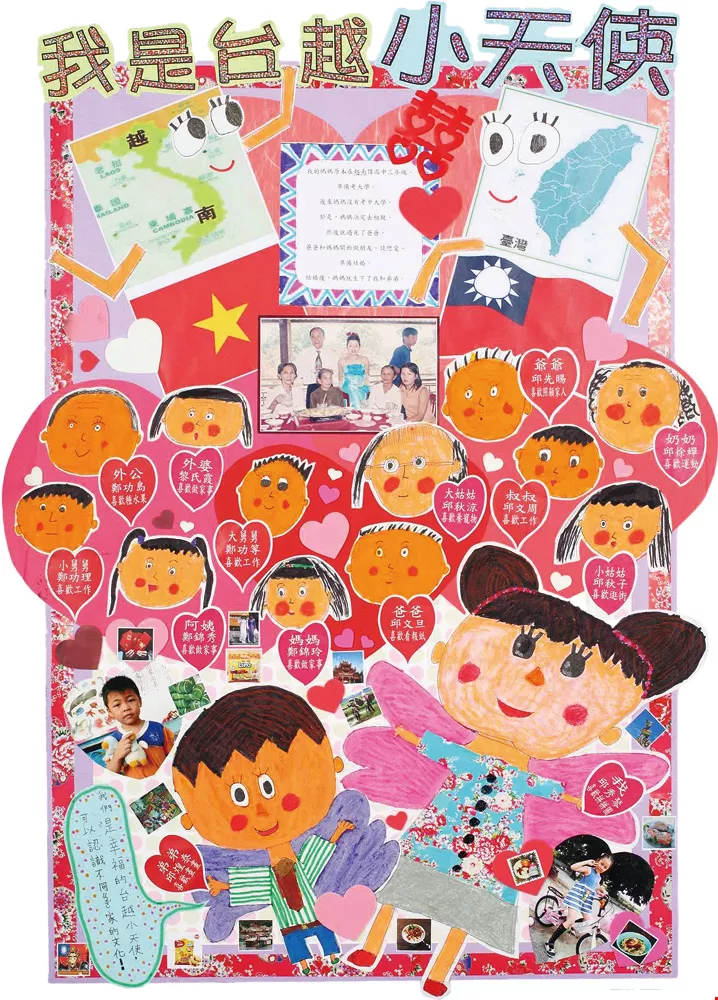
In the hearts and minds of children, the greatest of joys is having loving parents living together in a happy home. The photo shows an award-winning family tree created in a contest sponsored by the National New Immigrant Torch Plan.
JADWRP also frequently offers professional development seminars for teachers, where it clarifies points of confusion.
For instance, quite a few teachers are upset that relatively few of the immigrant mothers participate in school activities. How can they attract more of them to come?
Association staffers suggest that teachers first go to call on those students’ families in the home, to ascertain whether the mother really doesn’t want to go or whether the husband’s family simply isn’t happy when she leaves home. They also recommend that when creating activities for immigrants, it is best to provide bilingual services. When visiting homes, ideally go with an interpreter, so that you can learn what the immigrant women are really feeling and grasp their true needs.
Teachers point out that one reason why many children of immigrant mothers aren’t strong performers at school is that their home environments aren’t as supportive of education. Their mothers don’t understand Chinese and are busy working all day long, and the fathers likewise don’t offer much support. It ends up being the illiterate grandmothers who spend all day with the children. Under these circumstances it’s no wonder that it becomes hard to supervise and support their schoolwork.
Ho says that immigrant mothers also understand that “education is children’s only channel to advance themselves,” but their husbands aren’t willing to take on any more responsibility for monitoring their children’s educations. Consequently, it’s essential that children participate in supplementary instruction after regular school lets out. What’s more, government and school support ought to be extended to helping immigrant spouses in their daily lives via language study, professional development courses, career guidance, and marriage and family counseling.
JADWRP has also come across some children who, despite realizing that both the teachers in their multicultural classes and their mothers are Southeast Asian immigrants, are unwilling to acknowledge that their mothers are foreigners. Their eyes convey hostility to the teachers: “I don’t respect you and don’t want to deal with you.”
It often turns out that the mothers of these children had long been mocked and ridiculed by their husband’s family, or else they buckled under the heavy burdens of both working a job and caring for the family. They decided to leave, getting a divorce and returning to Vietnam. At such times, the children have not only lost a mother, but they also have often taken to heart negative messages such as “your mother ran away because she doesn’t love you” or “she’s crazy.”
“Those psychological wounds borne by children were created from social discrimination and the ignorance of adults,” says To Ngoc Anh. All JADWRP’s community workers can do is to console the children by saying: “Your mother has also been deeply hurt. No matter where she is, she still loves you.” They also remind teachers to strengthen classroom support for these children and to ask for help from social welfare organizations when needed.
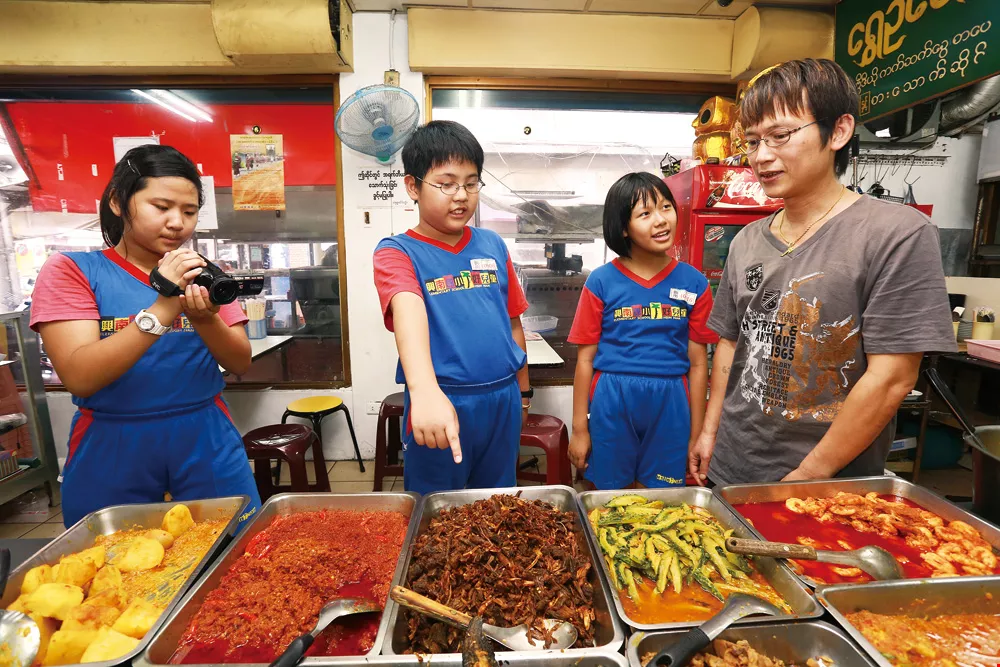
Mmm, why does Burmese cooking smell so good? The children of Xingnan Elementary in New Taipei City visit one of the many Southeast Asian restaurants on nearby Huaxin Street as student journalists.
In fact, when promoting multicultural classes in schools, there’s no need to be too concerned about their rigor. Most important is that the teacher takes initiative and shows enthusiasm, bringing concepts to life through experiential education.
For several years, Principal Li Chunfang of Xingnan Elementary in New Taipei City’s Zhonghe District has been urging the school’s entire faculty to make use of local cultural resources, such as its famous “Southeast Asian Gourmet Street” (Huaxin Street) and the annual Water Splashing Festival observed by immigrants from Thailand and Myanmar. Students are encouraged to document the happenings by going to local shops and restaurants with video cameras. There are also classroom discussions about the economies of Thailand and Myanmar, and the mythology and symbols of those societies. The varied efforts give children multi-level insight into those countries.
Li points out that there are abundant teaching materials about Southeast Asian culture available online. Determined teachers need not fear they will come up empty handed. But what’s most important is that teachers themselves are keenly observant and have critical thinking skills. For instance, when the media offers sensationalized reporting on foreign women entering into fake marriages to gain legal residency, teachers should respond with contrary positive examples, telling narratives of immigrant mothers who show courage and determination in the face of hardship as they work and live in this foreign land of Taiwan.
Many people ask: How important is it to encourage the children of immigrants to learn their foreign mother’s native language? And will this help in their educational development?
The National Immigration Agency’s Su Huiwen points out that if the mother’s language is valued, then the mother’s status within the family will rise. She views that as the most direct effect of those classes. In the long view, language is the mother of culture. If the children of immigrants can pick up the torch of their Southeast Asian heritage culture and language, it will also have a positive impact on their personal development and self esteem. In the future they will become the much-needed bilingual talent for expanding trade with ASEAN countries and increasing tourism.
Tsai Shun-jou, JADWRP’s director, notes that Taiwan society has long held unfair prejudices against Southeast Asian cultures and languages. Quite a few immigrant mothers and their children, when they find that strangers and in-laws don’t value their heritage, simply give it up. Yet if children are to inherit their mother’s language, then it will depend upon mothers and children communicating through the heritage language in their daily lives. Mothers must be courageous and secure in their status, and schools must foster an atmosphere that encourages multilingualism.

Taiwan is already a multiethnic society. In food and drink, customs and festivals, Southeast Asian culture has made its mark here. The photo shows a modified version of Thailand and Myanmar’s traditional Water Splashing Festival being celebrated in New Taipei City. It is held at those societies’ traditional New Year.
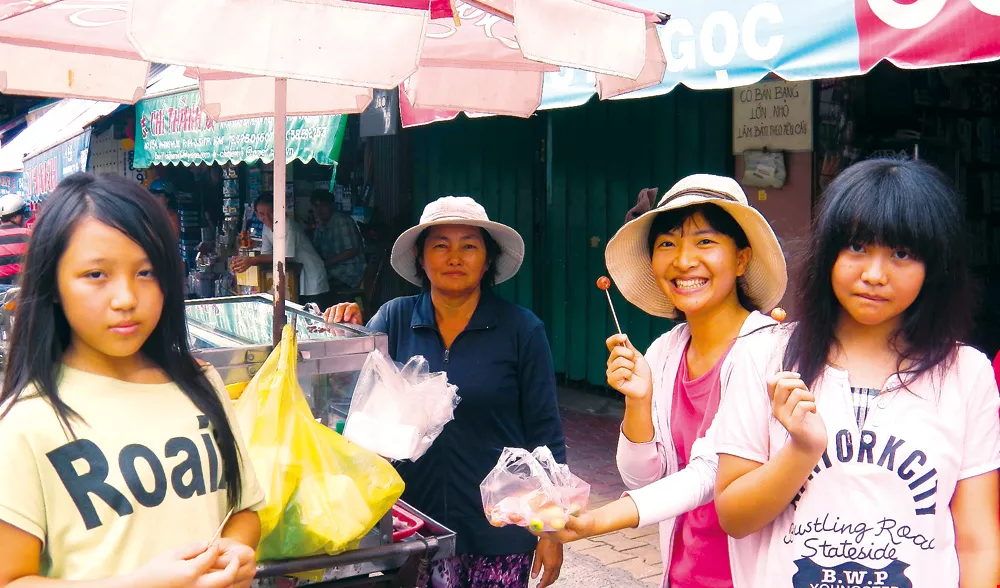
“Dear Grandma, long time no see!” Taiwan’s Vietnamese-language newspaper Bao Bon Phuong and the Chengzhi Educational Foundation joined forces to launch the Maternal Grandmother Bridge Program, which provides financial assistance for Taiwan’s teachers, as well as immigrant mothers and their children, to visit the nations of Southeast Asia where the children’s maternal grandparents live. Promoting cultural exchange and international friendship, the program aims to give participants a chance to experience life in those countries.

@List.jpg?w=522&h=410&mode=crop&format=webp&quality=80)

@List.jpg?w=522&h=410&mode=crop&format=webp&quality=80)


