

On a cold and cheerless day in the city of Kotzting, Germany, I asked a young girl, "Where's the traditional Chinese medicine hospital?" She kindly pointed straight ahead, saying "Downtown, just past the arched gate."
Walking along a main road in the center of this small city, I soon came across a huge white building with an eye-catching sign that reads TCM (traditional Chinese medicine). The moment I passed through the hospital gateway, a familiar scent of Chinese medicinal herbs assailed my nostrils. Chinese calligraphies and paintings, traditional Chinese vases, and Chinese-looking medical personnel hurrying along the corridors give the place an altogether un-German feeling. There's a good reason for this: the "China experience" is a big selling point for the clinic, which offers its patients the real thing in TCM. Of this effective marketing strategy, clinic director Anton Staudinger says with some pride, "Our patients feel reassured as soon as they see that our TCM doctors are real Chinese people." Dr. Staudinger says with a smile, "We don't have enough beds to meet demand. We have 80 beds that are occupied all the year round, and prospective patients spend several months on waiting lists to gain admission."
The Traditional Chinese Medicine Clinic in Kotzting is unique, because in other Chinese-medicine clinics in Germany most of the doctors are German. No other clinic in Germany boasts a team of Chinese physicians such as that found at the TCM Clinic. Still, some overly optimistic patients leave the clinic a little disappointed, saying things like, "It wasn't as magical as all that!"
As part of its patient-care evaluation program, the Center for Complementary Medicine Research (CCMR) of the Technical University of Munich has published a scientific report weighing in at more than 400 pages-based on a meticulous analysis of questionnaires filled out by patients immediately upon leaving the clinic, as well as three months, six months, and a year thereafter-which shows that patients treated with Chinese medicine have an average recovery rate of 20-30%.
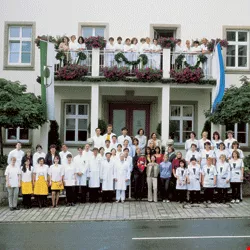
At the TCM Clinic in Kotzting, the Chinese staff are the "genuine product" and line up to look the part. The patients are suitably impressed.
Chinese medicine in Germany
Even so, Germans are turning to Chinese medicine in droves, and one could definitely say that an East wind is blowing. Given that Western medicine is fast reaching its limits and that naturopathic medicine is all the rage, in recent years traditional Chinese medicine, acupuncture, and moxibustion have become increasingly popular in Germany and all over Europe. It's such a hot field that physicians in Western-medicine clinics are rushing to study acupuncture and moxibustion (more than 50% of private clinics offer acupuncture treatment), and even sanatoriums, hotels that sell "wellness," and public hospitals are vying with each other to establish Chinese-medicine departments. For example, the CCMR offers acupuncture, moxibustion, and traditional Chinese medicine, in particular to alleviate nausea and other side-effects of chemo- and radiotherapy in cancer patients.
Dieter Melchart, director of the CCMR, explains that traditional Chinese medicine, acupuncture, and moxibustion have been widely adopted in Germany for quite some time. From the perspective of Western medicine, any treatment must be subjected to rigorous scientific verification. Therefore, as far back as 1982, when Chinese medicine gradually began to win popularity, the Technical University of Munich and other major universities (including the University of Berlin, the University of Frankfurt, the Medical University of Graz in Austria, and the University of Zurich), together with a number affiliated research institutions, drew up plans to carry out long-term evaluations, investigations, inspections, and analyses of Chinese medicine in Germany.
These institutions have discovered that acupuncture and moxibustion are effective in treating painful illnesses. Accordingly, a number of German health insurance companies that cover Chinese medicine costs have commissioned medical centers at several universities to make a thorough evaluation, on the basis of which they plan to expand their future coverage. This statistical analysis of 9400 private clinics and 50 hospitals cost several million euros and is the most extensive ever conducted in the world. The report is due to be published in 2004 and will decide the fate of traditional Chinese medicine in Europe.
There are somewhere in the region of 20 to 30 small and large acupuncture and moxibustion associations in Germany, including the Deutsche Arztegesellschaft fur Akupunktur (DAGfA, German Doctors' Acupuncture Association), the oldest and largest in the country. DAGfA offers two acupuncture diplomas: Diploma A, which requires 160 hours of study, and Diploma B, which is even more rigorous and requires more than 400 hours of study. The difference between the two diplomas is how much health insurance companies pay for acupuncture treatment. Patients who have coverage with a public health insurance company pay EUR25 (approx. NT$1000) for a single session with an acupuncturist with a Diploma A, and EUR35 for a single session with a Diploma B acupuncturist. Patients with private health insurance pay EUR50 per acupuncture session. Nor are the tuition fees to obtain a DAGfA diploma low: a Diploma A, which is a minimum legal requirement to give acupuncture treatment in Germany, costs at least EUR20,000 (NT$800,000). There are currently more than 40,000 certified acupuncturists in Germany, most of whom are members of DAGfA and other acupuncture associations.
To save money, to become more credible practitioners of Chinese medicine, or to pursue advanced studies, many Germans also go to China and Taiwan. A few years ago, even Saigon in Vietnam began offering a Chinese medicine program to foreign nationals. Except for a two-year hiatus following the Tiananmen Incident in 1989, Beijing has been the most popular choice for German students. Why do so few people go to Taiwan to study acupuncture and moxibustion? One German doctor who spent six months studying acupuncture and moxibustion in the Affiliated Hospital of the Beijing University of Traditional Chinese Medicine, says, "The mainland is more cost-effective in terms of tuition and board and lodging, and it also offers good organization and management. Moreover, Beijing's excellent reputation makes a big impression on patients back in Germany." Thomas Skoruppa, a student at the CCMR in Munich says, "When I open my own clinic in future, if I can't do acupuncture I'll lose out."
Knowledge from afar
In the midst of the Chinese medicine and acupuncture craze, the TCM Clinic in Kotzting has a whiff of Eastern mysticism about it, and gives patients the impression that they are the beneficiaries of superior knowledge brought from afar. Health insurance companies have agreed to provide full coverage for treatment in the clinic, which currently has 15 TCM practitioners from Beijing on its staff, including traditional Chinese medicine doctors, masseurs, qigong specialists, pharmacologists, dieticians, and interpreters (the fact that most of the staff don't speak German adds to the patients' feeling that they are getting the genuine article). German patients used to swallowing pills who come to the clinic have to ingest strange-tasting medicinal herbs that have been decocted or boiled. Although patients have a very hard time getting used to bitter and astringent decoctions, this is a minor matter. The most serious problem the clinic faces is the Bundesinstitut fur Arzneimittel und Medizinprodukte (BfArM, Federal Institute for Drugs and Medical Devices), the German agency that tests and approves drugs and medicinal materials.
Dai Jingzhang, medical director of the TCM Clinic, says that Germany has very stringent standards governing the inspection of Chinese herbal medicines. A great many medicinal herbs that have been tested and approved in Beijing fail to be approved in Germany. This poses the problem for the clinic that when different medicinal herbs have to be substituted, it cannot be ruled out that the efficacy of the treatment will be diminished. The BfArM sees things differently, and has published a report detailing the reasons why many medicinal herbs fail its tests. For example, some herbs are rejected because they are found to be contaminated by other substances. Problems related to soil properties, the application of fertilizer, pesticides, and processing are further reasons for rejection. Other reasons include contamination by germs, molds, and insects and other pests, or high levels of lead, cadmium, and mercury, as well as incorrect labeling.
In Germany, where the practice of medicine is highly regulated, the TCM Clinic in Kotzting is truly exceptional, which is no wonder because it was opened as a result of an official agreement between Germany and China (its sister institution is the Affiliated Hospital of the Beijing University of Traditional Chinese Medicine). The TCM Clinic has attracted attention from numerous official quarters, and has welcomed inspection tours from the German president, the German minister of health and social security, and other high officials, as well as delegations from Taiwan, Hong Kong, and mainland China.
But the TCM Clinic finds itself under enormous pressure, because many of its patients present complex symptoms that have proven resistant to Western medicine. Such patients place great hopes in Chinese medicine and set deadlines for positive results. The clinic faces the formidable challenge of improving patients' condition within three or four weeks of admission. Because there are risks when patients with serious and complex illnesses that have been treated for long periods with Western medicine suddenly switch to Chinese medicine, the clinic also has a team of Western-medicine physicians, led by Dr. Stefan Hager, that intervenes as the need arises.
TCM practitioners at the clinic also have to cope with the loneliness that comes from living in an alien land. Most of them don't speak German, because they are required to switch posts every couple of years and don't spend enough time in Germany to study the language properly. Kotzting is in a remote location with no Chinese people nearby, the TCM practitioners' work is monotonous, they have little contact with the outside world, and they are not allowed visits from family dependants, so they naturally feel homesick. Although between ten and 20 Chinese doctors live together in the clinic dormitory, where they have created a "little China," and they have their own Chinese cook, as soon as they leave the premises they experience isolation and have no way of integrating into the local community. This makes the clinic into a sort of prison. Dai Jingzhang says, "Homesickness, depression, and loneliness are hard to avoid. Fortunately, we get to go home to visit relatives once a year." Still, the clinic receives a large number of applications from prospective staff. When all is said and done, the clinic is in great demand, and the high salaries it pays are a big draw for Chinese people for whom the prospect of going abroad is an opportunity not to be missed.

@List.jpg?w=522&h=410&mode=crop&format=webp&quality=80)


