Bee Farmers Reap a Sweet Harvest
Chang Chiung-fang / photos Jimmy Lin / tr. by David Smith
February 2014


After flourishing for 25 million years, honeybees in recent years have for some reason started to find themselves poorly adapted to life on the blue planet. The problem of colony collapse is not so severe in Taiwan as in Europe or the Americas, but the number of beekeeping operations here has nevertheless dropped from a peak of more than 2,000 to less than 800 today. But, just as bees act as a vector for the pollination of plants, there are many beekeepers that continue to work their craft and, in the process, provide an invaluable service for others.
Huang Dong-ming, the proprietor of Bee Family in Yilan County’s Yuanshan Township, is the fourth generation in a line of beekeepers. There was a time when he ran a small operation generating less than NT$200,000 in revenues per year, but business grew at a clip of better than 10% a year for many years running, and today he heads a sizable firm that boasts nine retail outlets and brings in NT$120 million annually.
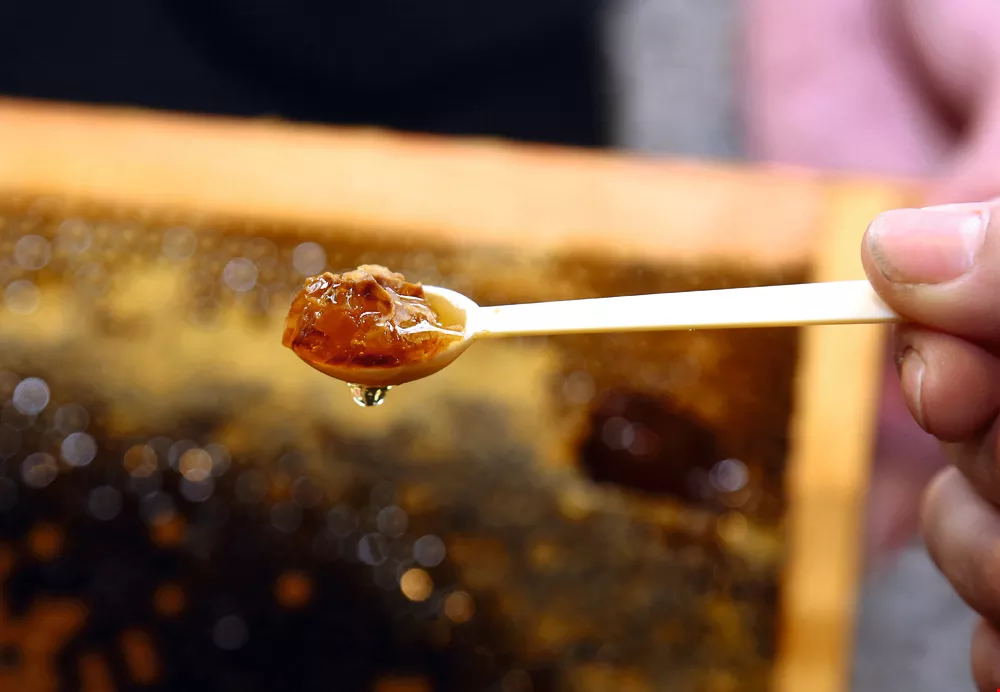
To ensure the quality of its honey, pollen, and royal jelly, Bee Family controls the whole process, from production to sales. Each item is marked with proof of inspection.
In the 1970s, royal jelly and honey together constituted Taiwan’s second largest agricultural export, after bananas. However, as more and more people acquired beekeeping expertise and as flower blooming periods became less regular, exports of royal jelly to Japan declined annually. In the space of just a few years, the price fell from NT$12,000 per kilo to something over NT$3,000.
“A beekeeper has to contend with both nature and man,” says Huang, who was named one of Taiwan’s ten most outstanding farmers in 2007. Bee colonies the world over are collapsing due to such human factors as urban encroachment on bee habitats, genetic modification, and agrichemicals.
The business of beekeeping has thus gone from a major export earner to a sunrise sector. Even so, Huang’s son, who holds a degree in electrical engineering from the elite National Chiao Tung University, turned his back on a prestigious career in Taiwan’s tech industry and returned instead to the countryside to continue the family business. Father and son are now working hard to reinvent their operation. Having started in the fields and moved on to processing, retail, wholesale, and even a honeybee museum, Huang has now set his sights on branching out into leisure farming.
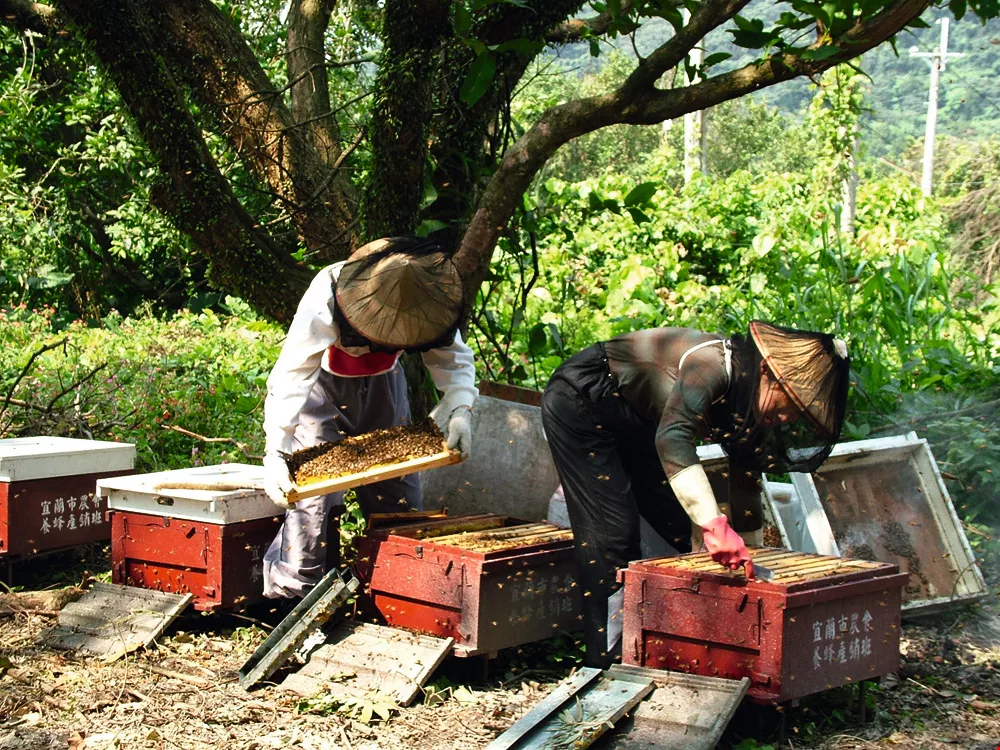
The beekeepers at Bee Family frequently inspect their hives and make adjustments to be sure their bees are in good shape and ready to work hard.
One of Huang’s apiaries is in Yilan County’s Sanxing Township. His 365 beehives there have an average of 100,000 bees per hive, which makes for a total of some 36.5 million bees in all.
An ordinary beehive can house no more than 50,000 bees, but Huang’s hives are bigger. The key to his beehive design is a split-level structure.
The design features a special grate between the upper and lower levels. Called a “queen excluder,” its interstices are too narrow for the queen bee to pass through, so that the queen and larvae are isolated in the lower level, while the upper level is used exclusively as a honey chamber. This enlarges the space available for bees to ripen the honey. The ripening process is improved, and the resulting honey is more nutritious. For over two decades now, Bee Family has won top awards from the Council of Agriculture for the quality of its honey.
Most honeybees in Taiwan are Italian honeybees (Apis mellifera ligustica), a subspecies of the western honeybee, while the remaining few are Asiatic honeybees (Apis cerana).
The Italian honeybee is highly resistant to hunger and cold, has a gentle temperament, and is an excellent forager. These characteristics make it very easy to keep, but long-term breeding in apiaries has resulted in backcrossing and close breeding that are beginning to make colonies increasingly feeble with each generation.
Huang points out that the collapse of bee colonies is also a problem in Taiwan; when a strain of bees becomes genetically degenerated, it often happens that bees go out to forage and never come back. Whereas a single beehive used to yield about 110 kilos of honey, production now is down to around 70 kilos.
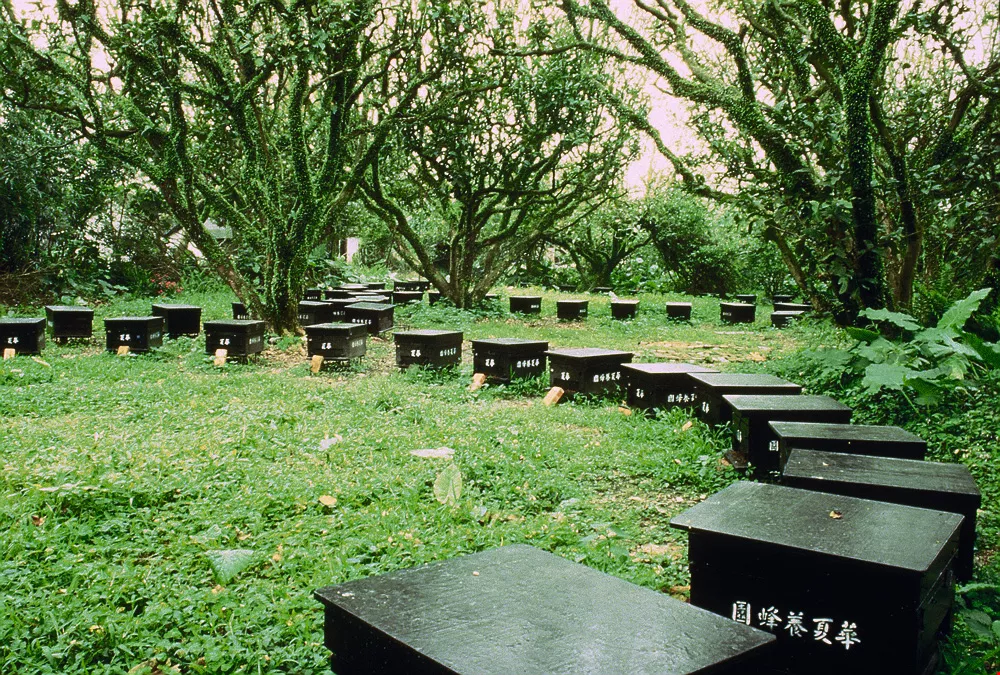
Huang Dong-ming’s bees are shown here feasting away in an orchard of wax apple trees in Jiaoxi Township, Yilan County.
To improve a strain, says Huang, a beekeeper must either arrange a “group date” with the bees from another apiary or manually select the healthiest males and females from their own stock and isolate them for breeding in a place where there are no other bees within a ten-kilometer radius.
The selection of superior bees requires close observation and careful record keeping. When studying his bees’ work habits, Huang makes a mark on a worker’s back as she prepares to exit the hive, then notes the time of her return. He has discovered that a quick one will come back in less than three minutes with a full load of pollen and nectar. Belly bulging, she dances in a “figure 8” or “S” pattern before the hive entrance to inform others of the direction and distance where her find was made. She will make 15 or 16 trips in a day.
A lazy bee, in contrast, will mosey around for more than 20 minutes, return with just a bit of pollen and nectar, and loiter at the hive entrance waiting for a guard bee to notice and poke her with its two antennae. “Lazy bees like that can’t be allowed to stay in the hive,” says Huang.
Of course, bees are afflicted by disease and pests, and once a bee is found sick, the entire beehive must be destroyed. “Beekeeping techniques in Taiwan are world-class, so disease and pests aren’t a big threat,” says Huang, who adds that a good strain of bee naturally has better resistance.
But Taiwan’s high population density makes for a relative scarcity of nectar sources. Ten years ago, Huang decided to head overseas and set up operations in Chiang Mai, Thailand. He found a site with good air quality that was not polluted by agrichemicals, where a huge longan orchard spread out for several kilometers. There he set out 4,800 beehives to specialize in producing longan honey.
Longan honey is made by bees that have collected their nectar exclusively from longan blossoms. In Chiang Mai, longan trees bloom from about mid-March to mid-April. No other flowering plants are in bloom at that time, which makes for a dependably pure nectar source. The only places in the world where longan honey is produced are Taiwan’s Chiayi County and Chiang Mai, both of which are located at the Tropic of Cancer.
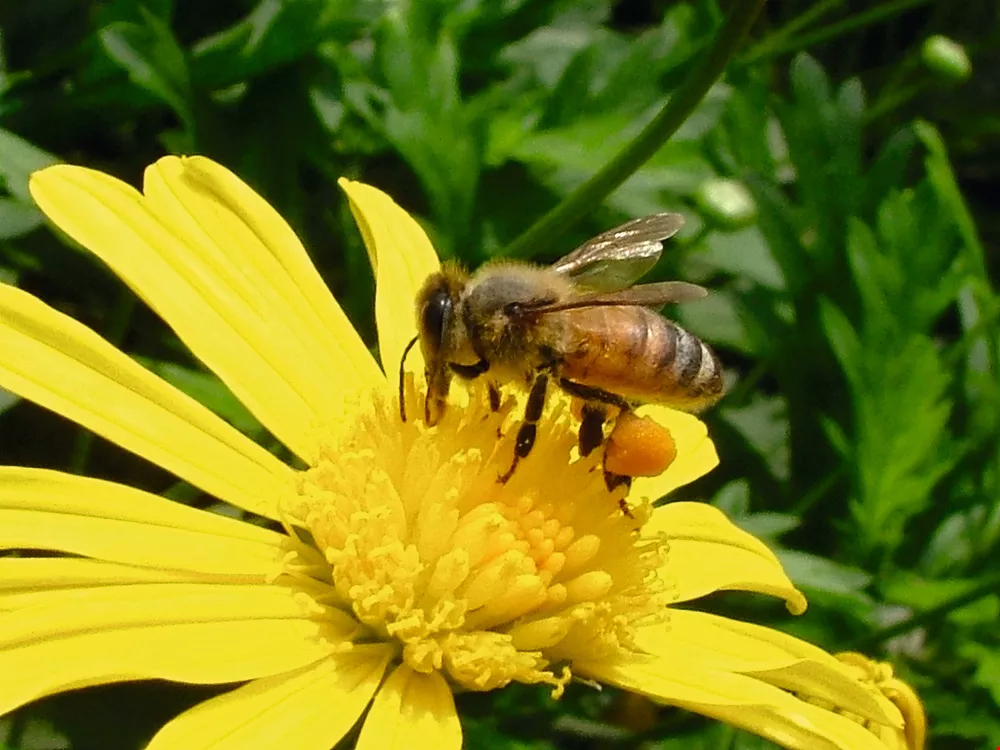
The pollen baskets on this bee’s hind legs are full of pollen as it collects nectar from a margarita flower.
Bees work from sunup to sundown. Beekeepers, for their part, spend the year following the bees from one field to the next.
Huang explains that the oval kumquat blooms in Yilan for a couple months each year, beginning in January. Then he packs up his hives and heads to Nanhua District in Tainan, where he stays for 20 days before moving on to Wufeng District in Taichung for about two weeks. After a stopoff in Miaoli County, it’s back to Yilan to set his bees loose in the townships of Sanxing and Datong. And so it goes.
Following the flowers like this might seem a romantic notion, but in fact it’s a very tough life. Fortunately, says Huang, farmers in recent years have taken to planting in greater variety and smaller volumes per crop, which means that beekeepers no longer have to move around as often as before.
Huang has a deep emotional attachment to his family’s bee business. Says Huang: “If I go a day without seeing any bees, I feel really uneasy.”
Indeed, his eyes light up as he talks about his bees.
“Bees are actually quite ruthless and calculating,” notes Huang with fascination. If a bee from one hive shows up at another with nothing to offer, the guard bees will kick her out and even destroy her wings. But if a bee shows up at the neighboring hive with nectar to share, they’ll welcome her readily into the colony as one of their own.
A queen bee lives for three to five years, and lays up to 3,000 eggs in a day. Drones are relatively large, and serve no other purpose than to eat and play Lothario to the queen, but they soon die after completing their mission. The workers are the most unfortunate ones. For the first few days of life they act as nurse bees, taking care of the queen. From days five to eight they are housemaids responsible for cleaning the cells. From day ten they spread water about the hive to keep it cool. Beginning on day 12 they secrete royal jelly for the queen to eat. After these secretions drop off on day 20, they must go out and forage for nectar and pollen. Workers live for a maximum of 60 days, but often die of exhaustion after 40 or 50 days.
The most fascinating products made by bees are their hexagonal honeycombs, which feature a remarkable bacteria-free environment. The combs are used for brood rearing, honey storage, and honey ripening.
Huang explains that a honeybee on one foraging trip generally collects about 200 milligrams of nectar, 99% of which is sucrose. As yet it has little nutritional value, but the workers repeatedly regurgitate it to mix it with enzymes inside their bodies. This process transforms the sucrose into saccharides. After fanning to evaporate off excess water, what is left is 40–50 mg of ripened honey. The cells holding this honey are then sealed off. At this point, crafty humans interlope and drain off the honey. When the bees discover two hours later that the honey is gone, they go out foraging again, and the process is repeated.
When honey production peaks in the spring flowering season, some 12 kilos of honey can be removed from each hive once every five days.
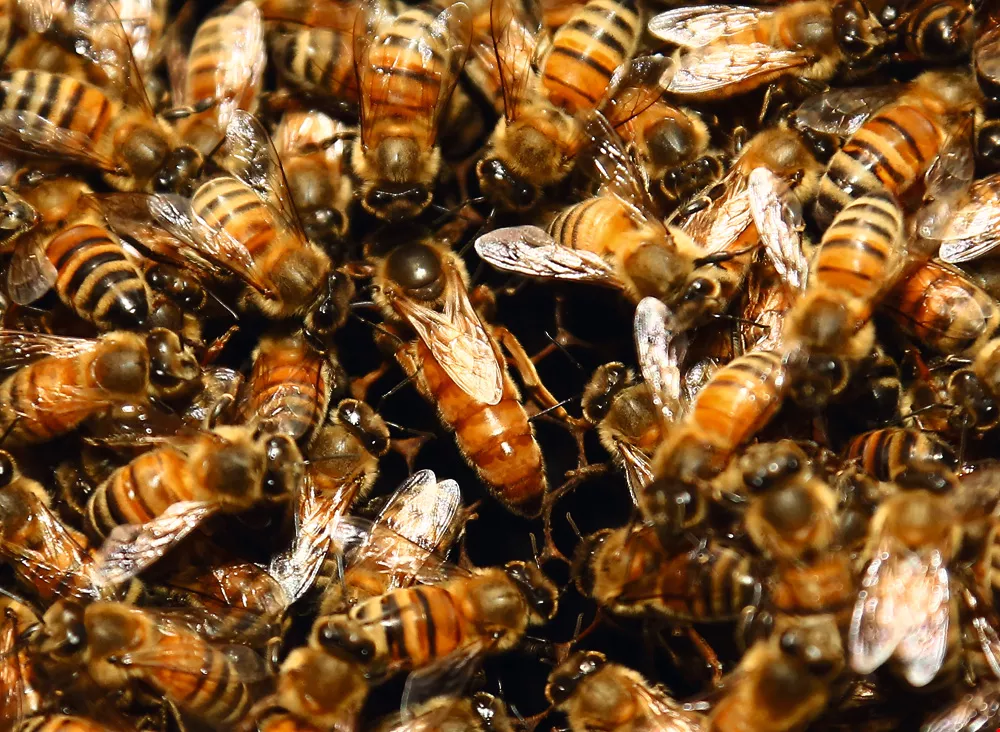
Bee Family takes a very active approach to the task of improving its bee stock. The big bee in the center of this photo is the queen. Her duty is to lay eggs.
It is said that without honeybees mankind could only survive for four years, because about one-third of all plants and fruit trees depend on honeybees for pollination. Without bees flitting from flower to flower, fruit trees would be barren.
Taiwan’s government in recent years has targeted “high-end agriculture” as a focus of development, making honeybees all the more important to the nation. In Yilan’s Sanxing (“three stars”) Township, the flowers of the “three-star general” pears grown there bloom in the chilly days of early spring when bees and butterflies are scarce, so fruit growers and their local farmers’ associations pool funds to rent bees from apiaries for pollination.
In net houses, of course, there is no possibility of insects of any sort getting to the crops, so honeybees must be released regularly inside the net houses for pollination. By providing bee rentals, apiaries have, in effect, branched out into the service sector. Indeed, Huang Dong-ming states that the output value of honey products in Taiwan only comes to about NT$2 billion per year, while annual revenues from crops depending on bee rental services exceed NT$20 billion.
It generally takes ten beehives to pollinate crops over an area of about one hectare, and a pollination engagement generally runs from a half-month to a month. At a price of around NT$15,000 per gig, the bees’ services are a steal compared with manual pollination by humans, which costs about NT$45,000.
Huang comments: “In the countryside, labor just keeps getting harder to find and more expensive. But bees are cheap and never go on strike, so they’re a win-win solution for both fruit growers and apiaries.”
But before Huang will set his bees out for pollination, the farmer must promise not to use agrichemicals on the crop. Huang explains that contact with agrichemicals can intoxicate a honeybee, with effects similar to what one sees in an alcohol-inebriated human. The bee becomes disoriented and unable to navigate. In this condition, it will often fly around until it drops from the air, dead of exhaustion.
And when a hive is set out in a net house, the beekeeper must take care that net house duty is assigned only to recently hatched bees whose wings had previously been too soft for flight. Bees less than ten days old aren’t yet familiar with the big wide world, and will think the net house is as big as the universe gets. Bees aged ten days or older, however, must be excluded, for they would struggle against the netting and suffer heavy casualties in the process.
Some people may feel bad about how bees are exploited as cheap labor. But, surely the creator has a design that accounts in some mysterious way for such things.
Huang points out a curious trait displayed by honeybees: When honey is stored up in plentiful supply, they become quite the “party animals.” All of a sudden, it’s time for gatherings and festivals. The honey is soon consumed, and then they head back out to forage for more.
Man’s incursions on bees’ honey stores spur the insects to forage—and pollinate—all the more industriously. Indirectly, then, we humans help the pollination process along, which is certainly a constructive thing. However, we can’t go killing the bees that lay the golden honey. We’re going to have to conserve nature if we’re to continue coexisting in harmony with bees.
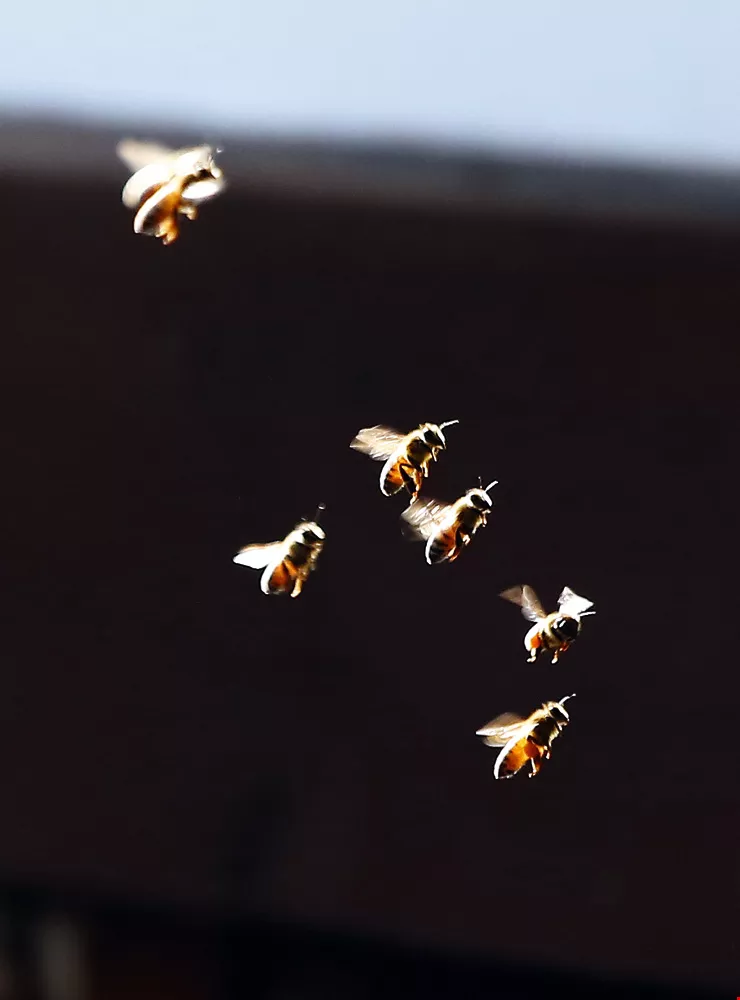
Most honeybees in Taiwan are Italian honeybees (Apis mellifera ligustica), which are gentle in temperament and easy to manage.
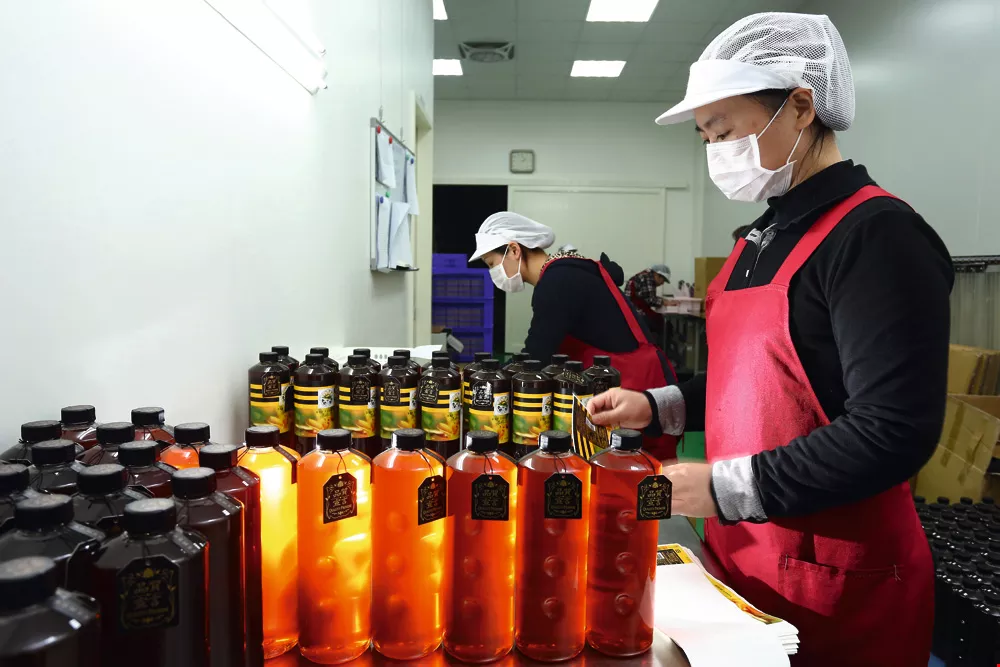
To ensure the quality of its honey, pollen, and royal jelly, Bee Family controls the whole process, from production to sales. Each item is marked with proof of inspection.
@List.jpg?w=522&h=410&mode=crop&format=webp&quality=80)

@List.jpg?w=522&h=410&mode=crop&format=webp&quality=80)


@List.jpg?w=522&h=410&mode=crop&format=webp&quality=80)

@List.jpg?w=522&h=410&mode=crop&format=webp&quality=80)
