

To achieve their aims of marketing through movies, Taipei and Kaohsiung have both established film commissions and other facilities to assist filmmakers, helping many in the film and television industries achieve dreams they once thought impossible.
In working with Black & White, the Kaohsiung Film Commission seems to have tapped just about every resource imaginable. From shots from helicopters, through on-street gunfights and explosions in parks and fast-food restaurants, to chases filmed in Kaohsiung Harbor and in Kaohsiung MRT trains and tunnels, the Kaohsiung City Government has demonstrated tremendous flexibility and the ability to do just about anything requested.
Kaohsiung City Information Office chief secretary Liu Hsien-huei even had to contact the deputy mayor to obtain a prisoner transport vehicle for the show, only to find out later that they were doing reshoots and needed the exact same vehicle and the exact same driver again.
Having spent nine months scouting for locations and shooting for Black & White, Kaohsiung Film Archive employee Tsai Chi-chu says that thanks to his local connections and knowledge, as well as having worked on-set before, he was able to find anything the director Tsai Yueh-hsun wanted. For example, the "secret base" in the show is in fact his own "private spot"-a rarely visited, barely known tunnel.
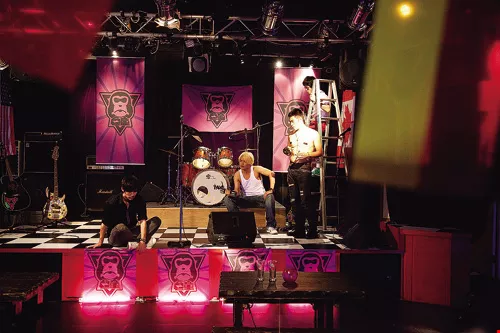
Filmed in Taichung, upcoming romantic comedy Love You Ten Thousand Years received NT$2.5 million in support from the city. With the help of the authorities, the film's leading couple were able to shoot in locations such as the well-known Emerge Live House, the century-old Taichung Park, and even at the airport.
Some jobs, though, need public-sector help to complete. The first film the Taipei Film Commission (TFC) worked on after its founding, No Puedo Vivir Sin Ti, is a perfect example.
The script had been percolating in the head of director Leon Dai for a while, but it wasn't until the establishment of the TFC that he had the courage to give it a shot. One reason was the demands of one particular scene-a daylight scene involving a threat to jump off an overpass, which would need a stretch of the high-traffic Zhongxiao East Road to be closed off, with traffic controls and safety facilities in place.
"In the past, we had to do street scenes on the sly, worried that the police would chase us out. I never thought we'd end up with the police helping us shoot by keeping order!" laughs Dai, who is full of praise for the TFC's efforts.
The level of openness on the part of the public sector is also surprising.
Already the Office of the President has provided the Presidential Palace for shooting, even breaking precedent and letting a dog inside. The dog in question, Kangkang from the show Niyada, must have felt like the king of the hill that day, as even the president's own beloved dog hasn't been allowed into his master's offices!
Similarly, even the mayor of Taipei-going back several mayors, in fact-has not set foot on the helipad atop City Hall, but the cast and crew of upcoming film Close to You have. Not only did the Taipei City Government offer use of the City Hall helipad, Mayor Hau Lung-pin even came to see how things were going, bringing coffee and cakes. The city government even organized for the neighboring Grand Hyatt Taipei to switch their lights on a little earlier in the evening to ensure the area around Taipei 101 was lit-up and beautiful.
As well as big things like closing roads and coordinating pyrotechnics, Taiwan's civil servants have also helped out in various smaller, less obvious ways.
For example, for better ambience in Taipei night scenes, Au Revoir Taipei needed some street lights on and others off. However, the lighting system is totally computer controlled, meaning the Parks and Street Lights Office had to send someone to manually take down the lights the filmmakers didn't need.
Another scene, of dancing in a street, needed a dream-like atmosphere, and so they asked for a street sprinkler truck to wet the road, using the steam that rose and the light from the street lights to create the interplay of light and shadow they wanted.
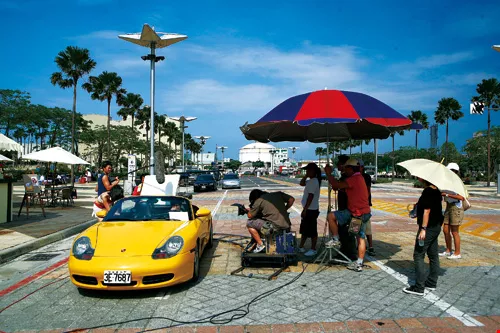
Finding locations, organizing helicopters, lending prisoner transports... the Kaohsiung City Government held nothing back in its support of Black & White, helping the producers achieve even the most impossible of missions.
"The support of the government is a huge confidence booster for the film industry," says Lee Yong-ping, a former theater worker and the current deputy mayor of Taipei City. In the past, she explains, there was no officially sanctioned intermediary between the government and filmmakers, and so even aspiring scriptwriters were stymied from the get-go. Now, with the reliable support of the public sector, filmmakers can have the courage to make their dreams reality.
And this support is not only helping local filmmakers, but also enticing foreign filmmakers to shoot in Taiwan.
Not long ago a German film telling the story of a Chinese immigrant to the American west in the 1930s-working title The Chinese Man-was to have five days of shooting, the filmmakers initially just wanting a large Chinese-style home and a vegetable market. However, after being shown around by the Taipei Film Commission, they decided to stay in Taiwan and try to find locations for their "African coast" and "American desert" scenes as well.
The TFC did all they could, taking the crew around the eastern coast and down the Mt. Huoyan in Miaoli for suitable locations. Thanks to the TFC's hospitality, the filmmakers were ultimately able to shoot 70% of their scenes in Taiwan.
You might be wondering how playing a "fake" version of another place helps Taiwan market itself.
In fact, such "mistaken identity" tactics are commonplace. Despite the uniquely Japanese architecture seen throughout it, many scenes in The Last Samurai were shot not in the historic village of Shirakawa, but rather in New Zealand for both cost reasons and similarity of location. Similarly, Like a Dream-a joint Australian-Chinese-Hong Kong coproduction which opened this year's Hong Kong International Film Festival-shot in the Taipei 101 mall for scenes ostensibly taking place in Macy's in New York.
TFC director Jennifer Jao comments that during the two weeks Like a Dream was shooting, the cast and crew ate, slept, and shopped in Taipei, so even though the film won't be explicitly marketing Taiwan, its production has brought other benefits.
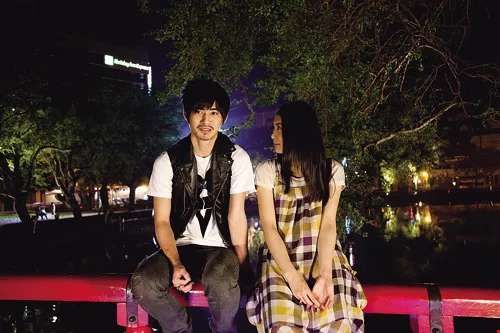
Filmed in Taichung, upcoming romantic comedy Love You Ten Thousand Years received NT$2.5 million in support from the city. With the help of the authorities, the film's leading couple were able to shoot in locations such as the well-known Emerge Live House, the century-old Taichung Park, and even at the airport.
"We need to win over the film industry before any tourism benefits start coming in, otherwise we may as well just cut to the chase and do tourism marketing," says Jao, adding that as Taiwan tries to woo the film industry, what is needed is more practice and more opportunities to prove itself. Only then will foreign films come in to shoot here, and that will provide valuable in-field training for Taiwan's film footsoldiers.
The 1966 American film The Sand Pebbles, shot in part in Taiwan, offers a valuable case study.
As Jao recalls, the film, set in China, had to move to Taiwan because the story involved issues of racial prejudice and because China itself was in the throes of the Cultural Revolution. The cast and crew spent over four months in Taipei and Danshui, the mouth of the Danshui River masquerading as that of the Huangpu River, and Yanping North Rd. as a street in Shanghai. The Taiwanese film industry learned much from this, lessons which were put to use two years later on the Taiwanese production Tien Tan Recovers the Kingdom. A few of the assistants on that film-namely Pai Ching-jui, Wang Tung and Lin Hung-chung-would go on to become famous directors themselves.
Now that using cinema as a marketing tool has become so popular, Taiwan is going all-out to court the film industry. As Deputy Mayor Lee has said, "It's like dominoes-when one goes, the next will fall, and the next, and so on. Taiwan is on the verge of a golden age of film!"
With such focus, surely the "brain drain" of Taiwanese filmmaking talent will become but a distant memory.

@List.jpg?w=522&h=410&mode=crop&format=webp&quality=80)

@List.jpg?w=522&h=410&mode=crop&format=webp&quality=80)


@List.jpg?w=522&h=410&mode=crop&format=webp&quality=80)

@List.jpg?w=522&h=410&mode=crop&format=webp&quality=80)
