Calm amid the Storm: Jeff Chang and T’ai Chi
Chen Yali / photos Chuang Kung-ju / tr. by Jonathan Barnard
August 2012


He works in the financial industry, where the pace is always frenetic and the pressure always immense. Yet Jeff Chang, the president of Cathay Securities, remains perpetually calm and energetic. His secret? He has been practicing t’ai chi for 20 years.
T’ai chi has helped him to strike a good balance in his work, life, and interpersonal relations; to maintain a healthy mind and body; and to keep his cool as he wheels and deals in the markets. It has also offered the side benefit of friendship with many fellow practitioners, and in particular with Stephen Chow, Hong Kong’s king of comedy.
What do you think someone who manages more than NT$100 billion does the first thing in the morning? Does he sit down at his computer to see how the US markets fared the previous day? Or turn his television to CNN to get the latest on the European debt crisis?
In this case, the answer is neither of the above. The first thing that Jeff Chang, president of Cathay Securities, does on rising at 6 a.m. is to practice t’ai chi. He says he has practiced the ancient discipline almost every morning over the last 20 years on a small outdoor platform at his Yonghe home.
Born in 1966, Chang became ING Fund’s youngest-ever chief investment director at 37. Two years later, when not yet 40, he became president of Cathay Securities, and was entrusted with the heavy responsibility of handling Cathay Life Insurance’s investments on the Taiwan Stock Exchange. Although he currently no longer manages funds, he still is responsible for the operational efficiency of Cathay Securities. Yet the pressure never gets to him: He always presents a glowing, smiling visage. His equanimity is closely connected to the first thing that he does every morning: practice t’ai chi.
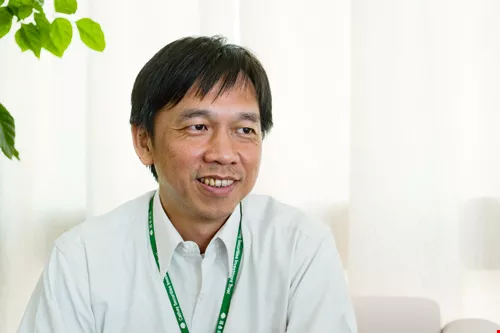
Practicing t’ai chi every day allows Chang to handle the pressures of the financial industry with great calm and composure.
The truth is that Chang has had a strong interest in Chinese martial arts and deductive reasoning ever since he was a child, when his greatest ambition was to be a detective. Although that dream never came to fruition, his other dream of becoming adept at martial arts, like Linghu Chung in Louis Cha’s The Smiling Proud Wanderer, did indeed bear fruit. He has ended up being highly proficient at both taekwondo and Shaolin kung fu.
There is a secret behind his study of taekwondo that few have previously known: Chang wanted to protect his family. His father was businessman in Taipei, and during Jeff’s elementary school years the family lived in a mansion. But when Jeff was in junior high school, his father’s business failed and the family’s fortunes plummeted. They owed hundreds of millions of NT dollars. Demanding payment, gangsters visited and smashed up their furniture. The family fled that very night and lived in fear in the months that followed.
“I started studying taekwondo and judo when gangsters were coming to collect debts,” says Chang. “My brother and I studied them for self-defense and to protect our family.”
Having always wanted to study qinggong—“light body skills”—so that he might scamper up walls with ease in the way portrayed in martial arts novels and films, he even went behind his mother’s back to buy some leg bindings and lead weights from a mail order catalog. He used them for two years, up until he tested into the industrial engineering program at Tunghai University and had to take them off to attend the summer military training program for those entering college. During those two years, he had three-kilogram weights attached to both legs night and day. They’d remain on even when he was asleep, jumping rope or running. He only took them off to shower or bathe.
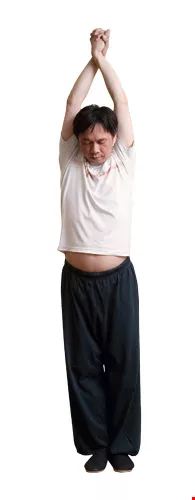
At university, Chang enrolled in martial arts classes to fulfill his physical education requirement. In the summers he often participated in training sessions sponsored by the university martial arts club. That was when he started learning Shaolin kung fu.
During the summer of his junior year, the clubs of Tunghai and Chinese Culture University put on some friendship activities, including a month-long dawn-to-dusk training camp at Taichung Park. One day on a break at the camp, Chang, brimming with energy, decided he wanted to try out qinggong, so he competed with classmates to see who could jump up on a stage that was nearly the height of a man. Putting his all into one jump, he cleared the front edge of the stage but landed poorly and fell off. The fall injured his tailbone and caused him to black out.
Although Chang’s friends were at a loss for what to do, fortunately there was an old man looking on who had been practicing t’ai chi. He rushed over and massaged Chang’s acupuncture points, starting with those on the soles of Chang’s feet. Chang felt a warm current surge through his body as he slowly regained consciousness. By the time the old man was massaging the baihui acupuncture point on the crown of his head, Chang’s vision had returned.
“T’ai chi saved my life!” Chang exclaims. From that moment forward, he not only was a deep believer in the effectiveness of t’ai chi, he also began to feel that inner-directed martial arts were superior, and he resolved to study t’ai chi and qigong.
Upon entering graduate school in industrial management at National Cheng Kung University, Chang immediately joined its t’ai chi club. After entering the workforce in 1993, he continued to take private classes and joined the Taipei T’ai Chi Association. By now, he has been studying the discipline for almost 20 years altogether.
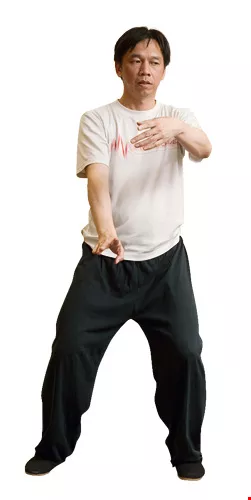
After Chang obtained his master’s degree, performed his military service and returned to Taipei to look for work, he applied for a position as an analyst with various securities firms, both large and small. Unexpectedly, none offered him a job, so he ended up as an industrial analyst at Chun Yuan Steel instead.
On January 17, 1995, the Hanshin earthquake battered Japan, causing much loss of life and changing Chang’s career path. After the earthquake, large-scale reconstruction began in Kobe and Osaka, which caused steel prices around the world to rise. The Taiwan securities industry, with its focus on investment in electronics, was caught unprepared. Suddenly, there was a great demand for analysts with a background in steel and construction. That gave Chang an opportunity to switch jobs to Capital Investment, which had only recently been founded.
Then 29, Chang participated in an analysts’ “boot camp” put on by Capital’s chairman Ye Zhiyong. Typically, 10 recruits would enter the program, but only two would survive. Facing that 80% elimination rate, Chang passed with flying colors and ended up as Ye’s chief analyst.
In the high-pressure world of investment management, fund managers spend every day studying markets and buying and selling. Maintaining one’s cool in the face of market fluctuations is key. Chang explains that the market operates under the same principle as t’ai chi: When things reach an extreme, they can only move in the opposite direction. The practice of t’ai chi has enabled him to maintain his health, relieve market-related stress and, most of all, cultivate an inner calm.
“T’ai chi cultivates mental tranquility, develops one’s qi, trains one’s breathing, and teaches a mind-body balance. It supports the long haul of the marathon, not the mad dash of the 100 meters. The same principles apply to investing in the markets: long-term performance beats short-term gains.”
Having formed the habit of practicing t’ai chi every morning, Chang sticks to his routine even when staying in hotels overseas: He practices standing meditation and his t’ai chi forms for 40 minutes every day without fail. On typical days of meetings at the office, if the pressure starts to get to him, and he can feel the tension building in his body, then he will place the tip of his tongue on his palate and breathe from his diaphragm, techniques that allow him to relax and achieve a state of balance wherever he is at any time.
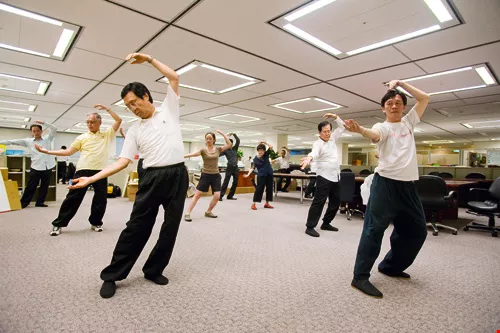
Accomplished at t’ai chi, Jeff Chang has attained certification as an instructor and teaches a class at the office for his colleagues’ benefit.
For Chang, an unexpected side benefit of practicing t’ai chi has been making friends with fellow practitioners, including the Hong Kong film star Stephen Chow.
In 2006 a Hong Kong friend of Chang’s introduced him to Chow. The friend warned Chang that the private Chow was taciturn by inclination and would leave within three minutes if he didn’t find the conversation to his liking. Yet finding that they shared the same interests, the two hit it off right away, chatting like old friends for three hours.
Their experience with the martial arts fueled their lengthy conversation. Chang had by then studied t’ai chi for more than 10 years and attained a deep level of proficiency. Chow, who had worshipped Bruce Lee as a child, was fascinated with Chinese kung fu, and had studied the Shaolin style and directed box-office hits such as Shaolin Soccer and Kung Fu Hustle that deal with martial-arts themes. At that first meeting, Chang disclosed that he had bound weights around his legs to practice qinggong. Little did he expect Chow to respond: “I did the very same thing!”
Now, whenever Chang goes to Hong Kong on business, no matter how busy his itinerary, he arranges a meeting with Chow. The two talk investments and martial arts until Chang has to leave for his flight.
“Chow has mostly studied outer-directed schools of martial arts,” Chang explains. “His knowledge of inner-directed disciplines such as t’ai chi has mostly come from me.”
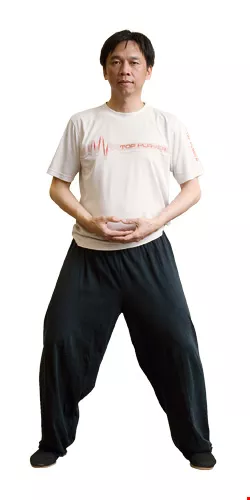
Chang has studied several kinds of t’ai chi, including the Yang and Chen styles. He used to practice on the roof of his apartment building, but the whims of the weather made it impossible to practice there every day.
To overcome those limitations, Chang thought up his own unique method: Unlike the t’ai chi you see in Taiwan’s parks, his revised version can be practiced at home or in the office. Starting with the t’ai chi commencement posture, one moves through a sequence of four or eight basic t’ai chi forms that are suitable for a small space. Once you finish the sequence, your right foot steps backward at a 45˚ angle and you start all over again. Using this method, one turns like a top in slow motion, facing every direction in a small room while repeating the same sequence of moves.
“If you plan on repeating a sequence of forms, the simpler the motions, the better. So long as you can study the basic moves of t’ai chi, and get a sense of t’ai chi’s health benefits, it will foster a virtuous cycle and you’ll be able to stick with it for many years.”
Chang points out that because modern office workers often get stiff necks and shoulders, they first need to warm up and get loose before they engage in standing meditation and practice their training forms. By so doing, their qi will start circulating, and they’ll achieve twice the results with half of the effort.
The stretching and loosening exercises he created draw from the essences of various schools of t’ai chi and also integrate yoga and exercises designed by John D. Young, chairman of Chang Gung Biotechnology. They help to loosen the shoulders and neck and correct habitually poor posture.
Now accomplished in his study of t’ai chi, Chang began to practice neigong (the study of cultivating and directing qi) five years ago. He also obtained certification as a t’ai chi instructor. Now he spends every Saturday morning teaching for free at Da’an Forest Park.
Two years ago, after Chang had attained a mastery of neigong techniques, enabling him to intentionally transfer his qi to others, he began holding a t’ai chi class in the office. Every Tuesday evening, he leads an hour-long session, covering body-relaxation skills, standing meditation techniques, and basic 13-form and 18-form t’ai chi sequences.
Cultivating body and mindChang deeply believes that anyone, so long as they stick with it, can reap the benefits of t’ai chi. At 174.5 centimeters tall and 72 kilograms in weight, Chang, 46, has a standard body type. Since he’s started practicing t’ai chi, he has rarely been sick. What’s more, he’s not picky at all about his diet. He’s been known to consume as many as 30 boiled dumplings at a single meal, yet he weighs the same as 20 years ago.
“It’s all thanks to t’ai chi,” says Chang, who credits its practice with speeding up his metabolism. Furthermore, no matter how late he stays up at night, it doesn’t keep him from waking naturally at six the next morning. That early rise has become like brushing his teeth or washing his face—part of his habitual routine.
T’ai chi may seem like a slow, easy, low-energy form of exercise, but looks can be deceiving. From many years of experience, Chang has discovered that practicing t’ai chi for only 40 minutes is enough for him to work up a sweat and get his circulation going. Furthermore, t’ai chi is the ultimate “soft” martial art, so that it suits people of all ages.
What’s more, t’ai chi emphasizes yin-yang balance, yin-yang harmony, reversion to the mean, the path of least resistance and other natural laws. Thus, through the practice of t’ai chi, Chang has gained an understanding of the yin and yang of material things, the waxing and waning of the moon, the rising and falling of markets, and the profit and loss of investments.
For Chang, t’ai chi isn’t merely a form of physical exercise: it’s an approach to life that helps him cultivate his mind and his body and maintain his composure even when faced with the frenzy and vicissitudes of the financial world!

@List.jpg?w=522&h=410&mode=crop&format=webp&quality=80)

@List.jpg?w=522&h=410&mode=crop&format=webp&quality=80)


