

Japanese friends have told me that a lyric from the Awa Odori song goes: "The dancing fool and the watching fool are the same fool." At first I was a little perplexed by this lyric, but after attending a few Awa Odori dance festivals I came to understand it.
For the Awa Odori, the number of dancers can range from several dozen to several hundred. Both men and women and the young and the old join in the fun and surge through the streets. Sometimes they shout, which only adds to the excitement. The musicians lead the dancers at the front of the procession, banging drums, striking metal percussion instruments and playing short flutes. The whole parade winds its way through the streets for at least one hour.
Captivated by the proceedings, spectators line the streets and shout encourage-ment. The dancers' sweat soaks their special Awa robes. The women wear big, pointy straw hats. In ancient times women were no doubt shy about dancing in public, so these hats, which conceal the top half of the face, were a smart choice.
With the heavy drums hanging from their necks and shoulders, the drummers have to work the hardest of all the musicians. It's a moving sight to see them giving their all to produce a thunderous beat. The dancers aren't really fools. Or if fools they be, they are "happy fools" or "intelligent fools who love their home-towns."
Those who watch the dancers also deserve praise-because a performance without an audience to provide encouragement and applause would be certain to lack energy.
When the music and dancing stop, people don't just go home. Instead they break up into little groups and go to prearranged places, where they consume cold thin noodles, beer, desserts and fruit. These dance nights provide a good opportunity for people to come together and socialize.
Apart from Awa Odori dancing, there is another kind of nighttime dancing performed by neighborhood people in parks or in front of temples. A two-story wooden platform is set up in the middle of the space. The dancers perform either on the first level of the platform or around the platform. The musicians occupy the second story of the platform. Drums, of course, take pride of place. Frequently, the drummers are quite young, but they nonetheless display excellent technique. There are also many children who dance beau-tifully. The secret behind the successful transmission of Japan's folk art legacy is that children are able pick up these arts from the environment around them. Passing along the torch is the responsibility of the adults.
The children enjoy going to these kinds of dances because there are always lots of stands right outside, selling food and toys that they wouldn't normally be able to get.
Rows of red and white lanterns are hung around the stage. These lend the scene a sense of festive cheer. Adults and children put on summer kimonos-some cute and some quite gorgeous-and dance happily. Complimentary fans are distributed, which some performers use as dance props and others stick into their belts at the small of their backs.
The night of Japanese dancing that was most unforgettable for me was the open-air dance festival put on by my daughter's school on the night before her last day of first grade. After receiving her report card, my daughter came home and changed into her cute kimono. Then the whole family went to the dance festival held in the schoolyard. The trees on all four sides of the schoolyard were hung with red and white lanterns that students had made in art class. The school's song, which is quite pleasing to the ears, played from the loud-speakers. Although this night lacked the energy of an Awa Odori festival, many students and parents-almost 1,000 in all-were in attendance, and the misty moonlight falling gently on the yard created quite a poetic feeling.
Don't panic about missing a step, let the music go on and on, let time slow down a bit-I silently prayed for these things on that night. In our modern, scientific and mechanized lives, such leisurely gather-ings, where whole families come out to dance together, are rare indeed!
But all gatherings end in dispersal. As I left the school, I couldn't help but keep looking back over my shoulder. It really was a case of "turning around to see what plucks the heartstrings"!
p.42
The Awa Odori dance is about to begin. The leaflets printed by the local government make things very clear for tourists. They even include a map so that you're sure to find your way.
p.43
A raised platform surrounded by lanterns looks even more magnificent at night. The photo shows a night of dancing sponsored by the Sugamo local government in July.
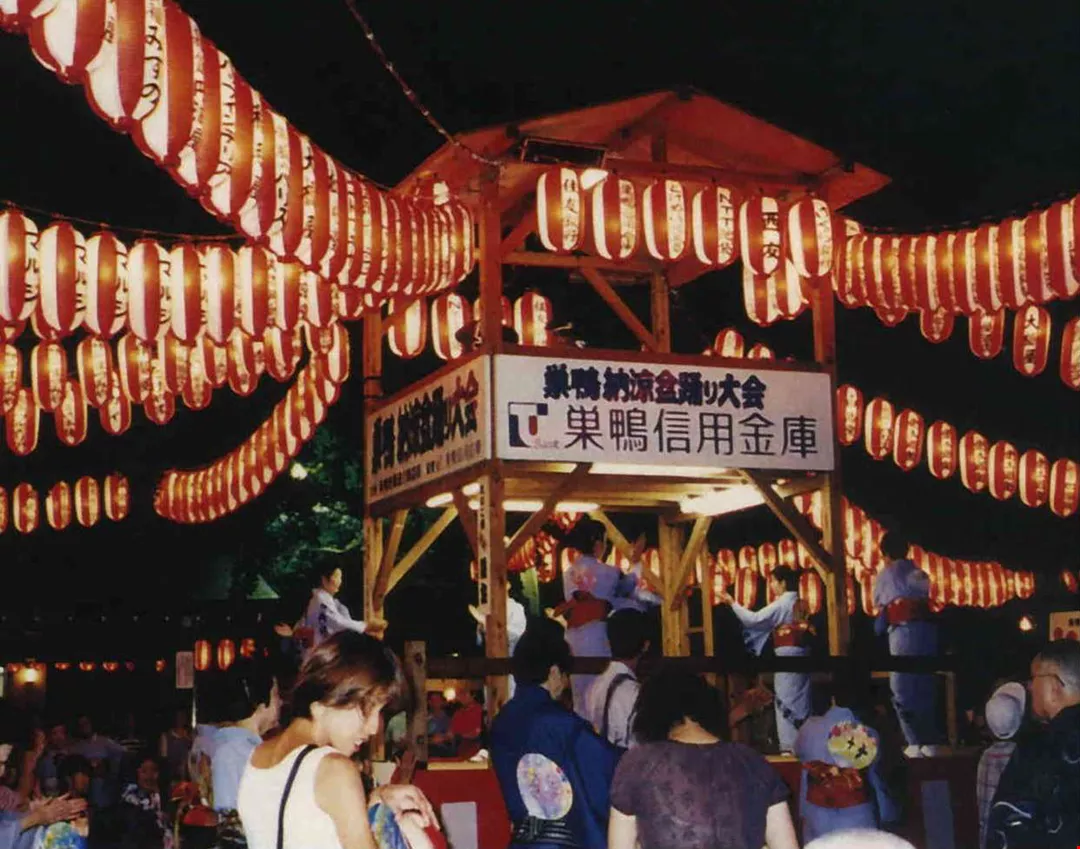
A raised platform surrounded by lanterns looks even more magnificent at night. The photo shows a night of dancing sponsored by the Sugamo local government in July.

@List.jpg?w=522&h=410&mode=crop&format=webp&quality=80)
@List.jpg?w=522&h=410&mode=crop&format=webp&quality=80)


