

In March 2008, Taiwanese cast 7.66 million votes to bring about the island's second transfer of power to an opposition party, putting aside ideological conflict in favor of reviving the economy. The election established a new foundation for cross-strait relations-one that includes official contacts and reciprocal, bilateral interactions-and opens the floodgates to cross-strait economic and trade cooperation.
Coincidentally, Time magazine just named the new ROC president, Ma Ying-jeou, and PRC president Hu Jintao among the 2008 Time 100, the 100 people the magazine views as the world's most influential. Ma received this distinction for being a politician who has "an opportunity to shape the destiny not only of their own nation but also of an entire region." In his 20 May inaugural address, Ma reiterated that cross-strait negotiations should resume as quickly as possible on the basis of the 1992 consensus, and that the two sides should seek peace and mutual prosperity. Most Taiwanese are hoping for a peaceful, mutually prosperous "new cross-strait relationship and new Taiwan." Much of the world may be struggling to cope with the United States' subprime mortgage crisis, soaring crude oil prices, the food crisis, and inflation, but right now Taiwanese are optimistic. At the same time, cross-strait trade is no panacea. While it offers tremendous opportunities, it poses challenges that are just as large. As we look forward to a new win-win future, let us take a moment to reexamine the history of Taiwan and China's more-intimate-than-it-appears relationship. "These are the worst of times," says Shive Chi, a professor of economics with Shih Hsin University who in the past has worked for the Ministry of Economic Affairs and for the Council for Economic Planning and Development, "yet they also have the potential to be the best of times. Heaven is helping Taiwan. The global economy is beset by concerns, but Taiwan has been given a tremendous gift and a new opportunity."
In fact, Taiwan's economic fortunes took a turn for the better right after the presidential election, even before the new cabinet was named or the new government inaugurated.
The stock market soared more than 300 points the moment it opened the morning after the election. It rose another 141 points to more than 9,000 points following vice-president-elect Vincent Siew and Chinese president Hu Jintao's mid-April handshake at the Boao Forum. Although in the absence of further good news share prices fell in late May in the wake of falling US stocks, Taiwanese markets are nonetheless expected to perform well.
JF Asset Management's Taiwan Investor Confidence Index, issued in mid-May, showed Taiwanese investor confidence soaring 12.7 points to a record high of 132.1 points. And while its global prosperity index fell 5.3 points, its Taiwan index bucked the trend, gaining 20.3 points (18.4%).
Meanwhile, Taiwan's property market, typically a leading indicator, has taken off even though the direct chartered flights between China and Taiwan slated to begin in July have yet to leave the runway, and no large groups of mainland tourists or investors have yet visited.
"The market's making up lost ground," says Cai Wei-min, a cross-strait real-estate guru and publisher of the magazine Shanghai Realty Information. According to Cai, Taiwanese real-estate prices used to be well below those in Hong Kong and Shanghai because of concerns about security in the Taiwan Strait. He believes local prices have room to rise even further in the future, and is himself now planning to put his nine years of experience in the Shanghai real-estate market to work raising funds from Taiwanese and mainland businesses for a cross-strait real-estate investment fund targeting managed real estate-hotels, office space, and recreational facilities.
"Many Taiwanese businesspeople dream of returning home wealthy," says Chang Jung-wu, deputy director of the Taiwanese business association in Qingyuan, Guangdong Province and chairman of the Yungching Group. Chang says that he too has begun thinking about buying some land near Taiwan's Taoyuan International Airport. His business may be spread across China, Vietnam, and Indonesia, but Taiwan is still his home. He adds that once direct flights are permitted, he'll have greater desire and more opportunities to return.
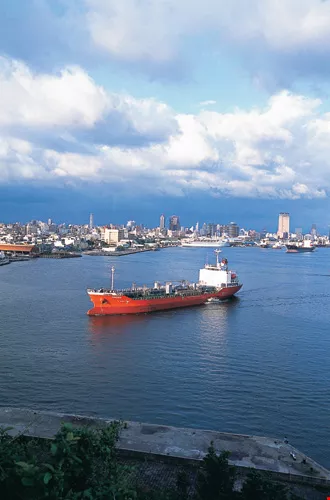
With the inauguration of the new government, cross-strait relations, frozen for the last eight years, have begun to thaw. Taiwan and China have now agreed to set aside disputes and keep politics and economics separate, with the result that the two sides can begin formally cooperating on trade and economic issues at an official level. The photo shows the Port of Kaohsiung.
Even Taiwanese businesspeople who've been largely fixated on China have noticed Taiwan's return to prosperity.
"We're expecting a lot of the new government," says Chiu Chuang-sheng, executive director of the Taiwanese business association, Shanghai, and a Mainland Affairs Council mentor to Taiwanese businesspeople. Chiu says that once direct transportation links are established, China's trade and manufacturing hubs, such as Shanghai, Guangzhou, Xiamen, and Shenzhen, will be less than two hours away from Taoyuan by air. Though Taiwan has lost the initiative on the Asia-Pacific Regional Operations Center concept that the KMT pushed so hard for 12 years ago, he believes the transshipment, financial services, and media industries still have a great deal of room to grow.
Moreover, if Chinese research and development personnel are permitted to reside in Taiwan on a long-term basis, offsetting Taiwan's lack of high-level people, the "develop in Taiwan, build in the mainland" model that Taiwan's high-tech industry has long anticipated might finally become a reality. This would, in turn, trigger a renaissance in Taiwan's economy and increase the effectiveness of the island's industrial transformation and upgrading.
The long-anticipated direct links would prove a similar boon to Taiwan's airlines, which have in recent years suffered from destructive competition and mounting losses.
"Recently a large number of international carriers have come to Taiwan to check out our local airlines," says Wei Chi-lin, chairman of Paradigm Asset Management Co., Ltd. "They are interested in acquiring Taiwanese carriers." Wei says that direct transportation links would give Taiwan the opportunity to join Hong Kong and Shanghai as a major western Pacific transportation hub.
"Now is the time," says Christina Liu, an economics professor at National Taiwan University and chief economic advisor to the Daiwa Institute of Research. Liu says that foreign firms used to undervalue or ignore Taiwan. Now, she argues, the timing, geography, and mood of the public are perfectly aligned for Taiwan to show itself to advantage. The world is awash in capital, and, with the US suffering the effects of its subprime mortgage crisis, that capital is turning to emerging markets. With cross-strait reconciliation in the offing, Taiwan is attracting attention as a place with serious development potential.
Liu says that Taiwanese industry has undergone a transformation, and that the service sector, which now accounts for 72% of GDP, is driving the economy's growth. "In the future, it will likely be domestic consumption that creates wealth." She recommends that the new government give up the old tendency to see manufactured exports as the source of all prosperity. Liu argues that if the administration wants to have a shot at achieving the goals it emphasized during the campaign-6% annual GDP growth, unemployment below 3%, and per-capita income of US$30,000 by 2016-it must seize the moment to attract foreign investment, and improve the quality and efficiency of the service sector.
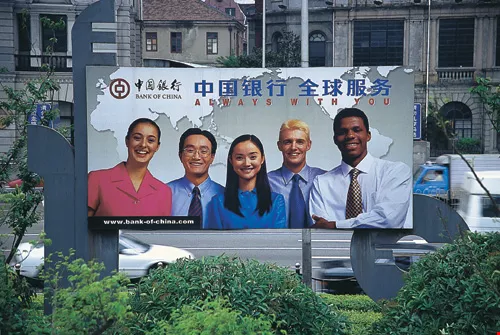
Now awash in foreign capital, China is implementing numerous measures aimed at replacing energy- and pollution-intensive traditional manufacturing with hi-tech businesses.
Expectations are running high for improved cross-strait relations, and Siew and Hu agreed at the Boao Forum that disputes should be set aside, and politics and economics kept separate. But better relations involve many variables and could prove tough to bring about in practice.
"We must rebuild trust," argues Liu Meng-chun, deputy director of the Mainland China Division of the Chung-Hua Institution for Economic Research (CIER). "Otherwise we'll have nothing but mutual suspicion and guardedness. The whole thing will bog down." At the same time, Liu says that you can't speak of international cooperation without raising the issue of national sovereignty. He cites the Ma-Siew campaign's talk of a cross-strait common market as an example, noting that the name is liable to cause misunderstanding in both Taiwan and China.
The mainland sees "cross-strait common market" as suggesting a state-to-state trade agreement, and believes that this use of "cross-strait" equates to Taiwanese independence. To some in Taiwan, on the other hand, "cross-strait common market" means a "one-China market," and represents a kind of surrender. Liu instead suggests using something like the Closer Economic Partnership Arrangement (CEPA) that Hong Kong and China signed as independent members of the World Trade Organization, as a means of achieving the long-term goal of integrating the mainland and Taiwanese economies while sidestepping the sovereignty issue.
The ultimate reason why the two sides haggle so much about the name issue comes back to the simple fact that they don't trust each other.
Liu Zhentao, currently director of the Institute of Taiwan Studies at Beijing's Tsinghua University and a former vice-chairman of the Association for Relations Across the Taiwan Straits, said at a forum held in late April by the Institute for National Policy Research that although Taiwan and the mainland have been engaged in economic and trade exchanges for more than 20 years, they have yet to move beyond their current model of "holding no direct official talks, acting through private-sector organizations, and negotiating only on a case-by-case basis and only on purely commercial matters." As a result, they have been unable to achieve real, fundamental solutions to many pressing issues, such as direct transportation links, investment guarantees, double taxation, and financial cooperation. Now that the two sides have agreed to normalize economic and trade relations, they need to create such negotiating mechanisms as quickly as possible.
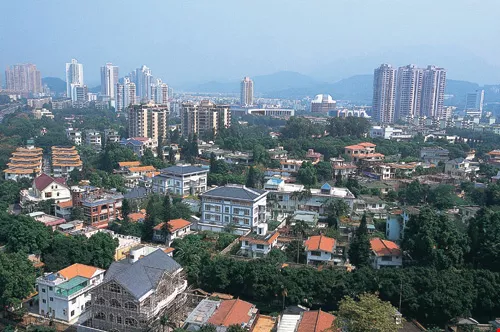
The establishment of the "three links" will bring Taiwan and China closer together as direct travel and exchanges increase our mutual understanding and trust. Already, Shenzhen looks no different than one of Taiwan's major cities.
"Cross-strait cooperation must begin by confronting reality," says Hsu Hsiao-po, executive director of the Epoch Foundation, taking the analysis a step further. Hsu points out that Taiwanese businesses are China's largest source of foreign investment. According to the International Investment Bank, Taiwanese businesses have invested a total of some US$300 billion in China (the figure likely includes reinvested profits), some six times more than the official PRC figure of less than US$50 billion.
"PRC officials underestimate the amount and influence of Taiwanese business investment in China," says Hsu, who argues that revealing how much Taiwanese businesses have invested and what they have invested in is a necessary first step towards designing future cross-strait cooperation mechanisms.
In particular, the mainland should acknowledge Taiwanese businesses' contributions to China and thank them for not pulling out their investments after the 1989 Tiananmen incident. Now that the appreciation of the RMB, tax reforms, and the implementation of a new law on labor contracts are presenting serious challenges to these businesses, the mainland should be offering them assistance and encouragement, not discarding them like used tissues and sitting idle while they relocate to Vietnam and elsewhere.
For Taiwan's part, it has to acknowledge that China's economy has taken flight and that the two have been well-matched rivals for some time. It cannot afford to maintain the superiority complex that makes it feel that Taiwan must lead.
The numbers back this up. China has averaged 9.9% annual GDP growth over the last 20 years, and now has the world's fourth-largest economy. It is also expected to overtake Germany as the world's largest exporter in 2009.
With foreign exchange reserves that exceeded US$1.6 trillion at the end of February, China has begun investing abroad. China's foreign investments have long exceeded Taiwan's, and in 2007 totalled US$18.7 billion, enough to rank it 13th in the world. Meanwhile, its major brands, including Haier and Lenovo, have demonstrated their global ambitions and strength by establishing factories and subsidiaries in the US, Italy, and elsewhere.

When vice president-elect Vincent Siew formally sought business and investment from China at the Boao Forum in mid-April, inviting China to participate in the new administration's proposed 12 major infrastructure projects, Chen Deming, China's minister of commerce, immediately expressed China's great willingness to bid for contracts, and promised to deliver "the world's lowest prices."
"China now has the desire and the ability to establish a global presence for its businesses through investment, seting up factories, acquisitions, and contracting," says economist and former National Taiwan University president Sun Chen. "Taiwan could be its destination of choice." Sun says that with the reopening of official cross-strait talks, and the elimination of political wariness, cross-strait trade will cease to be a "one-way transfusion" from Taiwan to China. For the last 30 years, people, money, technology and information have flowed out of Taiwan and not returned, but this situation could change virtually overnight.
Taiwan drew up guidelines for permitting mainland investment in Taiwan in 2004, calling for a phased implementation that would begin with the liberalization of investment in commercial real estate, non-securities financial services, transportation and ordinary manufacturing, but has postponed their implementation repeatedly. Beyond technical hurdles such as whether to tax mainland investors as domestic enterprises or as foreign ones, the larger issue is concern about the "shallowness" of Taiwan's economy. Specifically, the fear is that mainland capital might become annoyed during the course of a cross-strait standoff and flood Taiwan with capital.
"If mainland investment is permitted, there must be limits both on the amount and on the investment targets," says Lee-in Chen Chiu, a research fellow with CIER's Mainland China Division. Chen argues that national security concerns require that we "fortify" ourselves against mainland capital.
Speaking privately, academics are not optimistic about the prospects for mainland investment in the 12 infrastructure projects.
"BOT cooperation should involve firms from nations whose technology and management practices are more advanced than ours," says Chen. She notes that Chinese experts have called China's recent major infrastructure projects, such as Shanghai's Sino-German mag-lev train, "disasters" for their technological troubles, and that the projects have suffered from low utilization rates once completed. The quality of China's domestic construction is still unknown. If Taiwan were to roll the dice by becoming a testbed for mainland engineering exports, there's a good chance we'd end up picking up the pieces ourselves.
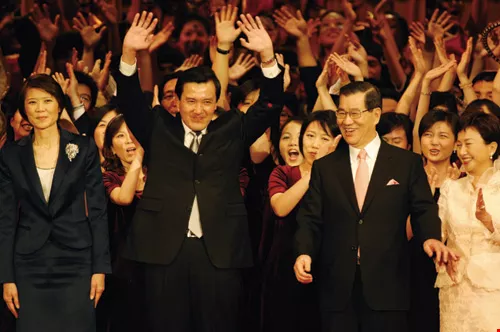
President Ma Ying-jeou and Vice President Vincent Siew took over the reins of government amidst acclamation and an air of expectation. With the economy in need of rescue, the have a great deal of hard work ahead. The photo shows their 20 May inauguration ceremony at the Taipei Arena.
If Taiwan were to liberalize mainland investment right now, the prime targets of the first wave would be commercial real estate, and leisure and tourism properties.
Cai Wei-min notes that though China has a lot of coastline, its only clean beach is at Sanya on Hainan Island. Taiwan, meanwhile, offers charming South Pacific island scenery, as well as dramatic alpine terrain. A number of mainland businesses are eager to help Taiwan rectify its severe lack of tourism facilities. In fact, a group of mainland business tycoons who visited in April gushed over Pingtung's Tapeng Bay and Kenting vacation spots.
Mainland tourists present another much-anticipated prospect for invigorating the Taiwanese economy.
The tourism industry can't be outsourced and almost always plays a crucial role in the transformation of an economy. Nearby Hong Kong offers a case in point.
Lawrence J. Lau, chancellor of the Chinese University of Hong Kong, says that two factors enabled Hong Kong to recover from 2003's SARS crisis: China's granting of numerous economic and trade benefits, and its liberalization of visits to Hong Kong by mainland citizens. Last year, nearly half of the 28 million visitors to Hong Kong were from China. Tourism has created enormous business opportunities, which, though they have increased the income gap, have also helped preserve the territory's prosperity.
Lin Chu-chia, a professor with National Chengchi University's economics department, says that if 3,000 mainland Chinese per day were permitted to visit Taiwan, it would mean about 1 million visitors per year. Based on average expenditures of NT$50,000 per visitor, these visits would be worth about NT$50 billion to the economy and create about 25,000 jobs. Given that, it's no wonder that the new government has made tourism a priority.
Opening doors internationally?With regional cooperation becoming the new order of the day, a new cross-strait relationship may not only bring new prosperity to Taiwan, but may also provide it with new access to the global stage.
"Right now, Europe, North America, and East Asia have divided the world into three spheres of influence," says Sun Chen. Europe has the European Union, which currently has 27 member states. North America has NAFTA, which includes the US, Canada, and Mexico. Sun argues that East Asia is rapidly integrating around ASEAN Plus Three-the ten nations of the Association of Southeast Asian Nations plus China, Japan, and South Korea. Chinese interference has so far kept Taiwan out of this body, but the thawing of cross-strait relations may offer Taiwan opportunities to join ASEAN and other international bodies.
"China is the only obstacle," says Lin, who is also part of Ma and Siew's braintrust. "Beginning with China, loosening up that resistance, is Taiwan's only way forward." Lin cites the free-trade agreement (FTA) that Taiwan and Singapore nearly signed in 2003 as an example of the problem. The agreement unraveled when Singapore, under pressure from China, requested that Taiwan sign as the territory of "Taiwan, Penghu, Kinmen, and Matsu." If Taiwan and China normalize cross-strait economic and trade relations, and Taiwan is able to sign an FTA with China, Taiwan will have no difficulty arranging agreements with other nations.
But Taiwan cannot wait for China to show goodwill. "There's a part of this we have to take care of ourselves," says CIER's Liu Meng-chun. "We have to first put forth some serious effort of our own." Liu suggests that Taiwan could first establish its own island-wide free-trade zone, then invite other nations to make use of it, unilaterally offering FTAs. This would create space for Taiwan to engage in international dialogue.
Reinvigorating businessTaiwanese businesses have been part of the soaring of the Taiwanese economy of the 70s and of the mainland economy of the 90s. Now they are facing a second crucial phase of transition and upgrading. If these firms are able to make effective use of local resources, this easing of tensions together with Taiwan's entry into international organizations could present them with unprecedented opportunities.
"Taiwan and China's current economic relationship is neither vibrant nor deep," says Liu Zhentao. "As a result, Taiwanese-invested enterprises have been developed and deployed in a manner both irrational and constrained, complicating Taiwanese businesses' efforts to shield themselves from risk." Liu notes that as of the end of 2007, nearly 90% of the 3,118 Taiwanese-invested enterprises in the Kunshan area of Jiangsu Province were solely owned. That is, there has so far been very little cross-strait business cooperation and very little joint investment. Taiwanese businesses have created closed supply systems in the mainland, regardless of whether their business model involves importing, processing, and reexporting, or clustering with other Taiwanese firms in the Yangtze River delta. In Liu's view, this shows that Taiwanese and Chinese firms have so far only mixed in a physical sense; they have yet to undergo the kind of chemical metamorphosis that would form a whole greater than the sum of its parts.
Liu Zhentao says that Taiwanese businesses get their core technologies from their Taiwanese parent companies, and tend to be unfamiliar with how to go about cooperating with mainland enterprises, or overlook the possibility of cooperation entirely. Hsu Sheng-hsiung, chairman of the China Productivity Center, says that China has the foundations for research and development work, as well as personnel and a market. Taiwan, on the other hand, can bring commercialization skills and highly efficient operations to the table. Their complementary competencies, together with future cross-strait scholarly exchanges on production management, could deepen cooperation across the board and bind the two sides more closely together, greatly benefiting Taiwanese firms.
"Taiwan's strength is in the private sector, not the government," says Chen Tain-jy, the new head of the Council for Economic Planning and Development. "But if the government doesn't play its own role well, the private sector will lose its vigor." Chen argues that Taiwanese firms must develop their brands and move into services if they are to succeed in an era of more open cross-strait economic and trade relations.
Acer founder Stan Shih believes that the cooperative-competitive relationship across the strait will intensify in the future. "We need to consider whether we want to be an integrator of resources, or a resource to be integrated," says Shih. If Taiwan is to remain on top, it must take the initiative and work constantly to increase its own value.
One little tigerWith trade and economic liberalization at the heart of the new government's policies, there will be endless reminders to "act deliberately" and to "cool things off."
"Cross-strait liberalization is no panacea," says Christina Liu. "Taiwan can't let wishful thinking or the desire to 'move things along' compel it to rush." Liu Meng-chun similarly argues that invigorating Taiwan's economy will require a major overhaul of financial and industrial policy, and of the tax code, in addition to the elimination of barriers to cross-strait trade.
Equality, mutual benefit, and shared prosperity are the new watchwords of cross-strait economic and trade relations. The new thinking instantly transforms the tumultuous relationship and disputes over cooperative competition. "When you're faced with an opponent you can't out-compete," says Sun Chen, "your best bet is to ally with him." Echoing KMT honorary chairman Lien Chan, Sun asks, "What's wrong with the two sides of the strait joining forces to make money from the world?"
Schive Chi, on the other hand, describes the post-liberalization situation as consisting of "one little tiger, and one awakened lion."
"During the Asian Financial Crisis of 1997," recalls Schive, "only China and Taiwan remained unbowed." Schive optimistically believes that once the floodgates are opened, both the little tiger and the wakeful lion will be able to successfully weather the current global economic downturn.
@List.jpg?w=522&h=410&mode=crop&format=webp&quality=80)

@List.jpg?w=522&h=410&mode=crop&format=webp&quality=80)
@List.jpg?w=522&h=410&mode=crop&format=webp&quality=80)


