Waving the Baton of Confidence: Bukut Tasvaluan's Vox Nativa
Teng Sue-feng / photos Hsueh Chi-kuang / tr. by Jonathan Barnard
September 2010


Who is Bukut Tasvaluan?
If you've visited the Taiwan Pavilion at Expo 2010 in Shanghai, or if you've seen a certain bank commercial, or if you remember that performance by a group of young Bunun dressed in traditional red, black and white at the 2009 Golden Melody Awards, or if you've made an Internet search for the Chinese characters for "Sing It!" and watched the two-minute video that tops the results, then you've seen this tan, silver-haired middle-aged man with a striking profile, whose face and gestures show great animation as he movingly conducts Bunun children in singing "Kipahpah Ima" ("The Clapping Song").
For 15 years Bukut has served as the principal of elementary schools in the tribal villages of Xinyi Township, and he has won numerous awards for his choirs. He firmly believes that teaching these Bunun kids to sing and getting them to keep practicing "will change the cycle of poverty that afflicts Aboriginal communities." Why does he attribute such miraculous power to choral practice?
"For these several days, without your parents or grandparents to take care of you, you'll have to get up on time, eat, help serve the food and clear the table, and then spend all day at school. This will help you to become independent. Otherwise, when you leave the tribal village one day, you won't be able to adapt. If you get through these seven days, you will have grown up, and you will have become more capable." Bukut Tasvaluan, principal of the Luona Elementary School, which is known for its prize-winning chorus, is addressing students at the library of the Dongpu Primary School in Xinyi Township, which is the Aboriginal elementary school closest to Yushan (Mt. Jade). Bukut is also conductor of the choir at the Vox Nativa Music School, which has been established for two years.
During the second week in July, Vox Nativa's students, who live in 11 different tribal villages and attend 17 different elementary schools, gathered at the Dongpu Primary School to attend a music camp. Aside from practicing singing, the campers also take English, science and math classes taught by students and teachers from Taipei's Jianguo Senior High School.
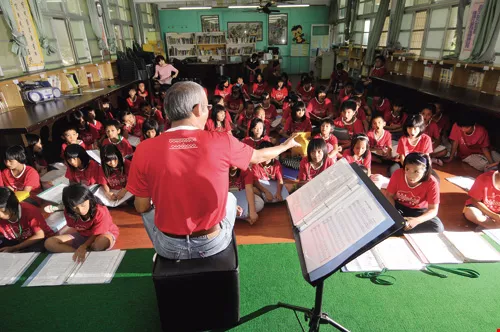
The Dongpu Primary School's library serves as a practice hall for the Vox Nativa choir. While the children sit on the floor, the animated, silver-haired Bukut Tasvaluan offers singing instruction, going over the song they are rehearsing phrase by phrase.
Why is Bukut giving them this pep talk before the start of choir practice?
It's because the previous evening, a fifth-grade girl had come to him in tears, saying she wanted to go home. "If you forsake this opportunity, you won't have another like it. Think about it more for yourself," Bukut had said, hoping to calm the girl down. "If you really want to go home, I'll call your mother."
Knowing that choir practice is hard work and worrying that feelings of homesickness would spread to other children, he hoped to nip the threat in the bud with the pep talk. After summer vacation ends, these students will have to come in for practice on weekends. Turning Saturdays and Sundays into schooldays is quite a test of will for these mountain children.
Transportation is convenient down in the lowlands, and schools are numerous there. But Xinyi Township is Taiwan's second largest in area (1,422 square kilometers) with elevations that range from 900 meters upward. The roads are rugged and winding, and settlements are widely spaced. And Vox Nativa is a magnet school that draws students from across district lines. On weekends during the school year three buses take children to the school to practice singing from within a 65-kilometer radius (settlements such as Tannan and Dili Village fall beyond the one-and-a-half hour bus-ride limit). During summer and winter vacation, when other children are playing ball, riding their bikes or watching television, they've still got to get up early to go to school. Bukut keeps a close watch to see if the children's commitment or determination begins to waver.
Establishing this school, which offers instruction in singing as well as supplemental academic classes, represents a dream of Bukut's that took 12 years to realize.
"Choral singing is the most effective way for Aborigines to build confidence, leave the tribal village, and have contact with the outside world," he says. Without choirs, Bunun children would never be invited to Rotary Club functions, the National Concert Hall, and National Taiwan University Stadium to perform-let alone leave the country to travel to Hong Kong, Thailand and the Expo 2010 in Shanghai. It offers the children an entree to the big wide world.
But why choral singing instead of athletics (which is what most Taiwanese regard as Aborigines' strong suit)?
"In athletics competitions, victory and defeat are clearly delineated, so there is a lot of pressure. Although there may be competitive aspects to choral singing, it's also a kind of performance. Whether they sing well or not, they will be applauded, and applauded children grow up with confidence," Bukut says. The relatively small stature of most Bunun, moreover, puts them at a disadvantage for many athletic events. But children in the mountains have a good sense of rhythm and strong lungs. And the Bunun are the only tribe in Taiwan that doesn't dance but only sings during its traditional ceremonies. In Bunun singing, which is famous for its eight-part harmonies, harmony is emphasized over melody. That makes it particularly well suited to choirs.
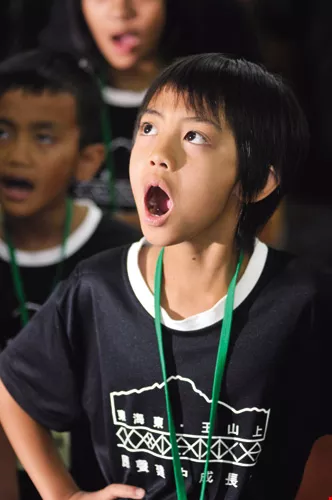
Bunun children tend to be shy, and during practice Bukut has to remind them to smile. Singers can only create a full sound when they open their mouths wide.
"Finding confidence through applause" is something Bukut has experienced for himself.
Bukut, who is 52, studied physical education at Taichung Teachers College (now National Taichung University), where he specialized in tchoukball and volleyball. He has become something of a legend for winning prizes with his choirs, despite being unable to play the piano and making frequent mistakes when reading scores.
Before he went to college, Bukut had never formally studied music. In the first music class at college, no matter how hard the instructor tried to explain middle C, Bukut couldn't understand. "I kept trying to understand, but the only 'middle' I could think of was the 'middle' used in the Chinese expression for Taiwan's 'Central Mountain Range.' I just couldn't find middle C." Much to Bukut's chagrin, when the teacher called for a student to come up and point out middle C on the piano, he picked Bukut. Bukut was clueless.
"I've spent a whole segment of class on this," scolded the teacher. "Haven't you been listening?"
Feeling frustrated and hurt, Bukut thenceforth refused to have anything to do with music at college. But when he performed his military service-that period that most men regard as an insult to their dignity-Bukut came to a turning point in his life.
Bukut was performing his military service in Kinmen. One day several women officers came to teach them how to sing some military songs, and one of the officers of Bukut's unit decided to pick a student to lead the group in singing. Many who had majored in music raised their hands, but most of them had majored in an instrument and didn't have voices suited to the powerful, majestic singing of military songs. Much to his surprise, Bukut was selected. In alarm, he replied to the officer, "I can't sing." But the officer barked: "You graduated from a teachers college. There's nothing you shouldn't be able to do!"
Bracing himself for combat, Bukut led the soldiers in belting out the song. When they finished, Bukut's commanding officer applauded vigorously. And from that point forward, Bukut had another duty-to go by jeep to various military bases to teach recruits how to sing military songs. He often won prizes for it.
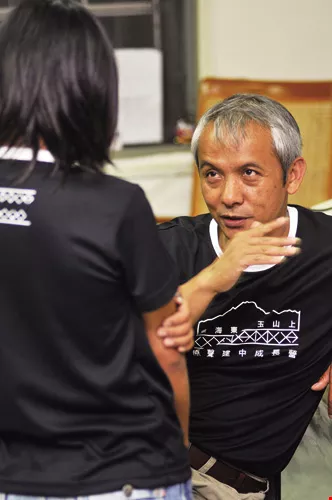
For a week-long summer camp, children stay at hot springs hotels near the school. One child began to feel homesick by the third day, and came to Bukut in tears. He did his best to comfort her.
The unforeseen and surprising circumstances that resulted in him teaching singing while serving in the military led him to "find himself." During his childhood, he had heard tribal elders singing drinking songs and ceremonial millet harvest songs. Bukut was well aware that the eight-part harmonies of Bunun singing had a cross-cultural appeal and a power to move people, so he reasoned that one method of changing the fate of his tribal people was to allow children to find confidence through song.
Bukut returned to his hometown to teach at Jiumei Elementary School, and in 1993 he began to conduct students in choral singing. Back then, the Taiwan Provincial Orchestra was promoting a plan to "bring music to the countryside," and they had selected three elementary schools each in the mountainous Xinyi and Ren'ai townships for instruction in recorders, percussion and choral singing. His school of Jiumei was selected as a demonstration school for singing.
Guo Yuezu, a music teacher from Taipei, would regularly come to Jiumei Elementary on Wednesdays to teach singing. Bukut observed and learned. She enlightened him about how to lead a choir.
After the demonstration period ended, Bukut began to conduct the choir himself. He used the simplest method to teach the children Bunun folksongs: He sang a line, and then they sang it after him. Copying his pronunciation and the shape of his mouth, they learned songs phrase by phrase.
In 1995, Bukut brought students to participate in the Nantou County choral competition for the first time. After drawing a number to determine when they would sing, they sat backstage. It was the first time that they had heard students from other townships, and some of them were using technically advanced embellishments. It scared the students, and they said: "Teacher, we don't want to sing!" "The way we sing is wrong, and the way they sing is right."
Bukut exhorted the children to get up on stage: "Don't worry about other people, just get up there and sing!" The children ended up belting out their songs, and won first prize.
From Jiumei, he went on to work at the Xinxiang, Dongpu, and Luona elementary schools, and at each he would establish a new choir that would end up winning first places in various competitions, including top prizes at national folk song competitions and national competitions for elementary school choirs.
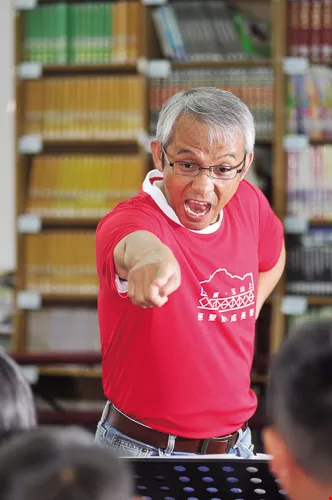
The Dongpu Primary School's library serves as a practice hall for the Vox Nativa choir. While the children sit on the floor, the animated, silver-haired Bukut Tasvaluan offers singing instruction, going over the song they are rehearsing phrase by phrase.
In 2005 he led Xinxiang Elementary School to Hong Kong to participate in the World Children's Choir Festival, and an audience of 2000 applauded vigorously after they concluded their performance. Amazed, a mainlander asked, "What kind of training did the children have?" And he replied: "It wasn't training; it was education."
The mainlander countered, "But how did you select the children?" And Bukut replied: "The whole school only has 70 students, so all the fifth- and sixth-graders were on stage."
Many believe that Aboriginal children have a gift for singing, and that it's only natural that they should get first prizes. But Bukut disagrees vehemently and argues that such notions belittle the children's hard work.
Bukut says that although Aboriginal children may have a good sense of rhythm and strong lungs, they have no advantages when it comes to tone, timbre or accuracy of pitch-and may even be at a disadvantage.
Because there are fewer teaching resources in remote areas and fewer students, children have virtually no opportunity to acquire a basic foundation in music, let alone learn how to read music, so they start at zero. For his choirs, he never holds tryouts or cuts children-all with interest can join. And because he doesn't select children, he describes how much hard work it takes to transform some of them from off-key "lost driftwood" into "pillars in midstream."
Even more difficult is that Aborigines have a much different way of vocalizing and talking than Han Chinese. In particular, the Bunun tend to create sounds lower in the larynx and tend to drop their voices at the end of every phrase. As a result, their soft palates don't open, making the quality of their voices particularly throaty. "The sound that they sing is broad, but not concentrated, so that their voices don't carry."
Bukut has to demonstrate one sound at a time, getting the children to recognize the difference between throat and head-voice resonance and then slowly bringing children from the former to the latter.
What's more, the Bunun language lacks aspiration and retroflexion, as well as the "u" sound, and these missing sounds pose difficulties for Bunun children when singing Mandarin songs. At first, they always sing with a heavy accent. Bukut has to put on a Mandarin teacher's hat, analyzing phonetic marks and structures, and making lip shapes for children to mimic. Often he has to spend a full period providing instruction on how to make a single sound.
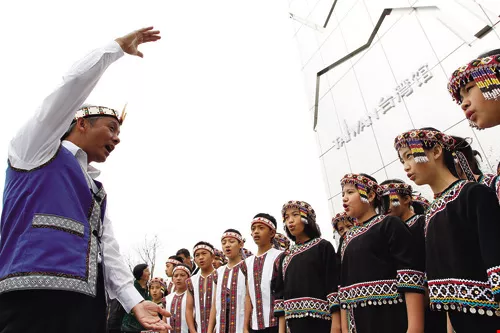
The Vox Nativa choir from Xinyi Township in Nantou County was founded by Bukut Tasvaluan, principal of the Luona Elementary School. The chorus has gone to Thailand, Hong Kong and mainland China, bringing the "Mt. Jade sound" to the world. (left:) The choir performs at the Taiwan Pavilion during Expo 2010 in Shanghai. (courtesy of the Vox Nativa Association) (right:) The choir gathers during summer vacation at the Dongpu Primary School.
During choir practice, Bukut often spreads his thumb and forefinger to create a Y, which he holds under his chin to remind the bashful Bunun children to keep smiling. "Open the mouth and bring strength to the abdomen." He also playfully scrunches his eyes to get the children to laugh.
"You've got to push the sound out slowly. You don't want to just dump it out. If you push it out too quickly, you won't have enough breath, and the sound will dissipate. Singing should flow like a river."
He is also good at using analogies to get children to understand how to sing gracefully. For instance, he will ask: "When the voice falls, what will it get eaten by?" And the children will respond: "Sharks!" He'll follow up by asking, "When the voice rises, where does it go?" "To Heaven!" the students reply.
Once, a professor who was researching Aboriginal music got into an argument with Bukut about how he doesn't teach his charges to read music from Western-style staff notation.
"Why must children be able to read staff notation? The more you read staff notation, the more difficult it becomes," Bukut said. "I'm not trying to train Aboriginal children to become musicians. I just want them to be happy when they sing!" Consequently, he gives the children sheet music using simpler numerical notation, so that they don't have to expend energy "counting beansprouts."
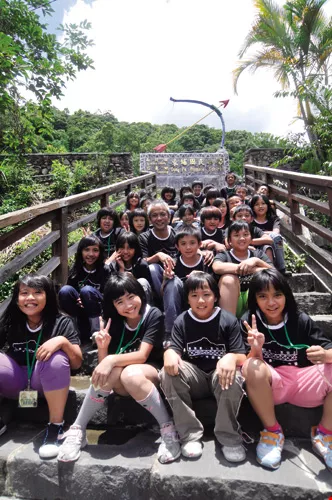
The Vox Nativa choir from Xinyi Township in Nantou County was founded by Bukut Tasvaluan, principal of the Luona Elementary School. The chorus has gone to Thailand, Hong Kong and mainland China, bringing the "Mt. Jade sound" to the world. (left:) The choir performs at the Taiwan Pavilion during Expo 2010 in Shanghai. (courtesy of the Vox Nativa Association) (right:) The choir gathers during summer vacation at the Dongpu Primary School.
Bukut has won numerous prizes, including for "best choir," but he emphasizes that "singing is secondary-the goal is education."
He doesn't use tryouts to eliminate students, and he doesn't make demands in terms of vocal timbre, but there are two requirements that choir members have to abide by: first, they must finish their homework on time; second, they must arrive on time for practice.
"I have a dream: I want to foster upward mobility among Aborigines, and I need more of a tribal elite here to do that," Bukut says. "When you add another PhD to a city, it's just a drop in a bucket-no big deal. But when a tribal village gets someone who is highly educated, it can change the whole atmosphere."
When Bukut waves his magic wand of confidence, quite a few children see their potential horizons broaden.
In the six years that Bukut has been at Jiumei, four students from the school have tested into prestigious National Taichung First Senior High School (and three of them would have been admitted without the bonus points awarded to Aborigines). Three have ended up at National Taiwan University (one of these is Bukut's son, currently a senior in NTU's Department of Computer Science and Information Engineering). For a school with only 13 graduates in a typical year, those are impressive accomplishments. And one year, among the 20-some students who graduated from the choir, five girls went on to attend the Department of Nursing at Chang Gung Institute of Technology, which offers free tuition to Aboriginal students.
Gratified, Bukut says, "Using singing to build confidence is no longer just a theory."
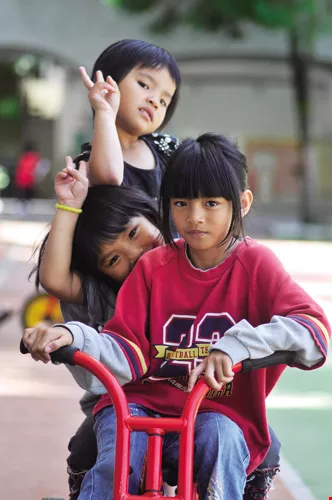
Dongpu Primary is a typical Aboriginal elementary school. Its entire student body consists of only 70-some children. Those who live in the village often come to ride their bicycles around the track oval.
He used to explain repeatedly his dream of an Aboriginal music school to people he would meet, but for more than a decade no one understood. It wasn't until he met Liao Dashan, who had retired from teaching biology at Taipei's Jianguo Senior High School, that he was able to realize his dream (see "From an Elite Taipei High School to Cultivating the Bunun Tribal Elite," p. 108).
In May 2008, the Vox Nativa Music School held meetings in several tribal villages in Xinyi Township to recruit students, but the parents who attended didn't leap at the opportunity. Only a dozen or so showed any interest. Many didn't understand what the point of the school was. But its good reputation would spread by word of mouth, and in January of this year, parents packed the small assembly hall at Luona Elementary School.
"The support of parents provides the greatest assistance to the school," says Bukut. He often cites his own mother as an example, telling parents not to be reluctant about prodding their children to work hard.
When Bukut was six, his father passed away. The family was very poor, and from a young age he worked with his mother. Beginning in fifth grade, he had to wake up every morning at three and go up to the mountains to pick two bags of corn before he could go to school. Once, when he was weeding, his mother asked Bukut: Are you tired? Without awaiting his response, his mother pointed at some elementary school teachers: "Look! If you become a teacher, you don't have to work out in the sun and get bitten by leeches." From his mother's words, Bukut constructed a dream.
Bukut's home village of Jiumei early on produced quite a few elementary school teachers, and they have served as role models. Parents began to emphasize education. Currently, Xinyi Township has produced six Aboriginal principals-four from the village of Jiumei alone. Two from Jiumei have also gone on to lead county or city indigenous peoples' bureaus.

Having spent their entire lives up in the mountains, Bunun children have strong lungs and a good sense of rhythm. And singing is one of the strong suits of Bunun culture. So long as their talents are cultivated, each of these children can turn into a polished vocal treasure. The photos show children enjoying the school's playground after class has let out. (photos by Lan Chun-hsiao)
Bukut's eldest son Tiang had no choice when he was young: He was forced to join the choir. Tiang remembers that people used to harbor suspicions about his father: "He's getting money from the children's performances!" or "The choir is all about satisfying his own yearnings for success!" A lot of people back then, Tiang recalls, didn't understand "Papa's dream"!
A graduate of National Taichung University, Tiang is now preparing to take the national civil service exams. He recalls an elementary-school reunion he attended. Everyone was remembering what hard work the choir was, but they all sounded nostalgic and grateful for the experience. He asked: "Didn't you all hate choir practice more than anything?"
"It turned out," he recalls, "that everyone savored their memories of the ovations, and were grateful for the opportunity to see the world outside the tribal village."
"Education provides the greatest opportunity for changing the fate of Taiwan's Aborigines," Bukut says. So long as there is change, there is hope.
If one Bukut can cultivate 10 others like him, then those 10 can cultivate 100 more. And the whole dream starts with: "Sing it!"
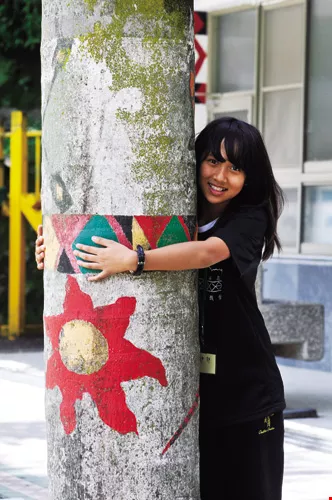
Having spent their entire lives up in the mountains, Bunun children have strong lungs and a good sense of rhythm. And singing is one of the strong suits of Bunun culture. So long as their talents are cultivated, each of these children can turn into a polished vocal treasure. The photos show children enjoying the school's playground after class has let out.
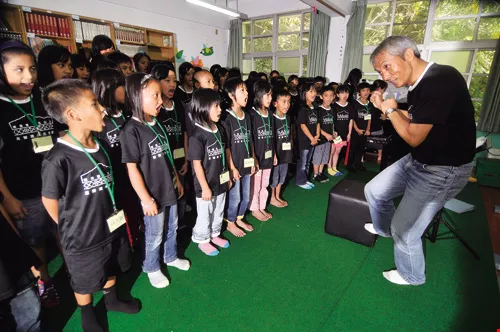
With the shorter children lined up in the front and the taller ones in the back, the small library quickly fills up. Vox Nativa currently includes more than 90 students.

@List.jpg?w=522&h=410&mode=crop&format=webp&quality=80)

@List.jpg?w=522&h=410&mode=crop&format=webp&quality=80)

@List.jpg?w=522&h=410&mode=crop&format=webp&quality=80)
@List.jpg?w=522&h=410&mode=crop&format=webp&quality=80)

