A Match Made in Heaven? Yue Lao Helps to Tie the Knot
Chen Hsin-yi / photos Chuang Kung-ju / tr. by Scott Williams
August 2012


With the rapid approach of the seventh day of the seventh lunar month, better known as Chinese Valentine’s Day, couples will soon be sharing romantic candlelit dinners, while singles explore countless other entertainment options. And everyone, partnered or not, can go to the temple to pray to Yue Lao, the marriage god, for a good spouse or long-lasting relationship.
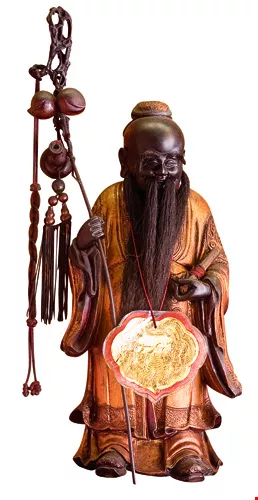
A smiling, bearded figure, Yue Lao is typically represented with a staff in his right hand, a marital register in his left, and red thread draped over his arms. Transformations in the god’s image since his origins in a thousand-year-old legend suggest that love has become the modern era’s ultimate belief.
Ms. Cai, a 29-year-old woman from Tainan, has been visiting the city’s Grand Matsu Temple since she was a little girl. Today, she’s here with her mother.
Skipping past the Yue Lao shrine at the rear of the temple, Cai casually tells her mother, “Work is more important than love. I want to make an offering for my career.”
Later, having made the rounds of the temple’s other shrines, Cai returns to the Yue Lao altar. Casting the wooden divination blocks, she trepidatiously asks whether she might inquire into her marriage prospects today.
On receiving a noncommittal “laughing” response three times in a row, she can’t help but laugh herself: “Yue Lao is laughing at me, probably because I’ve bugged him about this so many times already....” In a way, Cai’s return to the shrine echoes society’s ambivalence towards love: we all want it, but are afraid of getting hurt.
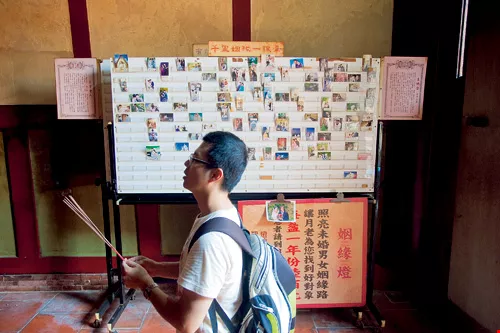
Handwritten appeals hang all over a wall of the shrine area, voicing adherents’ longing for love. “Yue Lao, if your follower Wang X isn’t fated to be with Liao Y of Qishan District, Kaohsiung City, please break it off and help me find someone else.” “Please help me find a spouse who is at least 177 centimeters tall, responsible, cultured, tolerant, capable, upbeat, mature, sunny, good to family and children, slim, and someone I can learn with.”
Even the most talented and efficient matchmaker is going to have problems meeting such a tremendous variety of requests. Does Yue Lao really have the capability to satisfy the demands of the masses? What does the legend say?
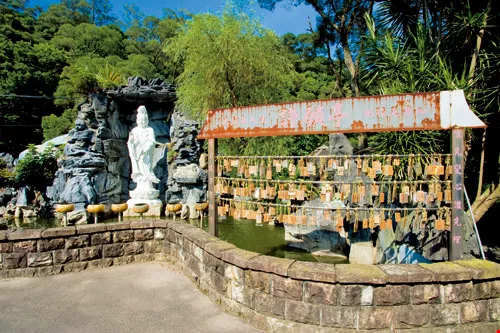
The wish pavilion at Beitou’s Zhaoming Temple is filled with secret infatuations.
Yue Lao’s legend dates back to the Tang-Dynasty story “The Marriage Tavern.” A scholar named Wei Gu meets an old man in a tavern. Watching him thumb through a barely legible text by moonlight, Wei realizes he’s the netherworld official who binds together couples listed in the registry of those predestined to marry.
When the curious Wei asks who he is destined to marry, the old man replies that he will marry the three-year-old daughter of a blind vegetable seller in the market. Upset by the news, Wei orders a servant to kill the little girl. She survives the attempt and is adopted by a provincial governor, who marries her to Wei Gu some 14 years later. After his marriage, Wei discovers that the flower petals his wife sticks to her forehead hide a scar from a knife wound received as a child, and realizes that Yue Lao’s prophecy was accurate.
Professor Lin Mao-hsien of the Department of Taiwanese Languages and Literature at National Taichung University of Education, an expert on folk religion, says that very few temples made offerings to Yue Lao prior to the 1980s. In the old days, marriages were arranged by matchmakers, and people sought partners from their own socioeconomic background. On the rare occasions that they turned to the gods for help, parents usually prayed to female figures such as Mazu, Guanyin, and Qi Xing Niang Niang. “Any woman who went looking for a spouse on her own behalf would have been mocked as being desperate to find a husband.”
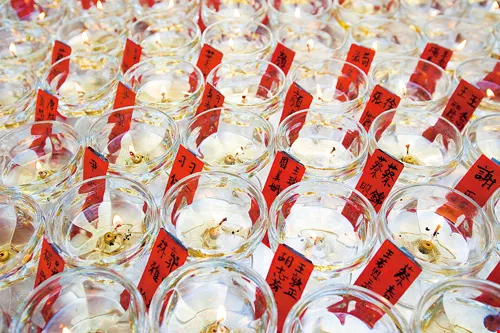
To better serve adherents, many temples around Taiwan are adding “marriage lights” to the “prosperity,” “peace,” and other lights with which they are traditionally adorned.
The social climate has changed since the 1980s. With young people yearning to choose their own partners, offerings at Yue Lao’s altars increased. Nowadays, prayers to Yue Lao are commonplace, whether offered up by the whole family, friends and relatives in the same boat, in company with a sweetheart, or even alone. And because people marry later nowadays, when they do go looking for a partner, they don’t dawdle.
In 2009’s Making a Date with Good Fortune, folklorist Miaoqing mentions visiting over 30 Yue Lao shrines around Taiwan, most of which had been established in the previous 20 to 30 years. For example, the Wan’an Temple in Shamei, Kinmen, added its small Yue Lao shrine—now permeated with the prayers of countless soldiers begging not to be “Dear Johned”—in 2007.
Currently, the most popular Yue Lao shrine in northern Taiwan is the one in Taipei’s Xiahai City God Temple. As protector of the city, the City God has always had a full retinue of assistants. The fact that Yue Lao didn’t join their ranks until 1971 suggests that matchmaking didn’t use to require divine help.
Titan Wu, the temple’s marketing director, observes that the number of people praying to Yue Lao has been growing over the years, with word-of-mouth and media reports both encouraging the practice. He adds that the modern tendency to prioritize education and career results in marriages being delayed until almost the last minute. People hoping to marry quickly often seek out divine assistance.
Successful supplicants typically send the temple a box of wedding cookies as a thank you. Based on the cookies it has received, the temple estimates that the number of couples Yue Lao has helped “tie the knot” has soared from 310 in 2000, to 3,177 in 2003, to 7,871—an average 21 boxes of wedding cookies per day—in 2011, as wedding fever took hold during the ROC’s centennial.
“When couples get engaged, many are surprised to discover that both people had made offerings at the temple prior to meeting,” says Wu. “Such couples’ thank-you gifts are especially full of feeling.”
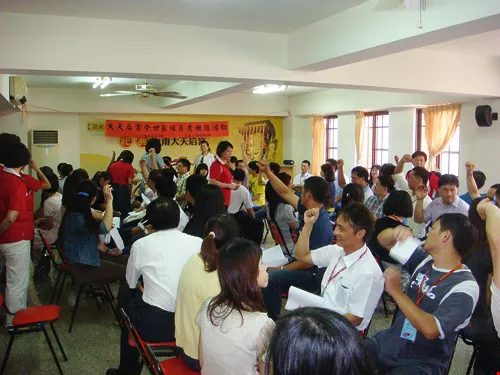
Tainan’s Grand Matsu Temple has created a Yue Lao hotline and arranged mixers for singles to encourage people to take charge of their love lives.
Reacting to the complexity of contemporary romance, many temples have developed more diversified and people-centric “Yue Lao services.”
Yu Zhimin, secretary of Tainan’s Martial Temple, has been manning the temple’s service desk for over four years, clearing up the confusions of men and women of all stripes. Drawing on his own experience, he says that in recent years the number of people seeking marital assistance has risen to roughly 46% of temple visitors, and the male-female breakdown is roughly 30:70. People looking for better health account for a further 30% of visitors. The remainder are largely seeking familial harmony or career help.
The temple bulletin board clearly delineates Yue Lao’s responsibilities: “interpersonal relations, marriage, ‘peach-blossom public relations,’ reunions, keeping relationships alive, and ‘plucking spoiled peach blossoms.’” His altar is practically a convenience store for relationship consulting.
Yu explains that “peach-blossom public relations” refers to short-term “marriages” intended to address professional needs. “For example, a bar girl hoping to bring in more customers, or a male seller of perfumes seeking to impress women and make them into repeat customers. As long as no one’s getting hurt, short-term flings are permitted.”
“Plucking spoiled peach blossoms” is another service that reflects contemporary sentiments. “The Martial Temple primarily honors Guan Yu, who is benevolent, righteous, courteous, wise, and honest. He is therefore very intolerant of dishonesty and inappropriate behavior towards a spouse. When necessary, he gives offenders three raps with his staff.”
But people can’t rely exclusively on the gods; they must also help themselves. “When you make your case to Yue Lao, you have to change your own behavior as well,” says Yu. Upright, outspoken, and in his own words, “obedient to the will of Heaven,” Yu says that when he deals with a wife complaining about a husband deviating from the straight and narrow, he sometimes has to give her a rap on the knuckles: “You are rude and arrogant, and dress in a slovenly fashion. Half the blame is yours!”
He also ran into a heartbroken young woman sobbing to Yue Lao that her boyfriend had had a change of heart. He reminded her: “Your fortune says you will have three relationships. This one was just a passing thing. Be strong and let go. The experience will help you mature, and you’ll meet the right person eventually.”
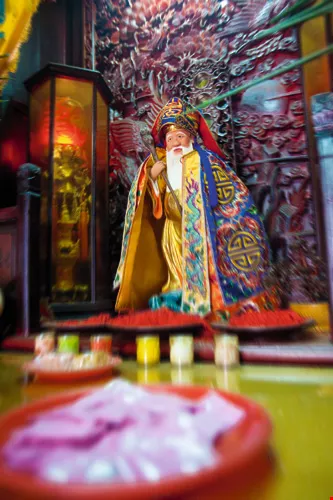
Tainan’s Martial Temple gave Yue Lao his septennial bath early this year, whitening a face and beard blackened by constant exposure to incense smoke. The bath also gave the god a more affable look, making him appear to smile upon the desires of mortals.
But not every temple is so good at clearing up visitors’ confusions. Given that delivering true one-on-one service is nearly impossible, many temples have developed standardized procedures for making offerings to Yue Lao. In some cases, this has meant innovating within the context of tradition. In others, the standardized procedures have grown out of interactions with adherents or the culture of the neighborhood.
Tainan’s Grand Matsu Temple is a case in point. Workers at the service desk walk first-time visitors through the process. They should first buy an offering or ghost money, and pick up the appropriate wish form (depending on whether they have a particular person in mind). Next, they should pray to Mazu, the senior god at the temple, before approaching Yue Lao. Finally, they should take a red marriage thread, but only if the divination blocks have given a positive response.
Unlike other temples, which exhort adherents to keep their red thread close to their person or under their pillow, the Grand Matsu Temple recommends keeping it in a pocket. “Yue Lao will take it from you at some point. Its disappearance indicates that he’s begun working on your case,” explains a volunteer.
The temple has taken other measures on young people’s behalf. Five years ago it established a space to hang wishes, and a display for small photos of couples in their wedding outfits. Three years ago it introduced a free “Yue Lao hotline,” albeit with stringent registration criteria. Registrants must be unmarried, show their ID, offer evidence of their academic credentials, and provide a photo.
Over the last three years, more than 500 people have registered with the hotline, divided roughly 60:40 between men and women. Volunteers play matchmaker to compatible registered couples. The temple’s annual mixer has also had some success, resulting in about 20 happy marriages.
Tainan’s Chongqing Temple is organizing its first group Yue Lao offering for this year’s Chinese Valentine’s Day. The idea originated with Li Guanyu, a young temple adherent and member of the Tainan Local Culture Studio.
Li got involved with the temple at the beginning of the year while working as a tour guide. He liked the affable look of Chongqing Temple’s Yue Lao, and put together the event to help raise the temple’s profile and to promote the neighborhood watch tradition. He will be thrilled if it also results in some weddings.
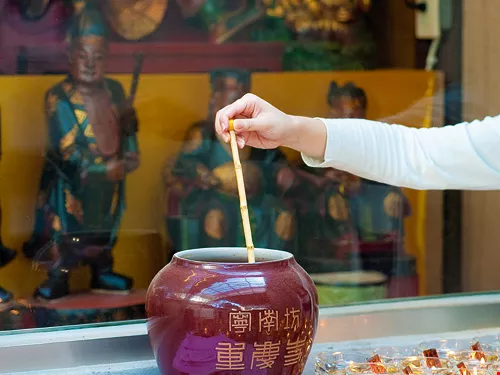
The Yue Lao of Tainan’s Chongqing Temple is assisted by the very efficient Subao Si (first from left in the display). The vinegar jar in front of Subao Si is even more amazing: legend says that those who stir it make their lover’s heart ache, causing him or her to treasure their relationship.
Taipei’s Xiahai City God Temple keeps the endless stream of visitors to the Yue Lao shrine flowing smoothly with a posted set of instructions. First-time visitors are recommended to buy three offerings: red thread, granulated sugar (to help Yue Lao sweet-talk the object of your affections into marrying you), and lead coins (the word for which is a homophone for “fated relationship” in Taiwanese). Visitors pray first to the Jade Emperor, then the City God, then Yue Lao. When praying, they silently recite their name, address, and other personal details, and describe the kind of person they hope to meet. Finally, they are instructed to keep and protect their red thread, but leave the sugar. They also enjoy “peace tea” provided by the temple.
On their second visit, those who have yet to find a spouse can buy offerings of jujubes, signifying quickly finding a partner, or goji berries, signifying taking care of oneself, on Dihua Street. Those who have found a significant other are supposed to bring flowers to represent an early blossoming and fruitfulness.
Temple director Chen Wenwen says: “Making an offering to Yue Lao is really only about increasing your confidence. If you are to find a good spouse, you still must take action on your own behalf. It also helps to be accommodating and self-aware.”
The temple also encourages those who come to see Yue Lao to turn their visit into an invigorating outing by using one of temple’s guidebooks to explore the history and culture of Dadaocheng, or by strolling or cycling around the wharf area.
The City God Temple isn’t the only institution jumping on the Yue Lao bandwagon. In Tainan, where religious sentiment runs deep, the city is using Yue Lao to expand the definition of “love.” The city’s Cultural Affairs Bureau established a Tainan Chinese Valentine’s Day Carnival last year, and invited a dozen-odd area temples with Yue Lao shrines to participate. The event, which included guided tours, art installations, and a block party, urged citizens to redefine and share “love.”
“Love can be an indicator of people’s feelings of attachment to or rootedness in a city, as well as an expression of self-confidence or self-love,” says Huang Hung-wen, chief of the CAB’s Arts Administration Division.
Yue Lao’s rising popularity in this age of high rates of singledom and divorce suggests that people are more passionate than ever about finding true love and are having a more difficult time doing so. In the process of carrying out this dialogue with traditional beliefs, many are discovering anew the beauty to be found in loving oneself and others.
Whether in the guise of the West’s naughty cherub or Taiwan’s wise old man, the gods of love represent the timeless desire for love.
Yue Lao (left) in his shrine at Taipei’s Xiahai City God Temple has been responsible for more than 50,000 marriages over the last 12 years, making him the busiest matchmaker in Taiwan. (right) After making an offering and obtaining a red marriage thread, worshippers are instructed to hold the thread between their fingertips and pass it in a circle over the incense burner three times to ensure the god’s help.

@List.jpg?w=522&h=410&mode=crop&format=webp&quality=80)

@List.jpg?w=522&h=410&mode=crop&format=webp&quality=80)

@List.jpg?w=522&h=410&mode=crop&format=webp&quality=80)
@List.jpg?w=522&h=410&mode=crop&format=webp&quality=80)

