Transplanted from Taiwan-Yam Culture Catches on in the PRC
Tsai Wen-ting / photos Pu Hua-chih / tr. by David Mayer
January 2002


The year 2001 has been a very good one for mainland China. Memories are still fresh in mind of the huge crowds that surged into Tiananmen Square to celebrate the awarding of the 2008 Olympics to Beijing, and now China has at long last won admission to the World Trade Organization (WTO). But PRC authorities have already announced that even after their admission to the WTO, they will not let non-PRC citizens engage in cultural enterprises such as publishing and related industries. Nevertheless, Taiwanese culture is already starting to hit the shores of mainland China.
A Taiwanese visitor to mainland China can't help but notice familiar things from home all over the place. Walking down the street, you hear pop singers Ah-Mei, Chyi Chin, and Richie Jen playing on the radio. Shops sell pearl milk tea, Yungho soybean milk, and Taiwan-style beef noodles. Li Li-chun, Grace Yu, and lots of other actors from Taiwan appear regularly on television.
Taiwan's influence is not limited to pop culture, either. In a list of the 100 best-selling literary works of 1999, compiled by a leading publishing industry magazine, 20 were written by Taiwan-based author Liu Yung, whose works claimed seven of the top ten spots. Not surprisingly, Liu was proclaimed a "super best-selling author" in mainland China. When a group of several dozen mainland Chinese media organizations voted on the ten top cultural figures for 2001, "Slicker" Tsai (Tsai Chih-heng), a wildly popular young Internet author from Taiwan, was ranked second. His work has touched off a wave of interest in online literature on the mainland. In addition to perennial leading lights Chiung Yao, San Mao, Bo Yang, Li Ao, Hsi Mu-jung, and Lung Ying-tai, the best-seller lists in mainland China also frequently carry the names of newer arrivals like Chang Man-chuan, Lin Ching-hsuan, Hsi Chuan, Chu Teh-yung, and Tsai Chih-chung.
In the performing arts, the China National Beijing Opera Company shelled out RMB400,000 to buy the copyright for Kingdom of Desire, a famous stage play created by Taiwan's Contemporary Legend Theater. Director Wu Hsing-kuo then spent two months in Beijing working on the play with mainland Chinese actors. And Performance Workshop scored a huge hit in Beijing on New Year's Eve 2000 with a performance of Look Who's Cross-Talking Tonight. It was almost impossible to get a ticket to the show, even from ticket scalpers.
The activities of these high-profile authors and performance troupes are not the whole story either. Kao Hsin-chiang, a leading light in the newspaper industry, and Wu Hsing-wen, a leading expert on bookplates, are both involved in the editorial process at Beijing's Pinnacle Weekly. Veteran media figure Li Ta-kang long ago bought property in Beijing and now contributes in-depth reports on mainland China affairs for media outlets in Taiwan and Hong Kong. Architectural designer Teng Kun-yan has played a leading role in a movement pushing for a cleanup of Shanghai's Suzhou River, and along the way has triggered a high tide of concern for historic preservation and recycling. Ethno-musicologist and cultural critic Lin Ku-fang, who has been to mainland China some 60 times, authored a book that has elicited widespread debate among his colleagues in the PRC.
More recent arrivals from Taiwan include Huang Chih-hua, who used to run the former Chinghua Books in Taichung, and Huang Yu-chih, former chief editor at Contemporary Design. Cultural figures who had made the jump to mainland China earlier on describe the traffic of those following in their footsteps as "a constant stream."
Of course, a stream of cultural figures can't begin to compare in volume with the flood of Taiwanese business persons in the PRC, said to number some 300,000 in Shanghai alone, but money and head counts do not reflect the impact of those who come to engage in cultural pursuits. What is it about Taiwan culture that has given it such powerful appeal in the PRC? What vacuum in mainland Chinese culture is being filled? Who constitutes the market for what we have to offer? Given the many restrictions that cultural undertakings on the mainland are still officially subject to, what sort of adjustments have had to be made to slip Taiwanese culture in past the censors?
Beijing's Chang'an Boulevard is to China what the Champs Elysees is to Paris. Roughly 80 meters wide and seven kilometers long, it runs through the heart of the city, including Tiananmen Square. It is down this avenue that the troops march for their annual review on National Day. The best department stores are found along this boulevard. The sidewalks are as wide as a street in Taiwan, and the air of imperial grandeur has not diminished a bit since the days when the Qing emperor ruled from behind the vermilion walls on the north side of Tianan-men Square. Ads on public buses and billboards celebrating Beijing's selection as the host of the 2008 Olympics seem to shout out that mainland China has joined the international mainstream and intends to provide its people with modern lifestyles.
Let's do a rundown of some Taiwan-related cultural activities that were going on in Beijing during just one week in November. At Chang An Grand Theater, located on Chang'an Boulevard, Chin Shih-chieh, Ni Min-jan, Chao Tzu-chiang, and other members of Taiwan's Performance Workshop were performing Look Who's Cross-Talking Tonight. The play tells the story of a teashop that has been in business for a century, operating on Chang'an Boulevard since the closing years of the Qing dynasty. A century later, the teashop has become a famous cultural landmark and is sold to a buyer from Taipei. Against this backdrop, the story shows what life was once like in Beijing in the late-Qing period, and what is like today in Taiwan. Now, performing in Beijing on the very street where the story takes place, it feels as if the play had been created from the very start for a Beijing audience. Says playwright Yu Chiu-yu, "To see the play performed at its best, you really should see it in Beijing."
Writer Liu Yung traveled from Taipei to Beijing to go on a speaking and promotion tour that will last about three weeks. He does two such speaking tours every year. And "Slicker" Tsai, whose Internet novel First Intimate Contact has been adapted for the stage in Beijing, held a press conference at Beijing's Wangfujing Hotel. Pretty good for just one week in late November. The papers were full of reports on these activities.
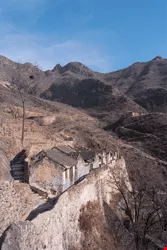
Many artists have come to live and work on the western outskirts of Beijing in Cuandixia Village (opposite page), attracted by the well-preserved homes dating as far back as the Ming dynasty and the distinctive down-home eating.Young travel writer Kuan Sun-chih (below, center) has been in the habit of traveling around with a backpack since middle school. He moved off to Shanghai right after finishing grad school the year before last to make a living there as a writer.
Beating the pavement
When Liu Yung and his son Liu Hsuan spoke at Chinese People's University, the standing-room-only crowd spilled out beyond the auditorium. Students perched on window sills and listened as the father-and-son duo followed their speeches with an impromptu musical performance.
Taiwanese authors with a big following in the PRC, such as Liu Yung, Chu Teh-yung, Lin Ching-hsuan, and "Slicker" Tsai, no longer communicate with their audiences via the published word, at two degrees of separation. Now they travel to the mainland in person to meet with their readers face-to-face at press conferences, book signings, and speeches.
"The mainland is so big. You have to travel the length and breadth of the country with a cup of water in your hand, inviting to people to drink from it." So says Lin Ching-hsuan, who is included by mainland critics among a group that's been dubbed "the four geniuses." Lin, who used to give 200 speeches per year in Taiwan, first traveled to mainland China four years ago, touring in the northwest for a month and following an itinerary arranged by his PRC agent. Since then he has been to more than 40 cities on the mainland and spoken at over 100 universities. His book signing sessions are always big events; once they actually had to bring in 16 police officers to maintain order.
"If you want to be a big name for just a little while," says Xu Longsen, the Shanghai-based agent of painter Cheng Tsai-tung, "all you have to do is spend some money. But if you want people in mainland China to remember your name, you have to become a part of the scene here. You have to rub elbows with people, and keep doing it for ten years." The painter Cheng Tsai-tung, noted for the "rat-race dropout" spirit reflected in his works, moved to Shanghai in 2000 and took part last year in a big contemporary art exhibition in the PRC. The event featured famous painters from three different phases of the post-Cultural Revolution period, including Zhang Xiaogang and Yue Minjun.
Chu Teh-yung, author of the comic serials Double-Gun Salute (about a married couple) and Uptown Singles (about four young women), has also made a name for himself on the mainland. These two comic series sold several million copies after they were published in the PRC. Chu now contributes regularly to Beijing Youth News and four other PRC publications. In addition, the PRC's China Central Television is planning to collaborate in producing a television drama based on Uptown Singles.
However, the literature from Taiwan making a big splash in mainland China almost all qualifies as xiao pin literature (generally light prose of short to medium length). Commenting on this phenomenon, mainland Chinese cultural critic Xie Xizhang notes that the residential patterns of old Bei-jing were disrupted by the Cultural Revolution. High-ranking government officials used to live primarily on the east side, and the area had a very cultured air. Rich merchants congregated on the west side, while the south side was the plebian part of town. During the Cultural Revolution, however, the highly educated cultural and political elite came under attack, and the Chinese people emerged from those years of chaos less prepared to appreciate refined culture.
Says Xie: "There is a fault line running through Chinese culture. There's no way a mainland-born author could write the really beautiful yet easily accessible sort of xiao pin works that authors from Taiwan turn out." Xie explains that the writers of his generation never read fairy tales when they were kids, and they started reading Marx and Lenin at age 15. They focused on ideology, and didn't care about the quality of their individual lives. Lacking the cultural background of Taiwan-based writers, they are naturally unable to write the same kinds of works. Xie continues: "We shouldn't look down our noses at these best-selling authors from Taiwan. The really well known ones represent the very best of popular culture, and without solid grounding in the culture, they couldn't remain cultural icons for long."
It also happens that writing from Taiwan speaks to the concerns of the PRC's newly arising "petit bourgeoisie." Liu Yung, Lin Ching-hsuan, and Chien Chen are all represented in mainland China by Qu Xiaoxia, who says that their works are just the kind of writing that mainland readers need now that China is growing rich and people are beginning to care about the quality of their lives. Qu points especially to the experiences of a man like Liu (who is intimately familiar with life in both the United States and Taiwan) and to the writing style of Lin Ching-hsuan, who re-creates a character's inner world so vividly.
Similarly, Xu Longsen, the Shanghai-based agent of Cheng Tsai-tung, says of his client and good friend: "Tsai-tung has enjoyed a good life ever since he was a kid. Although we in the mainland do not lack people of cultural depth, mainland writers aren't capable of taking the bric-a-brac of our daily lives and elevating it to the level of culture. He's the consummate epicure. If you want to know where to have fun or where the best places to eat are, he's the one to ask."
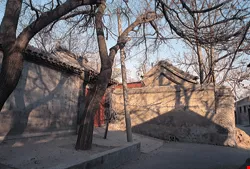
Beijing's east side is characterized by its rows of stately enclosed compounds that were home in an earlier time to the capital's political and intellectual elite.
Visitors and expats
The first high-tide of cross-strait comings and goings by cultural figures was triggered in 1987 when the government lifted the ban on travel to the mainland. Some might, in fact, trace the beginnings even further back than that. Unlike today, many of the travelers back then were people who had made entire careers of studying Chinese culture, or were performers of various traditional arts who were going back to see the place where their art had originated. Many other travelers went simply to enjoy the tremendous scenery. In any case, most visitors went there in a rather romantic frame of mind.
Fo Guang University president Kung Peng-cheng makes a trip to the mainland nearly every month. For the people of his generation, says Kung, "China is a huge mystery, familiar yet not so familiar, near yet far," and it is natural to want to get a proper understanding of the society without having one's perceptions clouded by ideology, and without looking at everything from a Taipei perspective. "I had a strong sense of mission. I wanted to use academic conferences and intellectual give-and-take to give the PRC a nudge in the right direction at a time when everything was in flux."
Li Ta-kang, a former employee of Earth Geographic magazine and the United Evening News who moved to mainland China in 1993, recalls the strong attraction he felt for the mainland's multi-ethnic culture when he saw the minority people living their ancient lifestyle in the highlands straddling the border between Yunnan and Guizhou provinces. He left his high-paying job at the United Evening News and took off with his savings to write poetry in the PRC. Li boarded initially at the home of the noted photographer Lin Tien-fu, a friend and former colleague who had struck out for the PRC before he did. From there he began visiting the many different ethnic groups living in the PRC.
Li has now bought a house and settled in Beijing, and from there contributes articles to many news organizations in Hong Kong and Taiwan. His home, near the Asian Olympic Village, is rather out in the sticks, and Li is very happy with the simple life he leads.
According to Lin Ku-fang, director of the Graduate Institute of Art History at Fo Guang University, "There's more to it than just a vague romantic attraction to the mainland. There is a matter of complex fundamental values involved in this. We are looking at a historical moment of flux, one that is built upon the debris of a great tragedy, and we do not want to turn our backs on it. Taiwan and mainland China have been separated for so long, there are many historical riddles that must be solved." In his book Ten Years of Going and Coming, which is soon to be published, Lin explains why a cultural figure like himself, with such deep roots in Taiwan, would want to make some 60 trips to the mainland over the past 13 years in the course of his research. He wrote the book to describe his thoughts and feelings over this time, in hopes it would help the cause of cross-strait cultural communication.
Hsu Chung-jung, the president of Chin Show Cultural Enterprise, has made a big splash with his cross-strait publishing activities. His first foray came in 1987, when he tapped into China's abundant supply of reasonably priced translators, editors, photographers, and other specialists. With the assistance of over 100 scholars and several thousand photographers, his company turned out three massive reference works on Chinese art that were the talk of the art publishing world for a good while. The books are out of print today, but they're sold second-hand at steadily rising prices, thus qualifying in a practical sense as works of art themselves.
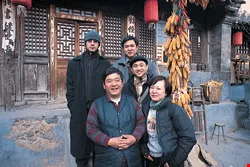
Many artists have come to live and work on the western outskirts of Beijing in Cuandixia Village (opposite page), attracted by the well-preserved homes dating as far back as the Ming dynasty and the distinctive down-home eating.Young travel writer Kuan Sun-chih (below, center) has been in the habit of traveling around with a backpack since middle school. He moved off to Shanghai right after finishing grad school the year before last to make a living there as a writer.
PRC ingredients, Taiwan recipes
This type of cross-strait cooperation is very beneficial to the PRC publishing industry and also enriches culture here in Taiwan, says Fo Guang University's Kung Peng-cheng. There are almost no translators in Taiwan who can work from languages other than English or Japanese, for example, but mainland China has plenty who can handle works from Eastern Europe and Latin America.
With the rapid economic growth now taking place in mainland China, and the Taiwan government's loosening of restrictions on mainland-bound investments, Taiwan's "mainland fever" has spread from the business community, and has now caught on with people in cultural circles, and the sense of cultural affinity that first spurred people to become involved with the mainland has now spawned a substantive Taiwanese presence in mainland markets. Cross-strait division of labor used to be a matter of vertical cooperation, with "the mainland handling the upstream processes, and Taiwan the downstream," but the two sides now engage in horizontal cooperation. And the market has shifted from high-spending Taiwan to the PRC, with its 1.2 billion consumers.
Chin Show Cultural Enterprise recently hooked up with a Shanghai publisher to produce a series of books for the mainland market, focusing on art, coffee, cocktails, fruit tea, and other upmarket items. The books are into their fourth printings already, and have inspired many copycats.
Taiwan, having embraced international currents earlier than the mainland, remains five to ten years ahead in the publishing industry. Says Lin Ku-fang, "It requires no major effort for people in Taiwan to integrate both traditional and Western concepts in their lives, and that is where we have an advantage."
China National Beijing Opera Company, China's leading Peking Opera company, bought the rights to Kingdom of Desire, a stage play created by Taiwan's Contemporary Legend Theater, for RMB400,000, and performed the work three times last September in Beijing without making a single change to the original script, music, lighting, or costumes. They also hired Wu Hsing-kuo to spend two months in Beijing directing the production. Says Wu, "I think we realized earlier in Taiwan than they did on the mainland that traditional Chinese theater is in danger of dying out, and we started incorporating contemporary elements before they did."
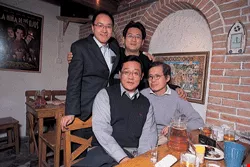
Many of the residential compounds on Beijing's east side have been converted into avant-garde pubs that have become a favorite with the cultural elite from both sides of the Taiwan Strait.
A bigger pond
As the mainland economy grows, media advertising becomes increasingly important. Sales for the Min Bao group in Guang-zhou soared to RMB5.6 billion in 2000. The mass media are still tightly controlled in the PRC, but firms from outside the mainland are using every artifice at their disposal to get involved in this sector, and many top media professionals in Hong Kong and Taiwan have been lured to high-paying jobs on the mainland. They have to keep a low profile, however, because of the legal environment.
Says Mary Ma, of Studio Classroom magazine's Education Division: "I used to think it was only businesspeople who set themselves up on the mainland. I had never thought about what someone in the cultural field might do over here." But then she left the Eurasian Publishing Group last spring to help Studio Classroom establish a branch in Beijing.
After graduating from the Institute of East Asian Studies at National Chengchi University, Ma earned a Master's in East Asian studies at Oregon University and worked as a reporter for the China Times and editor for the Taiwan weekly The Journalist and Hong Kong's Ming Pao Monthly. "Without really being aware of it, my interests were always connected with Chinese culture." Thanks to Ma's experience in teaching and her strong translation skills, Doris Brougham, founder of Studio Classroom, saw her as the perfect person to send to Beijing.
Ma has been in Beijing for a year now, and has discovered that the study of English there is wildly popular. School teachers tell their students to try and strike up conversations with any foreigners they see on the street, and Ma has noted that many of the participants in the big English contests that she has organized want very much to improve their mastery of the language so they can serve as volunteers at the 2008 Beijing Olympics. Ma is cooperating with leading middle schools in Beijing and Shanghai, organizing extracurricular English learning activities. She is also working with a radio station on an "Olympic English" program. Studio Classroom now has a circulation of over 100,000 in the PRC.
26-year-old travel writer Kuan Sun-chih, who just completed a degree in journalism at National Chengchi University, found his freelance opportunities greatly reduced after Taiwan's economy plunged into recession. His income was further reduced when mainland publishers pirated his work. A self-declared "citizen of the world," he moved to Shanghai, determined to make a go of it there.
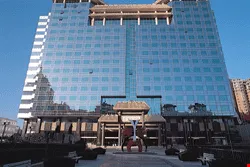
Chang An Grand Theater is located on Beijing's Chang'an Boulevard, the most famous street in all of China. Two theater companies from Taiwan-Contemporary Legend Theater and Performance Workshop-have played here in recent months, showing innovative new styles in their performances of traditional Chinese opera.
Leading lights in Beijing
Beijing's biggest pedestrian shopping district, Wangfujing, has for the past year or more been a "must" item on the itinerary for visitors from cultural circles in Hong Kong and Taiwan. The reason? This is where you find the headquarters of Pinnacle Weekly, established by media celebrity Kao Hsin-chiang.
A former leading light at various publications in both Taiwan and Hong Kong, before establishing Pinnacle Weekly Kao had kept a low profile for three years, volunteering for the Buddhist Compassion Relief Tzu-Chi Foundation. Although he continues to avoid the limelight and refuses all interviews, he cannot refuse all the literati from Hong Kong and Taiwan who stream in to see him.
Pinnacle Weekly is part of the China Youth News organization. Published every Friday, the 20-page publication specializes in job market information, and had a circulation of about 100,000 before Kao came aboard. The paper publishes analyses of the social context affecting the different sectors of the economy. An article on job hunting might discuss the personal growth issues that a job hunt can involve. And the paper has several regularly featured columns. In both breadth and depth of coverage, Pinnacle Weekly is markedly different from other publications. In the view of Feng Jicai, vice chairman of the All-China Federation of Literary and Art Circles: "Pinnacle Weekly is the diamond of Chinese newspapers. It's small, but brilliant."
Pinnacle Weekly is targeted at a white-collar readership that has received at least some tertiary education, and features columns by (or interviews with) such luminaries as Yang Qi (head of the international desk at Xinhua news agency), Wang Meng (former PRC minister of culture), Yang Lan (chairman of Hong Kong's Sun Television Cybernetworks Holdings Limited), Lee Shau Kee (a Hong Kong real estate tycoon), Li Ao (noted author in Taiwan), and James Gin (publisher of Taiwan's Business Weekly). Weekly circulation now stands at 180,000, which would be a respectable figure even in Taiwan.
Pinnacle Weekly editor Liu Mingjun, a Beijing local, is effusive in praise of his boss: "Mr. Kao is like a temple. The biggest-name scholars of our times come in here to sit around and chat. He's got amazing resources." Cultural figures from Taiwan have also benefited from their association with him.
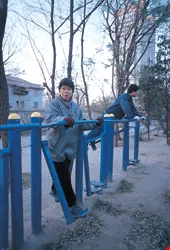
Mary Ma has held mass media jobs in the United States, Hong Kong, and Taiwan. Since last spring, she's been working in Beijing, helping Studio Classroom develop the mainland market.
Headhunting for Taiwanese talent
As the night fades into the wee hours, the bright lights on Chang'an Boulevard and Wangfujing Street gradually go dark, but in Beijing's Sanlitun district, the bars and pubs are still going strong. A pub called Azucar draws a regular crowd from the broadcasting industry, the sort who are into avant-garde music and ride the cutting edge in everything they do. Visitors from Taiwan's cultural circles are especially fond of the place, for here you can slurp up a bowl of authentic Taiwan-style beef noodles and follow it with shots of er guo tou (a type of Chinese vodka) followed by slices of lime. The Taiwanese bar owner calls his er guo tou plus lime slices "er-quila," a reference to the fact that tequila is often followed up with a slice of lime in the same way. The fast drinking and freewheeling conversation at the pub gives the clients a chance to feel like they are latter-day soulmates of the rowdy heroes in Outlaws of the Marsh.
"In Beijing, it's really true what they say," intones Pinnacle consultant Wu Hsing-wen as he downs an er-quila in one gulp, "about 'everybody having a chance, but nobody being sure of their chances.'" The legal environment is beginning to change, and right now there are a lot of gray areas where you can do certain things but you can't talk about it openly.
Wu, who had spent 15 years at Linking Publishing Company in Taipei, went to the mainland in 1998 when Yuan Liou Publishing Company established a huge database maintenance facility there and sent him to help run daily operations. As the work was winding down to a finish last March, Wu went freelance. He started off by publishing five books containing samples of his enormous bookplate collection. Then he went on a three-city tour to promote his books. Eventually he hooked up as a consultant to Pinnacle. Having started from scratch at over 40 years of age, Wu acknowledges that Beijing is intensely competitive, but he points out that the opportunities are also big.
Drinking together with Wu is Huang Chih-hua, who just arrived in Beijing last October. Huang used to run Chinghua Books, something of a cultural landmark in Taichung. In addition to books, his store sold music, doubled as an art gallery, and brought in live performances. With unfinished wooden floors, whitewashed walls, and comfortable seats, the store gave customers an ideal place to lounge and look through the books. Unfortunately, there are only so many people interested in such a refined place. Business was shaky, and the massive earthquake of September 1999 proved to be the last straw.
At about that same time, a department store in mainland China was advertising on Taiwan's Job Bank 104, offering a big salary for someone capable of running their private book store. It was a huge operation with 15,000 square meters of floor space. Huang never saw the ad, and it wasn't until last September that they made connections. The owner of the department store, working through a friend familiar with the Taiwan publishing industry, found out about Huang and offered him the job.
Another Taiwan expatriate working for a mainland boss is Huang Yu-chih, executive editor of Moving to Shanghai, a monthly magazine that was launched just last November. Formerly employed at Contemporary Design, Huang clarifies: "I didn't come looking for this opportunity." The turning point came in 2000, when she traveled to the mainland for a bit of R&R. She had been growing tired of the pack mentality and rumor-mongering of magazines in Taiwan, and decided to go to Shanghai and have a look around. It just happened that Tiansheng Company, a mainland real estate firm, was preparing to launch a new publication targeted toward Taiwanese businesspeople operating on the mainland. The job fell into her lap.
"In the past couple of years, mainland Chinese firms have begun to understand the power of the mass media, and new publications are popping up all over the place," says Huang, who explains that Tiansheng is mainly engaged in brokering high-end real estate for clients from places like the United States, Japan, Hong Kong, Macao, and Taiwan. Moving to Shanghai is printed completely in traditional characters and principally targets the 300,000 members of the Taiwanese business community in the city and its environs. The lead story in the first issue was "The Taiwanese versus the Shanghainese," while the second issue focused on cross-strait marriages among Taiwanese businesspeople on the mainland. The magazine is funded by real estate advertising, and its 45,000 monthly copies are distributed free of charge. Huang reports: "Letters to the editor came flooding in just three or four days after the first issue hit the streets. There is a clear demand for this kind of information."
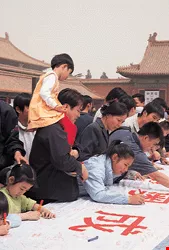
Everyone in the PRC took a close interest in Beijing's effort to host the Olympics. The affair is just one sign of mainland China's strong desire to take its place in the international community. (photo by Jimmy Lin)
Keeping it cultural
Sun Xiaoning, a reporter for the Beijing Evening News, laments: "In both Taiwan and the PRC, the star system just keeps gaining steam. The public is becoming quicker to accept a new face, and quicker to forget as well. Many big names get forgotten, and lots of good-quality people go ignored."
On the face of it, cultural exchange would seem to be one of the best ways for Taiwan and the PRC to work for their mutual benefit, but Lin Ku-fang isn't so sure that's the way things are working out: "In the current wave of 'mainland fever,' it seems that almost all Taiwanese, even the cultural types, are more concerned about the business angle than about extending their cultural understanding or achieving a deeper insight into life. If we just look at the mainland as a place to make money, cross-strait relations are in for some rough times."
Declares Lin Ching-hsuan: "Cultural integration is unstoppable. If our cultural elite lead the way, the integration will take place in a much more meaningful way." Every time Lin does a promotion tour on the mainland, he meets all over the country with leading writers and artists, and he donates the royalties from his works to help build Hope Schools. The first of these Hope Schools has already been completed in rural Shaanxi Province.
Cultural exchange should be about more than dollars and renminbi. Mainland China is rushing towards full-fledged membership in the community of nations, and its cultural life is on the verge of a new period of openness. Let's hope that the "monsoon" blowing in from Taiwan will turn out to be a sustained but gentle breeze that brings good things for many years to come.
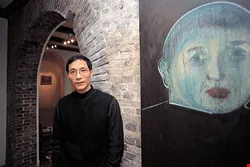
Xu Longsen, who runs the Donghai Tang art gallery in Shanghai, feels that mainland Chinese painters are incapable of imitating the "rat-race dropout" style of Taiwanese painter Cheng Tsai-tung, with his epicurean delight in the niceties of daily living. This is one of Cheng's paintings.

@List.jpg?w=522&h=410&mode=crop&format=webp&quality=80)
@List.jpg?w=522&h=410&mode=crop&format=webp&quality=80)


