Saving Taxi Drivers... From Each Other!
Wang Wan-chia / photos Chuang Kung-ju / tr. by Phil Newell
May 2011


W alking the streets of Taipei, you can see empty yellow taxis winding in and out everywhere amongst the other vehicles. It's a far cry from a decade or so ago when people stood by the roadside waiting in vain, unable to find a cab for love or money.
Now, as a result of many factors-such as the opening and growth of the MRT (subway) system, and the economic downturn-it's the turn of the taxi companies and drivers to be offering discounts and other incentives to attract customers. Add the rising price of gasoline to the discount wars, and it's no wonder that drivers are saying that they can't take it any more, that it's getting too hard to make a living.
These drivers, struggling to make ends meet, end up driving around the streets with empty cabs day after day, creating a vicious circle of more and more cabs competing because nobody is making enough to call it a day. What is to be done? Are there any new opportunities for the broad mass of drivers?
"There's no money to be made drivin' a taxi!" Veteran driver Mr. Li, a cabby for 25 years, says: "The price of gas just keeps going up, the streets are full of taxis-how is business supposed to get better if this keeps up?" Li, who is in his vehicle 12 hours a day, says that on a bad day he takes home less than NT$1000 after deducting his fuel costs.
"You spend all day in the cab, hardly moving, your meal times are irregular, and after a while you start getting problems with your stomach and your lower back. And I've heard that if you spend too much time in front of air conditioning eventually you'll have to get artificial joints. You wanna talk work-related injuries?" he says, his voice rising with frustration, "Hey, my whole body is a work-related injury!"
According to the Ministry of Transportation and Communications (MOTC), at the end of 2009 there were 88,000 commercial taxis in Taiwan, of which 31,000 were registered in Tai-pei City and another 23,000 in New Tai-pei City. This means that more than 60% of all the taxis in Taiwan are plying the streets of the Taipei metropolitan area each day. And that doesn't count the many cabs from nearby Tao-yuan, Kee-lung, or Yi-lan that occasionally make forays into Tai-pei to grab some customers. Competition is intense.
With the supply of cabs outstripping demand, drivers now work an average of 28 days a month and over 12 hours per day (not including meal times and breaks). Yet after deducting costs of fuel, parking, and routine maintenance, they are still only pulling in NT$20,000 or so per month, or about NT$70 per hour, less than a part-timer working at a fast-food restaurant. For many drivers, who are the sole source of income for their families, this means facing all the problems of being low-income marginal people, such as marital stress, difficulty paying even basic education fees for their kids, and similar family crises.
The real heyday of taxis was back in the 1990s, when the stock market was flying high and Taiwan was "knee-deep in cash." The MRT had not yet opened, and people were spending freely. Drivers were grossing more than NT$4000 per day and it was no problem to take home NT$40-50,000 a month clear. Compared to those days, today it's like the world has turned upside down.
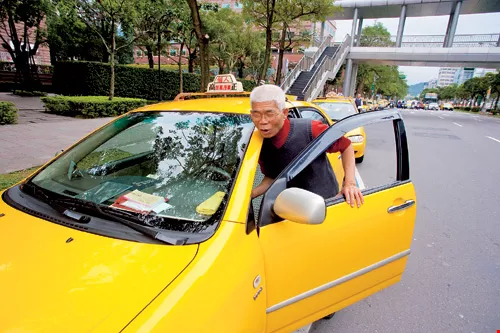
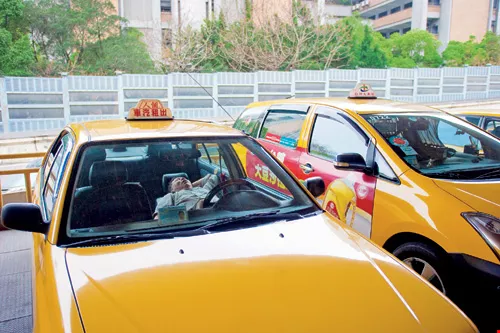
With competition so intense, drivers have little choice but to work longer hours, until they are virtually living in their vehicles.
Taiwan's taxi industry "suffers from both innate defects and acquired disorders." That's the verdict of Lee Ker-tsung, an associate professor in the Department of Transportation Technology and Management at Feng Chia University.
Driving a taxi is a "free profession." There are no organizational restrictions, and the industry is not subjected to much management or regulation. Because there are low barriers to entry-almost anyone can pass the test to get a basic license saying they are qualified to drive a cab, and then one remains qualified for life without any need to renew, and there is no required education or training-one could say that the quality of the human re-sources in the industry has been "uneven."
After the lifting of martial law in 1987, social movements flourished and people finally enjoyed real freedom of expression-. Taxi drivers, often people from the long-repressed lower end of society, were often linked to political movements and violent incidents involving control of territory. For example, some of the taxi companies founded in the 1990s had very strong political orientations, and were involved in a number of brawling incidents. For a while many ordinary people were frightened at the mere thought of getting in a cab. In addition, from time to time there were shocking criminal incidents in the news, such as the rape and murder of prominent women's activist Peng Wan-ru in 1996 by a taxi driver, further clouding the image of all taxi drivers.
The image of drivers was plummeting, and government had no remedies for the industry's ills. Issuance of taxi medallions-which are the actual permits to operate cabs, rather than just the licenses testifying that the person is qualified to drive a taxi-swung wildly back and forth several times between relaxation and tightness. There was even a period, following the issuance of huge numbers of new permits, when a total freeze was instituted, and the black market price for medallions then went through the roof.
Chen Teng, chairman of the Taiwan Taxi Transportation Federation, who has been running a taxi company for 40 years, tells us that there are three types of operating licenses ("medallions"): those for taxi companies, those for transport cooperatives, and those for one-man enterprises. This situation, he explains, has evolved over the course of the development of the taxi industry in the past half-century.
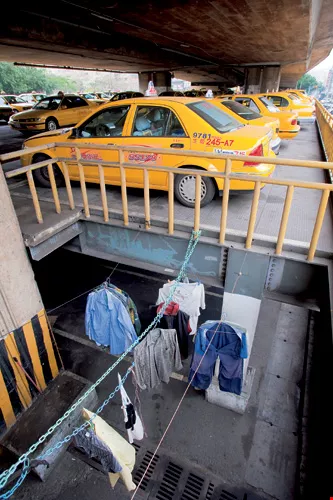
With competition so intense, drivers have little choice but to work longer hours, until they are virtually living in their vehicles.
The earliest was the car-company type. Depending upon ownership of the vehicle, one model was for drivers to rent taxis from the company, and another was for drivers with their own vehicles to "take cover" and drive under the name of the licensed firm. But the companies and drivers periodically came into conflict over management fees, rights, and responsibilities, and employer-employee relations were in a state of virtually permanent tension.
Generally speaking, drivers had to pay an average of NT$1000 a month to the company for "legal cover," and about NT$800 more each day in rent if the car belonged to the firm. If a driver wanted to sign up for the radio call system, that would cost another NT$2000 a month. After deducting NT$500-600 per diem in fuel costs, there wasn't much left at the end of a hard day of chauffeuring people around.
To prevent disputes over exploitation by cab companies, in 1986 the MOTC liberalized the law to permit one-man operations-essentially operating licenses for individuals. But these initial rules stated that only "superior drivers" who had been in the profession for six years and had had no traffic violations or customer complaints in the previous three years could apply to become their own bosses. The law, how-ever well intentioned, was too rigorous, and drivers expressed their unhappiness with it.
Next, after collective petitions and protests from drivers, in 1995 operating licenses started to be issued to a new category of "taxi and transport co-ops." Drivers could form their own organizations and manage themselves.
Finally in 1998 the Highway Act was amended to create formal legal criteria for the issuance of new medallions with the aim of slowing the growth in the total number of taxis. But for the industry as a whole, it was too little too late, and the balance between supply and demand was already way out of whack.
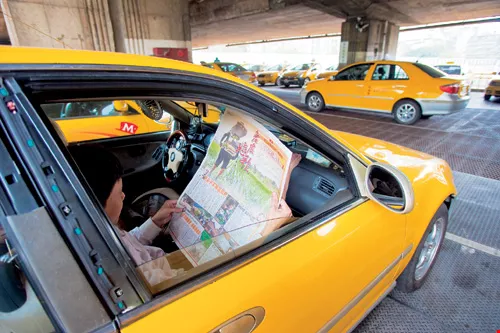
With competition so intense, drivers have little choice but to work longer hours, until they are virtually living in their vehicles.
Under the Highway Act as amended, local governments are only allowed to issue new medallions based on increases in population and in the total surface area of roads in their jurisdictions. But because the market was already saturated, the authorities in various cities and counties have year after year recommended that no new company or co-op operating licenses be issued. The number of such permits has gradually fallen, from the peak of 110,000 in 1998 to the current level of under 90,000. But to prevent the rise of oligopolies and protect the right to work, a small number of individual medallions are still issued (generally a few hundred per year, though the number fluctuates).
As for the satellite dispatch and wireless radio companies whose brand names are familiar to everyone in Taiwan, these are all operated under company licenses. Anyone-other companies, co-ops, or individual drivers-can affiliate with the brand name and compete for dispatches and assignments.
Because of intense competition, the issue of territorial control has long been an insoluble one, and chaos prevails. Hou Sheng-tsung, an associate professor in the Graduate Institute of Management of Technology at Feng Chia University, points out that you can easily find long ranks of parked taxis (often in no-stopping zones!) waiting for business in front of KTVs, hotels, busy MRT stops, and other locations where steady streams of customers can be expected. Companies have long staked out territories, and if "outsiders" unaware of the situation happen to join the line, cabs from the "local landlord" company will box that cab in so it can't move, to warn the intruder off. It has gotten to the point where criminal gangs have spotted a business opportunity in this situation, and extort protection money to hold down desired spots for one firm or another.
Wasted time, wasted resources
The failure to manage the number of taxis on the road not only means it is hard for drivers to make money, it is also a huge waste of resources. Hou Sheng-tsung has calculated that the time that a cab spends empty rose from 35% in 1995 to 80% in 2008. This means that the taxis of Taiwan are essentially driving around without passengers for 6 million kilometers per day, using up 815,000 liters of gasoline. In real terms, over the last 10 years the cost of fuel wasted in this way adds up to over NT$50 billion!
Although the latest statistics from the MOTC show that the overall vacancy rate has fallen to 65%, scholars like Hou still reckon that this will have to come down as low as 35% to ensure that all cabbies can make a decent living. To achieve that figure, the number of taxis working the streets of Taipei should be no more than 30-35,000, which is only about 60% of the current level.
Seeing the difficulty that drivers are in, the MOTC has come up with one relief measure after another. For example, in 2008, when the financial crisis dragged down demand and the price of gasoline rose sharply, the MOTC gave drivers a subsidy of NT$3 per liter of fuel. Beginning last September the MOTC also began a demonstration project encouraging civil servants to take taxis rather than government vehicles when going out on official business. The idea is that cars and drivers currently working for the civil service will be phased out of service. Since the average cost of a government vehicle and driver is NT$1000-2000 per trip, it's clear that the government can save a lot of money while helping to reduce the taxi vacancy rate.
Also, the MOTC is currently looking into making rules that would allow taxis to serve almost like miniature buses, picking up and dropping off multiple passengers, as well as promoting defined taxi pick-up points. Also, starting in June, new rules will go into effect forbidding companies from making drivers absorb discounts, in order to deal with the situation that angers so many drivers: "Companies give discounts, drivers take the hit."
The taxi business is heavily dependent on the overall health of the economy. During hard times, demand falls while many unemployed people join the ranks of taxi drivers, increasing supply. The opposite happens when the economy rebounds.
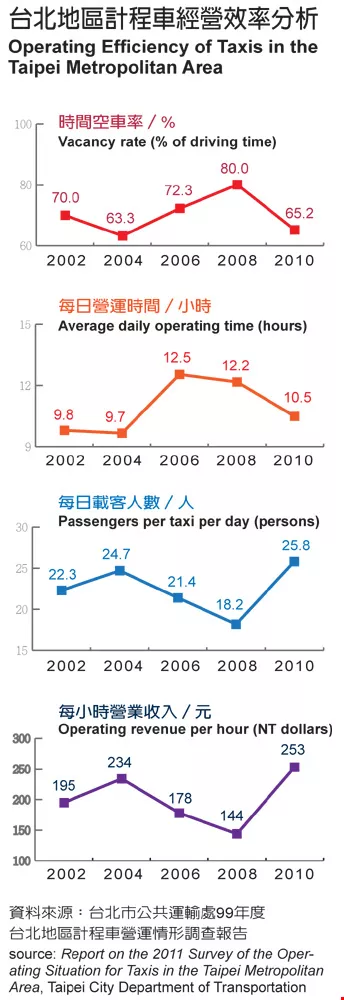
Operating Efficiency of Taxis in the Taipei Metropolitan Area
Scholars and unions both are saying that the only way to really deal with the problem is for the government to manage the total number of taxis.
Because of their different positions, in the past taxi companies and co-ops had nothing to do with each other. Today, because of the severe imbalance in supply and demand, and thanks to scholars acting as intermediaries, the two groups are starting to talk to each other, and are proposing that the government come up with a mechanism to pay back people who turn in their operating licenses and leave the trade.
Hou Sheng-tsung states that because revenues are falling, hours are getting longer, and competition is getting fiercer, an increasing number of drivers are getting out of the profession and changing jobs, leaving companies and co-ops with large numbers of cabs they can't rent out, and there are about 29,000 medallions out there with no one to drive the cars.
The problem is that the companies are asking for quite a lot of money for each returned license (about NT$200,000), based on a current dollar recalculation of what it effectively cost to get a license in a complicated rickshaws-for-taxi-license swap scheme the government used back between 1959 and 1978. But since then medallions have been issued through application, with no fee charged.
Lee Chao-hsien, an official in the MOTC's Department of Railways and Highways, responds that in deciding whether to reacquire operating li-censes, the government has to consider the fairness of distribution of government spending. Anyway, buying back medallions for cars that aren't even on the road won't solve the existing oversupply of active taxis. At present the MOTC is still inclined toward limiting new medallions and relying on the market mechanism to weed out competition and achieve the goal of controlling total numbers.
Because of the multiple forms of operations and the complicated factionalism among taxi organizations, the problem of how to regulate Taiwan's taxi industry has long been a thorny one. A balance should be sought as quickly as possible between market competition and government intervention so that drivers can get out of their current predicament of ever longer hours with ever lower incomes.
@List.jpg?w=522&h=410&mode=crop&format=webp&quality=80)

@List.jpg?w=522&h=410&mode=crop&format=webp&quality=80)
@List.jpg?w=522&h=410&mode=crop&format=webp&quality=80)


@List.jpg?w=522&h=410&mode=crop&format=webp&quality=80)
