Good Neighbors:Residents' Group Builds Forest Community
Wang Wan-chia / photos Jimmy Lin / tr. by Geoff Hegarty and Sophia Chen
December 2010


The dream of living in a remote corner of the countryside is a major driving force for those who take on the construction of their own home. Many believe that they have finally found their paradise on Earth, and look forward to a life like the ancient poet Tao Yuanming portrays in his poem: "While I pluck chrysanthemums by the eastern wall, I perceive in peace the mountains of the south." But it's not always that easy. It may not be difficult to buy a piece of land in the mountains, but managing to live there in peace is often a different matter. Surviving in a remote area with little assistance from neighbors can be extremely difficult, particularly for newcomers trying to settle in.
Nanzhuang Township, situated in the midst of the mountains in Miaoli County, boasts nearby famous tourist spots such as Mt. Elephant, Lion's Head Mountain and Lake Xiangtian. The region has gained fame mainly through the popularity of the Hakka Tung Blossom Festival. But the town has also become popular with city dwellers for another reason: many have chosen the area to settle in because of its magnificent scenery and easy commuting.
Chen Zhengwu and his wife from Tao-yuan City were amongst the first new residents to settle in Nanzhuang, moving initially because of concerns for Chen's health. A veteran born in 1947, Chen was diagnosed with leukemia not long after his retirement. He had chemotherapy for four years, a bone marrow transplant at the age of 53, and then they moved to the mountains. After years of living in Nanzhuang, Chen has experienced dramatic changes in his environment, diet, and even his personality and philosophy. Leukemia patients typically have less than a 20% chance of surviving for five years or more, but Chen has broken the mold, successfully fighting off cancer for 15 years to date.

Chen says that the initial reason they moved to the mountains was only for the sake of his health. As he was recovering from his illness, he lacked energy and was worried about getting an infection, so he hired a gardening company to landscape his 3960 square meters of land. The company, however, failed to take into account whether the new trees would fit in with the local ecology, and whether the fishpond would create a natural aqua-tic environment. He was very disappointed with the results.
Living in the mountains for a year gradually regaining his strength, Chen did a lot of reading about gardening in the type of environment they were living in, and decided that the best way to rehabilitate himself would be to do some hard manual labor. Thus, he planted trees, built a water-lily pond, excavated trenches for the local fauna, built a pavilion, began a compost system for his vegetable garden, and plan-ted a number of native Taiwanese trees such as waxberry and Chinese soapberry. In fact, he has made his isolated piece of land into an organic island, and because he has gained such broad knowledge about building and maintaining a mountain garden, all of which he happily shares with friends and neighbors, he has been given the nickname "Doctor Chen."
In response to a call from his neighbor, writer Shih Chi-ching, to help protect their mountain environment, Chen was appointed guardian of the forest. Thus was established the Miaoli chapter of the "Residents for Rebuilding a Jurassic Forest Community." The group currently boasts around 60 members. Whenever a new tenant moves into the area, Chen always visits to remind them of the importance of nature conservation, soil and water conservation in particular, at the same time urging them to avoid the use of pesticides or chemical fertilizers. He is also always keen to share his experiences with new neighbors.
The saying "a dear neighbor is better than a distant relative" seems to come alive for people living in the mountains. If neighbors can help each other, it may ensure the safety of the entire neighborhood. People living in the mountains seem friendlier than city folk, possibly because of their dependence on each other and the fact that they have so much in common: they share the same interest in and affection for the mountains, and consequently it's usually easier to make friends.
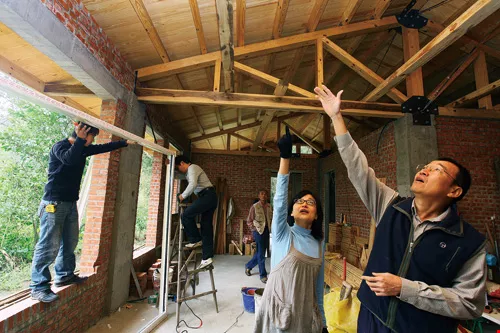
Wang Tianyi and his wife Wen Mingzhu are building a brick house together, and gradually creating their dream home.
Lu Shuya, for example, quit her job as a civil servant in Hsinchu and changed careers just before she turned 40. She learned how to bake and make good coffee, and opened a cafe in the mountains. One year later, she and her family decided to move to Nanzhuang. The five members of the family built their own house in 10 months, including facilities for a hostel and cafe. Because of its wonderful location and lovely views, the place has become a favorite with not only friends and neighbors, but also large numbers of tourists.
Another cafe in the mountains is run by Chark Liu. Liu previously managed a city convenience store with quite a respectable income. But about eight years ago he was bored with his lot, so he decided to close the business and buy a piece of land in Nanzhuang to establish a little cafe. He designed a house and a garden, hiring a master carpenter from Lugang Township in Changhua County to do the building work. Under the guidance of Chen Zhengwu, he quickly got to know about the local flora and fauna, and has taken on the responsibility of introducing the complexities of the local ecology to his guests.
Liu's talent for drawing was aroused by doing some promotions for an environmental event held by the residents' group. Since then he has fallen in love with art, painting mainly on pieces of stone or wood. His self-taught creative skills have become a key element of his rural life, and a major attraction for the guests at his cafe. Living in the mountains has, purely by chance, opened a new page in his life.
The residents' group is also active in other ways, such as organizing hikes and teaching plant grafting. The mountains cover a vast area and there are few inhabitants: the average distance between residences is over a kilometer, so it's very easy to believe that you're alone. However, through these and other activities, people get together, making friends and creating the consciousness of a new community. With the support of friends and neighbors, life in the mountains, though remote, should never be lonely.
Chen has been living in the region for 10 years, and has seen many people who want to live the dream of an idyllic life in the mountains. But many ignore the practical issues that will need to be dealt with. With his rich experience of mountain life, he always advises them: "Think carefully before doing anything rash."

People who don't understand rural life imagine that it must be carefree with few worries, but it is in fact full of hidden risks and traps for the unwary. For example, land developers often neglect the need for drainage facilities and soil conservation simply to save a few dollars. After the land is sold, residents are astonished to find that their gardens have washed away and the very structure of the land has been undermined after a storm. They watch the rainwater carry mud through their properties, eventually realizing that they have just witnessed a landslide. The repair bills are often enormous.
Another problem is water. There is no tap water in the mountains, so residents often have to pump water from nearby streams, but if the pipes are too long, they are easily damaged or become blocked. Some residents are unfortunately promised when they buy their property that they will be able to access water. But water is a scarce resource in the region, and often a source of conflict. Newcomers sometimes end up stealing water from the older residents, which leads to unfortunate and long-term disputes.
You will never find paradise without hard work, proclaims Chen. Maintaining a home in an environment like this is a never-ending struggle. If you want to enjoy the beautiful scenery, you must first fight the tenacious weeds and handle attacks from insects. He has witnessed many residents who eventually realized that the "gardening" work would never end after the honeymoon period, and are terrified to return to the mountains.
Chen says with a sigh: "Life in the mountains is like a mirror that reflects everything." Before he moved to the mountains, he believed that people with a love for nature were not supposed to be crafty. However, he has witnessed the theft of water sources, the illegal taking of other people's land, and intentional destruction of the forest. He never tires of reminding people who are keen to settle in the mountains that, in order to avoid conflicts, the buyer must request from the seller a survey report from the local land administration agency identifying boundaries. Disputes can arise easily if there is a lack of evidence, and quite often people make mistakes about who owns what.

To make a success of mountain life, people have to be able to bear the loneliness of living in an isolated environment. If a couple are living together, as Shih Chi-ching's writings say: "A life of isolation is the best measure of love."
On the day they were interviewed, Wang Tianyi and his wife were working on their house. Shih depicts them in her book as a "modern version of Shen Sanbai and Yunniang" (a famous couple in the Qing Dynasty). Wang, a university lecturer born in 1960, has a strong determination to fulfill a simple dream: to build a red-brick house. He has already spent a year laying foundations and building the walls; it's slow work. The structure of 132 square meters needs about 20,000 bricks. Whereas a skilled bricklayer and an assistant could lay more than 1000 bricks a day, the couple manages something less than 200. Although it's slow work, it has been done well and they are experiencing the great satisfaction of building their own house.
"Only a man could possibly dream of living in the mountains!" says Mrs. Wang. But she has no complaints and is very happy to be with her husband. Sometimes when Wang is laying bricks, his wife plays guzheng (Chinese zither) beside him. With the music and the stands of bamboo surrounding the house, it is as if they have traveled through time to an ancient traditional Chinese scene.
Life in the mountains is full of hardships unimagined by outsiders, but is still very attractive to many. Magnificent scenery, family, good neighbors-nobody could ask for more!

@List.jpg?w=522&h=410&mode=crop&format=webp&quality=80)


