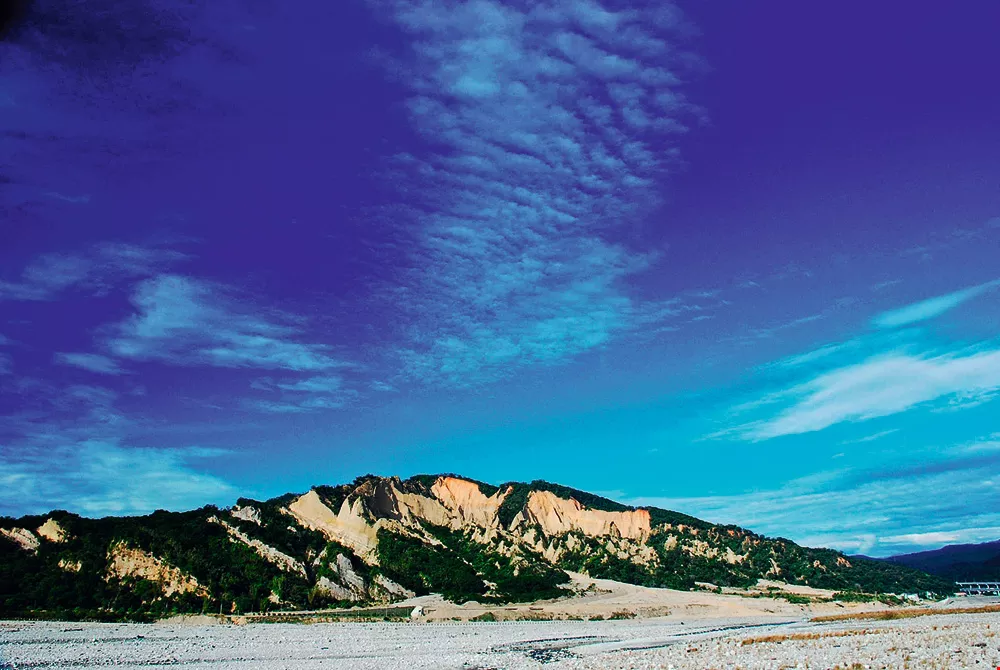
In the Forestry Bureau’s 2013 online poll of Taiwan’s Top Ten Landscapes, Huoyanshan took the ninth spot.
Huoyanshan (literally “Flame Mountain”) is located in Miaoli County, in the west side of Sanyi Township near the Yuanli Township border. At 602 meters, it’s the highest peak of the Miaoli Hills and a prominent landmark along the Sun Yat-sen Freeway. When people drive past Huoyanshan, their kids often ask, upon seeing it looming in the distance like flames rising from the plains, “Is Huoyanshan really on fire?”
But the mountain’s flame-like appearance is only part of the story. Behind its fiery façade lies gentle greenery that teems with rare species.
The classic Chinese fantasy novel Journey to the West describes a place called the Flaming Mountains, where “there is neither spring nor autumn; all four seasons are hot. Flames stretch for 800 miles and all around not an inch of grass grows.” But it’s the eroded gullies, devoid of vegetation, that make Miaoli’s Huoyanshan resemble fire in the orange glow of the setting sun, giving it its name.
Huoyanshan is not just a place name; it’s a badlands. It’s composed chiefly of coarse gravel, sculpted into a series of sharp peaks, dry valleys and gullies by heavy rains. And frequent landslides have stripped it of vegetation.

Looking down from atop Huoyanshan, traces of washouts are clearly visible, creating a stark contrast to the greenery on the rear side of the ridge.
Geologically, thick layers of gravel are a necessary condition for the formation of Huoyanshan’s terrain. The gravel originated in the Xueshan Range: vast quantities of rock were washed away by rivers, where it accumulated at what was once the mouth of the river. The strong currents washed stones of all sizes downstream, where they mixed together and piled up without having the chance to become sedimentary rock with its clearly defined strata. As a result, the rocks in Huoyanshan’s gravel layer are mostly rounded, averaging around 25 centimeters across, with some reaching over 50 cm. This thick layer of gravel, thanks to the uplifting of the earth’s crust, became what we call Huoyanshan today.
In contrast to the Flaming Mountains of legend, unbearably hot with towering flames, the Huoyanshan of reality isn’t characterized by flames, but by rains.
Lin Jiun-chuan, professor of geography at National Taiwan University, has studied the badlands of Huoyanshan over many years. Lin states that Huoyanshan’s appearance changes drastically after each typhoon. Since the matrix cementing the gravel together is made of clay and silt, in times of heavy rain the matrix washes away, taking gravel with it and forming washouts and steep cliffs. But ongoing orogeny preserves the steepness of the slopes. These wondrous landforms are the result of both clear and rainy weather.
Furthermore, rapid oxidation and leaching of iron and aluminum oxides in the mud paints the deep chasms and sharp peaks a rainbow of bright red, golden, orange-red and brownish-yellow colors, which when illuminated by the setting sun make them look like dancing tongues of flame, an apt description of Huoyanshan’s landforms.

Looking down from atop Huoyanshan, traces of washouts are clearly visible, creating a stark contrast to the greenery on the rear side of the ridge.
Southwesterly air currents in Taiwan’s summertime carry copious quantities of water vapor, which condenses into water droplets and small ice crystals when approaching the topographically isolated Huoyanshan, forming clouds and fog. And water vapor blown in by northeasterly winds in the winter condenses readily in the Huoyanshan area due to the same topography. So both the north and south sides of Huoyanshan see wildly differing climates: when it rains on the north side it’s often sunny on the south side.
Huoyanshan is also home to an important tree species in Taiwan: Masson’s pine (Pinus massoniana).
Masson’s pine is a species left over from the ice age. Its soft, slender needles are like a horse’s tail, so it’s also called the horsetail pine. But how can it grow on barren Huoyanshan?
Huoyanshan’s badlands actually just comprise the large area of gullies of the south side, while the remaining two thirds of the mountain are well vegetated and rarely see landslides. It’s here that Taiwan’s most complete natural forest of Masson’s pine is found.
To conserve this precious natural landscape and eliminate damage caused by human behavior, after the Cultural Heritage Preservation Act was passed the Huoyanshan area of Sanyi was designated as Taiwan’s first nature reserve in 1986.

Huoyanshan has a distinctive appearance. It’s also a climatic watershed, where clear and rainy weather systems meet.
The Huoyanshan Nature Reserve seeks two major goals: preserving the landforms and protecting the natural pine forest.
“Each year, Huoyanshan’s slopes retreat by 1.5 to 2.5 meters on average, with some parts receding by as much as three meters,” says Lin Jiun-chuan. Formed in 1986, his research team has observed erosion in Huoyanshan over the long term, and works with the Forestry Bureau to obtain aerial photos to build three-dimensional models so the receding slopes can be observed from many angles.
But will Huoyanshan vanish as a result of the erosion? According to Lin, material accumulating at the bottom of the slopes forms new piles of sediment, achieving a remarkable natural balance between erosion and growth. But human behavior may destroy this balance. Says Lin, “If the accumulated gravel sediment is dug up, Huoyanshan may well gradually disappear.” He stresses that the goal of setting up a nature reserve is to stop people from illegally extracting gravel so that the area can be returned to the control of natural mechanisms.
However, in 2002, a survey by a team from the Graduate Institute of Ecology at Providence University showed that Masson’s pine was facing extinction.
Ecologist Chen Zhengfeng remarks that damage from the invasive pine wood nematode (Bursaphelenchus xylophilus) was present in most of the area’s 192 Masson’s pines. Only 11 smaller trees had yet to exhibit signs of infection. In other words, 95% of the area’s Masson’s pines were infected.
Management standards for nature reserves are stricter than those of national parks: changes to a reserve’s natural state are prohibited and natural processes must be respected.
But wouldn’t that mean letting the pines go extinct?
To prevent this ice-age species from vanishing, the Forestry Bureau decided to gather seeds and build a genetic database to maintain the continued existence of the species, as well as attempt an outdoor planting program at Huoyanshan’s northeastern corner, with the caveat that the conservation principles of the nature reserve be should be respected.
Teeming with lifeHuoyanshan is nourished by water vapor coming in from the north and the south. Areas on the north side that have not collapsed remain lush and green, but few people ever see it because they’re drawn by the spectacular terrain of the south side.
There are more than just low-elevation natural forests here; there are also artificial plantings of Taiwan acacia and tung oil trees. The endemic Oldham’s azalea (Rhododendron oldhamii) and the colorful umbrella dracaena (Dianella ensifolia) also add color to this wilderness.
Huoyanshan is also the primary habitat of the leopard cat (Prionailurus bengalensis), a protected animal. With their speed and agility, wild leopard cats are rarely captured on film, and infrared cameras set up in the Huoyanshan area may operate for a long time before recording a precious image.
Sanyi’s Huoyanshan seems like a barren landscape, but behind this façade it teems with life. Perhaps Mother Earth wants to use its fiery appearance to protect her precious children from wanton human destruction.