Going with the Flow: Taiwanese Businesses Adapting to New Hainan Environment
Sam Ju / photos Jimmy Lin / tr. by Scott Williams
September 2012


Agriculture aside, what aspects of the “Taiwan experience” are Taiwanese businesspeople bringing to Hainan Island?
Will the mainland Chinese government’s efforts to turn Hainan into an international tourist destination force Taiwanese businesspeople out of the market? Will it open up new opportunities? What should Taiwanese do to keep their businesses viable?
Hainan Island used to be a place where banished ministers went into exile, a place far removed from the rest of the world. But when Deng Xiaoping, the principle architect of mainland China’s liberalization, stated, “If we succeed in developing Hainan, we’ll have done something amazing,” he also laid the foundations for Hainan’s subsequent development.
China made Hainan Island its first, and to date only, provincial-level special economic zone in 1988. To Taiwanese looking to invest in China, the designation appeared to create new opportunities.
Over the last 20 years and more, Taiwanese businesspeople have striven to establish themselves on the island. Whether working in agriculture or some other arena, the challenges have proved daunting.
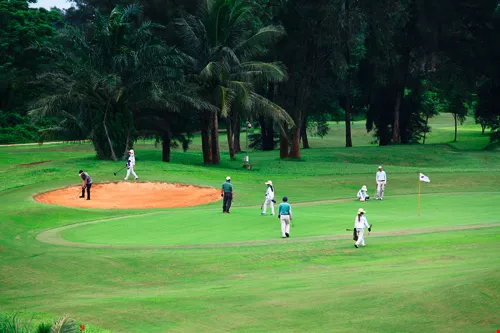
Hainan golf courses backed by Taiwanese investors laid the foundations for mainland China’s golf boom. The photo shows the Dongshan Golf Club.
Taiwanese businesspeople had their very own “first” on Hainan, building what was Hainan’s first (and just China’s third) golf course.
Construction on the Hainan Tai Dah Golf Club began in 1989 and was completed in 1992. The course, located just four kilometers from the Meilan International Airport, contributed enormously to the formation of a Hainan golf holiday business where none had existed before.
In an interview with mainland media, Tai Dah’s founder and former chairman Chen Qingquan explained that he had two major reasons for building a golf course on Hainan: the island’s tropical climate and its pro-investment policies.
These factors attracted other Taiwanese businesses, leading to the establishment of the Dongshan and IBL Golf Clubs, the other two members of Hainan’s 1990s golf-course triumvirate, in 1997.
But the good times were shortlived. Tai Dah was sold to mainland China’s CITIC Group in 2009, while IBL, which now sees fewer than 10 golfers per day, is reportedly looking for a buyer.
Dongshan Golf Club, the only one of the three still operating normally, has in recent years become a part of Forward Golf Tour Schedule, a group that arranges golf-related timeshares. The course has become dependent on the income generated by groups of Korean golfers who come in on chartered jets in the winter. The course’s operator also uses income from real-estate investments on the mainland to help keep the course running.
Xie Jinwang, the chair of the Dongshanhu Golf Tourism Development Corporation and former chair of the Taiwan Businessmen Association, Hainan, says that his company’s investment (including land costs) in Dongshan’s 120-hectare facility totals about RMB100 million. The club employs around 300 people, and its operating costs amount to some RMB12 million per year.
“If the club had to depend entirely on golf revenues, it would have long since gone bankrupt,” says Xie.

Cocunut Ice and its popular fruit sorbet.
Some 20 years ago, Taiwanese firms built the greens and fairways that kickstarted the Hainan golf industry. Now, one of those courses has been sold, another has closed, and the last is struggling to stay afloat. What has been the determining factor?
“We were far too optimistic in those days,” says Xie without hesitation. “We all rushed to take advantage of the ‘special economic zone,’ certain that the golf course market would turn out great. We never gave many issues any thought at all.”
What issues did Xie and the other Taiwanese investors ignore?
First, that the number of golfers in China had been dramatically overestimated.
Next, that cities on the mainland were building courses like mad, creating excess supply.
Prior to the mid-1980s, golf was still considered a pastime of the capitalist class and frowned upon by the Communist Party. It wasn’t until 1984 that the mainland built its first course in Guangdong Province. When golf courses began popping up all over the mainland in the 1990s, the Hainan courses, which were already having a tough time and were hoping that more mainland golfers would begin visiting Hainan, faced an existential threat.
“Hainan wasn’t the only winter golfing option for players from Northern China.” Xie explains that once prices for domestic flights to Hainan rose, Hainan’s courses became uncompetitive with those in Thailand, which already had a well developed international tourism industry.
Given the new interest in developing Hainan into an international tourist destination, do golf-course investments retain some allure for Taiwanese investors? Xie shakes his head and says that there’s no way to lease that much land now. Besides, the Chinese golfing population just isn’t that large. Right now, only the more prosperous urban areas—Guangdong, Shanghai, Beijing—have all the elements necessary to support a golfing population.
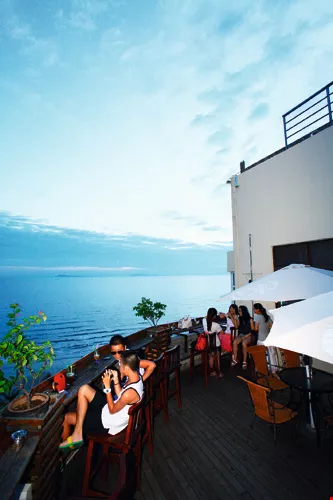
Located atop a Sanya skyscraper, Zaomiao Café offers fantastic views that attract crowds of young people in the evening.
The year 2000 marked a watershed for Taiwanese investment in Hainan. Prior to that, Taiwanese businesspeople in Hainan were either in agriculture or, to a lesser extent, real-estate development, both of which are strongly land-oriented. But when the government began repossessing leased property and the real-estate bubble began to form, the investment environment became more constrained. Taiwanese were compelled to either seek out other fields or return to Taiwan.
The first generation of Taiwanese investors in Hainan generally came to the island because they thought the outlook was bright for the special economic zone, and were generally in their forties when they arrived. The availability of large tracts of land at low cost made their early years here something of a golden age. But in more recent years, they’ve also seen land seizures and faced the prospect of having no land to use.
The younger generation of Taiwanese businesspeople on Hainan are somewhat different than their elders. They were generally in their 20s and 30s when they arrived—some were even just out of university—and largely missed the salad days. Their Hainan is no longer taking its first steps into economic liberalization, but rather striving to become a tourist mecca.
These mostly “post-1980” Taiwanese are enthusiastically embracing the innovation-intensive, marketing-driven, personal-network-dependent service sector. From their perspective, land-intensive agricultural businesses and capital-intensive real-estate investments are obsolete.
You certainly get that sense while sitting in the Sanya Bay shop of Taiwanese businessman Marco.
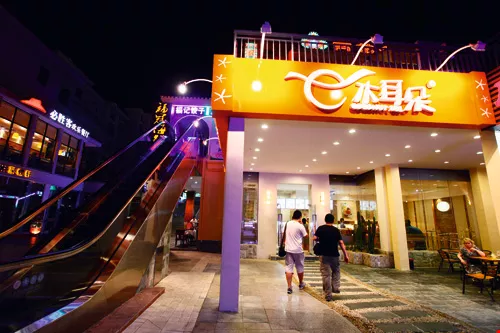
Cocunut Ice and its popular fruit sorbet.
Zhang Haogang, who goes by “Marco,” came to Hainan in 2007. One of his uncles, Lu Wenbin, is the founder and president of Shanghai Zaomiao Food Co. Another, Lu Wenyu, is the chairman of the BinGo-C chain of frozen dessert shops.
Marco, who was born in 1976, runs two “casual” restaurants in Sanya and oversees a fruit processing facility that BinGo-C opened in Changjiang in July 2012.
Marco’s Zaomiao Café is located on the roof of a building near the busy part of Sanya’s Jiefang Road. The café’s a great spot for taking in nighttime views of Sanya Bay, and his clientele is young. Marco calls it his “lite bar” because even though it’s nominally a café, its most popular items are beverages containing a splash of alcohol.
His other restaurant is a BinGo-C shop located in the Nanshan Cultural Tourism Zone. Opened at mid-year, it sells ice cream and shaved-ice desserts made with flash-frozen mangos and strawberries.
The prices at the Nanshan BinGo-C are about the same as those in Taipei. Marco says that product pricing was a consideration when he decided to locate the shop in a tourist hotspot. He reasoned that tourists from northern China have a great deal more money to spend than Hainan residents. If he’d opened the shop downtown, he wouldn’t have had any business.
The lease on the 660-square-meter shop costs him RMB2.5 million per year (about NT$12.5 million). By way of comparison, Marco says that the same rent would get you only “a tiny shop in a remote corner” of downtown Sanya, and notes that the high cost of doing business is more than most small investors can afford.
Zeng Yanwei exemplifies another type of Hainan latecomer. Rather than run his own business Zeng, a manager with Sanya Mu’erduo Restaurant Consulting, works for another Taiwanese businessperson.
Mu’erduo likewise operates a frozen desserts restaurant, Coconut Ice, located in Sanya’s über-fashionable Yalong Bay district. The 30-year-old Zeng, who worked for years in Taiwan as a chef preparing Western-style desserts, came to Hainan in 2006 at the invitation of a former boss and now plans to spend the rest of his life here.
Hainan grows a tremendous variety of fruit. Mu’erduo has taken advantage of this by going into fruit processing, producing fruit ice creams and sorbets that it sells at its own store and at five-star hotels. In fact, Zeng says, the two channels each account for approximately half of the company’s revenues.
Zeng adds that before he came to Hainan he assumed that the island’s hot climate would make frozen treats a staple with locals. When he arrived, he discovered that it was actually the wintertime tourists from northern China who were more fond of icy desserts. Mu’erduo’s business strategy is therefore much like BinGo-C’s: it targets tourists from the mainland with money to burn.
Tourists visiting Hainan are already making a significant contribution to the island’s economy. According to the China Institute for Reform and Development (CIRD), Hainan had tourism revenues of nearly RMB29 billion in 2010. CIRD forecasts that these will rise to as much as RMB200 billion by 2020.
Sanya attracts more tourists than any other city on the island. A member of the ground crew at Sanya Phoenix International Airport says that there were roughly 10 million visitors last year, about 90% of whom came from the mainland.
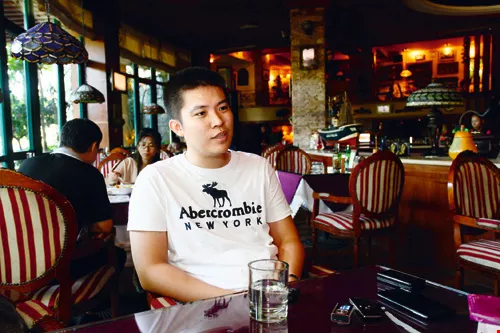
Alex Tsai, a second-generation Taiwanese businessman in his late 20s, is already running restaurants and KTVs.
Since Communist Party of China general secretary Hu Jintao’s 2008 directive that “Hainan must develop a modern service sector with tourism at the forefront,” all of Hainan, and Sanya in particular, has applied itself to the realization of this goal. Consequently, the bulk of the investment injected into the island has been directed into tourism-related assets.
Alex Tsai, the Sanya-region manager for Hainan Versailles Catering & Entertainment Management Co., is the son of Tsai Pao-liang, president of the Taiwan Businessmen Association, Sanya. Just 29 years old, the younger Tsai now runs his family’s Sanya restaurants and KTV businesses.
He recommends that future Taiwanese investors in Hainan focus on projects that are big, unique (such as a theme park, which Sanya currently lacks), accessible (such as inexpensive KTVs), or “high-class” (such as five-star hotels), projects oriented around recreation and tourism, and that have their own niche. He argues that profitable businesses don’t necessarily earn their money from the mass of consumers. More often, they earn it by targeting specific groups of consumers.
Anita Huang, deputy general manager of the Taiwanese owned and operated Le Parker, a five-star hotel located in Sanya, says that even more than financial capital, Hainan lacks “human capital.” She explains that Hainan’s service-industry workers lack the attention to detail of their Taiwanese counterparts.
The degree to which ordinary employees just “don’t care” drives Huang batty. She says that she’s constantly reminding employees to use standard polite expressions such as “please,” “thank you,” and “excuse me,” but “no matter how many times you tell them, they always forget.”
“The quality of service reflects the educational and cultural background,” says Huang. She recommends that new graduates of Taiwanese hospitality programs consider working on Hainan for a time. If they can get past the starting salaries of just RMB1,400 a month (roughly NT$7,000), the experience of working in what has become China’s hottest winter tourism destination will broaden their perspectives and enrich their résumés.
Though present-day Hainan still contains elements of its past, it is clearly no longer the special economic zone of 1988.
Having experienced the joy of cheap land, hemorrhaged profits during the bubble years, and agonized over the seizure of agricultural land, the first generation of Taiwanese investors warns the ambitious younger generation of investors: “Unless you have deep pockets, stay home.”
The younger generation, which has jumped on the “international tourism” bandwagon, offers advice of its own: “Unless you’re going to invest in the right areas, stay home!”
In spite of having lost much of their land, Taiwanese businesspeople have maintained a foothold on Hainan. But can they get in step with Hainan’s march towards development? Nowadays, they need to give the question serious thought before plunking down their cash.
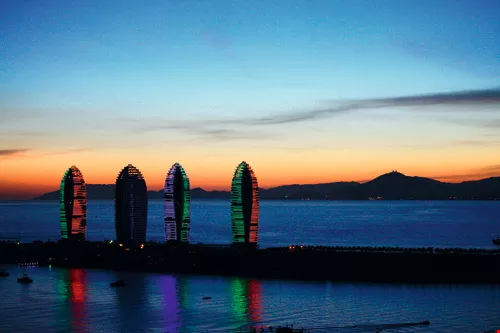
Taiwanese investors began developing Hainan some 20 years ago. Having since experienced a real-estate bubble and land seizures, some are leaving, others staying, and still others are preparing to leap aboard the “international tourism” bandwagon. The photo shows the manmade Phoenix Island, located just off the coast from Sanya, with its landmark skyscrapers.
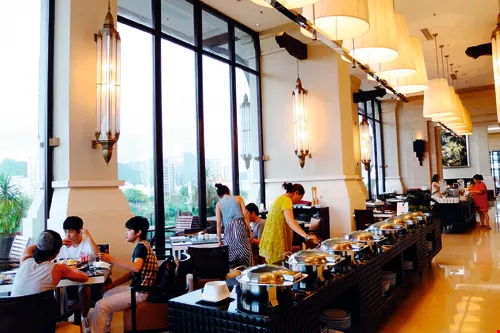
Seeing opportunities in the tourism sector, Taiwanese businesspeople are investing in Hainan hotels. The photo shows the Le Parker hotel in Sanya.
@List.jpg?w=522&h=410&mode=crop&format=webp&quality=80)

@List.jpg?w=522&h=410&mode=crop&format=webp&quality=80)
@List.jpg?w=522&h=410&mode=crop&format=webp&quality=80)


