

It’s possible to enjoy the pleasures of cultivating and harvesting your own vegetables right here in the city!
In recent years, increasing numbers of people have become worried about food safety and have turned to toxin-free or organic agro-products. Some have even begun to grow their own vegetables, leaving the choice of nothing—soil, fertilizer, seeds—in the hands of strangers.
This novelty of growing vegetables in idle urban spaces has expanded from campuses to communities. Local governments have also made land available and are promoting the idea of urban farming to citizens. Could a new way of life be in the offing?
Across the globe we see fragments of a “green evolution” aiming toward sustainable development. Small and micro farms are seen as part of the overall package needed for such development, and the United Nations has declared 2014 to be the International Year of Family Farming.
That’s cool. But it should be noted that Taiwan is already ahead of this curve.
For example, two students in the Graduate Institute of Sociology at National Taiwan University have worked out what they call “citizen agriculture” as a way to bring more vitality to underused public spaces, and they even have promoted their idea in the surrounding Jin’an Community.
This year, moreover, the Taipei City Government launched a program to use the amphitheater-like tiered concrete stands at the former Zhongshan Soccer Stadium, which was one of the sites of the Taipei Flora Expo, as a “sky farm.” The city has set up soil boxes with vegetables already planted in them, and has, since May, allowed citizens to “adopt” (i.e., rent) these boxes, in return for which the adopters are expected to spend at least two hours a week weeding and tending the plants. (Volunteers will handle Monday through Friday maintenance.)
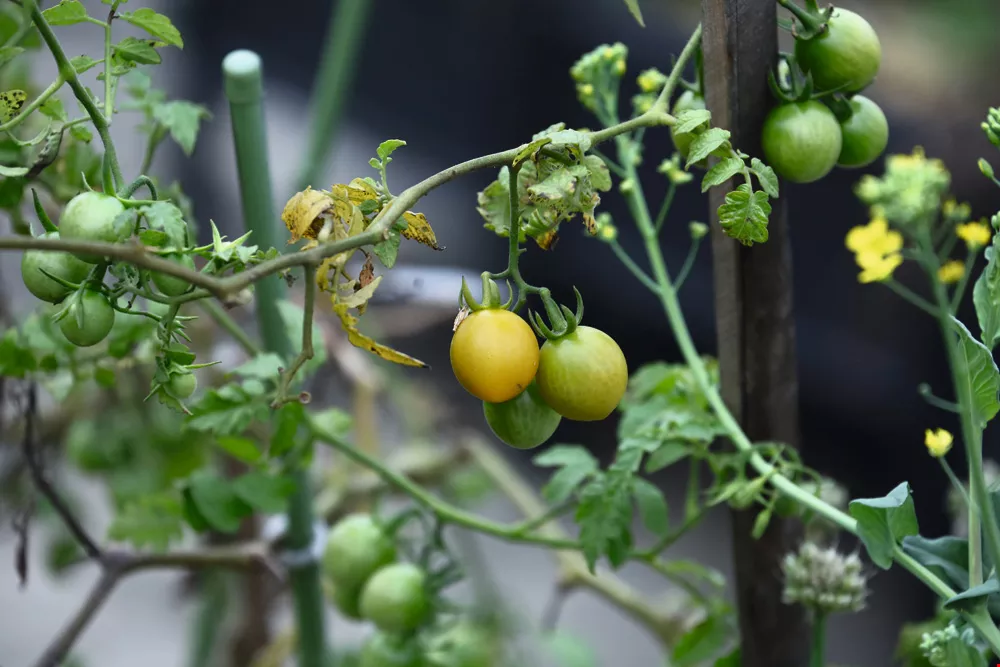
From leafy vegetables and fruit to spices and “succulents” (thick, fleshy plants), selecting the right species for rooftop micro-farming requires a lot of specialized knowledge. The little holes chewed through the leaves by insects indicate that these plants have been raised pesticide-free.
Inside the soccer stadium is a display hall that was built for the Flora Expo, on the first floor of which is the bright and mood-brightening “Green Earth Village,” decorated mainly in white and green. Here you will find a display of different types of agriculture—soil culture, hydroponics, aquaponics…. In addition, posters, images, and text on the walls contain a broad range of educational information about food and agriculture.
When you walk upstairs to the observation platform (originally designed for people to admire the Flora Expo’s vast stadium-carpeting floral exhibition), you see that much of the rough-and-ready tiered seating of the soccer stadium is now covered with planters and pots of soil, all seeded with vegetables, arrayed in neat and orderly ranks. It’s like looking over terraced fields, especially beautiful under a shining sun. They’ve given it a fine-sounding name as well: the “Sky Farm.”
In Taipei City, where every square inch of land is money in the bank, the core problem in realizing the idea of “family farms” is, naturally, space. While some citizens are lucky enough to have a flat and empty rooftop, others have chosen to head to the suburbs or up into the Yangming Mountains where they can rent some land and tend it on the weekends. Now that Taipei City has made the Sky Farm available to the public, citizens won’t have to go through the hassle of driving to their plots, but can experience the fun of being an “urban farmer” closer to home.
Chen Wen-shou, chief operating officer of the Taipei Expo Foundation (TEF), which is in charge of the project, says that after the Flora Expo closed in April of 2011, the Taipei City Department of Economic Development began to lay out plans for reuse of the idle space. In the fourth quarter of 2013 they took the first step toward implementing these plans by renovating and preparing a 4100-square-meter chunk of the stands in the old soccer stadium for use as a cultivation zone.
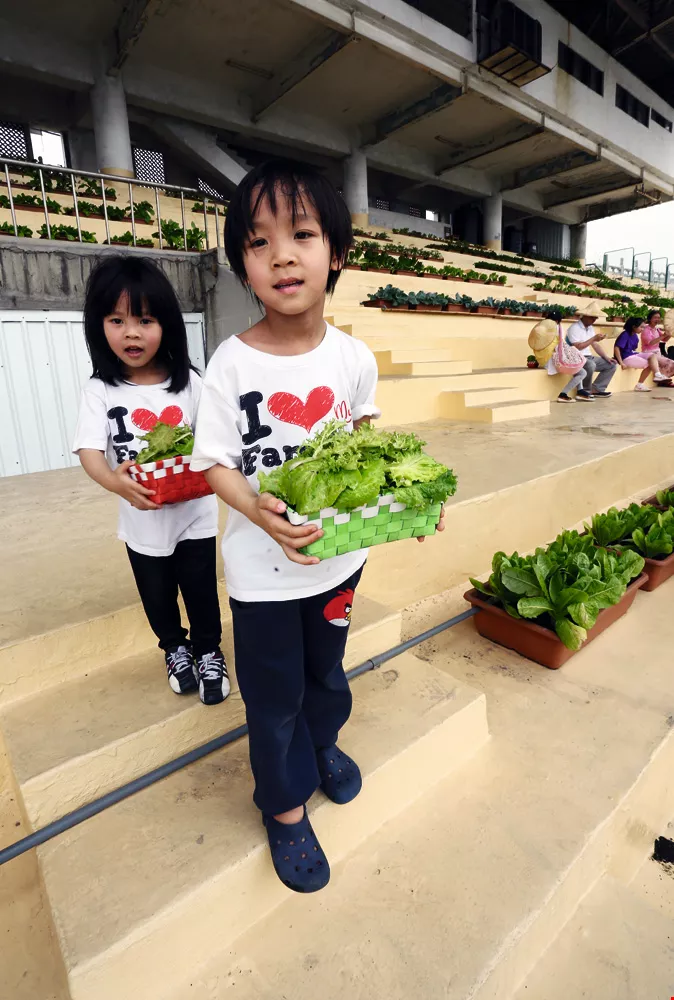
Making micro-farming a family activity not only gives kids a chance to understand how their food is grown; they will get comfortable with the idea of “getting their hands dirty” and will be more gardening-friendly in the future.
Built in 1989, the soccer stadium is now a very dilapidated structure. To ensure sustainable operations and prevent serious leakage problems while cultivation is going on, the TEF laid down a layer of waterproof paint and constructed a rain recycling, water collection, and irrigation system.
The Sky Farm offers not only space and infrastructure, but training in agricultural techniques and knowledge. The TEF has been working with the Qing Liang Di Organic Farm, a non-governmental group, and also with the Department of Bioenvironmental Systems Engineering at National Taiwan University, to transmit practical experience to ordinary citizens, to select appropriate crops for the Sky Farm, and to do demonstration trial cultivation.
So far the plants that have grown the best have been romaine lettuce and head lettuce. Because it is very windy at the soccer stadium, there are virtually no insect pests, so the strawberries have also been growing—without need of pesticides—to be sweet and beautiful beyond all expectations.
So far the project has made 520 soil boxes available to the public, which can be rented by 260 teams or groups of citizens. Each contract period is three months, with one renewal. The venue is open to the public from 10 a.m. to 5 p.m. daily.
The TEF is also holding workshops and family activities to help city slickers bone up on their farming knowledge, so they will have a better idea what to do when they actually start getting their hands dirty. “For a lot of city people, it’s only when they cultivate some plants themselves that they realize how tough farmers have it. After that they have much more of a sense of gratitude when they eat,” says Chen.
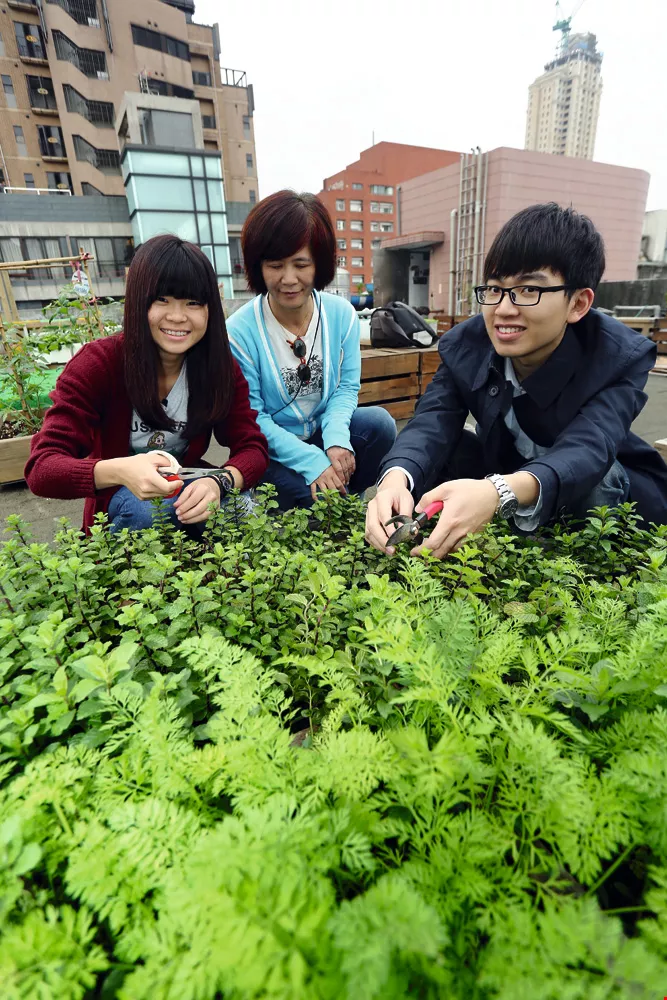
Mica Hsiao (first at left), a student in the Graduate Institute of Sociology at National Taiwan University, has been trying to reproduce the experiment of the sociology building’s rooftop micro-farm in the neighboring Jin’an Community. The collectively cultivated gardens not only enliven disused public spaces, they help bring people closer together.
Coming to another venue, the rooftop of the NTU Department of Sociology building, the eye is met by verdant rows of vegetables. They’ve got just about everything you can imagine up here, from water spinach and lettuce to beets and asparagus, as well as basil and a variety of other spices. “We’ve even got our own tomatoes, though I’m still not sure how they got into our micro-farm!” excitedly says Mica Hsiao, a sociology grad student, pointing to the rows of planted soil.
This is a collective experiment being done by graduate students in the Institute of Sociology. They persuaded the building’s managers to allow them to use the idle space on the rooftop to grow vegetables and get a first-hand feel for how the ideal of “urban agriculture” can play out in practice.
In 2012, Hsiao and her classmate Yang Chunming took a class in “socioeconomic organizational innovation and design,” taught by professor Chen Dung-sheng, and began to think about issues like urban gardens, community kitchens, revitalizing idle public spaces, and of course (this being sociology, after all!) the social and interpersonal implications of these.
Nine students in the class got together and chose as their final project “making urban vegetable plots practicable.” When the class was over, they applied for a grant from the Ministry of Education and formed the “Jia Jia Jiu Urban Cooperative Vegetable Garden Team.” In February of 2013, they began, bit by bit, to transform the sociology building rooftop into their downtown micro-farm.
Professor Chen says, “This is citizen farming in action!” At first, when Jia Jia Jiu was applying for space, there was disagreement in the sociology department about how best to use the building’s public areas. But, after discussion, Jia Jia Jiu and the department worked together to draft a set of mutually acceptable rules to govern the project. “This kind of process is an extension of the spirit of democracy,” comments Chen with approbation.
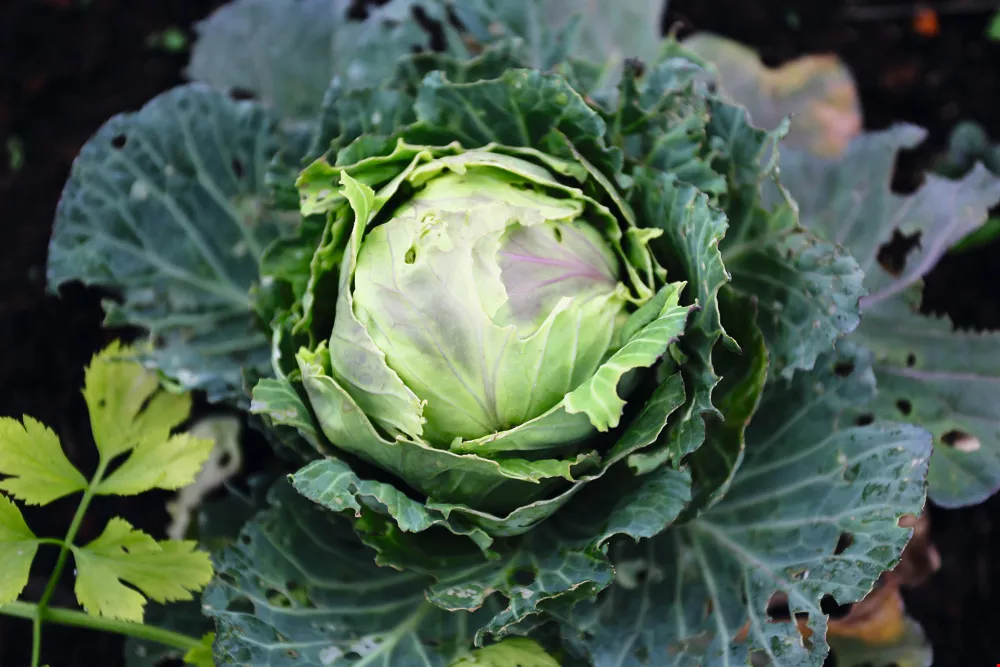
From leafy vegetables and fruit to spices and “succulents” (thick, fleshy plants), selecting the right species for rooftop micro-farming requires a lot of specialized knowledge. The little holes chewed through the leaves by insects indicate that these plants have been raised pesticide-free.
Mica Hsiao admits that when they started they “didn’t know squat” about farming. For example, they discovered that many plants they wanted to grow simply couldn’t survive the blistering heat on the rooftop. So they went back to the drawing board, reading books, finding information online, and asking advice from gardening experts. Going back to square one, they studied soil nutrition, composting, correct seed planting skills, and dealing with insect pests.
They also began composting leftover food from the sociology department and coffee grounds from local cafés. “We’re pretty much responsible for making a clean sweep of all the coffee grounds from all the coffee shops in this neighborhood,” laughs Hsiao. Using a coffee-ground composting system developed by an independent inventor named Yu Wei, they are able to apply an optimum aerobic composting technique, resulting in compost that is very permeable to air, doesn’t stink up the whole joint, and is ready to use after just two or three months.
But what did they do to address the number-one concern most people have about rooftop vegetable gardens—water leakage through the concrete roof?
Yang Chunming says that when flowerpots sit on the roof, puddles may easily form underneath, and this water will seep into the roof. What they have done with the sociology building micro-farm is to keep the boxes of soil from direct contact with the roof. Yang reckons that “the amount of water that leaks out of the growing containers is only about the same as you get when it drizzles.” So if your roof doesn’t leak when it rains, a micro-garden of this type isn’t going to be a problem.
Chen Dung-sheng suggests that citizen agriculture has its roots in two things: a rethinking of the whole model of commercial agriculture, and a desire for more community interaction. This is why Jia Jia Jiu have decided to expand beyond their department and even beyond their school, inviting students from the Department of Agronomy at NTU and from the neighboring National Taiwan University of Science and Technology to join their project and undertake improvements. NTU has also agreed to make the micro-farm one of the options undergraduates can choose to fulfill their requirement to participate in “service classes” (campus chores). With Hsiao and Yang as the “teaching assistants,” each semester there are places for 20 students in the micro-farm service class. Students are grouped into teams of five, and they agree on times to tend the farm.
The experiment is also being reproduced in the neighboring Jin’an Community.
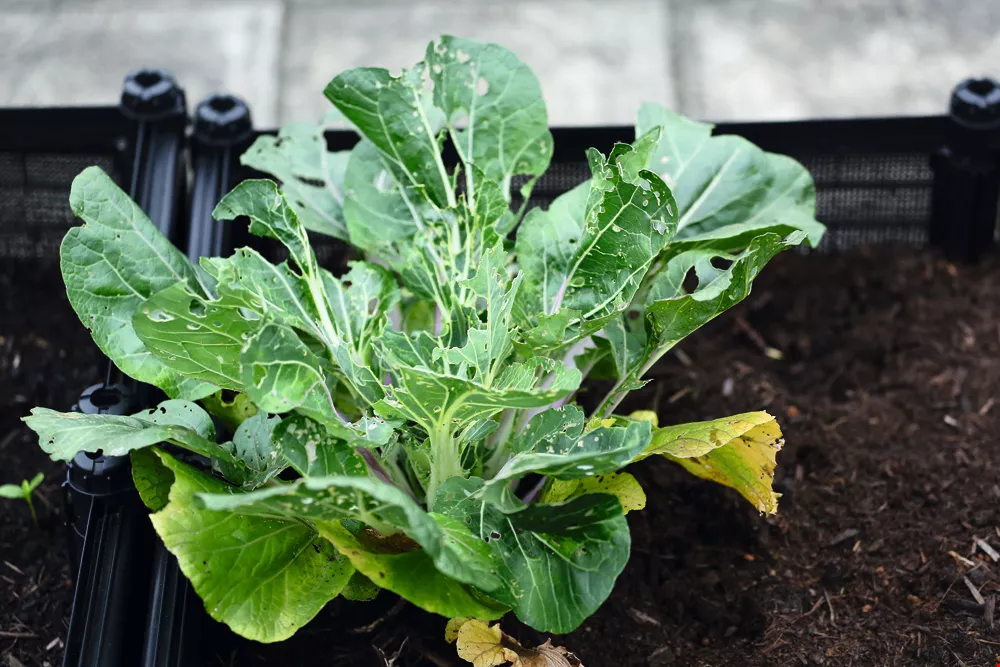
From leafy vegetables and fruit to spices and “succulents” (thick, fleshy plants), selecting the right species for rooftop micro-farming requires a lot of specialized knowledge. The little holes chewed through the leaves by insects indicate that these plants have been raised pesticide-free.
In the crowded classroom of a supplementary school on Lishui Street in Taipei City, 50 residents of the Jin’an Community are listening intently to the speaker on stage, Yu Fu-chun, the head of the social enterprise How’s Food. She is explaining up-to-date thinking about the healthiest ways to farm and eat. The response is gratifying, as people pepper the speaker with questions and engage in spirited discussion.
Professional community planner Sunny Chen, the Miracle Green City group (which includes trained community planners), and the chief of Jin’an Ward have worked together to set up a project for a micro-farm on the roof of the community activity center.
Chen, a vibrant and outgoing person filled with enthusiasm for life, was moved to action by a story she saw on the Internet education platform TED about some small towns in the UK that were promoting a policy of “edible landscaping”—replacing their purely decorative floral gardens with vegetable gardens. She put forward the idea in 2013, and it made a perfect fit with what Mica Hsiao was trying to do, so they started working together to promote micro-farms in the community. In order to ensure that local residents would have success with their vegetable gardens right from the start, they arranged for horticulture specialists to provide face-to-face guidance.
These kinds of activities bring vitality not only to public outdoor spaces, but to personal inner human spaces as well, making people more community minded. As an example of this attitude, Chen donates some of their vegetables to charitable organizations.
Meanwhile, Chen, Hsiao, and Yang Chunming recently created the XG Studio, and they are moving toward sustainable operations as a social enterprise. They will also offer a course at Da’an Community College to train “seed personnel” to engage in further promotion of community agriculture.
Citizen agriculture is not simply about putting idle space to some random use, or about some romantic best-of-both-worlds dream of becoming an “urban farmer.” It is mainly about sharing of knowledge and cooperation. “If everyone helps each other out,” says Chen, gazing with satisfaction at the flourishing rows of vegetables in the garden, “then something that once seemed like an impractical notion becomes a very real possibility.”
@List.jpg?w=522&h=410&mode=crop&format=webp&quality=80)

@List.jpg?w=522&h=410&mode=crop&format=webp&quality=80)


@List.jpg?w=522&h=410&mode=crop&format=webp&quality=80)

@List.jpg?w=522&h=410&mode=crop&format=webp&quality=80)
