Staff and Distaff-- Women Man the Temples
Tsai Wen-ting / photos Pu Hua-chih / tr. by David Mayer
November 1998


Go to any Taiwanese temple, and on most days you'll see that it is primarily women who go there to offer incense and pray. Go to the same temple on a special occasion, however, and it's a different story. When it comes time to celebrate a god's birthday or carry out a special ceremony to ward off misfortune, it is almost always men who take charge of the proceedings. In the temples and shrines of Taiwan, how exactly do women worship the gods?
It is October 13th, and Typhoon Zeb won't make landfall until tomorrow. Strong winds have brought brilliant, clear skies to Taiwan. A bright sun shines down on the stone steps of Hsing Tien Temple in Taipei. Dozens of older women are busily cleaning the temple to get it ready for a special occasion. Some are on hands and knees, scrubbing the steps. Others are wiping down the main temple gates, and still others scurry about with buckets of water to scrub the temple floor. A busier bunch could not be found, but each face beams with delight. Today, the temple is going to celebrate the birthday of the legendary Zhang Fei, sworn blood brother some 1800 years ago to the general Guan Yu. Hsing Tien Temple is dedicated to the worship of Guan Yu, so few birthdays are of greater importance to the faithful here.
A little past 7:30 in the evening, the celebration of the great warrior's birthday gets under way. The center of attention is no longer the women who were so busy cleaning the temple grounds a few hours earlier. Now, instead, the stars of the show are men, from the head of the ceremonies down to the lowest-ranking acolytes and attendants. Clad in long ceremonial robes, they "open the five doors" and offer incense and fruit to the gods.
Men also hold most of the high-ranking positions in other temple affairs. Men generally preside over the meetings of major temples, carry the religious statues and palanquins at temple festivals, and perform dragon and lion dances. It is male jitong (spirit mediums) who flagellate their bodies with knives and swords. Nevertheless, one large temple has departed from these traditional gender-defined roles. Tsu Huei Temple, which is especially noted for its ability to communicate with the spirit world, has over 1000 sub-temples, and women head half of them.
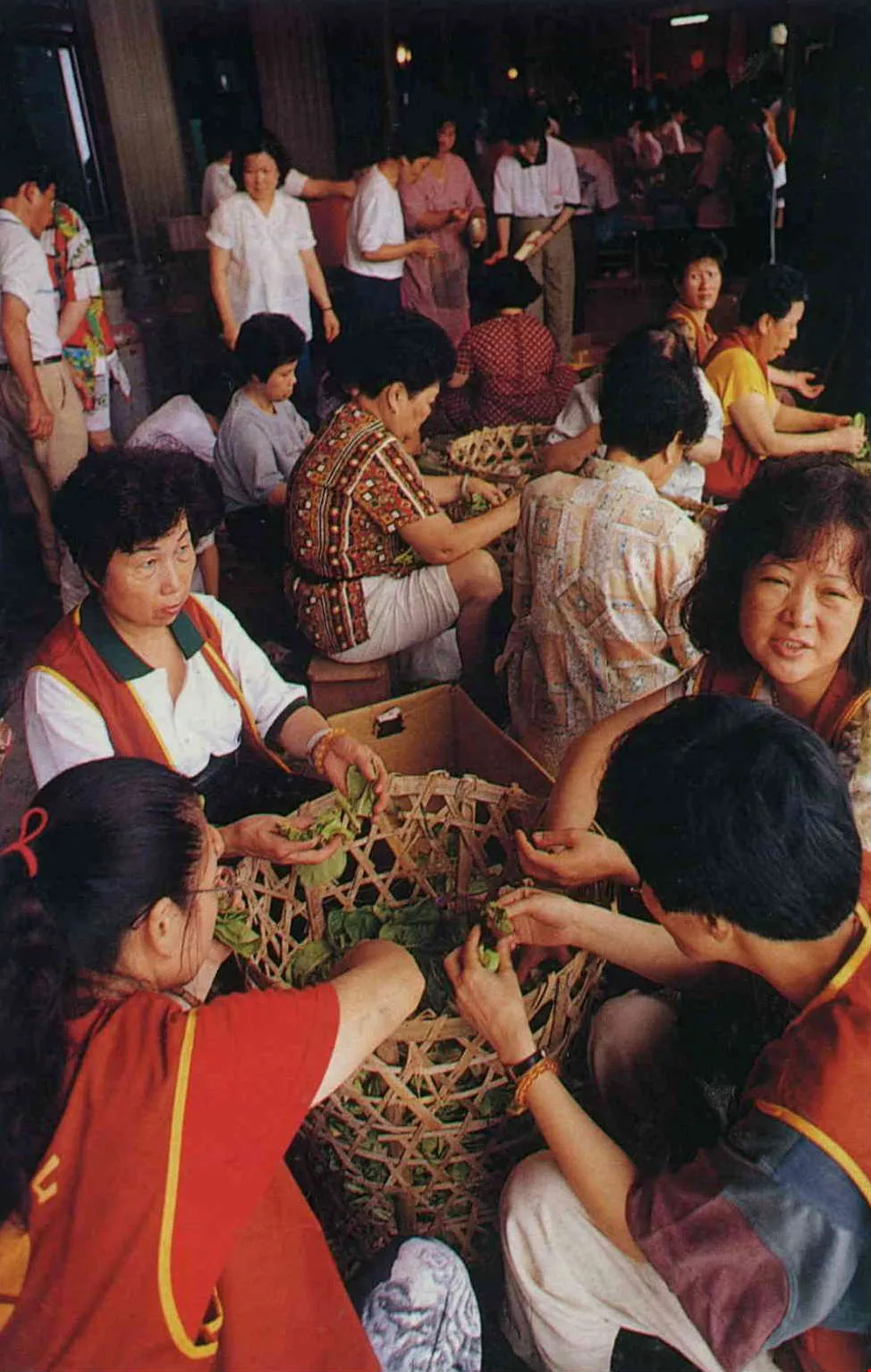
The women (left) who labor away behind the scenes in the kitchen are indispensable.
What kind of roles have women performed in religious activities at different places and times? Exalted sorceress
At the dawn of Chinese civilization, it was primarily women who acted as spirit mediums. This was perhaps due to the fact that China was then a matriarchal society. Perhaps, too, it was because women, who are more sensitive and sedate than men, are more in tune with the spirit world.
According to Lin Fu-shih, of the Institute of History and Philology at Academia Sinica, "Not only did sorceresses enjoy high political and social status at that time, they were also the equals of men in religious matters." Inscriptions on bones and tortoise shells from the Neolithic period include many accounts of sorceresses praying for rain, curing diseases, and capturing evil spirits. From the many different ethnic groups of northern China to the aboriginal inhabitants of Taiwan, sorceresses in the past enjoyed widespread prestige.
More than 2000 years ago, however, the social status of the practitioners of sorcery took a drastic tumble following the rise of Confucianism during the Han Dynasty. The only government post open to females up to that time had been the position of sorceress, but both sorcerers and sorceresses were excluded from the system by Confucian officials and scholars, who considered it a waste of time to concern oneself with some nether world that no one had ever seen. After that time, women very nearly disappeared from the public eye in official religious activities, to be replaced by legions of rigorously schooled Confucian literati. Sorceresses lost much of their former social status. No longer were they charged with the sacred tasks of beseeching the gods for good luck and warding off misfortune. Universally condemned by Confucian scholars, they drifted to the margins of society. A Confucian tract from that time states, "All those who pursue the sinister path throw government into chaos, and must die." The so-called 'sinister path' being referred to was none other than sorcery.
A man's world
Once Confucian men had taken control of the state's religious functions, they formulated laws and put Confucian scholars in charge of temple affairs at the local level to ensure that Confucian ritual would become an even more firmly established facet of popular religious belief. Beginning very early on, men alone carried out "the three offerings" to the gods (fruits, wine, and flowers).
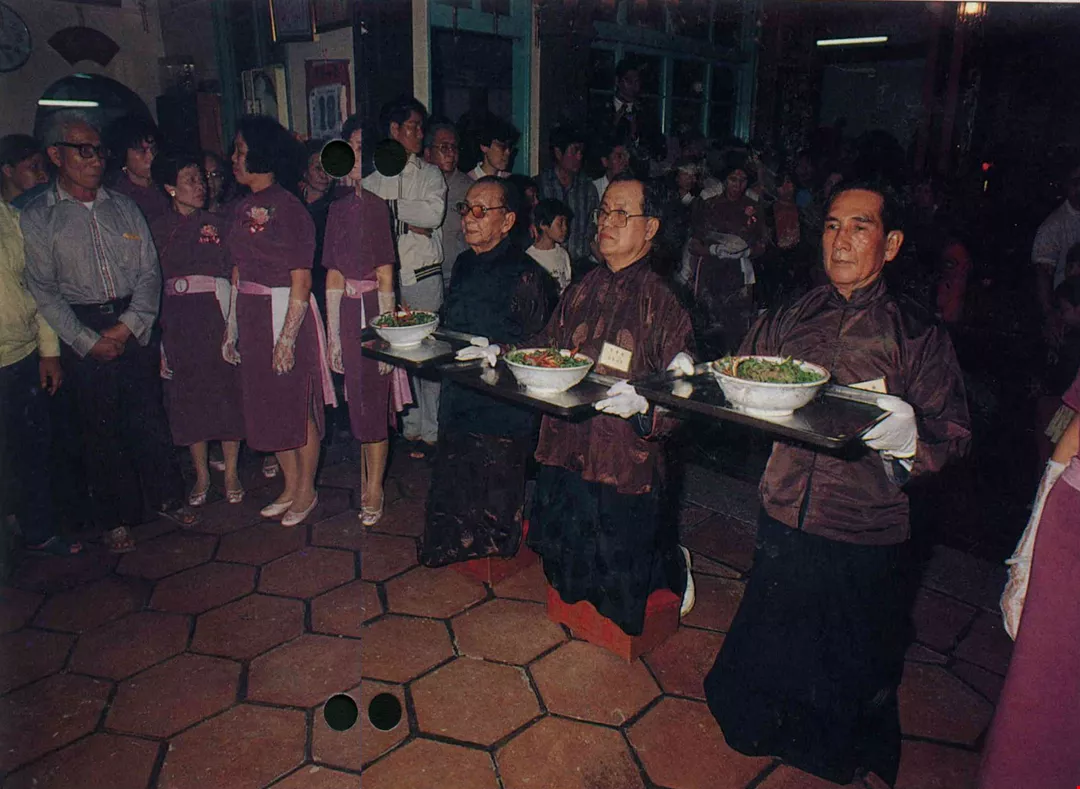
It takes more than the men (right) who perform the actual ceremonies to carry off a successful temple festival.
According to Lin Mei-jung of the Academia Sinica's Institute of Ethnology, "In traditional Chinese society, it was the man's place to take part in public affairs. At the local level, as well, men of good standing in the community would take charge of temple affairs, which had a great impact on the community's well-being." Furthermore, each household was only represented by males in meetings of the religious faithful, and this right to represent the household was passed down only to male descendants. Membership, as we might say today, has its privileges. Besides gaining the blessings of the gods, a man might also gain respect, and even support for a foray into politics. Small wonder, then, that candidates in modern-day election campaigns are always visiting temples. They say they do it to supplicate the gods, but their real purpose, in fact, is to hustle up votes. No girls allowed
In addition to having a lower social status and being barred from participating in religious functions, women have also long been regarded as "unclean." According to popular religious belief, women are unclean during menstruation and the first month after childbirth. All the women who volunteer their services at Hsing Tien Temple understand that they cannot go to the temple during their menstrual period.
A common sight at temple festivals in Taiwan is the jitong, or spirit medium, who defies nature by piercing his body and walking over hot coals without bleeding or blistering. It is said, however, that any jitong observed in such an act by an "unclean" woman will bleed profusely from his wounds. Likewise, a jitong walking over hot coals will suffer serious burns if an "unclean" woman is watching, because the jitong cannot commune with the nether world under such conditions. Nor are women allowed to perform the lion dance, which is believed to be an effective means of warding off evil.
In the opinion of Lin Fu-shih, "The idea of women being unclean cannot be interpreted simply as discrimination against women." Rather, says Lin, the sight of blood is inauspicious, and might have the power to disrupt religious ceremonies, or to interfere with the ability to communicate with spirits.
For this reason, work that brings people in close contact with the gods or entails preaching is mostly performed by men, while older women do the less glamorous tasks, such as sweeping the floor and cleaning tables.
Granny brigade
Hsing Tien Temple counts on the services of over 1000 volunteers at its temples in Taipei, Peitou, and Sanhsia. Most are older women. Certain tasks are performed almost exclusively by women-offering sticks of incense to visitors, trimming the votive candles, collecting the plates of offerings left by templegoers, and driving evil spirits away from visitors.
A woman in her 80s who has been handing out incense all day reveals that she has been working as a temple volunteer for over 30 years, but she points to a white-haired woman with a hunched back and says, "I'm not the longest-serving volunteer here. That woman there is over 90 years old, and she's been doing this longer than me."
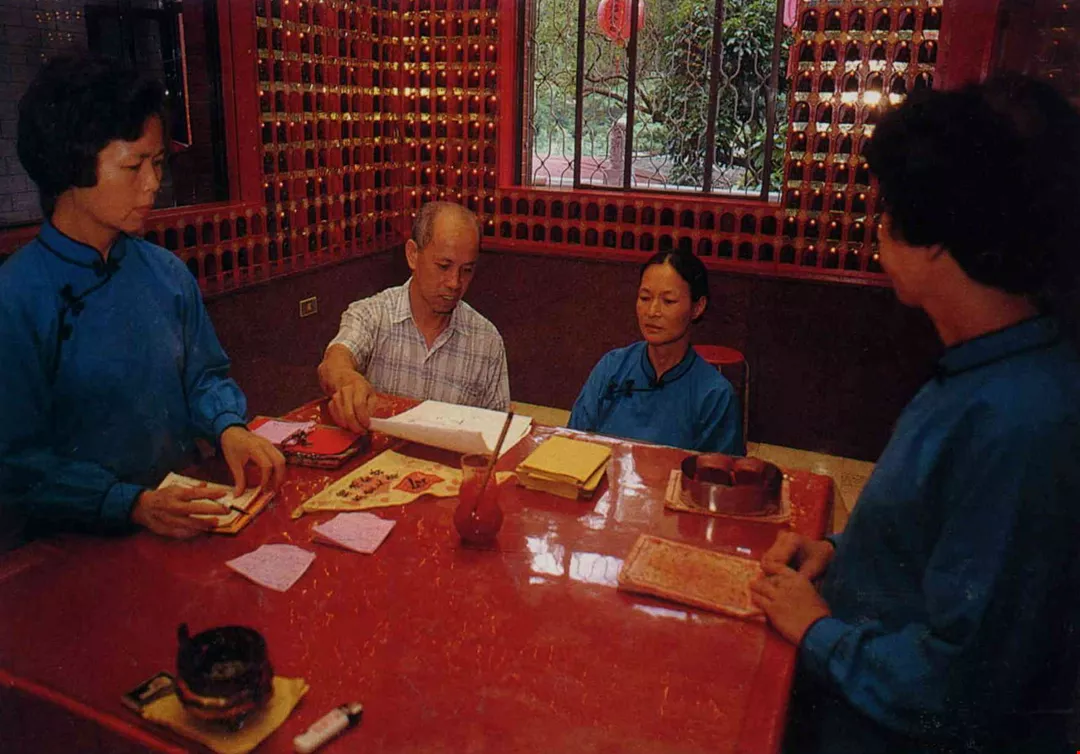
Dedicated to the worship of the goddess Jinmu, the Tsu Huei sect has women at the head of more than half of its temples. Sect leader Kuo Yeh-tzu is shown here helping a visitor communicate with the gods.
The head of the temple, Cheng Ming-ching, points out that the temple has less than 50 paid staff, so it is very dependent on these volunteers, who work at all hours of the day and night. The toilet detail, for example, is divided into three different shifts, the first of which gets started at 3:00 a.m. Some deities prefer women
Not all of China's religions, however, put men at the center of everything. Women are accorded differing degrees of status by different religions and sects. Women do especially well for themselves in Daoist religion.
Lin Fu-shih points out that Daoism frequently refers to the old adage that "the soft wears down the hard." Daoist religious training emphasizes the need to master both the yin and the yang, which is why there are so many references in Daoist legend to female deities, and to male deities bowing down in homage to them. In Taiwan, however, it is invariably men who take to the altar at Daoist ceremonies. The reason why most Taiwanese Daoist masters are male is that Taiwanese Daoism is an offshoot of the Zhengyi sect of Fujian Province, in which affairs are run by men who marry and practice the Daoist discipline at home.
Although almost all of the "martial" jitong, who flagellate themselves with nail-studded boards and "swords" fashioned from the snouts of saw sharks, are male, Cheng Chih-ming, director of the Institute of Religion and Cultural Studies at Nanhua Management College, estimates that some 80% of all jitong capable of communicating directly with the gods are female. From her own experience, Kuo Yeh-tzu, head of the Sungshan Tsu Huei Temple in Taipei, says, "Women are more sensitive and vulnerable than men. It's easier for them to empathize with the sufferings of others, so it's especially easy for gods to enter their bodies.
Much more than other religions in Taiwan, the Daoists accord equal treatment to men and women. Women can preside over religious ceremonies, and are allowed to interpret messages received from deities. Women enjoy particularly good status in the Tsu Huei sect. In fact, about half the Tsu Huei sect's temples are headed by women. Dedicated to the worship of the goddess Jinmu, this sect is one of the newer members of the Taoism Society of the Republic of China.
The female jitong who never rests
The Tsu Huei sect, which was founded in 1949 in Hualien County, now has more than 1000 temples throughout Taiwan. According to Ms. Kao Shih-chieh, who for the past 12 years has served as a jitong for communication with the goddess Jinmu, "Mother Jinmu once told us that it is better to have women serve as spirit mediums because female jitong don't feel as tempted as men to hoodwink the faithful to get money or sex. People find it easier to trust a female jitong."
The sect's temple in Taipei, Sungshan Tsu Huei Temple, is one of the ten largest temples in the city. As mentioned above, the head of the temple, Kuo Yeh-tzu, is a woman. In addition to her duties as temple head, Kuo also serves as leader of the Tsu Huei sect. She began acting as a spirit medium for female deities at the age of 28 to help believers ward off misfortune and recover from disease. 365 days a year, she works at the temple, serving as the medium for the goddess Jinmu to help people avoid calamity and cope with bad luck.
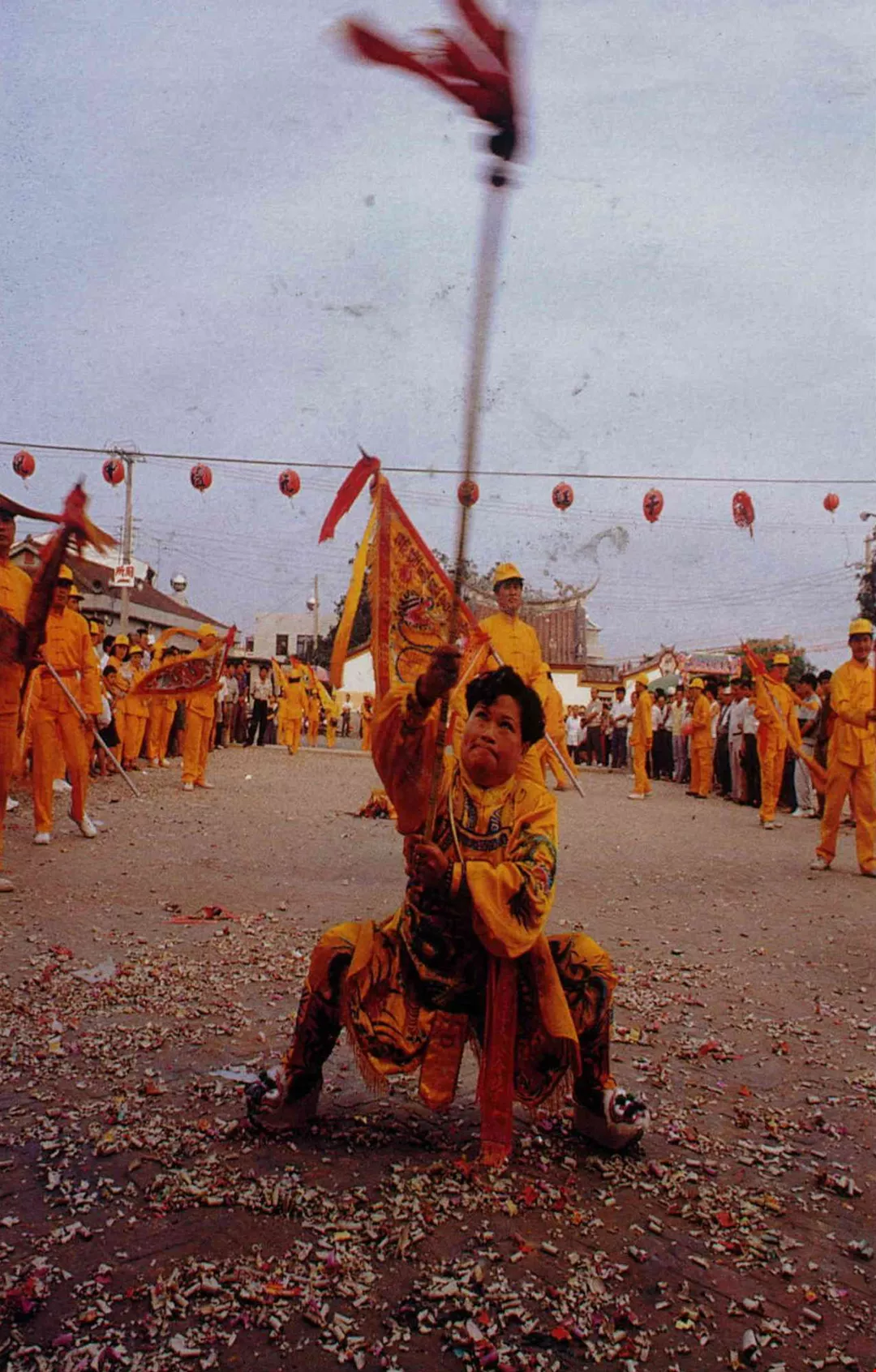
The "martial jitong" who punish their bodies with knives and swords are mostly men, but large numbers of women throughout history have acted as sorceresses and spirit mediums.
As a female head of temple, Kuo Yeh-tzu naturally has a different perspective from men regarding the various restrictions upon the role of women in religion. A strict vegetarian who is completely devoted to her work, Ms. Kuo states, "I just want to serve Mother Jinmu. Why in the world would I want to take five or six days off every month? And who cares whether you're a man or woman? As long as you have attained inner peace, what difference does it make?" Ms. Kuo has also broken with tradition by allowing people in mourning and women during their first month after childbirth to come to the temple. As she sees it, religion is there to save people, and if someone in the family has died, people should come to the temple as soon as possible to see that the departed is properly guided to eternal paradise. Female palanquin bearers
"Popular religion is always in a state of flux," says Lin Mei-jung. "When a need arises, religion will slowly change to accommodate it." Today, for example, more and more temples are being built in Taiwan, but the number of young people participating in temple festivals sinks continually lower. Furthermore, a male head of temple must, in addition to his duties in the temple, hold down a regular job, just like anyone else. Most attend to temple affairs only in their spare time. There are far too few hands available for all the temple work that needs to be done.
The void is being filled by middle-aged and elderly women. With their children gone from the home, they can devote every day of the year to the temple. These are just the people needed to carry out temple festivals. As a result, women are beginning to assume greater visibility in temple affairs. Some even take an active part in the performance of religious ceremonies.
No longer do women find themselves barred from some of the less physically demanding tasks. Now that there are not enough men available to do the heavy work of carrying palanquins on their shoulders, palanquins are being fitted with wheels and pushed along by older women. These volunteers are also allowed to hold religious statues and serve as attendants during ceremonies. At the Matsu Temple in Penghu, once every three years the goddess Matsu hosts a raucous gathering of deities in which wine is offered to the gods. At the festival held to mark the occasion, it has become the established practice for all of the ten or more statues of the gods to be carried by female attendants dressed in long ceremonial robes.
Another sign of change is the special ceremonies that are held to consecrate a newly built temple or drive away the lingering air of misfortune that remains after an unlucky event. In the past, only a very small number of men responsible for carrying out the ceremony were allowed inside the temple, but now if it is necessary for a woman to enter the temple, the head of the ceremony generally just dips a willow branch in water and sprinkles it over her, thereby symbolically "cleansing" her of female "impurities."
Yin on earth, yang in heaven
So do women have to achieve a more visible presence in religious life before it can be said that they have found their spot in the sun? In the opinion of Lee Hom-mou, a researcher at the Academia Sinica's Institute of History and Philology, "The head of the temple isn't the only person who plays an important role." Says Lee, "I once took part in a famous ceremony that's held every year in Peikang. During the ceremonies, the head of the temple asked with pride what I thought of the proceedings. I told him that the ceremony was a great success, and that the most impressive contribution of all was made by the old women toiling away in the kitchen."
Lee's view is that the temple head mostly deals with administrative issues, (i.e. the social aspects), and that the female volunteers, by looking after temple visitors and driving away the lingering effects of unpleasant experiences, handle the religious aspects.
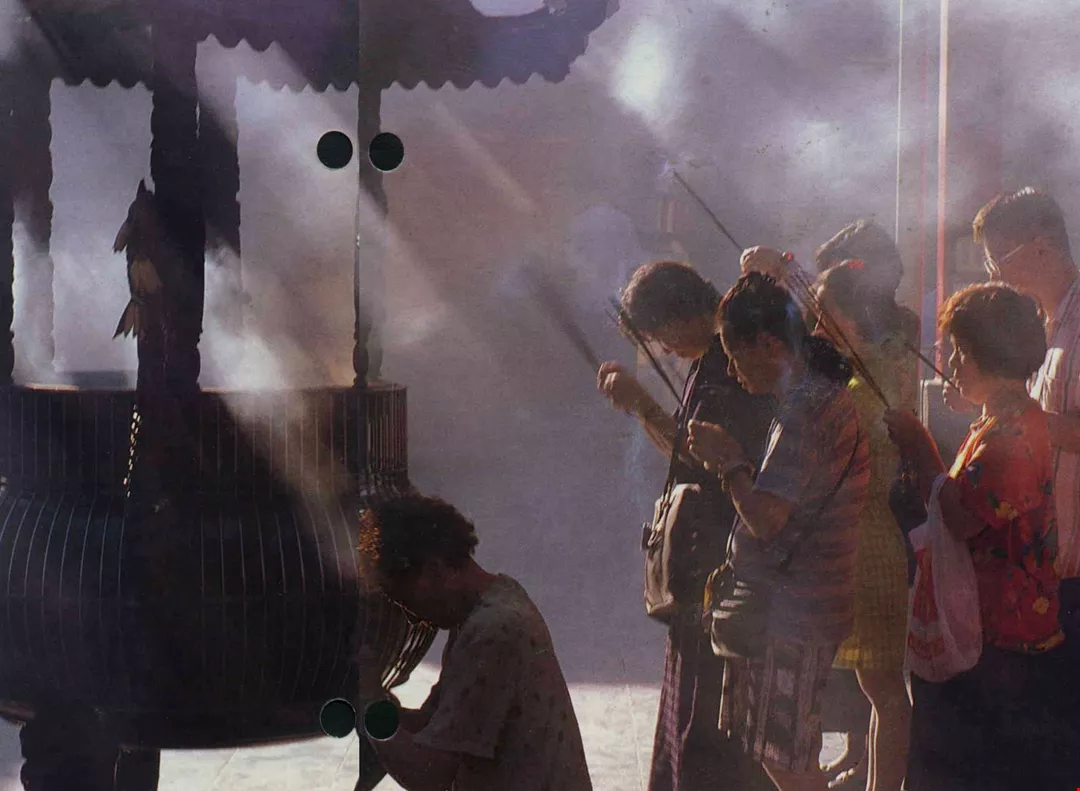
A stick of incense, a thousand hopes. Most templegoers are women, and so are most of the volunteers who keep the temples running.
"Those are not menial servant's tasks that the volunteers carry out. They are sacred services." According to Lee, the activities of the women volunteers constitute the heart of religious activities. Authoritative men, nurturing women
At Hsing Tien Temple, which has a large corps of volunteers, temple visitors wait in long lines for the women volunteers to drive away the lingering effects of unpleasant experiences. This is done in a rite known in Chinese as shou jing. Dressed in dark blue robes, the volunteer first asks the visitor's name. She then waves a joss stick in front of and behind the visitor to drive away whatever is troubling the person physically or emotionally. The men at Hsing Tien Temple, on the other hand, serve the visitors in a different way. Another common reason for going to the temple is to draw lots to obtain cryptically written messages which contain advice on how to manage one's affairs. There is an art to the interpretation of these messages, for they are largely unintelligible to the uninitiated. In general, templegoers much prefer to have their messages interpreted by a man, who they feel has more authority. Such is the division of labor between men and women at Taiwanese temples.
When a middle-aged woman sees her children, for whom she has toiled away her entire adult life, grow up and move away from home, she often suffers from "empty nest syndrome." Volunteering at a temple is an excellent way to deal with this problem. In addition to the fulfillment of being involved in a spiritual activity, the volunteer also gains the satisfaction of knowing that she is helping people. Says one woman as she uses a paring knife to trim the votive candles, "It's an honor to help out the gods, and it builds up good karma."
In the opinion of Lee Hom-mou, "You mustn't think that these women view their volunteer work as a self-serving exchange of favors for good karma. These women have worked all their lives for the sake of their husbands and children, so when they offer incense and pray to the gods, they're not just doing it for themselves. The good karma they build up is for their entire family." In addition, helping people is in essence an act of mercy and compassion. These women give of themselves to all templegoers, as if all were their children. "What they get in return is more than just the satisfaction of knowing that they've helped people. On a deeper level, I think that what they experience is the joy of motherhood."
The women who volunteer at temples never worry about whether their work puts them in the limelight. Their only wish is to make themselves useful. They don't need to order people around. Handing out joss sticks to visitors and assuring them that the gods are looking after them may seem to be simple tasks, but they are the heart and soul of temple life in Taiwan.

@List.jpg?w=522&h=410&mode=crop&format=webp&quality=80)
@List.jpg?w=522&h=410&mode=crop&format=webp&quality=80)


