“Some of the Dregs”—Writer Ma Kafai of Hong Kong and Taiwan
Wei Hung-chin and Teng Sue-feng / photos Chuang Kung-ju / tr. by Scott Gregory
August 2012


“Hong Kong is not where I will be laid to rest. Taipei is the place I will live out the rest of my days.” This is the confession of Hong Kong author Ma Kafai, 49. Ma loves Taiwan not just because he married a local; as professor Leo Ou-fan Lee says, it’s rare even in a multicultural place like Hong Kong for someone to be able to be so at home in both places. Ma can tell the story of Hong Kong star Leslie Cheung’s career just as well as he can relate the childhoods of Taiwanese directors Hou Hsiao-hsien and Edward Yang.
A frequent traveler in the Greater China region, Ma was selected by Southern Metropolis Daily as one of the opinion leaders of Shenzhen and Hong Kong for the year 2010. His writing is expressive and sharp, impressionistic and insightful. It provides Taiwanese with a window on the society of the Greater China region.
Few writers would describe themselves in this way, but Ma boldly declares he is one of Hong Kong’s top writers. This appellation comes from the sheer amount he publishes: besides columns in Hong Kong’s Ming Pao and Apple Daily, he writes for nine newspapers and three magazines throughout Greater China.
For the last 30 years, he has written at least 2,000 characters a day on average. If all of his columns were put together, with 600 characters per page, he figures his 22 million characters would come out to 187 books.
Writing every day, he has a strategy for his columns. On Mondays and Tuesdays, when readers’ spirits are up, he’ll discuss more serious topics. On Wednesdays and Thursdays, he’ll offer some playful perspectives, and on the weekends, he writes some anecdotes.
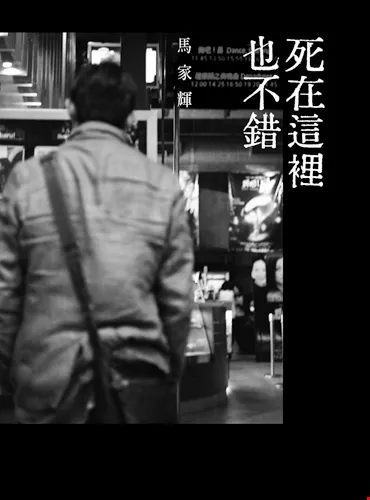
Ma’s writing is both stately and humorous, earning him a reputation in Taiwan as a “rare breed”—a cultured writer with a sense of humor.
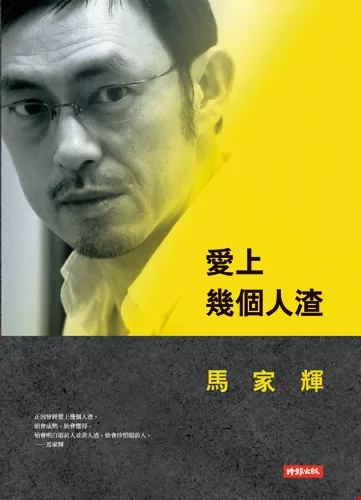
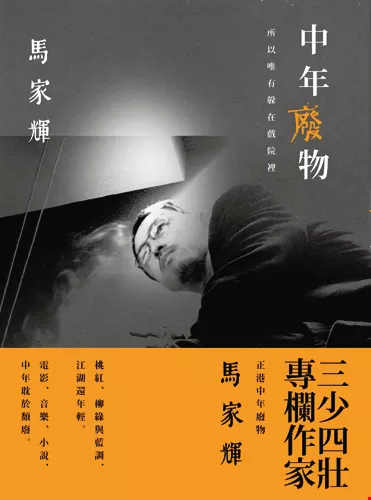
His straightforwardness is also reflected in the title of his new book, In Love with Some of the Dregs of Humanity. The publisher initially opposed the title, but Ma insisted because it is part two of his “Decadent Trilogy”: last year saw Middle-Aged Wastrel, this year it’s the “dregs,” and next year it will be “human garbage.”
However, Ma’s new book is not a defense of wastrels or the dregs of humanity. Rather, it’s a collection of observations from his own daily life that were originally published in newspaper columns in Taiwan, Hong Kong, and mainland China. They cover film, travel, opinion, and random impressions.
The “dregs of humanity” in his title actually comes from a classic line in the Hong Kong film Love in a Puff: “In all the years of your lifetime, you’re bound to fall in love with some of the dregs of humanity.” Ma says that men and women alike mature and grow from the experience of falling in love with some “dregs.” The experience makes them appreciate the good ones that come along later.
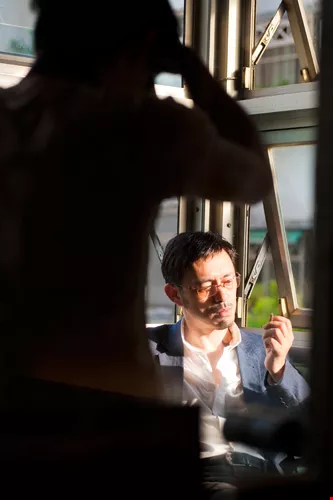
The Hong Kong writer Ma Kafai has one eye on the underworld and the other on the cultural world, and his writing is both pointed and expressive. He has many ties to Taiwan—he studied and worked here, and married a local woman.
The whole story behind the book’s title is tied up with Ma’s own personal background.
Ma was born in Hong Kong’s Wanchai area. Wanchai is an old community where all sorts of people are to be found. From an early age, he was accustomed to seeing drug addicts, prostitutes, gangsters, and other social outcasts.
“Everyone has their own definition of ‘dregs of humanity,’” Ma says. “Psychology says that we all have brightness and darkness, good and bad, in our minds, so why is it so easy for some to label others as the dregs?” Ma has a strong interest in such external labels. He had two uncles who were policemen but got caught up in drugs themselves. They attacked someone with knives for drug money and in the end committed suicide.
He grew up in a household of 10, with his grandparents, uncles, and others all packed into a small apartment. At one point, he even became a compulsive gambler. He once stayed at a table in a Macao casino for two days and nights without eating or using the restroom, watching the cards as if possessed. He had what he thought was a good hand, but when he put the cards down, the other players just gave him an odd stare—he lost everything. Twelve years ago, he decided to give up gambling for good.
His family’s story is grittier than the Hong Kong gangster films he grew up watching. He always wanted to play one of the mobster car attendants that are often in those movies, so he could drive a nice car and show off his tough, rootsy personality.
“Being in the mob is like having a license,” Ma says. “You can be a tough guy and hit people, curse people.” Unfortunately, he’s thin and pale, and wears thick prescription glasses—he’d never make it as a gangster.
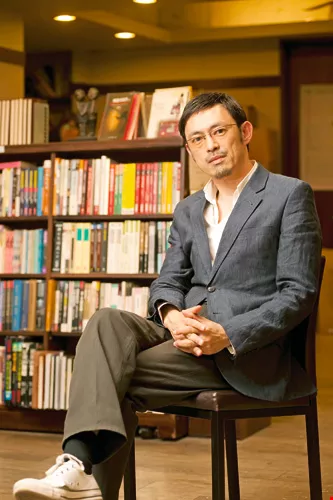
Ma’s words often surprise. He’s said he always wanted to be a car attendant for the mafia, so he could drive all the fancy cars.
Ma loves to talk about the underworld, the loyalty between gangsters, and the double-crossing that goes on. He is interested in that life but also has the air of a scholar and the ability to express his opinions—qualities that can be attributed to his family environment. His father was editor-in-chief of the Oriental Daily, and he first started submitting his writing for publication in high school. He hasn’t let up for 30 years, and has worked in media ever since graduating from college.
When he was 17, Ma came across a book by Taiwanese cultural enfant terrible Li Ao. He was captivated, and went on to read all of Li’s works. He also determined to write about Li Ao one day.
A cinephile, Ma once idolized the Hong Kong director Tsui Hark and entered a Hong Kong university to study film. But under the spell of Li Ao, he soon decided to go to Taiwan to study psychology at National Taiwan University.
While a student, he continued to read Li Ao, and even went to visit him. Every afternoon, he’d go to Li’s home to help with clipping articles and to listen to Li’s funny stories.
In his second year at university, Ma completed his book Eliminate Li Ao, or Be Eliminated by Li Ao. After reading it, Li Ao said, “You understand Li Ao better than I do myself.”
“I just used Li Ao the irresistible force to attack Li Ao the immoveable object,” Ma says. “I didn’t think I would receive his blessing. I felt a real sense of accomplishment.” A few years ago, Tsui Hark asked him out of the blue to act as a consultant on a documentary he was planning to make about Li Ao. It was as if his life had come full circle, and he had met everyone that he was destined to meet.
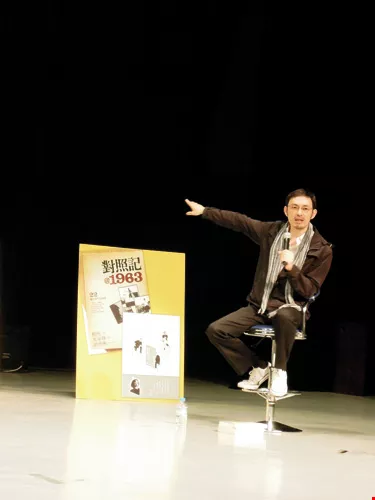
Earlier this year, Ma, Taiwanese writer Yang Zhao, and mainland media figure Hu Hongxia collaborated on a book of the collective memory of the greater China region. As all three of them were born in 1963, the book was called Comparative Collection@1963. Ma is pictured here giving a lecture in China.
After graduating from NTU, he remained in Taiwan to work. He worked as a copywriter in an advertising company, and as a magazine journalist. He then went to America to earn a PhD in sociology, and in 1997 returned to Taiwan to teach at Shih Hsin University.
Around Chinese New Year that year, the well-known Taiwanese newspaperman and founder of the China Times’ literary supplement Kao Hsin-chiang called Ma from Hong Kong and said, “You’re a Hong Konger—what on earth are you doing in Taiwan? Why don’t you come and work at Ming Pao?” The next day, Ma was on a plane to Hong Kong, and went to take the job as Ming Pao’s deputy editor-in-chief.
Ma developed a supplementary section for Ming Pao. Supplements in Hong Kong newspapers had traditionally been focused on local gossip columns, but Ma widened the scope to include articles by well-known writers on Taiwan, Hong Kong, and mainland China. He fashioned it into a major cultural publication.
He took up a teaching position at City University of Hong Kong in 1998, and when he wasn’t teaching he kept himself even more busy. As well as staying on at Ming Pao as a consultant, he also appeared on TV and radio, and put out a daily newspaper column. From 1998 to 2000, he hosted a talk show on Phoenix Television that aired Monday through Friday and was viewed by 200 million people. He was recognized everywhere he went.
Ma says that professors in Hong Kong usually remain aloof from society, but he threw himself into social reform and would often discuss politics and current events in public forums. His front-page opinion column in Ming Pao (which is like an editorial in Taiwanese newspapers, but carries a byline) caught the attention of Hong Kong’s former chief executive Tung Chee Hwa, who specially asked the paper’s editors and the administrators of Ma’s university to “have coffee” with him. The editors knew the value of free speech and told Ma to ignore it.
July 1, 2012 was the fifteenth anniversary of the handover of Hong Kong from the British to the Chinese, and as in the past tens of thousands of Hong Kongers took to the streets to make demands of the local government and the PRC. Over the last 15 years, how much has Hong Kong changed?
“The protestors marching today have even less faith in the abilities of the region’s administrators to govern Hong Kong. The protestors’ demands are much more varied than they were 15 years ago. There are many more young people protesting than 15 years ago. The protestors’ chants are much more against the so-called ‘integration’ of the mainland and Hong Kong than 15 years ago.”
Ma Kafai expresses himself in his rich writing. He writes on places, underworld battles, romance, and film. He’s experienced at writing in many non-fiction genres.
According to Ma, Hong Kong residents are deeply troubled by the collapse of their “core values” of democracy and rule of law, and that the widening income gap and high cost of housing prove that the promises of a “high degree of autonomy” and “local governance of Hong Kong” were nothing but hollow words.
He says that anyone born and raised in Hong Kong can come up with a reason to fear the mainland: Young people fear that jobs are being taken away, because mainlanders can come to Hong Kong to get a master’s degree, then stay to work and apply for permanent residence. Shenzhen residents drive over the border on the weekends and snap up everything that’s on sale, so that baby formula might be HK$30 this week and HK$40 the next—mistrust of goods manufactured in the mainland has led to higher prices in Hong Kong. Expectant mothers worry that when it’s time to give birth there will be no beds available in the hospitals. “But this isn’t a clash of civilizations,” he says, “it’s a clash of interests.”
“To judge how civilized a society is, you don’t look to see how many bad things happen. You look to see how the society responds and discusses things. On this aspect, Taiwan has a high level of education.” Ma says that mainland tourists to Hong Kong and Taiwan like to buy banned books, and they hide the books in their carry-on bags as if they were concealing drugs. The limited freedom of speech and lack of rule of law in China shows by contrast Taiwan’s strengths.
After writing for so many years, Ma says he aims to “avoid harsh words” not because he is “afraid of offending people” but because he “doesn’t want to hurt people.” With his pen, Ma questions the world and challenges himself. He’s straightforward in his words, putting his all into every one.

@List.jpg?w=522&h=410&mode=crop&format=webp&quality=80)


