Taking Offshore Production to Myanmar: Case Studies
Lin Hsin-ching / photos Chuang Kung-ju / tr. by Geoff Hegarty and Sophia Chen
November 2012


Myanmar, a nation with a labor force of around 60 million low-paid workers, is becoming a sort of “holy land” for global outsourcers. A host of international manufacturers are waiting for the country’s amended Foreign Investment Law to take effect to move into the nation. As early as a decade ago, in fact, two listed Taiwanese companies—Tah Hsin Industrial Corporation and Asia Optical—were already putting capital into Myanmar, and have since become valuable models for more recent investors. Asia Optical remains the first and only foreign electronics manufacturer in Yangon (formerly Rangoon), while Tah Hsin, hit badly by past US and European economic sanctions against Myanmar, is currently thriving.
In the 1990s, Myanmar was the global hub of garment and footwear manufacturing with over a 1000 foreign companies—including several hundred from Taiwan alone. Drawn by cheap labor, Tah Hsin set up its operation there in 1999.
In the early 1990s, Tah Hsin set up factories in China’s Fujian Province and Vietnam. But according to Weisner Jiaan, VP of sales management, the prospect of rising wages and a lack of labor soon started causing problems in these regions. In response, the company began searching for a new production base, and as the result of an introduction through Japan’s Mitsui Group, they finally settled on Myanmar’s Mingaladon Industrial Park.
In 1999, Tah Hsin became Taiwan’s first listed company to invest in Myanmar (even though at the time they were registered in Hong Kong), with capital of around US$13.5 million. At the time, even university professors in Myanmar earned an average monthly salary of a mere US$20–30, not to mention average laborers, so the country offered possibly the cheapest workforce available in regions where Taiwanese business was investing.
But the good times were shortlived. Around 2003, as a protest against Myanmar’s military-dominated dictatorship, Europe and the US enforced tough economic sanctions on the nation, with a ban on imports of “Made in Myanmar” goods, triggering the mass exodus of foreign capital. Taiwanese-owned garment factories also had to retreat.
Fortunately, with Mitsui’s support, Tah Hsin aimed at developing the Japanese market rather than exporting to Europe or the US, and also were able to partake in some of the work won by the company’s other factories in mainland China and Vietnam. So eventually Tah Hsin made it through the difficult times of economic sanctions.
Since last year, in response to democratic reform in Myanmar, the EU has opened up imports of Myanmar goods. Tah Hsin predicts that opportunities will flow from Aung San Suu Kyi’s prominence—European customers may begin asking for “Made in Myanmar” products as the country moves gradually toward democracy and its image improves.
Tah Hsin survived the calamity of economic sanctions with, today, a huge increase in employee numbers from 600 to 1600, and 39 production lines. Except for Wednesdays and Saturdays, overtime is necessary to meet the demand. Products range from inexpensive plastic raincoats for Japanese elementary school students, to premium items such as jackets and raincoats worth several thousand NT dollars each. The scale of the Myanmar operation has now surpassed those of mainland China and Vietnam: with revenue of around NT$290 million in 2011, it has become Tah Hsin’s largest offshore production base.
However, rising wages and a growing awareness of labor rights are creating concern for the company’s future in Myanmar.
Chen Wuyao, general manager of Tah Hsin’s Myanmar plant, states that garment factory workers in Mingaladon Industrial Park went on strike in July this year, finally negotiating for a 15–17% wage increase. Tah Hsin’s minimum monthly wage including overtime is currently around US$100.
In addition, the appreciation of the local currency (the kyat) has added another challenge for export-oriented companies like Tah Hsin. Fortunately, Myanmar still has an advantage with its cheaper workforce. And when the US lifts import restrictions completely and grants tariff preferences, the nation’s economic outlook will become even brighter. “In response to market projections, we are preparing to expand our production facilities in the region,” says Chen.
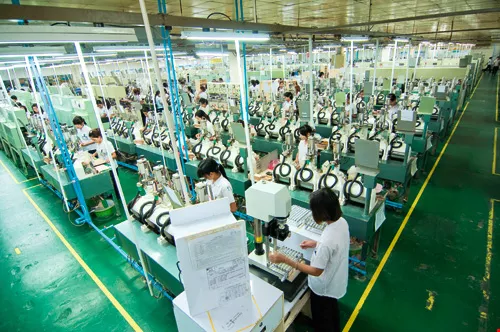
Asia Optical’s plant in Myanmar has a complete production line from lens grinding to coating, producing a range of optical lenses. Lenses are inspected for imperfections at Asia Optical’s Myanmar plant.
Established 31 years ago, Asia Optical is Yangon’s first foreign electronics factory. Currently the world’s largest manufacturer of optical lenses, the company has 16 operating divisions with products ranging from optical components (lenses, camera lenses and filters) to laser rangefinders, microscopes and cameras.
To remain competitive, they have invested heavily in technological R&D in areas such as optoelectronics and lens coatings. But at the same time, the company retains the need for a substantial labor force mainly for grinding lenses.
Myanmar, with the clear advantage of abundant young labor and low wages, was the first choice for Asia Optical’s expansion to supplement operations in mainland China and the Philippines.
Their plant in Mingaladon Industrial Park was opened in March 2003 at a formal ceremony attended by Myanmar’s former prime minister Khin Nyunt and the Japanese ambassador, as well as government and business representatives from various sectors. The government clearly values the company’s investment in Myanmar.
It may seem strange that Asia Optical chose a different path from other foreign companies which withdrew their capital when Myanmar came under economic sanctions in 2003. The reason is simple. The components produced in the Myanmar factory were used mainly to supply Asia Optical’s other plants, so the Myanmar operation was part and parcel of the company’s internal supply chain. Without concerns about exporting, the Myanmar plant was able to focus on maintaining steady production. Today when people visit the plant, they see busy production lines operating in a clean and spacious working environment. The plant employs nearly 5000 people, produces 250,000 lenses and 8,000 sets of camera lenses daily, and has grown into one of the largest foreign operations in Yangon.
Managing such an enormous plant is not easy, especially today when Myanmar workers are becoming increasingly aware of their rights. But Asia Optical is proud of its reputation and is generally recognized by its employees as providing a healthy working environment.
One of Asia Optical’s directors, Iris Wu, says that the plant in Myanmar provides free accommodation and meals (four meals a day) for employees, and boasts air-conditioned facilities. In fact, the plant is currently the only one in the city that has air-conditioning.
“If the free accommodation and meals are put into the equation, the average monthly salary of employees comes up to about US$120.” Wu explains how important it is for the workers to have free bed and board as many Myanmar families are unable to afford meat, and some even lack water and electricity at home. The plant has also set up a shrine where devout Buddhist employees can worship.
Asia Optical has also implemented a policy of promoting local employees to senior positions. In the initial stages, Asia Optical brought 71 senior personnel from mainland China to manage the Myanmar factory and train local ethnic Chinese workers to become team leaders, who were able to pass on their skills to other locals.
Wu points out that foreigners make up only 1.5% of the total workforce at the plant in Myanmar. Assigning management responsibilities to local workers not only makes full use of local manpower, but also provides promotion opportunities for local employees, thereby reducing cultural barriers.
Looking to the future, which for the moment is looking quite rosy, Asia Optical may be able to export products directly to Europe and the US. In fact, acting before prices skyrocketed, they have leased several pieces of land in Mingaladon Industrial Park to meet the needs of future expansion.
“Go for it! We need to meet our quota!” As a shift begins, calls like this can be heard echoing around the factory where workers seem to be brimming with energy. Care for their workers is a key concept of Asia Optical’s management philosophy, and one which has allowed the company to take solid root in Myanmar.
@List.jpg?w=522&h=410&mode=crop&format=webp&quality=80)

@List.jpg?w=522&h=410&mode=crop&format=webp&quality=80)


@List.jpg?w=522&h=410&mode=crop&format=webp&quality=80)

@List.jpg?w=522&h=410&mode=crop&format=webp&quality=80)
