Missionary Lumaf Damapima: Serving Forgotten Minority Peoples
Polly Peng / photos courtesy of Lumaf Damapima / tr. by Scott Williams
March 2015


“I had a stroke while I was writing my doctoral dissertation, perhaps because I was overworked and exhausted,” recalls Lumaf Damapima. Lumaf, who goes by Jiang Guanrong in Mandarin, says: “I promised God that if I got well I would dedicate my life to him.” After recovering from his stroke and completing his PhD, Lumaf resolved to go into the mountains to bring the Gospel to “minorities the world has forgotten.”
Born in a small Bunun community in the mountains of Hualien, Lumaf Dumapima used to spend six hours a day walking to and from school. The effort involved made him cherish his educational opportunities, and may well have influenced his decision to serve as a missionary in remote parts of Southeast Asia. Though he went on to earn PhDs in both architecture and divinity, Lumaf’s particular concern is the education of young children. As a missionary, he has used all the strength and resources at his disposal to establish schools that provide refugee children with educational opportunities of their own.
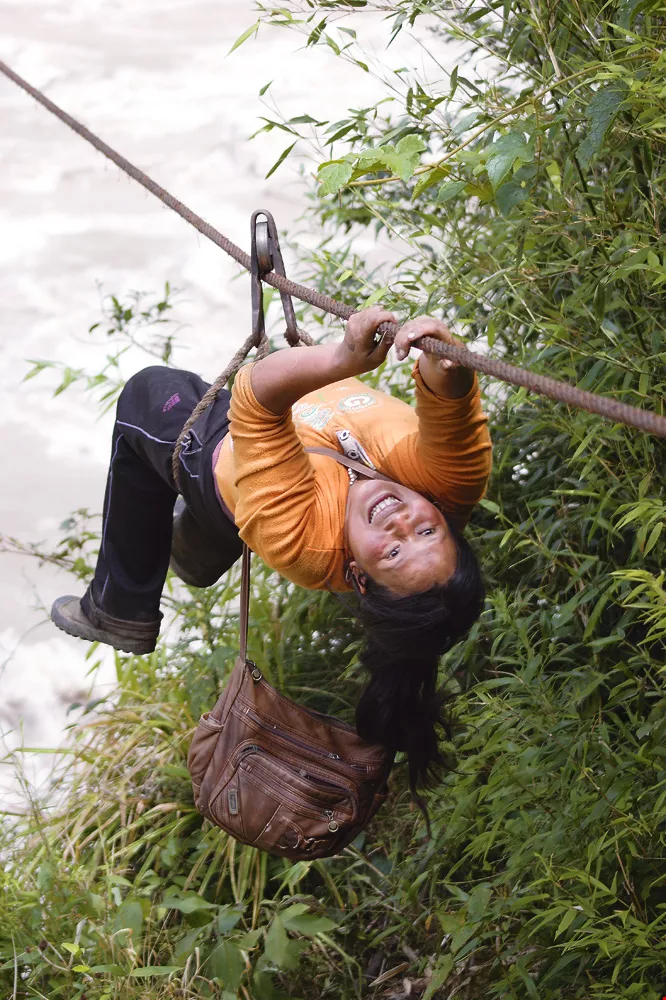
Getting around in the mountains can be a major undertaking. Sometimes zip lines are the only way to get to a refugee camp.
Lumaf joined Minorities for Christ International in 2005, and was formally designated a missionary in 2007. “I promised God to serve minorities and refugees for ten years,” he explains. “I think of a decade as a phase or stage: it’s how long you have to work on something before you begin to see incremental changes.”
Lumaf also married his girlfriend of ten years in 2007. Missionaries are expected to pay their own way. When he went into the mountains on his mission, his wife, an ethnic Chinese lawyer, not only took charge of earning their livelihood, but also set about raising funds for him. “My wife worked day and night taking on cases and writing briefs to earn money.”
Soon thereafter, she too decided to become a missionary and serve people on the geopolitical and social margins. “We had many economic concerns and struggles at the outset, but have learned over time that there’s nothing to worry about. God provides everything we need. His blessings are enough for us.”
Lumaf says he has learned that he is very well suited to serving minority villages in remote areas. “First, I’m an Aborigine, too. I understand the people’s situations, values and ways of thinking, so we have fewer barriers to communication.” He adds that some missionaries from the plains have a hard time with the “facilities” in the mountains, noting that there aren’t any proper toilets. He laughs: “They don’t know where to relieve themselves.” That isn’t a problem for him. “The mountains are vast. I’ve been ‘giving back’ to nature since I was a child.”
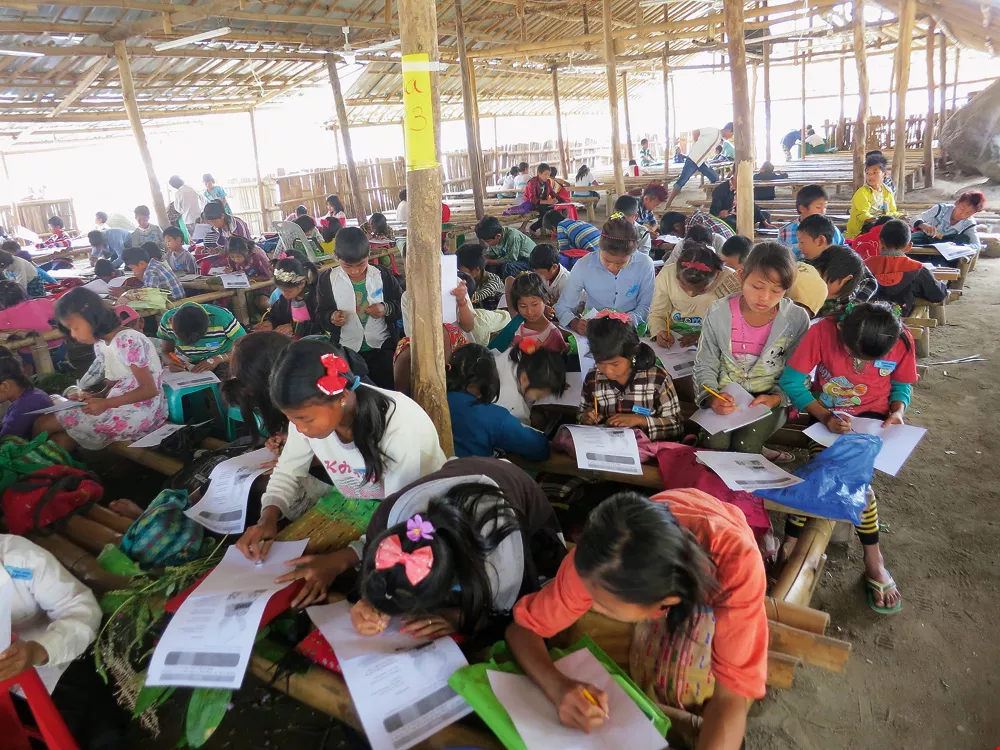
Lumaf Damapima has established schools to educate refugee children.
Lumaf also learned that many of the missionaries serving in remote mountain areas have a hard time adapting to the local diet. “They go through dozens of bouts of diarrhea before they get used to it.” But Lumaf didn’t suffer from this difficulty either. The poor sanitary conditions and lack of medical resources typical of refugee camps make diseases such as gastroenteritis and dysentery far more dangerous than they are on the plains. Lumaf believes that the dire poverty of his own childhood may have provided him with some degree of resistance to them. “If I hadn’t come here, who would have?”
Lumaf’s PhD in architecture means that helping to build homes, or more accurately, put up tents, is right up his alley. “It allows me to provide people in mountain villages and refugee camps with a very practical kind of aid.” He believes that God prepared him to work in these remote areas by encouraging him to develop what turned out to be very useful skills and expertise. His wife’s legal background is also very helpful in refugee camps because “protecting refugees involves fighting for their rights and fighting to obtain resources, things that require an understanding of the law.” The couple never imagined that white-collar professions like architecture and law would reveal their true value when put to use aiding people who had lost their homes and the standing to speak on their own behalf.

A minority village in the mountains.
In spite of his comfort with the conditions in the backcountry, Lumaf has still faced challenges in his missionary work. He mentions one particularly horrifying experience, an occasion on which he had hiked through the mountains for days to attend an important missionary event. Attendees trickled in, all of them praying and singing in sweltering heat. The organizers had provided only one towel for everyone to use to mop up the sweat pouring out of them. Just one towel, passed hand to hand from dawn to dusk, with which to wipe off everyone’s hands, necks, arms, and faces.... Lumaf recalls that by the time it reached him, it looked like sausage meat, a long strip of blackened, yellowed fabric twisted and wrinkled beyond recognition. The solicitous event worker who passed him the towel said he looked beat, and suggested he wipe the sweat from his brow. Lumaf hesitated for a moment, wondering, “How can I wipe my face with this!?” But he then recalled Paul’s admonishment to the faithful to be all things to all people. He therefore calmly accepted the towel, wiped his face, and passed it on to the next person, saying: “It’s hot and you’re sweating. Here’s a towel to wipe your face.”
Doctors had told Lumaf that his stroke had left him infertile. He and his wife accepted the news, and consoled themselves with the thought that not having children probably made it easier for them to pursue their vagabond lifestyle. They were therefore flabbergasted when she became pregnant in their seventh year of marriage. “It was completely unexpected. We were amazed by the news.” They named their boy Mu’en (“grace”) in the hope that he would spend his life living in God’s grace.
Lumaf’s other “child” is his recently published account of life as a missionary, Letters from Mountains Flooded with Showers of Grace. The book documents seven years of his life in the mountains in poetic prose of philosophical depth. He says that every time he thinks of the refugee camps, he remembers a pair of hopeful, tear-filled eyes. “I ask myself, if I were in the same boat as those people, if I had nothing at all and were living in danger, would I still have faith and compassion?” The answers to such questions are not “blowin’ in the wind,” but are found through the practice of love.


