Fung Kai’s Din Tao: Leader of the Parade A New Take on Folk Performance Art
Chen Hsin-yi / photos courtesy of ifilm / tr. by Jonathan Barnard
April 2012


Among eight local films released for Chinese New Year’s, Din Tao: Leader of the Parade, a low-budget production that cost under NT$40 million to shoot, has turned out to be a smash hit at the box office, with earnings already surpassing NT$300 million.
Din Tao is based on the true story of the Chio-Tian Folk Drums & Arts Troupe. It describes a group of rambunctious dropouts who turn over new leaves under the tutelage of the troupe master. They help to breathe new life into traditional dintao folk performance art, bringing it from Taiwan’s temples (where it is often performed by homeless youths who may be gang members) to the international stage.
People ascribe the dramatic tension and box-office success of the film to the skills that director Fung Kai honed during many years of work on television serials. Ultimately, how much were elements of television dramas brought to bear on the crafting of this film? And can the moving feelings that Din Tao engendered both on the screen and in the audience stir up a craze for films dealing with the lives of common people in Taiwan?
“Life requires warmth; it absorbs it like a sponge. You need to look at society from different viewpoints so as to understand different kinds of people and establish affection for them. With that, everything you design will have more value.”
So spoke Fung Kai, 50, when he delivered a guest lecture to an urban studies class in the department of architecture at Shih Chien Univeristy.
Fung is an old hand in Taiwan’s television industry, having worked in the field for more than 20 years. He has directed numerous popular dramatic series, including Unique Flavor and Heaven’s Wedding Gown, both of which received top ratings among local productions when they aired. Over the past three months, he has visited campuses time and again to share his feelings about his first feature film, Din Tao: Leader of the Parade.
“Originally, the idea was to shoot something that would express a concern for education, so I treasure these invitations from campuses. Once, in a post-screening forum, I met a kid who was a dintao performer. He had become estranged from his father and they hadn’t spoken for many years, but after watching this film he decided to go home. ‘See!’ he planned on saying. ‘Dintao doesn’t turn kids bad!’ His remarks caused audience members and those of us up on stage to break into tears.” As Fung, an imposing man with dyed blond hair, recounts the incident, his own eyes start to well up with tears.
Those involved in the film’s production really got absorbed in making it, and Din Tao has also had a big impact on audiences. Inspired by the film and his own personal “spiritual enlightenment,” one plumber-electrician who had performed in dintao troupes for more than a decade took a solo 33-day trek around the island, visiting more than 100 temples along the way. A national competition of Song Jiang dintao troupes, which has been held in Kaohsiung’s Neimen for eight years, received particularly large audiences this year, demonstrating the growing popularity of these traditional folk performance arts in the wake of the film.
“This film conveys a kind of simple faith, and it moves many people and gives them hope,” says Fung Kai. “That’s a success far greater than box-office receipts.”
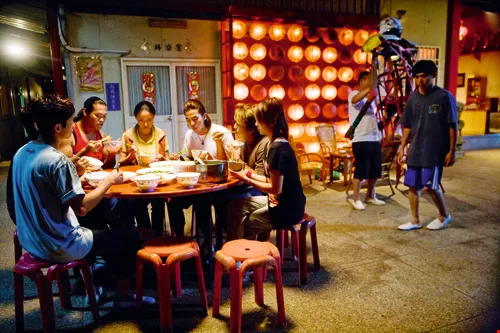
Playing troupe members who were very close, the actors themselves grew to be much like a family during the shooting. The cast included consummate professionals such as Chen Bozheng, Ke Shuqin, Zheng Zhiwei (right photo, first to third from left), and Liao Jun (facing page bottom photo, first right in front row).
Fung Kai, who first sat in the director’s chair at age 24, grew up on sets. His mother Zhou You is known as the “godmother of television.” When she needed to fill a child’s role, Fung would put on makeup and act. Although his mother had wanted him to study business administration at a university, he did so poorly in his studies that couldn’t even finish his degree from a junior college. With no career path open to him, he went to his mother’s production company and started at the bottom.
Although he created one excellent show after another as he refined his craft over the years, Fung Kai was never able to completely step out of his mother’s shadow. It wasn’t until he was 43 that he set off with Jiang Mingye, his partner in work and life, to found his own production house, which makes dramatic serials for Sanlih Entertainment Television.
In 2006 Fung won a best director’s Golden Bell for Green Forest, My Home. The dramas he has created in the years since have also won critical and popular success, giving the world a good look at his true talents. But two years ago, non-stop work had left him physically and emotionally exhausted. “For six months I had only been sleeping three hours a night. I had lost all passion for directing and was just going through the motions. Nothing seemed interesting.”
Just as he felt a hankering to try something new, a friend suggested he shoot a film version of Green Forest, My Home. “The original topic for the film was chamber music, but with my grassroots sensibility, I’d have no way of grasping the essence of classical music. It’s not something I love.”
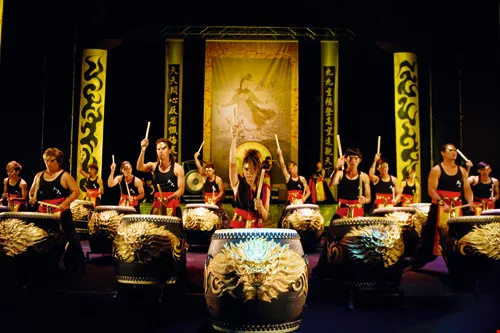
Din Tao conveys the abundant vitality of folk culture—whose vigor resembles that of the domestic film industry over the last two years. Whether the local film industry can keep going strong is a question of concern for many.
At a loss, he took his wife and kids on a vacation to Disneyland in Tokyo, and he suddenly saw the two Chinese characters for dintao. “Previously, my impression of dintao performance arts came from the glimpses I had of them at temple fairs, but immediately I had an intuition that there would surely be a good story to tell in material so close to the common people’s beliefs and lives.”
When he returned to Taiwan, he threw himself into fieldwork, which brought him into contact with the Chio-Tian Folk Drum & Arts Troupe in Taichung. He hit it off with troupe leader Hsu Chen-jung, a man who had pulled himself up from humble beginnings.
Twenty years ago, at the Immortal Maiden of the Ninth Heaven Temple in Taichung’s Mt. Dadu, Hsu brought together some young dropouts to form the Chio-Tian troupe. At first the group was looked upon warily by outsiders, who regarded them as a bunch of hooligans. But Hsu insisted that members would have to enroll in school before they could train on the drums. Moreover, he punished anyone who cut classes, swore or fought. In the process, he provided a way for a lot of boisterous young men who weren’t academically oriented to turn over new leaves. After many years of hard work and praise from all quarters, the group gradually turned into a professional performing arts troupe that nowadays frequently performs at celebrations both in Taiwan and abroad.
As it provides a sense of substance and essence of the troupe, the film explains how this offbeat group persevered through adversity for over a decade.
Every year, in the seventh lunar month, members of the troupe shoulder the Prince Nezha deity and embark on a pilgrimage that circles the island. Last year, during the period documented by the film, the troupe took an unprecedented seven-day, 250-kilometer walk through the Sahara Desert.
“I asked Hsu, ‘Why do you have to make it so hard for yourselves?’ And he responded: ‘I want to have a troupe like no other. What’s more, dintao has always been about pushing boundaries.’ I took this spirit and inserted it into the film. Just they as put themselves on the line with hard physical training, I wanted to push myself to capture their real essence, not mouth cheesy slogans.”
The most serious line in the film—“We want to create a dintao troupe that gets people’s respect and that doesn’t require us to shave, put on makeup and dress up as deities”—is a line that gets to the heart of Fung’s thoughts about the true essence of Chio-Tian.
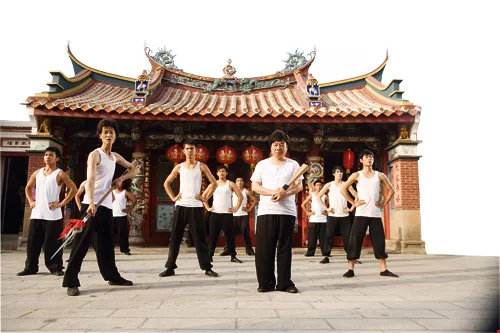
Playing troupe members who were very close, the actors themselves grew to be much like a family during the shooting. The cast included consummate professionals such as Chen Bozheng, Ke Shuqin, Zheng Zhiwei (right photo, first to third from left), and Liao Jun (facing page bottom photo, first right in front row).
Although the production process was extremely moving, Fung Kai admits that film people, academics and finance types all expressed grave doubts about its box-office potential.
Apart from noting the lack of stars and expressing fears that folk arts don’t attract viewers, they also had doubts about the director’s abilities.
“After I delivered presentations to financers, I kept hearing that dintao performing arts were ‘low class.’ And a member of a judging panel deciding on subsidies granted by the Government Information Office questioned if dintao really represented Taiwan. All the prejudice and slander I encountered gave me a resolve to really shoot this film.”
The production and publicity budgets for Din Tao totaled NT$45 million, and the investment came from Jiyong Films, which Fung Kai started himself with a group of friends, as well as Ji Shi Entertainment, which had invested previously in Night Market Hero, and Sanlih-E Television. Fung also invested NT$10 million himself. Although he wasn’t afraid of losing his own money, he was afraid of losing the confidence of his friends.
So as to meet with audiences face to face to get to know what they thought about the film, Fung led the cast and crew to test screenings at theaters throughout Taipei City. A total of 10,000 people attended 40 feedback forums that were held after screenings. “With our promotion budget of NT$11 million, we could use only the dumbest, most traditional forms of marketing. The results have shown that so long as the film is of high quality, this kind of method will leave a deep impression on audience members, so you’ll have good word of mouth.”
The first screening attracted only nine people, and the second only one. “I thought I’d lost all my money for sure, but I still took the opportunity to interact with the audience.” Fortunately, with good word of mouth, it would gross NT$1 million in its first three days.
Beginning on Chinese New Year’s Day Din Tao had box-office receipts in the millions, which only grew. After 12 days, islandwide receipts totaled NT$103 million. It was the biggest hit of the holidays, out-grossing big productions such as Black & White Episode I: The Dawn of Assault and the US production Journey 2: The Mysterious Island, which hit theaters at the same time as Din Tao.
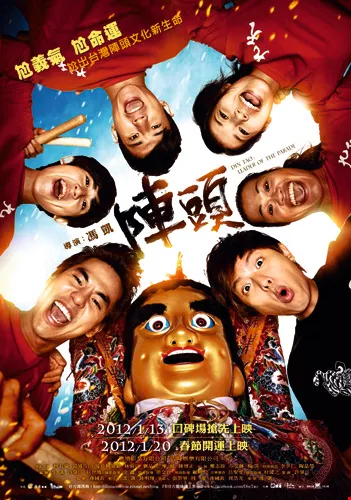
Playing troupe members who were very close, the actors themselves grew to be much like a family during the shooting. The cast included consummate professionals such as Chen Bozheng, Ke Shuqin, Zheng Zhiwei (right photo, first to third from left), and Liao Jun (facing page bottom photo, first right in front row).
Fan Jianyou, producer of Night Market Hero, points out that a winning formula has been for films that deal with the lives of common people in Taiwan to have happy endings and to be released during the Chinese New Year’s holidays. Night Market Hero fits into this formula, as does Din Tao. Particularly in recent years, it has been popular in central and southern Taiwan for families to watch films together during the Chinese New Year’s holidays. That kind of audience has been particularly receptive to domestically produced “local color” films. For instance, in central and southern Taiwan Din Tao has earned 1.88 times as much as in Taipei.
The film critic Mai Jo-yu has praised Fung for both his screenwriting and his directing: “He’s put an entirely new spin on the ‘local flavor’ film.” The characters are well drawn, and there are well-fleshed-out relationships between father and child, teacher and student and peers. These spur all kinds of emotions and conflicts. “Virtually every segment of the film leads to a dramatic conflict or climax.” Fung fully grasps the pacing of a commercial script and completely persuades the audience by the themes conveyed in the film.
What’s more, the sophisticated camera work and art direction make effective use of the facial make-up and dance poses of dintao performance troupes as well as the resounding drumming, turning them into a bright spot for the film.
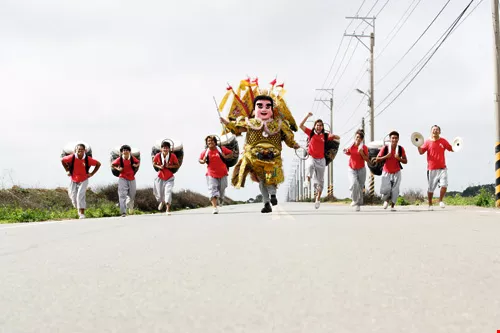
The film Din Tao: Leader of the Parade successfully conveys the vital spirit of the common people.
How does the director view the differences between television and film?
“Whether for TV or films, I have always been totally wrapped up in my work. My attitude is always the same; what differs is only the technology and techniques,” says Fung. As an example, he cites his work on the popular historical drama Dance with Dragon more than a decade ago. What with the leads, the supporting actors and the bit-part bandits, scenes would often involve a dozen or more people. “When coaching the actors during rehearsals, I definitely tried to enter each character’s emotions. I didn’t just ‘act’ the characters; I tried to ‘be’ the characters. Then, when shooting and editing, I had to distance myself to retain a critical eye. Shooting a drama in this way, emphasizing the different emotions from different viewpoints, is very tiring, but when done right it provides a sense of accomplishment—because I’ve got to move myself first before I can move anyone else.”
Din Tao’s strongest selling point is that the story really grabs hold of people emotionally due to the consummate acting skills of the film’s many experienced actors, including Chen Bozheng, Liao Jun and Ke Suqin.
The critic Zhang Guanlun has praised Fung for his depiction of the two dintao troupes in the film. Via the familial relationships between their members and the master-disciple relationships between related people, Fung is able not only to demonstrate the affection between these people from disadvantaged backgrounds and their concern for traditional culture, but also show the importance that Taiwanese put on the family and describe how the definition and forms of the family are broadening.
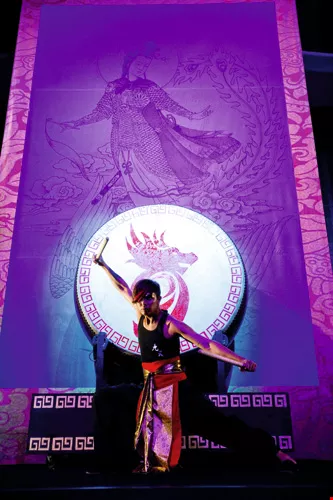
The film examined the crisis of passing down dintao culture as well as the challenge of bringing innovation to it, wrapping these issues in a generational family drama. (right:) The young actor Huang Hongsheng worked extremely hard to learn dintao techniques. His performance earned well-deserved plaudits.
Yet Din Tao has also attracted quite a bit of heated criticism. Aside from criticisms that some characters were poorly developed and that plot twists were too extreme, these have mainly focused on the film’s superficial introduction to dintao culture.
The blogger “reke” complained, “After watching the film, we still don’t understand what the dintao tradition is all about, or what, for that matter, is the value of these innovations. Ultimately, Din Tao doesn’t answer the questions it raises.”
“Dintao culture takes on no meaning in itself that would allow the father-son conflict to be tied together with differences between the old and new culture,” reke continues. “All the film does is explore the differences in character between two people. The flickering images of folk deities up there on Taiwan’s silver screens are all flash but no substance. The film doesn’t take advantage of the opportunity to demonstrate the essence of dintao culture.”
With regard to these kinds of doubts, Fung responds that he wanted the film to use the process of dintao innovation to express the concept of persevering in working toward one’s dreams.
“The most important concept I learned from Chio-Tian was: How does one find and insist upon value in human existence? These kids on the margins of society, who had been abandoned by schools and society, originally only felt frustrated and depressed when facing life. They had no way to point to their own accomplishments. Today, they can stand proudly for everyone to see. They have a lot of confidence and are clear about their own futures. This moving spirit is what I wanted to convey.”
After becoming the NT$300-million director, Fung didn’t immediately look to shoot another film. Instead he returned to Sanlih and created the TV drama Inborn Pair. Fung’s wife and greatest supporter Jiang Mingye says that after Fung recharged his batteries working in film, his new television serials have even more potential for breaking new ground.
Fung confesses that previously when he shot television dramas, he would often disdainfully wonder: “What makes you filmmakers so proud?” But after shooting Din Tao, he realized that only with a film could you take the time to wait for each scene’s perfect light. “Now I say: Be as arrogant as you like, and I’ll applaud.”
As for attaining his own dreams? “When you shoot a film, you’ve got to treat the audience right. Regardless of the topic, I want audiences to come out of the theater either smiling or with tears running down their cheeks. I want them still to be thinking about the film when they fall asleep.”
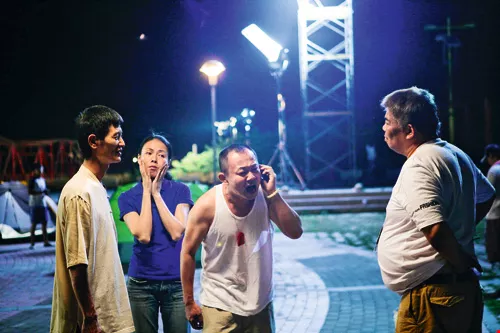
Playing troupe members who were very close, the actors themselves grew to be much like a family during the shooting. The cast included consummate professionals such as Chen Bozheng, Ke Shuqin, Zheng Zhiwei (right photo, first to third from left), and Liao Jun (facing page bottom photo, first right in front row).
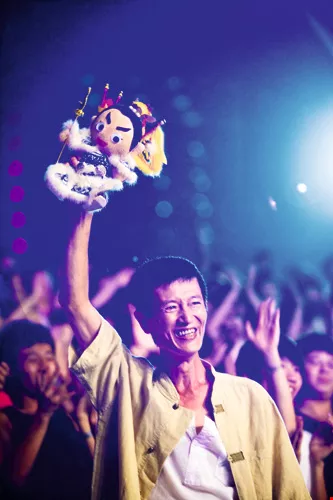
The film examined the crisis of passing down dintao culture as well as the challenge of bringing innovation to it, wrapping these issues in a generational family drama. (right:) The young actor Huang Hongsheng worked extremely hard to learn dintao techniques. His performance earned well-deserved plaudits.

@List.jpg?w=522&h=410&mode=crop&format=webp&quality=80)
@List.jpg?w=522&h=410&mode=crop&format=webp&quality=80)


