The Taiwan Cooperative Bank Table Tennis Team
A Wellspring for the National Team
Lin Hsin-ching / photos Chin Hung-hao / tr. by Scott Williams
September 2013


2013 has been an amazing year for Taiwanese table tennis! Chuang Chih-yuan, ranked number one in Taiwan and seventh in the world, and his up-and-coming young partner Chen Chien-an, won Taiwan’s first world championship crown in men’s doubles. Perhaps just as impressively, our national table tennis team earned two golds, one silver, and two bronzes at the just-completed 2013 Summer Universiade.
These outstanding players all share a common background: they are members of the Taiwan Cooperative Bank table tennis team. Their collective success is no coincidence. Instead, it’s the fruit of the bank’s 66 years of painstaking cultivation of young local talent.
Did you know that table tennis is tremendously popular with Taiwan’s bankers?
The reasons are pretty straightforward. “It’s easy to find space to play,” explains Leon Shen, chairman of the Taiwan Cooperative Bank and the former head of the Ministry of Finance table tennis club. “You can even play in an office. Plus, the game moves very fast. Matches are exciting and often rise to fever pitch, making the sport a perfect way for bank employees to blow off steam at the end of a long, tension-filled day.”
Consequently, Taiwan’s financial institutions, from its major publicly and privately operated banks down to its credit unions, have played an important role in spreading the game and are littered with amateur stars.
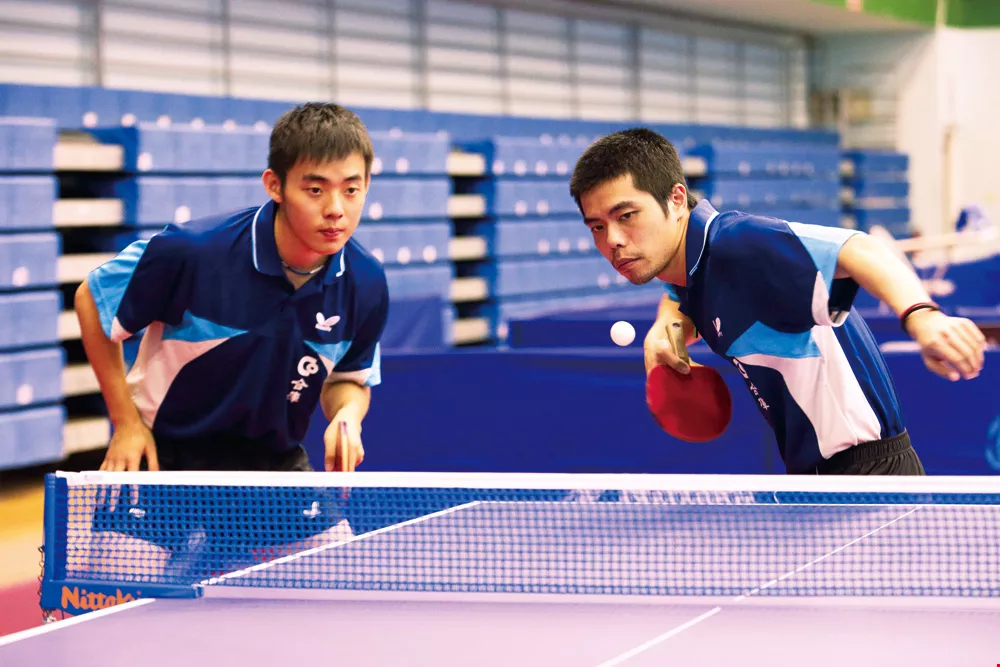
World men’s doubles champions Chuang Chih-yuan (right) and Chen Chien-an are both members of the Taiwan Cooperative Bank team.
Founded some 66 years ago, the Taiwan Cooperative Bank team is especially well known.
The bank was established during the period of Japanese rule, when it was known as the Taiwan Industrial Bank. Ping-pong-loving employees founded the bank’s team in 1947 as a mechanism for good players to learn from one another.
When Taiwan’s economy began taking off, Taiwanese began placing new emphasis on physical education. Against that backdrop, the bank team began evolving along more professional, structured lines in 1972. This change in tone would ultimately make it an important incubator for Taiwan’s international players.
Among the most laudable aspects of the bank’s management of its team are its guarantee of lifetime employment to team members and its development of players from an early age. As a part of its effort to identify the stars of tomorrow, the team recruits players ranging in age from 12 years old to adulthood from a variety of national tournaments, including those used to select the national team.
New players recruited onto the team first join the practice squad. On signing their contract, they begin receiving a monthly stipend that starts at NT$3,000. As players become more skilled, the stipend increases to tens of thousands of NT dollars. Players who do well at international competitions also get prize money.
Once team members have completed their educations, they have the opportunity to become salaried members of the bank team, which enables them to focus fulltime on the development of their playing skills. Team members who wish to retire from competition, whether as a result of injury or age, have the option of going into coaching or taking a job at one of the bank’s branches.
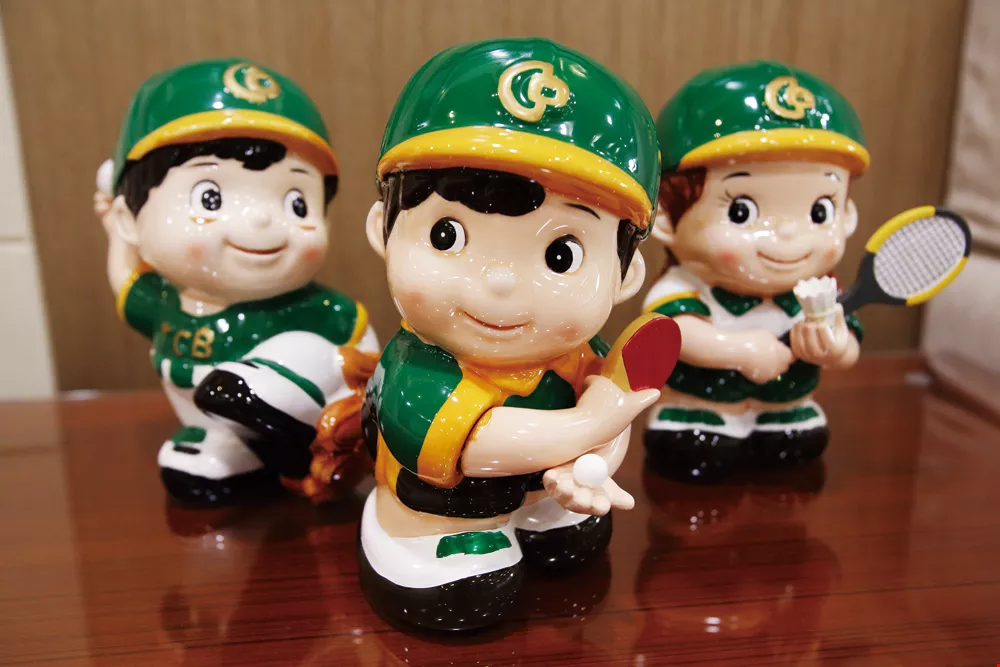
A long-term supporter and popularizer of table tennis, baseball, and badminton in Taiwan, the Taiwan Cooperative Bank has also created these adorable figurines.
Bank chairman Leon Shen explains that Taiwanese parents typically stop their kids from pursuing their sports dreams out of concern over how they will transition out of athletics. The bank’s cultivation of young players, guarantees of employment, and offer of jobs in its branches after players retire help lay parents’ fears to rest, allowing them to support their children’s pursuit of sports.
That’s a key reason why so many of Taiwan’s top international players, including Chiang Peng-lung, Chuang Chih-yuan, Chang Yen-shu, Wu Chih-chi, Chen Chien-an, Chiang Hung-chieh, Huang Sheng-sheng, Lee I-chen, and Cheng I-ching, have connections to the bank team. In fact, at this summer’s Universiade, eight of the 10 players on the Chinese Taipei table tennis team were members of the bank team, making it seem very much like the “Chinese Taipei/Cooperative Bank Team.”
Chuang Chih-yuan, Taiwan’s top player, currently receives a salary and living allowance of nearly NT$120,000 per month from the bank team, an amount equivalent to a branch manager’s salary. The bank also provides him with a substantial “per diem” when he’s participating in major international events.
Chuang is grateful for the bank’s long-term support, noting that it is this support that has enabled him and his teammates to focus on the development of their talents and become professional table-tennis players.
The bank first spotted rising star Chen Chien-an when he was still in middle school. This year, coaches decided that Chen’s lefthandedness and aggressiveness would make him a good doubles partner for Chuang Chih-yuan. The pairing worked, and the two went on to win the world doubles title in May, stopping mainland China’s march towards a tenth consecutive title in its tracks and earning Taiwan its first gold medal in men’s doubles.
Terrific salespeopleThe bank also gets praise for developing athletes in sports other than table tennis. It also sponsors baseball and badminton teams, providing the same job security to members of those teams. In all, the bank spends an estimated NT$100 million or more per year on support for its athletes, an amount equal to roughly 1.5% of its earnings.
Its baseball team, founded one year after its table tennis team, has also been an important incubator for national talent. Big-name players who got their start with the team include Nippon Professional Baseball standouts Kuo Yuen-chih and Kuo Tai-yuan, Taiwan’s first Major Leaguer, Chen Chin-feng, and contemporary Chinese Professional Baseball League stars Peng Cheng-min and Lin Chih-sheng.
Though the badminton team came later, it too has had great success. Tai Tzu-ying, the team’s 19-year-old sensation, is a case in point. Having won this year’s women’s singles title at the Malaysia Open, she now ranks seventh in the world and is attracting a great deal of attention within the international badminton community.
Athletes are often stereotyped as being less-than-conscientious workers. Given the emphasis that bank workers place on careful attention to detail, many people wonder how former table tennis, baseball, and badminton team members adapt to bank work once they retire from competition.
“Bank employees need to generate large volumes of savings and lending business,” says Shen. “Athletes are proactive, straightforward, and get along well with people. They make great salespeople that customers trust.”
Hsieh Ming-yung, the “king of the steal” and a member of Taiwan’s 1972 Baseball World Cup team, is a great example of a ballplayer turned bank worker. Hsieh worked for the bank for 43 years, starting as a part-time employee in the back office and retiring as an assistant branch manager.
“Customers would catch sight of him and run over to ask him to autograph a ball or take a photo with them. He really didn’t have to do much of anything to start talking business,” laughs Shen.
As a winner of four consecutive Sports Activist Awards from the Ministry of Education’s Sports Administration (formerly the Executive Yuan’s Sports Affairs Council), an institution that gives back to the community, and a provider of lifetime employment to its athletes, the Taiwan Cooperative Bank is a sterling example of how the private sector can promote sports and athletics.

@List.jpg?w=522&h=410&mode=crop&format=webp&quality=80)

@List.jpg?w=522&h=410&mode=crop&format=webp&quality=80)


