The Formosa Wall Painting Group:Heart to Heart with Art
Sam Ju / photos courtesy of the Formosa Wall Painting Group / tr. by Scott Williams
November 2013


The Formosa Wall Painting Group is out to prove that art can transcend spatial limitations. The group, which got its start at the Qiaotou Sugar Refinery in Kaohsiung and lacks both a fixed base and a formal membership, employs a “mobile” creative process that is bringing art, and with it a certain kind of “human warmth,” to a variety of non-traditional locations. In a sense, the FWPG is actually a humanizing movement, one which also happens to be stretching the boundaries of art.
October has arrived, bringing with it an autumnal breeze wafting off Osaka Bay into the Port of Kobe. Within the confines of the port itself, the curtain has risen on the fourth Kobe Biennale.
The Kobe Biennale has long focused on the points at which art and society intersect. With this year marking the second anniversary of northeastern Japan’s battering at the hands of the Tohoku earthquake and tsunami, the Formosa Wall Painting Group (FWPG) has been invited to attend the biennale to exhibit work from its “heart-to-heart” arts events in disaster-stricken Ishinomaki, Miyagi Prefecture, and Otsuchi, Iwate Prefecture. The project has become the darling of the Japanese media, including broadcaster NHK, and the subject of numerous reports on its progress.
The story begins with FWPG’s construction of what it calls Guide ByWood, which is essentially the wooden frame of a building, on the grounds of the Qiaotou Sugar Refinery in Kaohsiung.
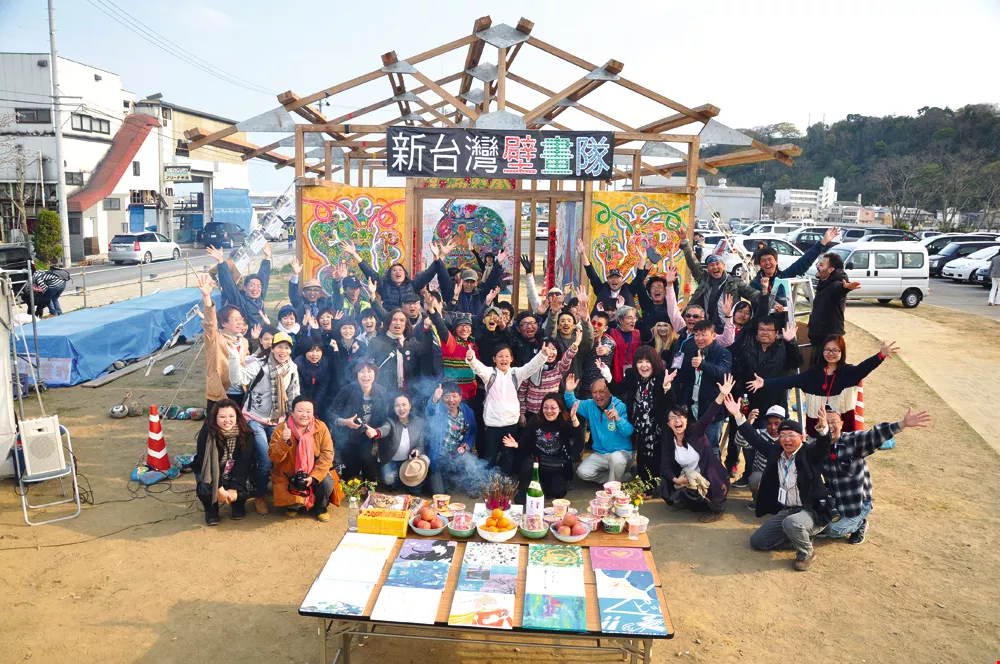
After assembling its “Guide ByWood” framework in Ishinomaki in May 2013, the Formosa Wall Painting Group set to work painting with local artists.
Originally built by the Japanese, Qiaotou was Taiwan’s first modern sugar refinery. Shuttered in 1999, the facility reopened as a government-funded artists’ village in 2001.
When the government support dried up in 2008, a group of local artists and cultural–historical workers moved to keep Qiaotou’s creative spirit alive by forming the ByWood Company and leasing the facility from Taiwan Sugar.
At the time, Lee Jiun-shyan, a former director of the Kaohsiung Museum of Fine Arts, was using a warehouse at the refinery as his studio. Observing that many of the artists exhibiting at the fine arts museum required multiple projectors and several exhibition rooms to display their so-called art, he began wondering what had happened to the hands-on craftsmanship at the core of the arts, and if there was any reason for exhibitions to be confined to museums.
Lee’s dissatisfaction resonated with an artist named Lee Jiun-yang, and the two soon decided to form a “wall painting group” expressly focused on painting pieces by hand.
Their decision happened to coincide with the ByWood Company’s plan to create an artists’ village on the grounds of the sugar refinery. The two groups decided to merge their efforts and began recruiting artists to participate in what they were now calling the Formosa Wall Painting Group.
Its name notwithstanding, FWPG doesn’t actually paint on walls. Instead, it erects a wooden framework in the basic shape of a house, then uses this space as a platform for creating and displaying art. The artists involved in each “Guide ByWood” project paint on white canvas panels, then attach the completed panels to the house’s frame to form its walls and roof. By the time they are done, this “white house” is covered in art both inside and out.
The FWPG’s ideals quickly attracted attention. In November 2010, more than 60 artists from around Taiwan converged on Qiaotou to take part in the nearly two-month-long and very experimental effort to build the first “white house.”
The idea caught on and spread like wildfire from the grassroots to Taipei, resulting in an invitation to exhibit at the Museum of Contemporary Arts, Taipei (MOCA Taipei).
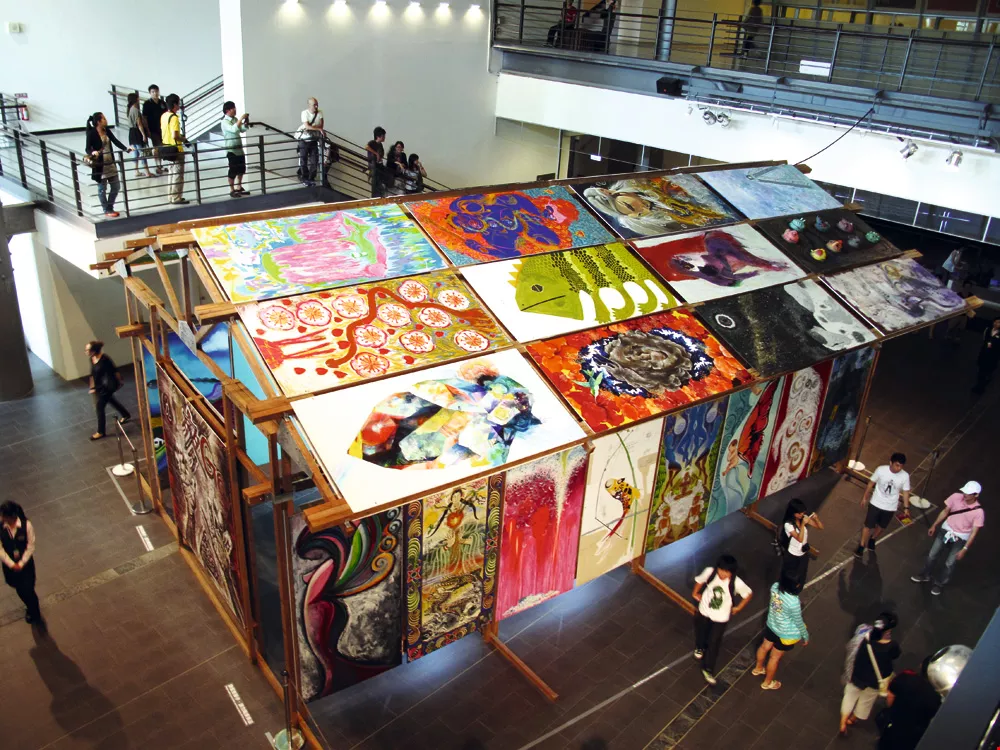
The Formosa Wall Painting Group exhibited its “Guide ByWood” traveling art show at the National Taiwan Museum of Fine Arts in Taichung in 2012.
The FWPG was formed with two key objectives in mind. At home, it would seek to connect with communities to ensure that its art reflects real life. Abroad, it would seek to participate in international art shows and exhibitions. Fixed membership or no, the group has proved to be anything but a flash in the pan.
Prior to its MOCA Taipei exhibition, the FWPG recruited eight artists for a mission to Baishu, a community near Qiaotou. There the artists made a point of first being present in the neighborhood and having heart-to-hearts with residents, before going on to paint their reactions to the experience on the walls of an abandoned building.
Chiang Yao-hsien, CEO of the ByWood Company and curator for the FWPG, likes to cite the Baishu experience of graffiti artist “Mr. Ogay” as an example of the FWPG’s nteractions with the community. An elderly Baishu woman “adopted” Mr. Ogay as he worked on his piece, looking over his shoulder and muttering comments on his painting: “What on Earth are you painting? It makes no sense!”
It’s a rare artist who can handle negative commentary about his or her work, and that’s doubly true when those criticisms are coming from a granny with no artistic training. But when the granny passed by again on the artists’ last day in Baishu, she cackled with laughter: Mr. Ogay had inserted her into the painting, writing “hello” to one side of an image of her head and crowning her with a douli (the woven bamboo hat commonly worn by farmers). He flattered her shamelessly as well, telling her she was absolutely lovely and “Qiaotou’s own Lin Chi-ling.”
By interacting with this granny, Mr. Ogay was able to produce a painting that meant something to community residents. Chiang believes the general public ignores art because art ignores it. The “Guide ByWood” movement represents an attempt to address this issue.
After wrapping up the Baishu event, the FWPG exhibited at the MOCA Taipei, then erected the Guide ByWood frame in Yunlin and Taitung. At each stop, the group invited local artists to participate as a means of incorporating local perspectives into its work.
The FWPG reached beyond Taiwan’s borders in 2012, choosing as its first stop a Japanese city ravaged by 2011’s Tohoku earthquake and tsunami: Ishinomaki.
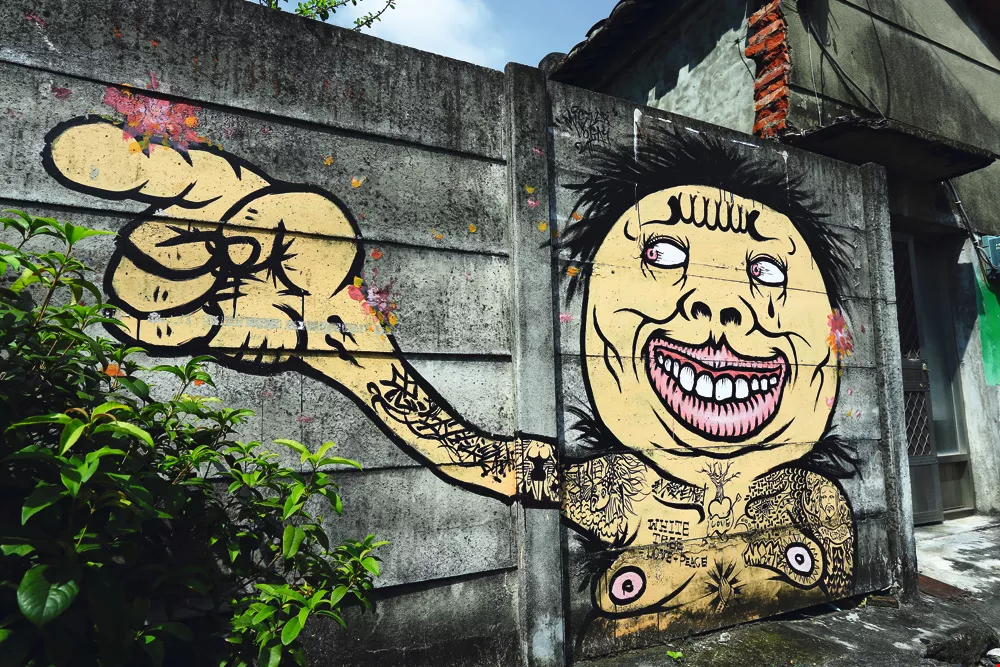
This wall painting in Kaohsiung’s Baishu neighborhood was among the first the Formosa Wall Painting Group produced as part of its community “heart-to-heart” arts program.
Japan and Taiwan are alike in having suffered the trauma of major earthquakes, which may well explain why we have had such intimate exchanges of our respective disaster reconstruction experiences. After Kobe was badly damaged by the Hanshin earthquake in 1995, architect Shigeru Ban created a building he called the Paper Dome as a temporary replacement for a Catholic church knocked down by the temblor. The Paper Dome became symbolic of Kobe’s reconstruction efforts and in 2005 was presented to Puli Township, Nantou County, as a tangible expression of the hope that Taiwan would soon emerge from the shadow of the 1999 Jiji earthquake.
Meanwhile, Taiwan’s standing as one of the international community’s most generous donors to the Tohoku earthquake relief efforts is well known among Japanese.
Given this history of mutual support in the aftermath of earthquakes, it was only natural that when the FWPG began thinking about taking the Guide ByWood program abroad, the idea of visiting locations in Japan recovering from the Tohoku earthquake would leap to mind. With Taiwan’s New Homeland Foundation and Eiji Tarumi, a former director of Kobe’s Housing Bureau, facilitating the process, the group finally settled on Ishinomaki.
Some nine artists from areas of Taiwan affected by the Jiji earthquake and Typhoon Morakot spent the summer of 2012 painting with students in Ishinomaki, sharing and exchanging experiences in an effort to transform painful memories into the strength to rebuild. Ishinomaki’s citizens were profoundly moved when the students hung their canvases of their families, their ruined homes, and drifting rubber rafts from the fences surrounding reconstruction sites.
One local senior said that although the tsunami had carried away homes and family members, the people of Ishinomaki felt no hatred for the ocean. Instead, residents believe that their city’s location between the Pacific Ocean and the Kitakami River makes them all part of the same community of life.
Regarding the FWPG’s visit, the senior remarked: “The most important thing isn’t that we get some paintings out of this, but rather that we forge connections between people. We hope to have still more exchanges that can be reflected in [future] works.”
Eiji Tarumi, who has traveled back and forth between Taiwan and Japan more than 50 times supporting reconstruction efforts, says, “Art needs no translation, and is a tremendous source of strength for us.”
The summer 2012 artistic meetup was also aimed at establishing an agreement with Ishinomaki’s residents on the assistance they would provide when erecting the Guide ByWood framework the following spring.
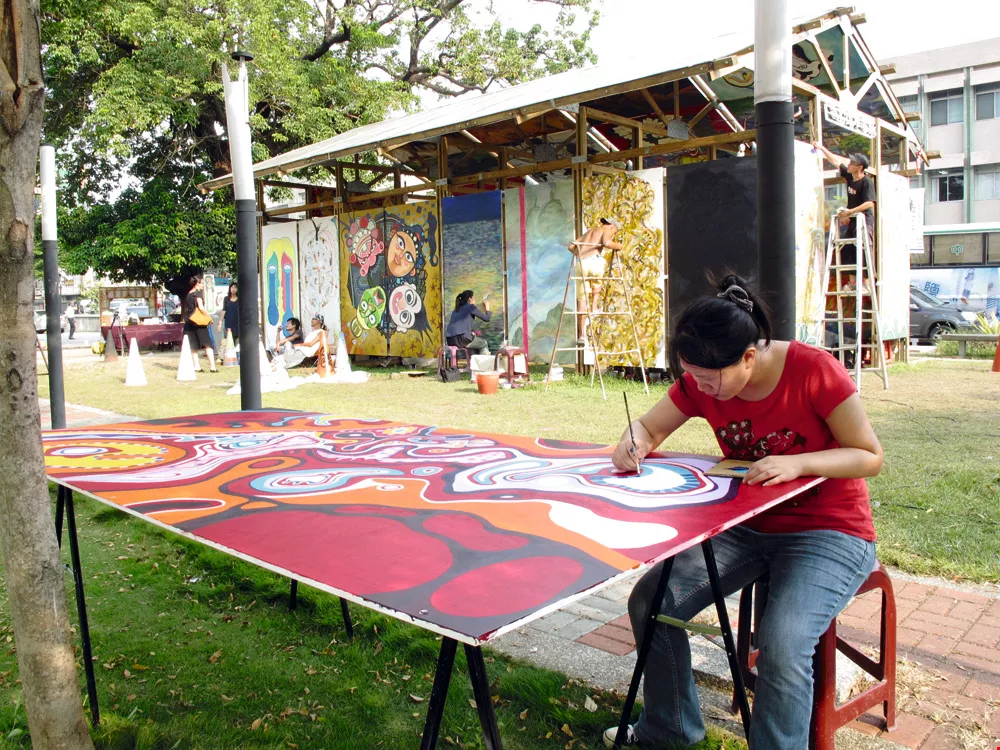
In September 2011 the Formosa Wall Painting Group brought its peripatetic artistic program to the Yunlin Hand Puppet Museum for a creative face-off with local artists.
In April 2013, the FWPG brought Guide ByWood to Ishinomaki’s recently reopened Ishinomori Mangattan Museum. Manga artist Shotaro Ishinomori, creator of the Kamen Rider TV series, grew up near Ishinomaki and as a boy frequently haunted the city’s movie theaters.
After erecting the house on a bit of open ground at the museum, 18 artists each from the FWPG and Ishinomaki went to work painting it.
Lama Moltis, a Taiwanese Aboriginal artist, used Kamen Rider’s profile in his painting to express his hope that the character’s courage and compassion would bring hope to Ishinomaki. Other artists invoked the gods’ blessings for the townsfolk with impressionistic takes on the goddess Mazu and her two generals, “Sharp Eyes” and “Sharp Ears.”
During the two-week-long Guide ByWood heart-to-heart, Ishinomaki’s residents frequently brought the artists piping hot meals intended to help get them through the chilly nights. Each time they did, work would come to a halt so that artists and locals, speaking through interpreters, could share their experiences with one another.
The artists packed up the framework when their stay in Ishinomaki ended. In August, they took it to Otsuchi, which had also suffered in the earthquake and tsunami.
Chang Yuan-chien, head of the Asian Cultural Council Taiwan Foundation, has likened the white house movement to Rome’s Pantheon. Chiang Yao-hsien elaborates, explaining that artists participating in FWPG’s traveling heart-to-hearts produce paintings that draw on their own feelings and their understanding of the locale in which they are working, using them to construct a “shrine” very different from a traditional museum. To Chiang, the process is itself a part of the art.
The next stageSome 165 artists have participated in the FWPG in the three years since its formation, including the likes of Yao Jui-chung, Lee Min-chung, Hung Yi, Wu Tien-chang, and King Cola. Chiang says the group’s next step, after it wraps up its participation in December’s Kobe Biennale and after it finishes the last of its mobile heart-to-hearts at the Paper Dome in Puli, will be to transform its framework into a rural classroom that can function as an outpost for educating people about Taiwanese culture.
“When all is said and done, art’s foundations are historical and cultural,” says Chiang. He has no regrets about the FWPG bringing its Guide ByWood program to a conclusion next spring, and is confident that its “heart-to-heart” spirit will spark a new wave of community empowerment in Taiwan.

@List.jpg?w=522&h=410&mode=crop&format=webp&quality=80)


