Aiming for the Top: HIWIN Technologies
Lin Hsin-ching / photos Chuang Kung-ju / tr. by Scott Williams
June 2014


Intel’s famous “Intel Inside” slogan is indicative of the brand’s influence in the personal computer market. In recent years, “HIWIN Inside” has come to enjoy a similar standing in the machine tools industry.
HIWIN Technologies is the top company in Taiwan’s electromechanical industry, the world’s second-largest maker of linear drive controls, a leading brand in the systems technology space, and a key player in Taiwan’s precision machinery cluster.
HIWIN’s niche is the manufacture of ball screws, linear guides, and industrial and medical robots. The products have applications in a wide variety of fields. In fact, HIWIN products are important components in the tools used to manufacture iPhones, in the sun tracking systems at Google’s solar power plants, and in automated robots used in semiconductor manufacturing.
“An ordinary-looking steel rod can generate 40% profit margins and drive a company’s stock price to more than NT$300 per share? What kind of business is this? It’s unbelievable!” exclaimed an unnamed Foxconn senior executive after visiting HIWIN’s ball screw production line in 2011.
With the global economy picking up again, Apple reported that iPhone sales had surpassed 100 million units. Foxconn, the iPhone’s largest OEM, relies on HIWIN’s ball screws and linear guides in the precision machinery it uses to build the iPhone.
But HIWIN’s huge list of global customers meant Foxconn often had to wait for its orders to be fulfilled, leaving Foxconn’s senior management stamping their feet with impatience. When news of the bottleneck appeared in Taiwan’s major papers, it gave the Taiwanese public an inkling of HIWIN’s level of influence.
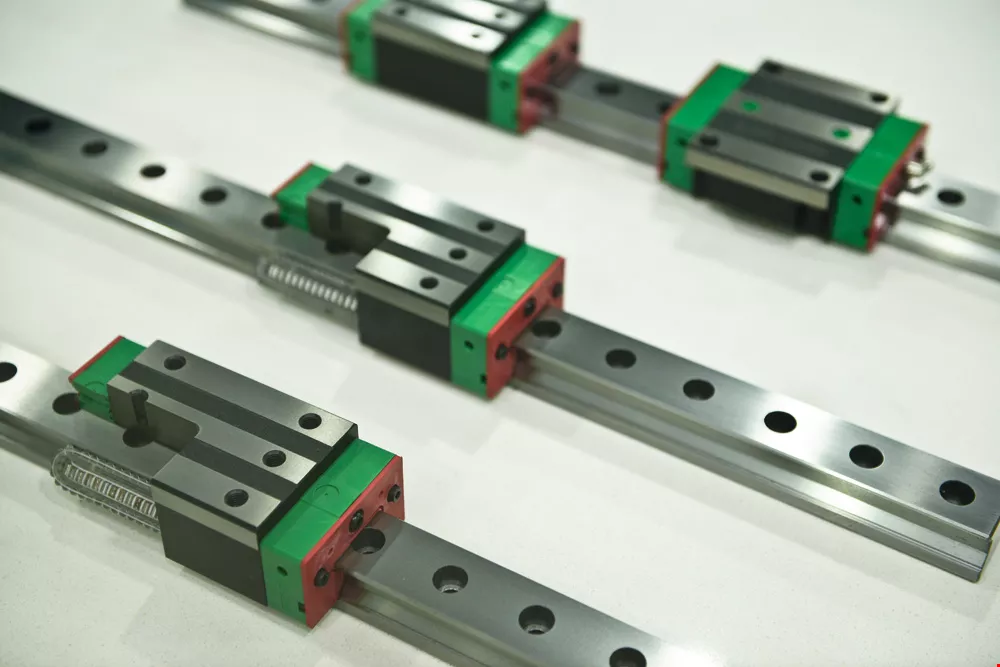
Linear guides are a key part of the iPhone manufacturing process. For all that they may look like ordinary steel bars, the guides have a profit margin of 40%.
Eric Chuo, HIWIN’s 72-year-old chairman, likes to say, “We make products for every stage of people’s lives.”
It’s no exaggeration. HIWIN makes parts for everything from artificial insemination devices and robots used for shoulder and elbow rehabilitation to heart-assist devices and the vehicles that transport coffins. In fact, HIWIN’s components are essential to the drive controls and positioning accuracy of all kinds of precision machinery and devices.
Perhaps the most surprising thing about HIWIN is that the leaders of this company crucial to the precision machinery industry aren’t themselves techies. In fact, Chuo was originally a banker and Tsai Hui-chin, the company’s general manager, was a magazine editor.
Chuo’s journey from banker to tech titan began 30 years ago.
In 1983, Chuo, then the chief secretary of Chiao Tung Bank, was asked to help reorganize San Shing Hardware, then Taiwan’s largest manufacturer of nuts.
Chuo spent a year at the company’s facility, helping it recover from financial crisis while also becoming familiar with the machine tools industry. There he learned that small companies with a firm grasp of a niche technology and manufacturing process can stand toe to toe with the world’s major corporations.
Chuo resolved to give up his large, steady paycheck from the bank to establish his own manufacturing firm. He founded HIWIN in 1989, at the age of 46, to produce ball screws and linear guides.

The shaft motors on which these action figures are posed may look simple enough, but these vital components used in high-speed drilling machines and other precision machinery are highly challenging to manufacture.
“People shouldn’t sneer at components like this,” says Tsai. “Each of these parts is itself the product of 30-some industrial processes. Together, they enable us to live our modern lives.”
Tsai, the “dragon lady” of Taiwan’s precision machinery industry, has a backstory that’s nearly as legendary as Chuo’s own. Thirty-some years ago, she was an ordinary “office lady,” an editor at Chuo’s Foreign Trade magazine much appreciated by her boss for her attention to detail, willingness to learn, and flexibility. As Chuo’s first hire at HIWIN, she played an important role in developing and marketing the brand.
Tsai recalls that in those days the industry wasn’t optimistic about HIWIN’s prospects. “But they ignored the fact that a company’s marketing capabilities and innovativeness are as important to its success as its technology, especially since technological capabilities can be acquired over time.”
HIWIN was the first company in its industry to pursue a formal branding strategy. Prior to its founding, German and Japanese companies dominated the market for ball screws and other components. Taiwanese firms had to scramble for their leavings, and none were willing to spend big money on branding.
But Chuo, a son of a poor Hakka farming community, has never been the kind to give up. Once he decided that his goal was to lead HIWIN past its German and Japanese competitors to the top of the industry, he brought the full measure of his determination to bear on the task of building and managing its brand.
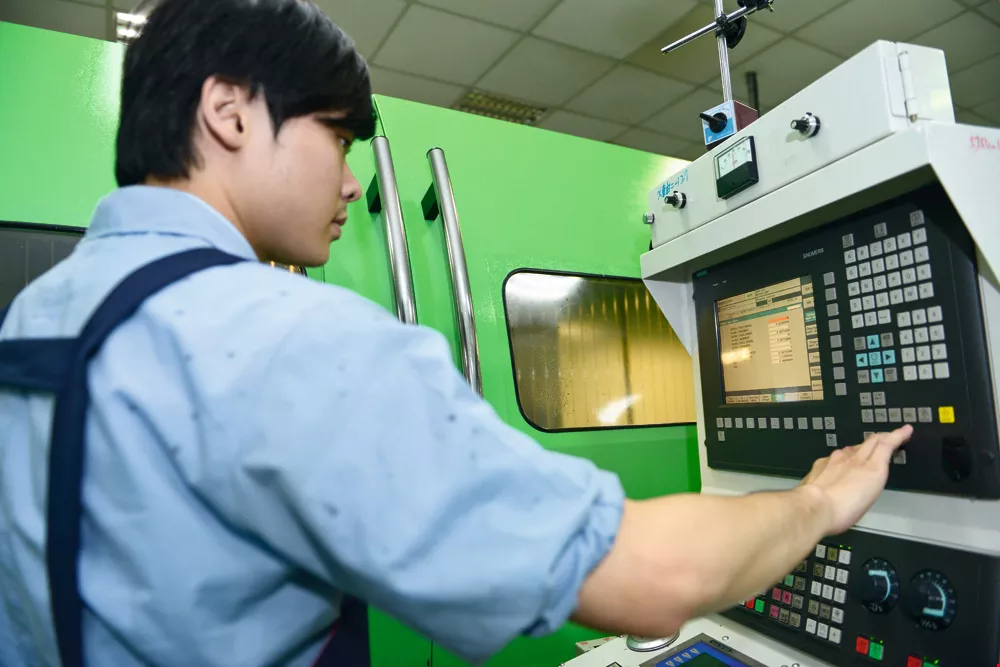
HIWIN’s success has its roots in the company’s long-term focus on innovation and R&D.
Chuo budgets 3–10% of annual revenues to research and development to foster innovation. He and his technology team are constantly looking for ways to improve product quality by, for example, increasing the speed at which screws can turn and decreasing the rate at which they wear. Actuator movements are also very precisely controlled, with positioning errors capped at less than 0.5% of the diameter of a human hair.
In addition to being devoted to R&D, Chuo has put his financial acumen to good use in buying foreign competitors to acquire their technologies.
His first acquisition was Holzer, a 40-year-old German ball screw maker that he bought in 1993 to consolidate HIWIN’s ball screw manufacturing technology. The fact that a Taiwanese SME had purchased a major German manufacturer was the talk of the industry for a time. HIWIN’s resultant notoriety led to a number of long-form stories on the company in the German media, raising the company’s profile enormously.
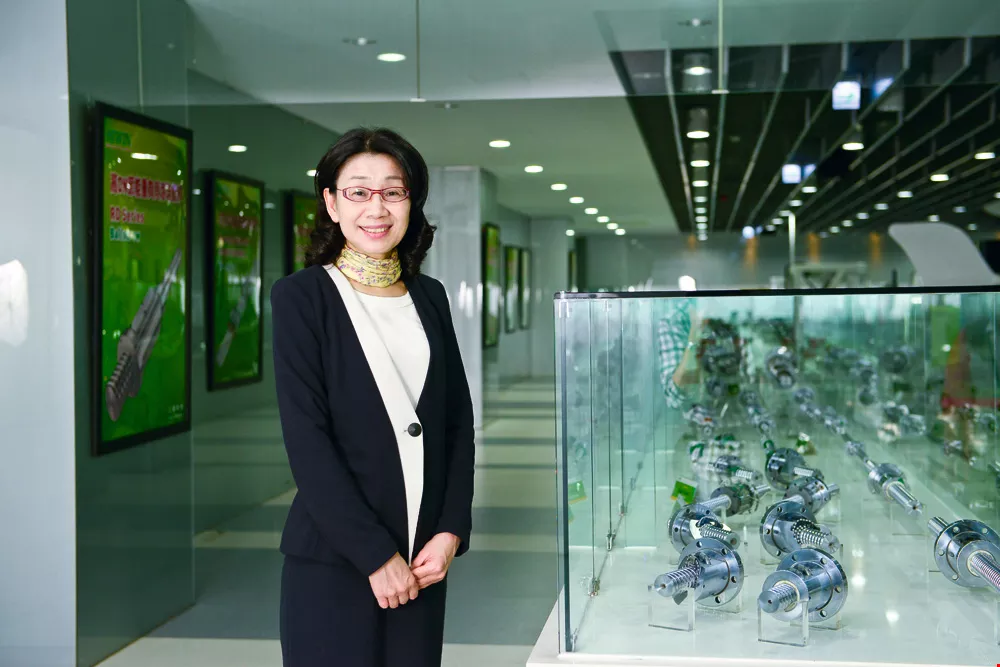
HIWIN general manager Tsai Hui-chin is a former magazine editor who has developed a profitable business model for her company and become a legend within the precision machinery sector.
Within a few years of HIWIN’s Holzer acquisition, it was making ball screws of a quality comparable to those of Japanese firms, but at a better price. An up-and-comer in the industry, HIWIN introduced “pre-sales service” and “six-month tryout period” strategies to encourage potential clients to give its products a try.
When HIWIN’s then-current products had gained a substantial market share, Chuo began pouring money into developing linear guides, which are an important component of drive controls. Unwilling to give up when he discovered that Japanese firms had locked up the materials and manufacturing equipment required to make the products, Chuo bought Matrix, a British manufacturer of thread grinders, to give HIWIN the upstream production capabilities it needed.
HIWIN then developed its own manufacturing equipment. It named the line “EK” to refer to its ambition to “eat” the market share of three Japanese companies—THK, NSK, and IKO—and to remind its own employees to keep working hard.
Chuo’s EK ambition was more than empty words. HIWIN’s high-quality, flexibly priced ball screws and linear guides have propelled the company past NSK and IKO to its current number-two position in the global market for linear drive controls and systems technology, and enabled it to bring competitive pressure to bear on the number-one company in the market: THK.
Having turned HIWIN’s ball screws and linear guides into money trees, Chuo moved into a third market: automation and robotics.
He acquired Mega-Fabs, an Israeli developer and manufacturer of tip actuators and control systems, to supplement HIWIN’s capabilities in those areas, and make the company more competitive in the semiconductor equipment and robotics sectors.
All HIWIN’s effort has paid off. The company now has the capability to manufacture medical robots used for endoscopic surgeries and for lower limb strength training, as well as industrial robots integrating optics, information and communications technologies, and software design. It has also become the first company in Taiwan to manufacture entire robots in-house.
A sense of missionHIWIN’s vertical integration of its manufacturing technology has generated eye-popping results. In fact, its 2013 revenues of more than NT$12.4 billion and earnings of NT$7.96 per share have made it the king of the electromechanical sector.
HIWIN is also one of the few manufacturers in Taiwan to really stress cooperating with academia and cultivating future talent. It created the HIWIN Thesis Award in 2004 and the HIWIN Hands-On Intelligent Robot Manipulator Competition in 2008 specifically to encourage Taiwanese university faculty and students in the mechanical engineering field to innovate and to cultivate potential future employees for itself.
HIWIN’s determination to be a global champion has earned made-in-Taiwan precision machinery new respect in the global marketplace, and brought the company very close to achieving its ambitions.

@List.jpg?w=522&h=410&mode=crop&format=webp&quality=80)

@List.jpg?w=522&h=410&mode=crop&format=webp&quality=80)

@List.jpg?w=522&h=410&mode=crop&format=webp&quality=80)
@List.jpg?w=522&h=410&mode=crop&format=webp&quality=80)

