Bear Tales of Bunun Tribesman Lin Yuan-yuan
Coral Lee / photos Hsueh Chi-kuang / tr. by Chris Nelson
May 2010


With a towel wrapped around his head, plastic rain boots on his feet, a plug of betel in his mouth, and an open umbrella lashed to a backpack resembling a rice sack on a metal frame, he stands out from the rest of the black bear research team. He is Bunun tribesman Lin Yuan-yuan, a ranger of Yushan National Park, an unsung hero who, over a decade ago, helped Hwang Mei-hsiu catch 15 Formosan black bears. With his keen senses, copious knowledge of the forests, years of experience in these dense jungles, and steady pace on the mountain trail, Lin is a source of assurance for the rest of us. Brother Lin, as Hwang calls him, killed two bears in his youth and has had many face-to-face encounters with big bears in the mountains. He enjoys recounting the bear stories passed down by tribal heroes.
When the Taiwan Panorama team arrived at the park headquarters for our trek to Dafen, we had the good fortune to have Lin Yuan-yuan, whom Nan'an Visitor Center director Tseng Hui-hsiang dubs the Jewel of Yushan National Park, as a guide. Before setting out for the Walami trailhead the first day, Lin took out some millet wine and a stick of incense, and with a pious expression chanted in the direction of the mountains.
Lin didn't say much on the way, but he would sometimes stop, perhaps pointing out a hollow in a Taiwan Zelkova tree by the trailside, telling us it's where a bear had dug out a beehive, or showing us deep brown claw marks on a tree trunk. From time to time we'd catch a glimpse of a "Caution: bears" sign, making us wonder if a bear might be lying in wait for us not far away.
Though clumsy-looking and plump, black bears are expert tree climbers. Lin relates a true story passed down from his father and other village elders: a hunter who had had too much to drink the day before dozed off by the side of the trail. In his stupor, he noticed a black, furry she-bear heading straight for him, and with no time to escape his only choice was to play dead. To his horror, the bear dragged him up a large cypress tree to be dinner for two waiting bear cubs. Luckily for him, the mother bear climbed back down. Seeing his chance, the hunter drew his knife and killed the cubs, but their death cries startled the mother into action. As the mother was climbing back up, he struck her with a piece of wood, stunning her, and she fell from the tree to her death. After the hunter breathed a sigh of relief, he found he was stuck seven or eight meters up the tree. Soon the tribesfolk, seeing that he had not returned, sent out a search party. When they found him, they sighed at his predicament, then spent the next three days gathering wood and vines to fashion a ladder to rescue him. During this time the hunter subsisted on the meat of the bear cubs.
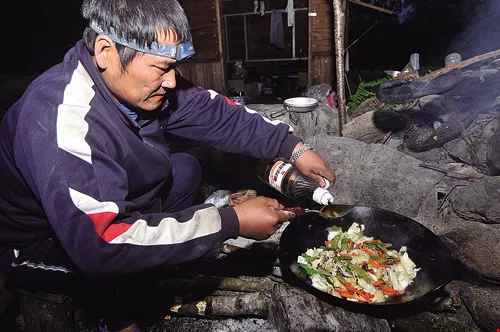
Lin plays multiple roles. Besides serving as a guide for the our reporting team, he is a consultant for Hwang's research on animal bones and head chef for the work team.
In her younger days, Hwang Mei-hsiu often came across bears with severed paws. Some may misread this to mean that Aborigines were hunting the protected Formosan black bear. "Aborigines don't go out for the specific purpose of hunting bears," says Hwang. After Lin took her to interview many hunters, she learned that the Bunun have a complex love-hate relationship with bears. First of all, it is very difficult to predict the whereabouts of a black bear; second, there's a lot of risk in bear hunting, and there are many taboos before and after the hunt.
For the most part, the reason that these bears were missing a paw was that they had been caught in traps meant for other animals (such as wild boar or muntjac). Such traps aren't usually powerful enough to hold an adult bear, so when a bear struggles to free itself, it will drag the snare along with it, which constricts the paws and leads to necrosis. To save their lives, some bears chew their own paws off. And the findings of Hwang's survey revealed that three quarters of the bears that had been shot after mistakenly getting caught in a trap were young bears.
"Bears are as tall as us when they stand up, they only give birth to a few offspring in their lives, and they eat anything we eat, so the tribespeople see killing a bear as akin to killing a person, bringing bad luck to families," says Lin. A hunter encountering a bear in the mountains won't kill it if there's no danger. When he was young, he once came across a bear on the trails of Maxishan. He happened to be downwind from it, so it didn't detect him. He then hid and observed the bear's gait, and found its habit of taking several steps and then lifting its head to look around to be quite adorable.
For a long time, the Bunun have felt that hunting bear is too troublesome. If they hunt during the time millet is planted or when it ripens, the entire village has to stop working for one day; to do otherwise would be inauspicious. If someone ignores this taboo and plants millet anyway, it will turn black, as if scorched.
But if a hunter kills an especially ferocious bear, the Bunun believe the bear is a gift from their ancestors, and the hunter will be seen as a hero by the tribesmen.
Lin shot his first bear when he was 19, at a time when the government had not yet listed the Formosan black bear as a protected species. While hunting in the mountains, he saw that a bear was caught in a trap and couldn't escape, so he shot it with his hunting rifle. Risking the possibility of attack from another bear that was lying in wait in the nearby silvergrass, he carried the carcass to the Gongliao cabin for preparation: removing the fur, skinning the animal, and butchering and cooking the meat to prevent spoilage. All the while he heard the constant roar of the other bear coming from the ridge, as if it were still waiting for its companion. That night the bear prowled around the cabin, and Lin and his cousin fired their guns and lit fires to scare him off.
The second time Lin bagged a bear was after he served in the military. He and his father were hunting muntjac at Maxishan, a three-day trek from the village. Lin hid in a tree and blew on a piece of bamboo to mimic a muntjac's barking call. But to their consternation, the sound attracted a bear! They were unable to get away in time, so Lin shot it with his rifle.
"To kill a bear you have to fire a fatal shot into its chest. If you don't kill it, you risk being attacked," says Lin. This was a rather large bear, weighing about 100 kilograms, and it took two careful shots from up in the tree to bring him down.
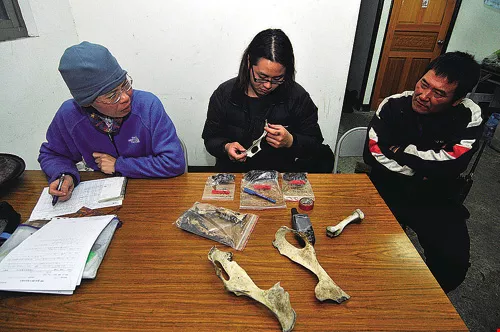
Lin plays multiple roles. Besides serving as a guide for the our reporting team, he is a consultant for Hwang's research on animal bones and head chef for the work team.
After killing the bear, he and his father field dressed the meat and brought it to Abulang. His father returned first to the village to report the good news, and he prepared some wine to celebrate a successful hunting trip. On the appointed day, Lin carried the heavy meat down from the mountain, and as he approached the village his father and the elders formed the first line of people to greet him. After receiving the bear meat, they fired their rifles skyward and sang a bear song (Lin hums a gloomy tune in an intoxicated manner). Then they fired off shots and chanted over and over, burning incense and praying on their way to the trailhead, where they were greeted by women (including Lin's wife and mother) and children. Some of the women cheerfully vied to carry some of the meat.
Before reaching home, they first gathered at the village pavilion to sing the bear song together. Thus all the villagers knew they were back. Then they assembled at Lin's house to celebrate; before entering the house they placed the bear's chin and skin as well as the hunting rifle at the threshold as an offering, praying that the bear's spirit would lead them to other animals.
Next the women busied themselves preparing food and four vessels of millet wine, while the men circled together discussing the course of the hunt. The elders touched Lin's hands and gave blessings. Then everyone drank and shared the meat, celebrating late into the night.
At three or four the next morning, Lin recalls, the young men carried out a pre-dawn ritual, taking turns wearing the bear skin and performing a bear dance, each one quaffing a big bowl of wine and eating a large hunk of meat after finishing. Then once again the skin and the chin were presented as an offering, and the bear song was sung. At daybreak, the elders and women came forward one by one to partake of the bear meat. The whole village halted work for the entire day; to do otherwise would break a taboo.
"On the third day, the elders came and asked me if I had dreamed of anything," says Lin, recounting this story of glory as if it had happened only recently. A good dream means that everything will go well for the village and that there will be a good harvest. If it's a bad dream, the shaman needs to be called upon to dispel misfortune.
The Bunun have a story about bear hunting. Early one day a hunter set out to hunt bear in the mountains. He came across three bears. He successfully shot the first bear and the second bear, but when he tried to shoot the third, his gun kept jamming. The elders said, "This means our ancestors were saying that two bears were enough; no need to shoot another."
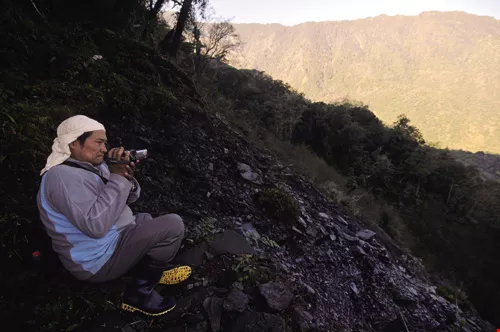
Last year in the national park, Lin set down his hunting rifle and took out his camcorder to film a mother bear trying to help her cubs across a river. But the current was too strong for the cubs, and they gave up.
The ecological wisdom that the Aborigines have gained from coexisting with nature is naturally revealed in these stories, passed down through the generations, and their numerous ceremonies and taboos forbid them from doing things detrimental to nature.
When asked whether he hoped his children would hunt, Lin replied, "Not possible!" Young people find life in the mountains too difficult with no TV, computers, or running water; they feel it's much better to work and earn money.
Lin, a living treasure able to locate wild boar passing through the underbrush and discern the distant calls of muntjac and mountain goats, found in the nick of time that we had taken a wrong turn because he didn't see the reporters' footprints. And if we want to build suspension bridges deep in the mountains and refurbish old Japanese-built trails, it would be a travesty for the mountains and forests if such jungle expertise were not passed on and were allowed to die out.
Having served as a ranger for nearly 20 years, Lin believes that young Aborigines, despite not hunting, can find suitable work as rangers, offering steady income and the chance to scout around in the alpine forests. He has encouraged his kids to do so: his eldest son has worked as a ranger for a year now. And now, under Hwang's advocacy, the park administration is launching a new project: to recruit young rangers to patrol the mountains as well as to serve as research assistants and gain a more in-depth understanding of the mountain ecosystem.
Though hunting is a thing of the past, work as a forest ranger, if incorporated into heritable indigenous culture, can offer a new livelihood for Aborigines. This could be propitious for Taiwan's alpine forests and black bears.
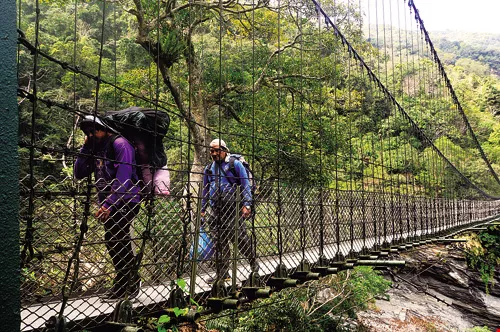
Lin's eldest son Lin Zhizhong (left) greeted the team on their way down and took up his father's backpack. This reflects the Aboriginal tradition of family members hailing the hunters as they return home.

@List.jpg?w=522&h=410&mode=crop&format=webp&quality=80)


